Grievances and disputes are common occurrences within organizations, and they can arise due to various reasons such as unfair treatment, breach of contract, or disagreements over policies and procedures. It’s essential for students to understand the distinctions between grievances and disputes
Grievances and Disputes Notes and Exam Questions Business Studies Grade 12
Notes on Managing Grievances and Disputes: In their Business Studies curriculum, Grade 12 students are likely to encounter various strategies and techniques for managing grievances and disputes. Here are some key notes to consider:
Establishing Grievance Redressal Mechanisms: Organizations should have clear procedures in place for employees to address their grievances. This may include setting up grievance committees, implementing open-door policies, or providing access to mediation services.
Effective Communication: Communication plays a crucial role in resolving conflicts. Students should understand the importance of active listening, empathy, and clarity in communication when dealing with grievances and disputes.
Negotiation and Mediation Skills: Negotiation and mediation skills are valuable assets in resolving disputes amicably. Grade 12 students should learn about principled negotiation techniques and the role of mediators in facilitating constructive dialogue between conflicting parties.
Legal Framework: Understanding the legal framework surrounding grievances and disputes is essential. Students should familiarize themselves with relevant labor laws, contractual obligations, and dispute resolution mechanisms outlined in employment contracts or collective bargaining agreements.
Exam Questions: To assess students’ understanding of grievances and disputes in a business context, exam questions may cover a range of topics, including:
Define the term “grievance” and provide examples of common grievances that employees may have in the workplace.
Discuss the differences between informal and formal methods of resolving grievances. What are the advantages and disadvantages of each approach?
Explain the concept of “collective bargaining” and its role in addressing grievances within labor unions.
Analyze a case study involving a workplace dispute and propose strategies for resolution using negotiation techniques.
Evaluate the impact of unresolved grievances and disputes on organizational performance and employee morale.
The Term 1 March 2022 Common Test for Grade 12 Business Studies likely covered a broad range of topics from the syllabus, reflecting the foundational knowledge and skills expected at this level.
The test would have included questions designed to assess students’ comprehension, application, analysis, and evaluation abilities within the field of business studies.
List of available Business Studies Grade 12 Term 1 March (Control Test) 2022 Common Test Question Papers and Memorandums
Find questions and answers in a downloadable format below:
Compulsory insurance is a fundamental aspect of risk management and legal compliance in the business world. By mastering the concepts and principles of compulsory insurance, students of Business Studies Grade 12 can develop a deeper understanding of how insurance operates within society and the broader economy.
Compulsory Insurance Notes and Exam Questions Business Studies Grade 12
Here On this article, grade 12 students learn and study for revision using EXAM questions based on Compulsory Insurance topic, using activities and engaging quizzes.
What is Compulsory Insurance?
Compulsory insurance, as the name suggests, refers to insurance coverage that is mandated by law. Unlike other forms of insurance that are optional and often depend on individual preferences or risk assessments, compulsory insurance is obligatory for certain entities or individuals within a jurisdiction.
Key Areas of Study
In the syllabus for Business Studies Grade 12, compulsory insurance notes and exam questions typically cover several important aspects, including:
Legal Framework: Understanding the legal basis for compulsory insurance is paramount. Students should grasp the legislative requirements that dictate who must obtain compulsory insurance, the penalties for non-compliance, and any exemptions or special provisions.
Types of Compulsory Insurance: It’s essential to differentiate between various types of compulsory insurance. This could include motor vehicle insurance, workers’ compensation insurance, health insurance, and liability insurance, among others. Each type serves a specific purpose and addresses particular risks within society or the business environment.
Social and Economic Implications: Compulsory insurance often intersects with broader social and economic issues. Students should explore the reasons behind the introduction of compulsory insurance schemes, such as promoting social welfare, protecting vulnerable parties, or stabilizing certain sectors of the economy.
Insurance Principles: While compulsory insurance is mandated by law, it still operates based on fundamental insurance principles. These include principles such as insurable interest, utmost good faith, indemnity, contribution, and subrogation. Understanding these principles is crucial for comprehending how insurance functions in practice.
Risk Assessment and Management: Although compulsory insurance is mandatory, businesses and individuals still need to assess and manage their risks effectively. Students should learn how compulsory insurance fits into broader risk management strategies, including identifying, analyzing, and mitigating risks.
Exam Preparation Tips
Preparing for exams on compulsory insurance in Business Studies Grade 12 requires a comprehensive approach. Here are some tips to excel in your exams:
Understand the Legal Context: Pay close attention to the legal framework surrounding compulsory insurance in your jurisdiction. Familiarize yourself with relevant laws, regulations, and case studies to provide context to your answers.
Master the Concepts: Ensure you have a solid understanding of the key concepts related to compulsory insurance, including its purpose, types, principles, and implications. Practice applying these concepts to real-world scenarios to reinforce your understanding.
Review Case Studies: Case studies can provide valuable insights into how compulsory insurance operates in practice. Analyze case studies related to compulsory insurance to understand the challenges, benefits, and outcomes associated with these schemes.
Stay Updated: The field of insurance is constantly evolving, with changes in legislation, industry practices, and societal needs. Stay updated with the latest developments in compulsory insurance to ensure your knowledge is current and relevant.
Practice Past Exam Questions: Familiarize yourself with the format and types of questions typically asked in exams. Practice answering past exam questions under timed conditions to improve your exam technique and confidence.
Find Professionalism : Notes, Common Exam Questions and Answers Guide, Online Quizzes and Activities for Business Studies Grade 12 Revision Studies, from Ethics and Professionalism section. This content is under Term 1 as per the CAPS Curriculum.
Professionalism Business Studies Grade 12
Professionalism in business refers to the set of behaviours, attitudes, and values that individuals exhibit in a business setting. It is characterized by a commitment to excellence, ethical conduct, and a focus on delivering high-quality products or services to clients or customers. Professionalism is essential for building trust and credibility in business relationships, and for creating a positive and productive work environment.
Professional Behaviour
Professional behaviour is defined by several key characteristics, including:
Respect: treating colleagues, clients, and customers with dignity and respect, regardless of their position or background.
Honesty and Integrity: adhering to high ethical standards, being transparent, and acting with integrity in all business dealings.
Responsibility: taking ownership of one’s work, being accountable for one’s actions, and meeting commitments.
Collaboration: working collaboratively with others, listening to their perspectives, and contributing to a positive team environment.
Continuous Learning: seeking out opportunities to learn and grow professionally, and keeping up-to-date with industry developments and best practices.
Principles of Professionalism
There are several principles that guide professional behaviour in business, including:
Ethics: acting in a manner consistent with ethical principles and values, and adhering to applicable laws and regulations.
Excellence: striving for excellence in all aspects of work, and continuously improving one’s skills and abilities.
Customer Focus: focusing on meeting customer needs and delivering high-quality products or services.
Professional Development: investing in one’s own professional development, and supporting the development of others.
Teamwork: working collaboratively with colleagues to achieve shared goals and objectives.
Communication: communicating effectively and respectfully with colleagues, clients, and customers.
Examples of Professionalism in Business
Examples of professionalism in business include:
Maintaining confidentiality of sensitive information.
Treating all clients and customers with respect and professionalism.
Meeting commitments and deadlines, and communicating effectively if any issues arise.
Being open to constructive feedback and actively seeking opportunities for professional development.
Collaborating effectively with colleagues to achieve shared goals and objectives.
Adhering to ethical standards and conducting business in a transparent and honest manner.
Professionalism in business is essential for building trust and credibility, and for creating a positive and productive work environment. Professional behaviour is characterized by respect, honesty and integrity, responsibility, collaboration, and continuous learning.
The principles of professionalism include ethics, excellence, customer focus, professional development, teamwork, and communication. Examples of professionalism in business include maintaining confidentiality, treating clients and customers with respect, meeting commitments, seeking feedback, collaborating effectively, and adhering to ethical standards.
Distinguishing between Ethics and Professionalism
Ethics and professionalism are two essential components of an individual’s behavior in the workplace and other social environments. While they may sometimes overlap, they are distinct concepts that should be understood and applied separately.
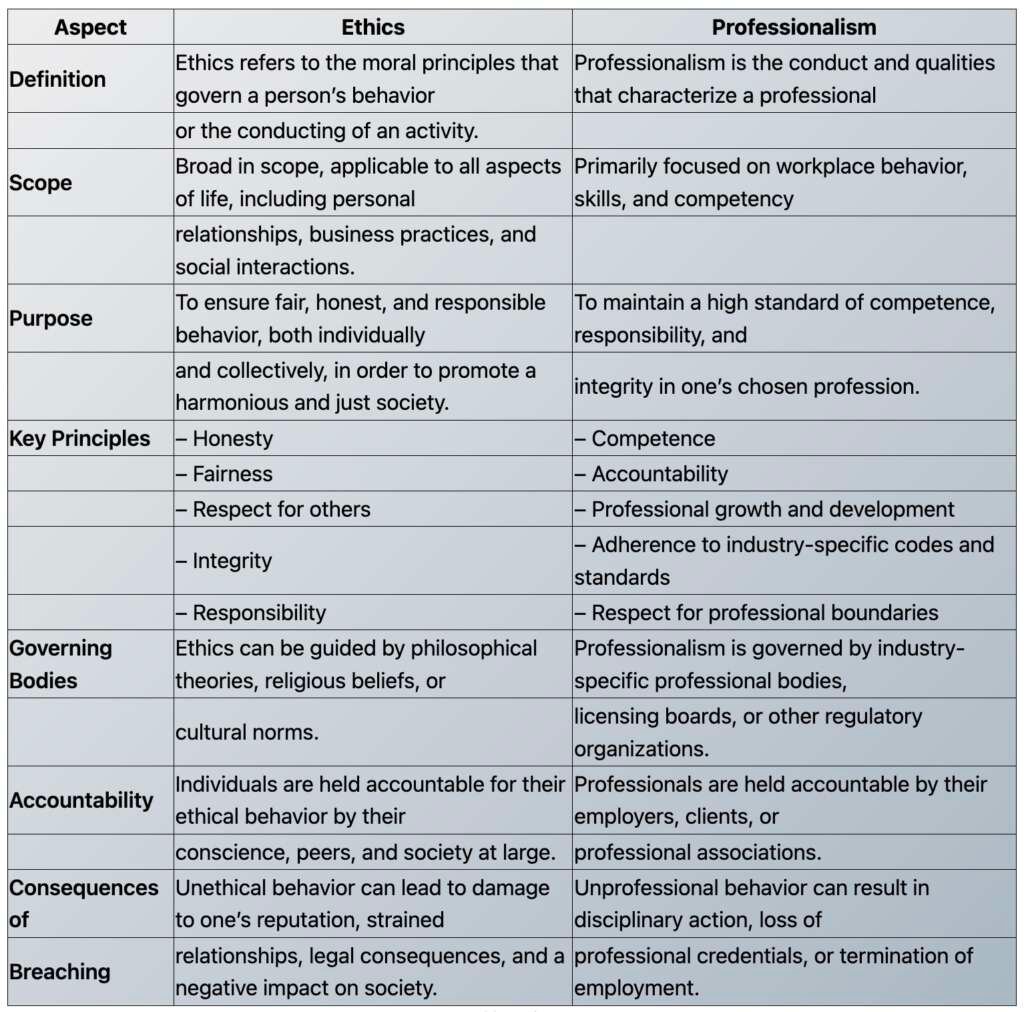
In order to clarify the differences between ethics and professionalism, we have created a table that outlines the key characteristics of each concept.
Aspect
Ethics
Professionalism
Definition
Ethics refers to the moral principles that govern a person’s behavior
Professionalism is the conduct and qualities that characterize a professional
or the conducting of an activity.
Scope
Broad in scope, applicable to all aspects of life, including personal
Primarily focused on workplace behavior, skills, and competency
relationships, business practices, and social interactions.
Purpose
To ensure fair, honest, and responsible behavior, both individually
To maintain a high standard of competence, responsibility, and
and collectively, in order to promote a harmonious and just society.
integrity in one’s chosen profession.
Key Principles
– Honesty
– Competence
– Fairness
– Accountability
– Respect for others
– Professional growth and development
– Integrity
– Adherence to industry-specific codes and standards
– Responsibility
– Respect for professional boundaries
Governing Bodies
Ethics can be guided by philosophical theories, religious beliefs, or
Professionalism is governed by industry-specific professional bodies,
cultural norms.
licensing boards, or other regulatory organizations.
Accountability
Individuals are held accountable for their ethical behavior by their
Professionals are held accountable by their employers, clients, or
conscience, peers, and society at large.
professional associations.
Consequences of
Unethical behavior can lead to damage to one’s reputation, strained
Unprofessional behavior can result in disciplinary action, loss of
Breaching
relationships, legal consequences, and a negative impact on society.
professional credentials, or termination of employment.
By understanding the distinctions between ethics and professionalism, individuals can better navigate their professional lives and contribute to a more positive and effective work environment. While ethics focuses on the moral principles that should guide behavior, professionalism emphasizes the conduct and qualities that define a professional. Both are necessary for success in any profession.
Professionalism VS Unprofessionalism
Professionalism and unprofessionalism are two contrasting qualities that play an essential role in determining the success of individuals and organizations. Professionalism entails adhering to ethical and professional standards, demonstrating a strong work ethic, and maintaining a positive attitude towards work. Unprofessionalism, on the other hand, is characterized by a lack of regard for established norms, poor work performance, and an inability to maintain a positive work environment. Understanding the differences between these two qualities can help individuals and organizations improve their work culture and achieve better outcomes.
The Mind the Gap Business Studies has been designed to assist Grade 12 learners who have been underperforming due to a lack of exposure to the content requirements of the Curriculum Assessment Policy Statement (CAPS).
“Mind the Gap” emerges as a beacon of hope amidst the sea of uncertainties. Developed with the expertise of seasoned educators and industry professionals, this study guide is meticulously crafted to cater to the unique needs of Grade 12 Business Studies students.
The study guides are written by subject expert teams, comprised of teachers, examiners, moderators and subject advisors.
Mind the Gap Business Studies Revision Video
Mind the Gap Business Studies Grade 12 Study guide
The Business Studies Grade 12 Free Study Guide—a comprehensive resource designed to aid students in their journey towards success. Developed by educators and subject matter experts, this guide serves as a roadmap, offering clarity on key topics, exam preparation strategies, and valuable tips for maximizing performance.
Business Studies Grade 12 Free Self Study Study guide pdf download
Placement and induction notes act as foundational pillars in the journey of mastering Business Studies. They provide students with a roadmap, guiding them through the intricate concepts and theories essential for comprehension.
Placement notes typically outline the fundamental principles of each topic, serving as an initial point of reference. On the other hand, induction notes delve deeper into specific concepts, elucidating complex ideas with clarity.
On this article, grade 12 students learn and study for revision using REAL EXAM questions based on Placement and Induction topic, using activities and engaging quizzes.
Placement and Induction Notes and Exam Questions Business Studies Grade 12
In any organization, the process of selecting and placing employees in specific job positions is a crucial aspect of human resource management (HRM). Placement involves matching the qualifications, skills, and personality of a selected candidate with the requirements of a specific job, thereby ensuring optimal performance and value addition to the business. In this article, we will explore the meaning of placement, the placement procedure, and the importance of training and skills development in HRM.
Meaning of Placement
Placement refers to the process of assigning a specific job to a selected candidate based on their qualifications, skills, and personality.
The objective of placement is to ensure that the candidate functions optimally and adds value to the business. The right placement is critical as it ensures that the employee is happy, productive, and motivated to give their best.
Placement Procedure
The placement procedure involves several steps, including outlining specific responsibilities and expectations of the employee’s new position, determining the relationship/similarities between the expectations of the position and the competencies of the employee, and subjecting the employee to various psychometric tests to determine their strengths, weaknesses, skills, and interests.
Outlined below are the specific steps involved in the placement procedure:
Outline specific responsibilities/expectations of the employee’s new position: Before selecting a candidate for a particular position, the employer should outline the specific responsibilities and expectations of the position. This helps to ensure that the selected candidate is a good fit for the position and will be able to meet the employer’s expectations.
Determine the relationship/similarities between the expectations of the position and the competencies of the employee: Once the employer has outlined the specific responsibilities and expectations of the position, they should determine the relationship/similarities between the expectations of the position and the competencies of the employee. This helps to ensure that the selected candidate has the necessary qualifications, skills, and personality traits to perform optimally in the position.
Determine the employee’s strengths/weaknesses/skills/interests by subjecting him to various psychometric tests: To ensure that the selected candidate is a good fit for the position, the employer should subject the candidate to various psychometric tests. These tests help to determine the candidate’s strengths, weaknesses, skills, and interests, thereby ensuring that the candidate is placed in a position where they will function optimally and add value to the business.
The Importance of Training/Skills Development in HRM
Training and skills development are essential aspects of HRM. Employees who receive the necessary training are more able to perform in their jobs, which, in turn, leads to increased productivity and improved business performance. Below are some of the reasons why training and skills development are critical in HRM:
The employee who receives the necessary training is more able to perform in their job: Employees who receive the necessary training are better equipped to perform in their jobs. They are more confident and capable of handling their tasks, which leads to improved job performance and productivity.
The investment in training that a company makes shows employees that they are valued: When a company invests in training its employees, it sends a message that it values them. This, in turn, boosts employee morale and motivation, leading to improved job satisfaction and productivity.
An effective training program allows employees to strengthen their skills: An effective training program allows employees to strengthen their skills and improve their performance. This, in turn, leads to increased productivity and improved business performance.
Productivity usually increases when the human resources function implements training courses: When the human resources function implements training courses, productivity usually increases. This is because employees are better equipped to handle their tasks, leading to improved job performance and productivity.
Ongoing training and upskilling of the workforce encourage creativity: When employees receive ongoing training and upskilling, they are better equipped to come up with new ideas and innovative solutions to problems. This encourages creativity and helps the business to stay competitive in the market.
Placement is a crucial aspect of HRM that involves matching the qualifications, skills, and personality of a selected candidate with the requirements of a specific job to ensure optimal performance and value addition to the business. The placement procedure involves several steps, including outlining specific responsibilities and expectations of the employee’s new position, determining the relationship/similarities between the expectations of the position and the competencies of the employee, and subjecting the employee to various psychometric tests to determine their strengths, weaknesses, skills, and interests.
Training and skills development are also critical in HRM as they lead to increased productivity, improved job performance, and business performance. Companies that invest in training their employees show that they value them, which boosts employee morale and motivation. Therefore, it is crucial for businesses to prioritize placement and training to ensure that their employees are equipped with the necessary skills and placed in positions where they can perform optimally and add value to the business.
Find Notes and Exam Questions about Determining Employee Salary Business Studies Grade 12.
Determining Employee Salary Business Studies Grade 12
Determining employee salary is a critical task for any organization, as it ensures that employees are fairly compensated for their work and helps to attract and retain talented employees.
Important Keywords you should know
Here are some important keywords related to salary determination in South Africa:
Minimum Wage: The lowest wage that employers are legally required to pay employees for their work. The minimum wage is set by the government and varies depending on the industry and type of work.
Collective Bargaining: The process of negotiations between employers and employee representatives, such as unions, to determine terms and conditions of employment, including salary.
Cost of Living: The amount of money needed to sustain a certain standard of living, which includes basic necessities such as housing, food, and healthcare.
Living Wage: The minimum wage that allows employees to meet their basic needs and maintain a reasonable standard of living.
Market-related Salary: A salary that is based on the market value of the employee’s skills, experience, and job role. It is determined by comparing the employee’s salary to similar job roles in the same industry.
Performance-based Pay: A pay structure that rewards employees based on their performance and contributions to the organization. It is often used to motivate employees to perform at their best.
Salary Survey: A survey of salary data within an industry or job market to determine the average salary for a particular job role or experience level.
Salary Structure: A framework for determining employee salaries based on factors such as job role, experience, and performance. It outlines the salary range for each job role and provides guidelines for salary increases and promotions.
Total Cost to Company (TCTC): The total amount that the company pays for an employee’s salary, benefits, and other expenses related to employment.
Understanding these keywords can help employers and employees in South Africa to navigate the complex process of determining and negotiating salaries.
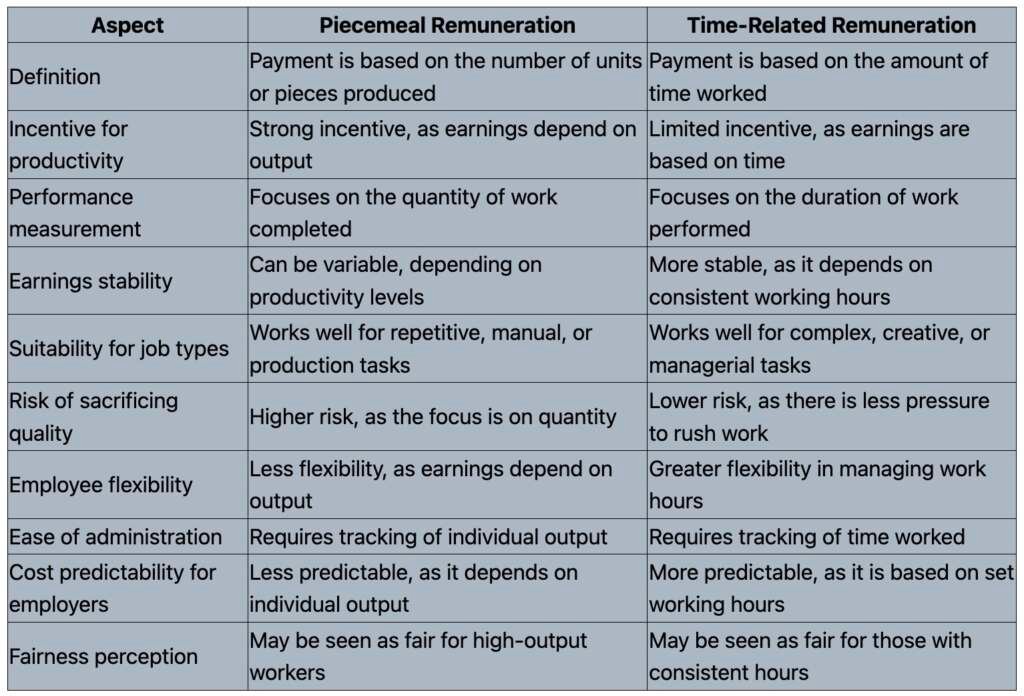
Differences between piecemeal and time-related remuneration
The link between salary determination and the Basic Conditions of Employment Act
The Basic Conditions of Employment Act (BCEA) is a South African labor law that outlines the minimum employment conditions for workers, including hours of work, overtime pay, leave, and remuneration. The act establishes a legal framework for salary determination and requires employers to comply with certain standards when determining employee salaries. Here are some ways in which salary determination is linked to the BCEA:
Minimum Wage: The BCEA sets a national minimum wage, which is the lowest wage that employers can legally pay employees. Employers must ensure that their employees are paid at least the minimum wage, regardless of the type of remuneration.
Overtime Pay: The BCEA requires employers to pay employees for any overtime worked, at a rate of at least one and a half times the employee’s normal wage. Employers must also ensure that their employees do not work more than the maximum number of hours per week set by the BCEA.
Deductions: The BCEA sets limits on the deductions that employers can make from employee salaries, such as for pension contributions or union fees.
Equal Pay: The BCEA prohibits discrimination in remuneration on the basis of race, gender, or any other arbitrary grounds. Employers must ensure that employees are paid equally for work of equal value.
Record-Keeping: The BCEA requires employers to keep accurate records of employee salaries, including hours worked, overtime pay, and any deductions made.
Compliance with the BCEA is essential for employers when determining employee salaries, as failure to comply can result in penalties and legal action. Employers must ensure that their salary determination processes are in line with the requirements of the BCEA to ensure fair and lawful remuneration for their employees.
Salary Administration
Salary administration refers to the process of determining, implementing, and maintaining an organization’s salary structure and compensation plans for employees. It involves setting and adjusting employee salaries and benefits in accordance with the organization’s compensation policies and industry standards.
Deductions
Here are some deductions that may be made from employee salaries and who is responsible for each deduction in a table format:
List of Applicable Deductions
Here is a list of common deductions that may be made from employee salaries:
Taxes: Federal and state taxes, including income tax and Social Security tax, are deducted from employee salaries.
Retirement Plans: Contributions to retirement plans, such as 401(k) or pension plans, may be deducted from employee salaries.
Health Insurance: Premiums for employer-sponsored health insurance plans may be deducted from employee salaries.
Life Insurance: Premiums for employer-sponsored life insurance plans may be deducted from employee salaries.
Union Dues: Membership fees for labor unions may be deducted from employee salaries if the employee is a member of the union.
Wage Garnishments: Court-ordered wage garnishments, such as child support payments or unpaid debts, may be deducted from employee salaries.
Loans: Deductions may be made from employee salaries to repay loans made by the employer or other third-party lenders.
Savings Plans: Deductions may be made from employee salaries to contribute to savings plans, such as Flexible Spending Accounts (FSAs) or Health Savings Accounts (HSAs).
Uniforms or Equipment: The cost of uniforms or equipment required for the job may be deducted from employee salaries.
It is important for employers to comply with relevant laws and regulations when making deductions from employee salaries. Employers must also provide employees with clear information about any deductions made from their salaries, including the reason for the deduction and the amount deducted.
Examples of Employee Tax and UIF
Employee Tax and UIF (Unemployment Insurance Fund) are both statutory deductions made from an employee’s salary in South Africa. Here is an explanation of these deductions and how they are calculated:
Employee Tax (PAYE):
Employee tax, also known as Pay-As-You-Earn (PAYE), is a tax that employers deduct from employee salaries on behalf of the South African Revenue Service (SARS). The amount of tax deducted is based on the employee’s gross salary, as well as any deductions or exemptions they are entitled to.
The tax calculation takes into account the employee’s tax bracket, which is determined by their annual salary. For the 2022 tax year (1 March 2021 to 28 February 2022), the tax brackets and rates are as follows:
Up to R216,200: 18% of taxable income
R216,201 to R337,800: R38,916 plus 26% of taxable income above R216,200
R337,801 to R467,500: R70,532 plus 31% of taxable income above R337,800
R467,501 to R613,600: R110,739 plus 36% of taxable income above R467,500
R613,601 to R782,200: R163,335 plus 39% of taxable income above R613,600
R782,201 and above: R229,089 plus 41% of taxable income above R782,200
For example, an employee earning a gross salary of R300,000 would be in the third tax bracket. Their taxable income would be R83,200 (R300,000 minus R216,200), and their tax would be R19,919.52 (R70,532 plus 31% of R83,200).
UIF:
The Unemployment Insurance Fund (UIF) is a compulsory fund that provides short-term relief to workers who are unemployed or unable to work due to illness or maternity leave. Employers are required to deduct 1% of their employees’ gross salaries and contribute an additional 1% on behalf of the employee to the UIF.
For example, if an employee earns a gross salary of R20,000 per month, their UIF contribution would be R200 (1% of R20,000) and the employer would contribute an additional R200 on their behalf.
Employee tax and UIF are two statutory deductions made from an employee’s salary in South Africa. Employee tax is based on the employee’s gross salary and tax bracket, while UIF is a fixed percentage of the employee’s gross salary. These deductions are important for funding government services and providing social welfare support to workers.
Understanding Differences between Net Salary and Gross Salary
Gross salary and net salary are both terms used to describe an employee’s earnings, but they represent different amounts. Here is an explanation of the differences between gross salary and net salary:
Gross Salary: Gross salary is the total amount of money earned by an employee before any deductions or taxes are made. This includes all forms of remuneration, such as basic salary, bonuses, overtime pay, and allowances.
For example, if an employee has a basic salary of R15,000 per month and receives a R5,000 bonus, their gross salary for that month would be R20,000.
Net Salary: Net salary is the amount of money that an employee takes home after all deductions and taxes have been made from their gross salary. This is the amount that appears in an employee’s bank account at the end of each pay period.
Deductions from gross salary include:
Employee tax (PAYE)
Unemployment Insurance Fund (UIF)
Medical aid contributions
Retirement fund contributions
Other statutory deductions, such as skills development levies or employee benefits
The net salary is calculated by subtracting these deductions from the gross salary.
For example, if an employee’s gross salary is R20,000 and their total deductions for that month are R5,000, their net salary for that month would be R15,000.
In summary, gross salary refers to the total amount earned by an employee before any deductions or taxes, while net salary is the amount of money that an employee takes home after all deductions and taxes have been made. It is important for employees to understand the difference between gross and net salary to effectively manage their personal finances and plan for their future.
Fringe Benefits
Fringe benefits, also known as employee benefits, are non-salary compensations that employers provide to their employees in addition to their regular pay. These benefits can be monetary or non-monetary and are designed to attract and retain employees, improve their job satisfaction and motivation, and enhance their overall well-being.
Here are some common examples of fringe benefits that are applicable in South Africa:
Medical Aid: Employers may provide their employees with medical aid as part of their employee benefits package. This covers the cost of medical expenses, including doctor’s visits, hospitalization, and prescription medication.
Retirement Funds: Employers may offer retirement funds, such as pension or provident funds, to employees to help them save for their future.
Life Insurance: Employers may provide life insurance coverage to employees as part of their fringe benefits package. This ensures that the employee’s beneficiaries receive a payout in the event of the employee’s death.
Education Assistance: Some employers provide education assistance to their employees to help them further their education or develop new skills.
Car Allowance: Employers may provide a car allowance to employees who need to use their personal vehicles for work purposes.
Cellphone Allowance: Employers may provide a cellphone allowance to employees who need to use their personal phones for work purposes.
Housing Allowance: Employers may provide a housing allowance to employees who need to live close to their place of work or in expensive areas.
Travel Allowance: Employers may provide a travel allowance to employees who need to travel for work purposes.
Fringe benefits are an important part of an employee’s compensation package and can have a significant impact on their job satisfaction and retention. It is important for employers to offer a range of benefits that meet the needs of their employees and are aligned with their overall compensation strategy.
Advantages and Disadvantages of Fringe Benefits
Here is a table format with the advantages and disadvantages of fringe benefits to businesses:
Advantages and Disadvantages of Fringe Benefits to a Business:
Advantages
Disadvantages
Increased Employee Satisfaction
Additional Costs
Improved Retention and Reduced Turnover
Complexity in Administration
Enhanced Recruitment Appeal
Potential for Perceived Inequality
Increased Productivity
Tax Implications
Healthier and Happier Employees
Difficulty in Choosing Appropriate Benefits
Examples of Advantages:
Increased Employee Satisfaction: Providing employees with benefits such as health insurance, retirement plans, and paid time off can boost their job satisfaction, making them more committed to the company.
Improved Retention and Reduced Turnover: Fringe benefits can help retain valuable employees, reducing the costs and disruptions associated with high turnover rates.
Enhanced Recruitment Appeal: A competitive benefits package can help attract top talent to the company, giving the business an edge over competitors.
Increased Productivity: Benefits like flexible work schedules or wellness programs can lead to healthier, more focused employees, which can translate into increased productivity.
Healthier and Happier Employees: Benefits such as gym memberships or mental health support can promote overall employee well-being, resulting in a more positive work environment.
Examples of Disadvantages:
Additional Costs: Offering fringe benefits can be expensive for a company, particularly for small businesses with limited budgets.
Complexity in Administration: Managing a variety of fringe benefits can be time-consuming and complicated, requiring additional resources and expertise.
Potential for Perceived Inequality: If certain benefits are only available to specific employees or departments, it may create perceptions of inequality and discontent among the workforce.
Tax Implications: Some fringe benefits are taxable, which can complicate tax reporting and compliance for both the company and the employees.
Difficulty in Choosing Appropriate Benefits: Determining which fringe benefits will be most appealing and beneficial to employees can be challenging, and the wrong choice may result in wasted resources or reduced employee satisfaction.
While offering fringe benefits can have many advantages for businesses, such as attracting and retaining employees, motivating and improving morale, and providing tax advantages, there are also potential disadvantages, such as the cost and administrative burden, perceptions of unfairness, and the potential for abuse. It is important for businesses to carefully consider the pros and cons of offering fringe benefits and to ensure that they align with their overall compensation strategy and business objectives.
Strategic Management Notes and Exam Questions Business Studies Grade 12, Strategic management is the process of formulating and implementing strategies to achieve organizational goals.
It involves analyzing the internal and external environments, setting objectives, crafting strategies, and executing plans to ensure sustainable competitive advantage.
In simpler terms, strategic management is about making informed decisions to steer a business towards success amidst uncertainties and competition.
Strategic Management Business Studies Grade 12
Strategic management is the process of formulating, implementing, and evaluating strategies to achieve the goals and objectives of an organization. It is an essential part of management that focuses on long-term planning and decision-making, and it involves analyzing the internal and external environment of an organization to identify its strengths, weaknesses, opportunities, and threats.
Here are some key points about the background of strategic management:
Origin: Strategic management has its roots in the military, where the art of strategy was used to win battles and wars. Over time, it was adapted for use in the business world, where it became known as strategic management.
Definition: Strategic management is a process of setting goals, analyzing the internal and external environment, formulating strategies, implementing them, and evaluating their effectiveness.
Importance: Strategic management is important because it provides a framework for achieving long-term goals and objectives, and it helps organizations to adapt to changing circumstances.
Components: The key components of strategic management include strategy formulation, strategy implementation, and strategy evaluation.
Tools: There are many tools and techniques used in strategic management, including SWOT analysis, Porter’s Five Forces analysis, and the Balanced Scorecard.
Challenges: Strategic management can be challenging due to the complexity of the business environment, the need to balance short-term and long-term goals, and the need to adapt to changing circumstances.
Strategic management is a crucial aspect of management that involves setting goals, analyzing the environment, formulating and implementing strategies, and evaluating their effectiveness. It has its origins in the military and is important for organizations to adapt to changing circumstances and achieve long-term success.
Purposes of Strategic Management
The purpose of strategic planning is to set a clear direction and long-term vision for an organization, and to develop a plan of action to achieve its goals and objectives.
Here are some reasons why strategic planning is important:
Provides direction: Strategic planning helps an organization to set a clear direction and vision for the future.
Aligns resources: It enables an organization to align its resources, including people, time, and money, towards achieving its goals and objectives.
Improves decision-making: Strategic planning helps an organization to make informed decisions by considering various internal and external factors.
Increases efficiency: It helps an organization to identify areas of improvement and to streamline processes, which leads to increased efficiency and productivity.
Enhances communication: Strategic planning encourages communication and collaboration within an organization, which fosters a shared sense of purpose and a team-oriented culture.
Manages risk: Strategic planning enables an organization to anticipate and manage risks, which helps to mitigate potential threats to its success.
Facilitates growth: By providing a roadmap for achieving its goals and objectives, strategic planning can help an organization to expand and grow in a sustainable manner.
Strategic planning is essential for any organization that wishes to achieve its long-term goals and objectives. It provides a clear direction, aligns resources, improves decision-making, increases efficiency, enhances communication, manages risk, and facilitates growth.
Strategic Management: The process of formulating and implementing strategies to achieve organizational goals and objectives.
Strategic Planning: The process of defining an organization’s strategy, or direction, and making decisions on allocating resources.
Vision: A clear, concise, and inspiring statement of what an organization intends to achieve in the long-term.
Mission: A statement of the organization’s purpose, outlining what it does, who it serves, and how it achieves its objectives.
Goals: The broad, long-term aims that an organization wants to achieve.
Objectives: Specific, measurable targets that an organization wants to achieve within a certain time frame.
Strategy: A plan or course of action designed to achieve an organizational goal or objective.
Formulation of strategies: The process of developing and selecting the best strategies to achieve organizational objectives.
Implementation of strategies: The process of putting a strategic plan into action and ensuring that it is effectively executed.
Evaluation of strategies: The process of assessing the effectiveness of strategies in achieving organizational objectives.
Integration strategies: Strategies aimed at strengthening an organization’s existing operations.
Intensive strategies: Strategies aimed at increasing an organization’s market share in existing markets.
Diversification strategies: Strategies aimed at expanding an organization’s operations into new markets.
Defensive strategies: Strategies aimed at protecting an organization’s market position from competitors.
Industry analysis tools: Techniques used to analyze an organization’s competitive environment, including its suppliers, buyers, competitors, substitute products or services, and new entrants.
Suppliers: Organizations that provide goods or services to another organization.
Buyers: Organizations or individuals that purchase goods or services from another organization.
Competitors: Organizations that offer similar products or services in the same market.
Substitute product or service: Products or services that can be used as an alternative to an organization’s products or services.
New Entrants: Organizations that enter a market in which they have not previously operated.
Online study activities have revolutionized the way students approach learning. With the advent of digital platforms, students now have access to a wealth of resources, including interactive lessons, virtual classrooms, and collaborative tools.
This shift towards online learning has been further propelled by recent legislations aimed at promoting digital education and accessibility. Recent legislations have introduced various changes that directly impact online study activities for Business Studies Grade 12 students.
Impact of Recent Legislations – Business Studies Grade 12
Skills Development Act:
The Skills Development Act was established in 1998 and aims to promote skills development in South Africa. This Act requires employers to contribute towards the Skills Development Fund, which is used to support training and development initiatives for employees. The Act also created the Sector Education and Training Authorities (SETAs), which are responsible for developing and implementing training programmes within specific sectors. The SETAs work closely with employers to identify their training needs and to provide funding for training programmes.
Labour Relations Act:
The Labour Relations Act regulates the relationship between employers and employees in South Africa. This Act outlines the rights of employers and employees and provides guidelines for resolving disputes between the two parties. The Act also establishes the Commission for Conciliation, Mediation and Arbitration (CCMA), which is responsible for resolving disputes between employers and employees.
Employment Equity Act:
The Employment Equity Act was established in 1998 and aims to promote equity in the workplace. This Act requires employers to eliminate unfair discrimination in the workplace and to implement affirmative action measures to promote the employment of previously disadvantaged individuals. The Act also requires employers to submit annual reports on their progress towards achieving employment equity.
Basic Conditions of Employment Act:
The Basic Conditions of Employment Act outlines the minimum conditions of employment that employers must provide to their employees. This Act covers areas such as working hours, leave, and remuneration. The Act also provides guidelines for the termination of employment contracts and the resolution of disputes between employers and employees.
Compensation for Occupational Injuries and Diseases Act:
The Compensation for Occupational Injuries and Diseases Act provides compensation to employees who are injured or become ill as a result of their work. This Act requires employers to register with the Compensation Fund and to contribute towards it. The Fund provides compensation to employees who are injured or become ill as a result of their work.
Broad-Based Black Economic Empowerment Act:
The Broad-Based Black Economic Empowerment Act was established in 2003 and aims to promote economic transformation in South Africa. This Act requires companies to implement strategies to promote the participation of previously disadvantaged individuals in the economy. The Act provides guidelines for the implementation of broad-based black economic empowerment (BBBEE) initiatives.
Differences between BEE and BBBEE:
BEE (Black Economic Empowerment) refers to initiatives that promote the participation of black individuals in the economy. BBBEE (Broad-Based Black Economic Empowerment) refers to initiatives that promote the participation of previously disadvantaged individuals, including black individuals, women, and people with disabilities.
Application of the Five BBBEE Pillars:
The Five BBBEE Pillars are ownership, management control, skills development, enterprise and supplier development, and socio-economic development. These pillars provide a framework for the implementation of BBBEE initiatives.
National Credit Act and Consumer Protection Act:
The National Credit Act regulates the granting of credit in South Africa and aims to protect consumers from unfair lending practices. The Act provides guidelines for the granting of credit, the collection of debt, and the resolution of disputes between creditors and debtors. The Consumer Protection Act provides guidelines for the protection of consumers in South Africa. The Act outlines the rights of consumers and provides guidelines for the resolution of disputes between consumers and suppliers.
Online Study Activities: Impact of Recent Legislation
Online Study Activities: Impact of Recent Legislation:
Scenario 1:
Q: If a company wants to implement affirmative action measures to promote the employment of previously disadvantaged individuals, which Act would they need to comply with?
A: The company would need to comply with the Employment Equity Act. This Act requires employers to eliminate unfair discrimination in the workplace and to implement affirmative action measures to promote the employment of previously disadvantaged individuals.
Scenario 2:
Q: An employee is injured at work and is unable to continue working. Which Act would provide compensation to the employee?
A: The Compensation for Occupational Injuries and Diseases Act would provide compensation to the employee. This Act provides compensation to employees who are injured or become ill as a result of their work.
Scenario 3:
Q: An employer wants to train their employees to improve their skills. Which Act would provide funding for training programmes?
A: The Skills Development Act would provide funding for training programmes. This Act requires employers to contribute towards the Skills Development Fund, which is used to support training and development initiatives for employees. The Act also created the Sector Education and Training Authorities (SETAs), which are responsible for developing and implementing training programmes within specific sectors.
Scenario 4:
Q: A company wants to promote the participation of previously disadvantaged individuals in the economy. Which Act would provide guidelines for the implementation of broad-based black economic empowerment (BBBEE) initiatives?
A: The Broad-Based Black Economic Empowerment Act would provide guidelines for the implementation of BBBEE initiatives. This Act was established in 2003 and aims to promote economic transformation in South Africa. The Act requires companies to implement strategies to promote the participation of previously disadvantaged individuals in the economy.
Scenario 5:
Q: An employee feels that they have been unfairly dismissed from their job. Which Act would provide guidelines for the resolution of disputes between employers and employees?
A: The Labour Relations Act would provide guidelines for the resolution of disputes between employers and employees. This Act regulates the relationship between employers and employees in South Africa and provides guidelines for resolving disputes between the two parties. The Act also establishes the Commission for Conciliation, Mediation and Arbitration (CCMA), which is responsible for resolving disputes between employers and employees.