Home Blog Page 158

Geography Grade 12 Latest Essays and Topics Guide CAPS

Geography Grade 12 Latest Essays and Topics Guide CAPS For Grade 12 students following the Curriculum and Assessment Policy Statement (CAPS) in South Africa, the final year of high school is a crucial period to delve deeper into the complexities of geographical concepts. In this blog post, we’ll explore the latest essays and topics that Grade 12 students encounter, providing a comprehensive guide to help them navigate the terrain of Geography.

Understanding the CAPS Curriculum:

The CAPS curriculum for Grade 12 Geography is designed to foster critical thinking and analytical skills. It encompasses a variety of themes such as Geographical Skills and Techniques, Human and Natural Environments, and Contemporary Global Issues. Each theme is further divided into subtopics, forming the foundation for the essay questions that students will encounter in their exams.

Featured Video Lesson

Grade 12 Geography Essay Questions are all based on the knowledge you have acquired before. If you are given options to choose, you should choose the one which works for you.

Uses the annotated guide below (compiled by Mr. Alberts) to see what is expected of the best essay responses.

Grade 12 Essay Geography

On this page you will find Geography Grade 12 Essays and Topics Guide for Term 1, Term 2, Term 3, and Term 4.

Available Essays and Topics Guide Geography Grade 12 pdf downloadable

More Education Resources

Conclusion:

Grade 12 Geography under the CAPS curriculum offers students a unique opportunity to explore the intricacies of our world and develop critical thinking skills. By mastering the latest essays and topics, students can confidently navigate the final year of high school, armed with a deep understanding of geographical concepts and their real-world applications. As they embark on this journey, they not only prepare for exams but also cultivate a lifelong appreciation for the dynamic and ever-evolving field of geography.

Geography Grade 12 Research Tasks (Topics) and Memos (SBA)

Geography Grade 12 Research Tasks (Topics) and Memos (SBA) Geography at the Grade 12 level is a fascinating journey into the intricacies of our planet. As students delve into the subject, they encounter a variety of Research Tasks and Memos that not only deepen their understanding of geographical concepts but also hone their research and analytical skills. In this blog post, we’ll explore some captivating Geography Grade 12 Research Task topics and offer insights into crafting effective Memos for the Skills-Based Assessment (SBA).

Assessment is a continuous planned process of identifying, gathering and interpreting information about the performance of learners, using various forms of assessment. It involves four steps: generating and collecting evidence of achievement; evaluating this evidence; recording the findings and using this information to understand and assist with the learners’ development to improve the process of learning and teaching. Assessment should be both informal (assessment for learning) and formal (assessment of learning). In both cases regular feedback should be provided to learners to enhance the learning experience.

School-based assessment (SBA) is a purposive collection of learners’ work that tells the story of learners’ efforts, progress or achievement in given areas. The quality of SBA tasks is integral to learners’ preparation for the final examinations.

This booklet serves as a resource of four exemplar SBA tasks to schools and subject teachers of Geography. SBA marks are formally recorded by the teacher for progression and certification purposes. The SBA component is compulsory for all learners. Learners who cannot comply with the requirements specified according to the policy may not be eligible to enter for the subject in the final examination.

The formal assessment tasks provide the teacher with a systematic way of evaluating how well learners are progressing. This publication includes tests, a project and a case study. Formal assessment tasks form part of a year-long formal programme of assessment. These tasks should not be taken lightly and learners should be encouraged to submit their best possible efforts for final assessment.

The teachers are expected to ensure that assessment tasks are relevant to and suitable for the learners being taught. Teachers should adapt the tasks to suit learners’ level of understanding and should be context-bound; however, they should also take cognisance of the requirements as set out in the Curriculum and Assessment Policy Statement (CAPS) document.

Video Guide

What Skills are Assessed for Research Tasks in Grade 12

The following skills are assessed. Some/All of these skills may be tested in any external examination:

  • Gathering data
  • Interpreting data
  • Analysing data
  • Comparing different sets of data
  • Representing data in written, graphic or mapped format
  • Problem-solving
  • Drawing conclusions
  • Hypothesis statements

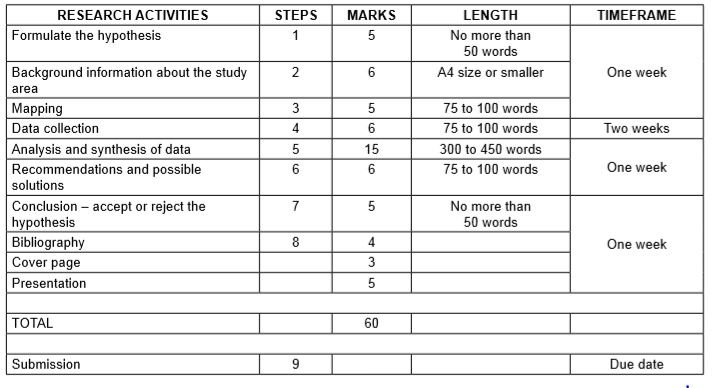
Research framework for assessment (Guideline on administration of research task)

Grade 12 Research tasks Geography

Step 1: Formulating a hypothesis/problem statement.

Guideline: Geography Grade 12 Research Tasks

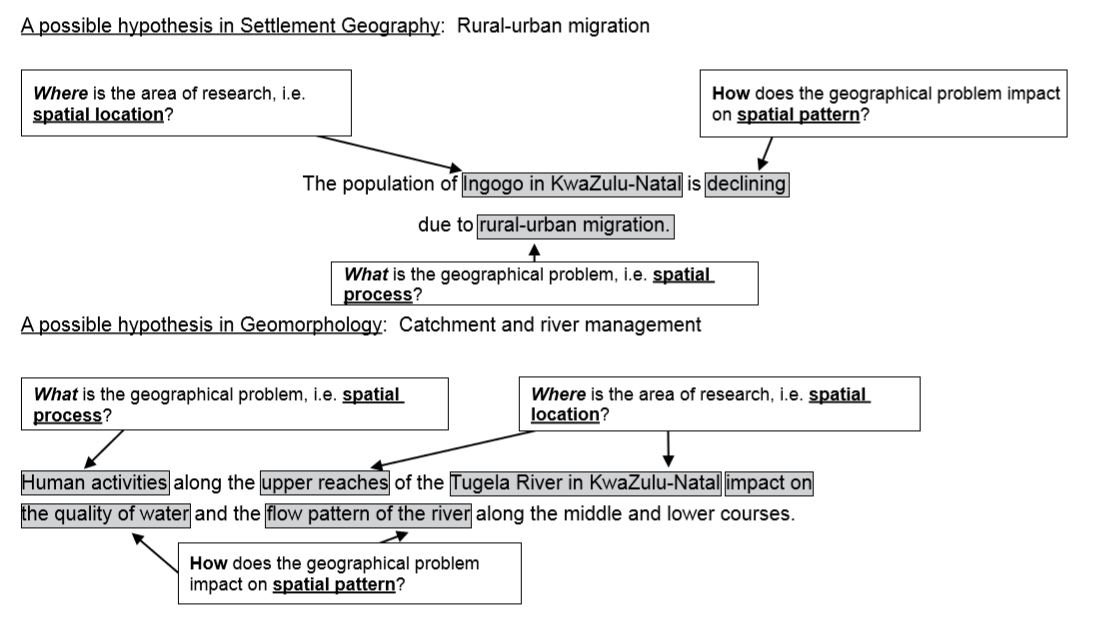
Step 1: Formulating a hypothesis/problem statement. As Geographers we seek to understand and explain the interactions amongst humans, and between humans and the environment in space and time. This is achieved by asking questions or making informed geographical decisions. This entails the development of a hypothesis or a problem statement to be tested.

  • You have to choose a specific area of study where a geographical problem exists.
  • During this stage, a geographical question showing a problem is asked.
  • Identify the problem from a local area.
  • Formulate a hypothesis or a problem statement. (Hypothesis research is used to prove that certain variables are dependent on or independent of each other. Problem statement research is only to highlight that a specific problem exists in a specific community.)
  • You should then follow the steps of research to ensure that the geographical question is answered.
Guide Graph Geography Research Tasks

Geography Research Project Topics for Grade 12 South Africa

  • The value of property along north-facing slopes is higher than the value of property along south-facing slopes in Meyersdal, Gauteng (choose local area).
  • The cause of rural-urban migration in Ndwedwe, KwaZulu-Natal (choose local area), is the lack of service delivery in the health sector.
  • Climate change will impact negatively on grape farming and related industries in the Western Cape.
  • The closing down of many primary schools in Lusikisiki (Eastern Cape) (choose a local area) is due to a decline of the population in the age group 7 to 15 years.
  • The poor condition of roads (specify the names of the roads) leading to/in Harrismith, Free State (choose local area), is due to the lack of proper planning by the local municipality.
  • The impact of building a dam along the Jukskei River in Gauteng (choose local area) upstream of Alexandra will reduce flooding and the subsequent loss of life in Alexandra.
  • The e-toll system will impact negatively on the economic position of people using private transport in Gauteng.
  • The e-toll system will impact positively on traffic flow to the major urban centres in Gauteng.
  • Informal settlements in the Vhembe district of Limpopo have low levels of development due to the lack of provision of basic needs (choose ONE informal settlement in your local area.)
  • Overcrowding of informal settlements is due to the lack of proper planning by the local government (choose local area).

Step 2: Background information about an area of study

  • You must explain where in South Africa the study area is located. (This can be indicated on the map.)
  • Describe the study area in terms of its exact position (degrees, minutes and seconds).
  • Provide relevant information about the area, for example population of the area or climate of the area.

DON’T MISS: How to Pass Geography Grade 12 NSC With Distinction

Step 3: Mapping

  • You must provide a map of the area in question.
  • During this stage you must create a buffer zone around the area where the geographical problem exists.
  • The map should have a clear legend/key and must be drawn to scale. The scale must be indicated on the map.
  • If the map used covers a wider area, buffer zones around the area of study should be created.
  • The map used should be the most recent map of the study area

Step 4: Methods of data collection

(a) PRIMARY DATA SOURCES

  • The use of questionnaires
  • Interviews
  • Observations
  • Field trips

(b) SECONDARY DATA SOURCES

  • Newspaper articles
  • Government department statistics
  • Books
  • Internet

Step 5: Analysis and synthesis of data

• Learners must use collected data now to formulate a discussion around the existing geographical problem. • At this stage learners should represent some of the information graphically where necessary, for example graphs and sketches. • Learners must analyse graphic information during this stage.

Step 6: Recommendations and possible solutions

• Learners should now make recommendations to solve the geographical problem in question. • Learners should present their original and realistic opinions as far as they possibly can.

Step 7: Conclusion – accept or reject the hypothesis

  • Learners should now take a decision to either ACCEPT or REJECT the hypothesis.
  • Learners must give reasons for either ACCEPTING or REJECTING the hypothesis

Step 8: Bibliography

  • Learners must include a comprehensive bibliography.
  • Learners must list websites in full.
  • Learners must include annexures of questionnaires and interviews conducted

Geography-English-SBA-Caps-Teacher-Guide-1 Download

The Impact of Droughts in South Africa Essay

The Impact of Droughts in South Africa Essay South Africa, a country known for its diverse landscapes and rich biodiversity, has been grappling with the recurring challenge of droughts. Drought, a prolonged period of abnormally low rainfall, poses a severe threat to the nation’s environment, economy, and society. This essay explores the multifaceted impact of droughts in South Africa and examines the measures taken to mitigate these effects.

The Impact of draughts in South Africa Essay Guide

When you an essay about draughts in South Africa, you should include all three sections of what every essay is made up of: introduction, body, and conclusion.

Introduction (What you will be talking about)

The first paragraph of your draughts in South Africa essay needs to introduce your topic and provide direction for the entire essay. This is where you introduce the main key points of the essay.

Example:

According to ……. South Africa has been experiencing draughts since….. This has a negative impact on the South African fragile economy where unemployment is rife. This essay will be talking about the main impact of droughts in South Africa, focusing on the issues such as: a shortage of water, shortage of food, dying livestock, loss of jobs, etc…

The Body (Discussing all Keypoints in details)

The body of the essay will be made up of the key points you highlighted in your introduction. These key points should be discussed in detail (preferably a paragraph for each). So your main paragraphs will be made up of:

  • shortage of water,
  • shortage of food,
  • dying livestock,
  • loss of jobs
  • and any related…

The Conclusion (Summary)

The conclusion will now summarise all the key points you discussed. After providing the summary, then you will have to make a point or a closure.

Example:

This essay has discussed and identified the following: a shortage of water is currently a crisis in South Africa and serious measures are needed as a matter of urgency, dying of livestock will not only harm the economy in the next decade but will immediately starve the communities, ………………(summarise all other key points in this manner).

Closure Statement: To combat the long-term effects and current challenges of draughts is not solely eh government responsibility, but communities’ responsibilities as a whole, including the private sector, households, and every individual.

The Impact of Droughts in South Africa Essay

Environmental Impact:

  1. Water Scarcity: Droughts lead to a significant reduction in water availability, affecting both surface water and groundwater sources. This scarcity impacts ecosystems, wildlife, and plant life, threatening the delicate balance of the country’s biodiversity.
  2. Loss of Biodiversity: The reduction in water supply disrupts ecosystems, leading to habitat degradation and loss of biodiversity. Flora and fauna, particularly those dependent on regular water sources, face challenges in adaptation, leading to population decline and, in some cases, extinction.
  3. Soil Erosion and Desertification: Prolonged droughts contribute to soil erosion and desertification, as the lack of vegetation makes the soil more susceptible to erosion. This has long-term consequences for agricultural productivity and exacerbates the challenges faced by farmers.

Economic Impact:

  1. Agricultural Losses: Agriculture, a cornerstone of South Africa’s economy, is heavily dependent on water. Droughts lead to crop failures, livestock losses, and reduced yields, affecting both large commercial farms and small-scale subsistence farmers. This, in turn, contributes to food insecurity and drives up food prices.
  2. Impact on Hydropower Generation: South Africa relies on hydropower for a portion of its energy needs. Reduced water levels in dams and rivers diminish the capacity for hydropower generation, increasing the nation’s dependence on more expensive and environmentally impactful energy sources.
  3. Job Losses and Economic Decline: The agricultural sector, directly affected by drought, is a significant employer in South Africa. Job losses in this sector contribute to higher unemployment rates and economic decline, as the ripple effect extends to related industries and services.

Social Impact:

  1. Food Insecurity: As agricultural production declines, food becomes scarcer and more expensive. This contributes to widespread food insecurity, particularly affecting vulnerable populations that already face challenges in accessing nutritious meals.
  2. Health Challenges: Water scarcity and poor sanitation resulting from droughts contribute to health challenges, including waterborne diseases. Limited access to clean water and proper hygiene exacerbates health issues, particularly in rural areas with inadequate infrastructure.
  3. Migration and Displacement: The social impact of drought is often compounded by migration and displacement. Rural communities, especially those heavily dependent on agriculture, may be forced to migrate to urban areas in search of livelihoods, placing additional strain on urban infrastructure and services.

Mitigation Strategies:

  1. Water Conservation and Management: Implementing effective water conservation measures and improving water management practices are crucial for mitigating the impact of droughts. This includes investing in water-efficient technologies and infrastructure.
  2. Diversification of Agriculture: Encouraging the diversification of crops and promoting drought-resistant agricultural practices can help build resilience in the agricultural sector. This may involve the adoption of drought-resistant crop varieties and sustainable farming methods.
  3. Investment in Renewable Energy: To mitigate the impact of reduced hydropower generation, there is a need to invest in alternative and renewable energy sources. This not only addresses the energy crisis but also contributes to sustainable development.
  4. Community Education and Empowerment: Educating communities about water conservation, sustainable farming practices, and climate resilience is essential. Empowering communities to adapt to changing climate conditions can enhance their ability to cope with the impact of droughts.

Conclusion:

The impact of droughts in South Africa is a complex and interconnected challenge that requires a holistic and multi-pronged approach. While addressing immediate concerns such as water scarcity and agricultural losses is crucial, long-term solutions involve building resilience at the community and national levels. Through sustainable practices, technological advancements, and community engagement, South Africa can navigate the challenges posed by droughts and work towards a more resilient and sustainable future.

How to Pass Geography Grade 12 NSC With Distinction

How to Pass Geography Grade 12 NSC With Distinction

How to Pass Geography Grade 12 NSC With Distinction Are you Grade 12 Students Looking how to Success in Geography Grade 12 NSC examinations this Post is Accuracy Complete Tips Displayed to help Students to know specific Tricks and Tips on making Geography Grade 12 NSC Examination Preparation.

Top Tips on Passing Your Geography Grade 12 NSC With Distinction

One of the most significant accomplishments in your Geography career is passing Geography Grade 12 NSC on matric exam. It provides access to a wide range of post secondary options and employment possibilities. Use our best study advice to complete your matriculation, and you’ll succeed with flying colors.

  1. Understanding of What is Being Read

This is very the first step on how to pass exams and yet underestimated. Trying to cram a lot at midnight hour so that you can pour on the D-Day can prove very unfruitful. Learning is a rather slow yet steady effort at understanding any body of knowledge. Avoid the Six Bad Reading Habits while preparing for exams.

This is why students actually struggle with many questions and give the usual excuse that they weren’t taught. Every means must be exploited to understand be it copying notes or even attending classes to ensure understanding is gained.

  1. Attend Classes

You are likely not expecting to have this on the list of guides on how to pass exams right? we understand that there are certainly some courses in which attending their classes can really turn out to be waste of time, yet, you would agree with me that the same can’t be said for every other class.

Being present at classes and attending lectures can make reading a lot easier especially when the teacher taught well and broke the subject area into understandable bits. Students need to disabuse their minds from the fact that classes generally are time wasters.

  1. Understand The Course and Exam Structure

Every course as the case is has its peculiarities. You would be doing yourself as a student a world of good when you spend time grasping the course outlines and what the learning objectives are. This puts you in a great place in knowing what to expect come exam day.

  1. Corporate Studying

Whether we agree with it or not, our minds are wired to think in a specific kind of way. Many times, our peculiar thinking isn’t enough, we then need the thinking of others to have a broader perspective of a particular topic.

Asides from that, time is saved when we interact with others bright minds. Bear in mind, that you must have understood yourself to know who and who you could pair up with to have a great group study. Advisably, the number should be kept as high as four persons.

  1. Focus on Your Weak Subject Areas

You don’t want to pass a particular course and then fail another one, it would generally be regarded as a failure. This isn’t saying you should totally abandon the course you are flourishing at, but, simply that more effort should be channeled to your weaker areas. Let these weaker areas be tops on your priority list. Allot more hours to them compared to the areas you do better at.

  1. Study Past Questions

Seeking out past question papers with intervals of at least seven years can be very helpful. This way you point out repeated questions that are most likely to come out and also be wary of questions that haven’t been asked in a while.

  1. Don’t Keep to Yourself

Many students hide under the shadow that they are introverts or in extreme cases, that they don’t want to be insulted or taken advantage of. Whilst they are valid reasons in certain situations, many at times, it is just the mentality.

Students don’t exactly like it when their fellow student is teaching them. Unfortunately, they forget that not requesting help puts you in the dangerous place of failing an examination.

  1. Self-Confidence

Too many times students have read and on the day of the examination, they are crippled by fear. This shouldn’t be so. You need to take care of the kind of thoughts you allow into your space during exam periods. If it means staying away from certain people who only recount how difficult a particular course is, you should.

  1. Participate in Class and After-Home Assessments

It is what you can remember, not necessarily what you read, that you write down in an examination. One major way to heighten remembrance would be to do every assignment and classwork that the teachers deem fit to give even when they aren’t considered in the overall marks.

  1. Understand the Marking Scheme

For every examination, there are different exam bodies that organize them. You would want to know the major areas they stress and consider exam-worthy so that you don’t spend so much time reading unnecessary things.

Even when you know what could appear in these exams, you need to understand how marks are appropriated so that you could have maximum scores.

  1. Sleep Well

As much as it’s recommended to Study Late at Night, The many hours of studying can end in futility if you don’t get enough rest before the night of an exam. our brain needs a degree of ease to recall maximally all that was committed to memory. You don’t want to get to the hall and are entirely blank on what to write.

  1. Read and Understand Questions First

Don’t be in such haste that you forget to read and understand what each question demands of you. You would be putting yourself in harm’s way if you just rush to offload what you know about a particular area. Some examiners are very principled to such an extent that if they don’t see what they want, they award no marks at all.

  1. Pray

steps on how how to pass exams will never be complete with this. This was intentionally placed last to emphasize its importance. Pray as much as you study. There are too many variables you can’t control during examinations.

You can never tell where questions would come from or even in worst-case scenarios how much time you would be given to answer questions. You need God as much as you need a retentive memory.

14.Take Extra Classes

Some students might not be able to get distinctions by simply attending class or participating in study groups. You can take additional lessons. You’ll see things from a new angle as a result of this. Additional classes could help you comprehend things better.

15.Create a Study Schedule

Use a study schedule to stay current. Record the dates of your exams and the times you will study each subject. Give each subject enough time, and don’t forget to include relaxation days.

16.Make Past Papers Your Go-to Study Guide

Although matriculants may come and go, the exam papers they submitted will always remain available. It’s helpful to have access to previous matric exam papers when studying. Past-paper advantages include:

  • Helping you see how the questions are structured
  • Insight on the format, e.g, layout of the sections, questions
  • Making sure you know what stationery you need, e.g, ruler, calculator
  • Helping you see how much time you need to spend on each section in the exam

 

Mapwork Skills Notes for Geography Grade 12

Mapwork Skills Notes for Geography Grade 12 Mapwork skills are essential in geography, and they often include a range of tasks such as reading and interpreting maps, using map symbols, understanding scale and distance, and analyzing spatial patterns.

Here are some key mapwork skills notes for Geography Grade 12:

  1. Map Reading:
    • Understand the key components of a map, such as title, legend, scale, and compass rose.
    • Read and interpret different types of maps, including topographic maps, political maps, and thematic maps.
  2. Map Symbols:
    • Familiarize yourself with common map symbols and their meanings. These symbols represent physical features, cultural features, and other elements on the map.
  3. Scale and Distance:
    • Understand the concept of scale on a map and how it relates to distance on the ground.
    • Differentiate between large-scale and small-scale maps and their uses.
  4. Direction and Orientation:
    • Use a compass rose to determine cardinal directions (north, south, east, west) and intermediate directions.
    • Understand how to orient yourself on a map using a compass or other directional indicators.
  5. Grid Systems:
    • Learn how to use grid systems on maps to locate specific points and determine coordinates.
    • Understand latitude and longitude and their significance in locating places on the Earth’s surface.
  6. Topographic Maps:
    • Interpret contour lines on topographic maps to understand the relief and elevation of the land.
    • Recognize landforms, valleys, hills, and other physical features on a topographic map.
  7. Spatial Patterns:
    • Analyze spatial patterns and distribution of features on a map.
    • Understand the factors influencing the distribution of human and physical features.
  8. Map Skills in Data Analysis:
    • Use maps to analyze and interpret data related to population, climate, land use, and other geographical phenomena.
    • Understand how to extract information from thematic maps and use it for analysis.
  9. Map Sketching:
    • Develop the skill of sketching maps, indicating key features, and adding annotations.
    • Pay attention to accuracy in proportions and placement of features.
  10. Map Interpretation:
    • Develop critical thinking skills to interpret maps in the context of geographical processes and trends.
    • Relate information from maps to broader geographical concepts and theories.

Let’s understand what Maps are

Maps show what the world looks like from above. They are very useful because they give information and show where places are. There are many different types of maps. These include street maps, road maps, atlases and ordnance survey (OS) maps.

Map Techniques you should know

  1. A map is a reduced representation of reality.
  2. Maps are either drawn on paper or produced digitally.
  3. Maps show reality in two dimensions. If we want to represent the third dimension (height or altitude) we have to use contour lines or spot heights.
  4. On many maps (including synoptic maps) it is not necessary to show altitude. However, symbols are needed to represent other information on the map.
How to Interpret weather and climate-related data in Geography studies
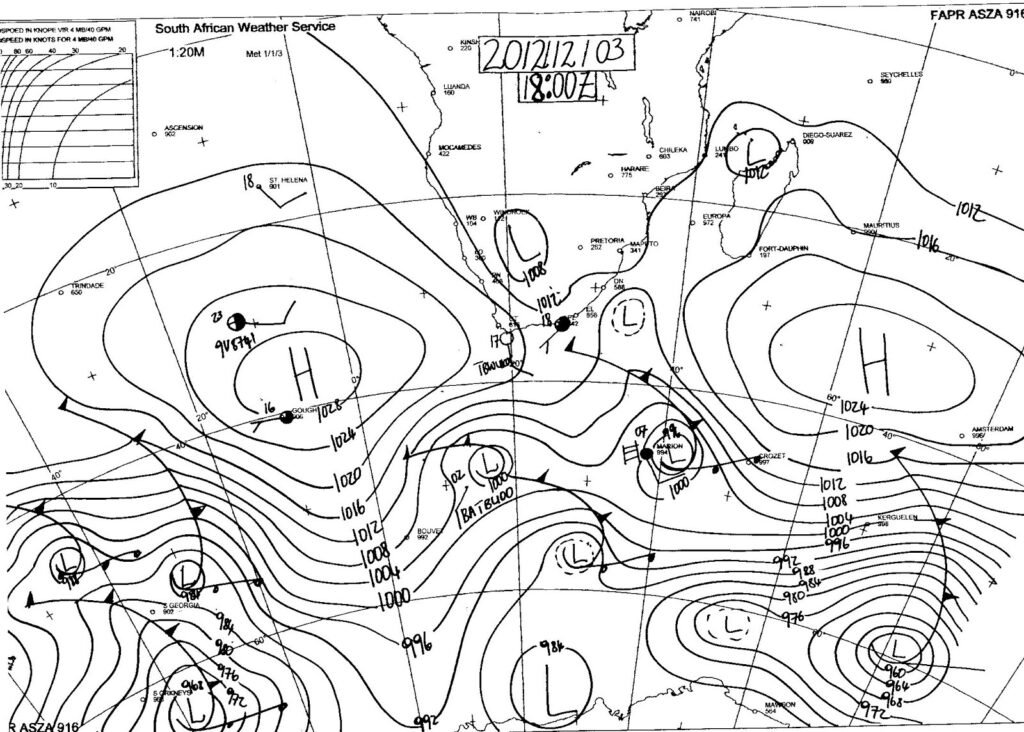
  1. A synoptic weather map provides a summary of weather conditions over a particular area at a particular time.
  2. Synoptic charts, satellite images and other data give us valuable information about the weather and climate.
  3. To make a weather forecast, forecasters examine a series of synoptic charts and compare them to satellite images and data from weather stations and weather balloons.
  4. Synoptic charts show weather-related data only and include isobars, station models (the symbols that show a variety of conditions) and weather features.
  5. Satellite images are remotely sensed. This means that there is no contact between the sensor in the satellite and the item being sensed (e.g. the Earth’s surface).
  6. Satellite images are digital images captured by sensors in satellites that orbit the Earth.
  7. Meteosat satellites are weather satellites and their sensors capture images of large areas.
  8. Satellite sensors don’t just capture images; data is also collected from outside the visible light spectrum, for instance, infrared.

Map and photo interpretation: reading and analysing features

  • In settlement geography, map and photo interpretation is just as important as in physical geography.
  • Settlements are often influenced by physical features (slope steepness, soil, availability of water, avoidance of marshy areas and wetlands), so you must be able to read and analyse physical features in the landscape.
  • Constructed features are those things which humans place (build) on the landscape to serve their needs.
  • Communications and transport (telephone lines, roads, railways), power lines, dams, and the settlements themselves are examples of constructed features.

Downloadable Guides and Notes for Mapwork Skills for Geography Grade 12

What are the main causes of rural-urban migration in South Africa

What are the main causes of rural-urban migration in South Africa Rural-urban migration in South Africa, like in many other countries, is driven by a combination of push and pull factors. The specific reasons may vary among individuals, but some common causes of rural-urban migration in South Africa include:

What are the main causes of rural-urban migration in South Africa

causes of rural-urban migration in South Africa

  1. Limited Economic Opportunities in Rural Areas:
    • Many rural areas in South Africa face challenges in terms of limited job opportunities and economic activities. Urban areas, on the other hand, tend to offer a broader range of employment options and better chances for economic advancement.
  2. Poverty and Unemployment:
    • Rural areas often suffer from higher levels of poverty and unemployment, leading individuals to seek better prospects in urban centers where there are more job opportunities.
  3. Better Education and Training Facilities:
    • Urban areas typically have better educational and training facilities, including schools, colleges, and universities. Individuals may migrate to urban areas in search of quality education and skill development.
  4. Access to Services and Infrastructure:
    • Urban areas generally have better access to healthcare, transportation, and other essential services. This can be a significant pull factor for individuals looking to improve their quality of life.
  5. Social and Cultural Amenities:
    • Urban areas often offer a more diverse range of social and cultural amenities, including entertainment, recreational activities, and a vibrant social life. This can attract individuals seeking a more dynamic and stimulating environment.
  6. Land Redistribution Policies:
    • South Africa has undergone land redistribution policies aimed at addressing historical inequalities. Some individuals may migrate from rural areas due to changes in land ownership and agricultural practices.
  7. Infrastructure Development:
    • Investments in urban infrastructure, such as roads, public transportation, and communication networks, can make urban areas more attractive and accessible.
  8. Security Concerns:
    • In some cases, rural areas may face security challenges, including crime and conflict, which can drive people to seek safer environments in urban centers.
  9. Social Networks and Migration Patterns:
    • Migration can be influenced by existing social networks. Individuals may move to urban areas where family or community members have already established themselves, creating a network of support.

These negative factors are referred to as push factors. The positive factors in urban areas, which attract people to cities are called pull factors.

The challenges that rural-urban migration cause in South Africa

The influx of people to urban areas poses great challenges to the government and it’s resources allocation process, such as:

  • increased population-growth in urban area
  • increased housing infrastructure challenges.

Causes and consequences of rural depopulation on people and the economy:

  • Young adults move away and more so young men
  • Elderly, women and children are left behind
  • Productivity in rural areas drop
  • Income declines
  • Services close down as they are not supported anymore
  • Poverty increases
  • More people leave the rural areas
  • Displacement of families and social problems

DON’T MISS: How to Pass Geography Grade 12 NSC With Distinction

Solutions to rural-urban migration in South Africa

The following are the solutions to the rural-urban migration challenges in South Africa, which the government can apply:

  • Job creation projects in rural areas
  • Decentralisation of industries
  • Development corridors
  • Improved basic services in rural areas
  • Skills development in rural areas
  • Farming related industries in rural areas
  • Improved transport, health, education services
  • Retirement villages in rural towns to attract people there
  • Incentives for professionals and employers to settle in rural areas
  • Development of eco-tourism through conservation of natural habitats and thus creating income opportunities for the local population

Conclusion

It’s essential to note that these factors are interconnected, and individuals may migrate for a combination of reasons. Additionally, the impact of rural-urban migration has implications for both rural and urban areas, affecting demographics, social structures, and economic dynamics. Government policies and interventions play a crucial role in addressing the challenges associated with migration and promoting balanced development across regions.

How can social justice help fight lack of basic services in South Africa

How can social justice help fight lack of basic services in South Africa Social justice can play a crucial role in addressing the lack of basic services in South Africa by advocating for fair and equitable distribution of resources, promoting inclusivity, and challenging systemic inequalities.

How can social justice help fight lack of basic services in South Africa

Here are several ways in which social justice can contribute to addressing these issues:

  1. Advocacy for Resource Allocation:
    • Social justice advocates can work to ensure that government budgets prioritize the provision of basic services, such as healthcare, education, water, and sanitation, especially in underserved communities.
    • They can lobby for transparent and accountable systems for resource allocation, making sure that funds are directed towards areas with the greatest need.
  2. Community Empowerment:
    • Social justice initiatives can empower local communities to actively participate in decision-making processes related to the provision of basic services. This includes involving them in planning, implementation, and evaluation of projects.
    • Empowering marginalized communities ensures that their specific needs and concerns are taken into account, fostering a more inclusive and responsive approach.

DON’T MISS: How to Pass Geography Grade 12 NSC With Distinction

  1. Education and Awareness:
    • Social justice efforts can focus on raising awareness about the importance of basic services and the rights of individuals to access them.
    • By educating communities about their rights and how to navigate bureaucratic systems, people can become better equipped to demand and access the services they need.
  2. Addressing Discrimination and Inequality:
    • Social justice advocates can work to eliminate discriminatory practices and policies that contribute to unequal access to basic services based on factors such as race, gender, or socio-economic status.
    • By challenging systemic inequalities, social justice initiatives can help create a more just and inclusive society where everyone has equal access to essential services.
  3. Policy Reform:
    • Social justice movements can engage in policy advocacy to reform existing laws and policies that perpetuate disparities in the distribution of basic services.
    • This may involve pushing for anti-corruption measures, improved governance, and policies that specifically target the needs of marginalized populations.
  4. International Collaboration:
    • Social justice efforts can extend beyond national borders, collaborating with international organizations and advocates to bring attention to and address global issues that impact basic services, such as climate change, which can disproportionately affect vulnerable communities.
  5. Legal Action:
    • Social justice initiatives can utilize legal avenues to challenge policies or practices that contribute to the lack of basic services. This may involve filing lawsuits, advocating for legal reforms, and holding those responsible accountable.
  6. Data Collection and Monitoring:
    • Social justice advocates can contribute to the collection and analysis of data on the distribution of basic services. This information can be used to highlight disparities, monitor progress, and inform evidence-based advocacy.

Reasons why social justice help fight lack of basic services in South Africa

Below are some of the reasons why social justice help fight lack of basic services in South Africa:

  • Access to resources is limited in rural areas as people live far apart and this makes it difficult to offer improved services
  • HIV/Aids is a major problem as people get sick and then return to family in rural areas, which place an increased burden on the limited income of the family and the limited health resources in rural areas.
  • Land reform is necessary in South Africa inequalities exist due to apartheid legislation of the past which prevented all people to own land.
  • Land reform – equitable distribution of landownership by changing laws about ownership of land
    • Land redistribution – some agricultural land must be bought and given to black owners by the state
    • Land restitution – return of land to people who fell victim to forced removals
    • Land tenure reform – to secure the residential rights of people living on the land of other people

The process responsible for the release of heat energy by the earth to the atmosphere

The process responsible for the release of heat energy by the earth to the atmosphere The process responsible for the release of heat energy by the Earth to the atmosphere is primarily known as terrestrial or longwave radiation. Here’s a brief explanation:

  1. Incoming Solar Radiation: The Sun emits shortwave radiation, which includes visible light and other forms of electromagnetic radiation. This radiation reaches the Earth and warms its surface.
  2. Earth’s Absorption: The Earth’s surface absorbs a portion of the incoming solar radiation, primarily in the form of visible light. The surface then re-emits this energy in the form of infrared or longwave radiation.
  3. Terrestrial Radiation: The Earth’s surface emits longwave radiation back into the atmosphere. This process is often referred to as terrestrial or longwave radiation.
  4. Greenhouse Effect: Greenhouse gases in the Earth’s atmosphere, such as water vapor, carbon dioxide, methane, and others, absorb and re-emit some of the outgoing longwave radiation. This process traps heat in the atmosphere, maintaining a temperature suitable for life on Earth. This natural greenhouse effect is essential for regulating the planet’s temperature.
  5. Heat Exchange: The Earth’s surface also exchanges heat with the atmosphere through conduction, convection, and latent heat processes. These mechanisms play a role in redistributing heat within the Earth-atmosphere system.

How do the three major processes of heat transfer affect the temperature of the earth?

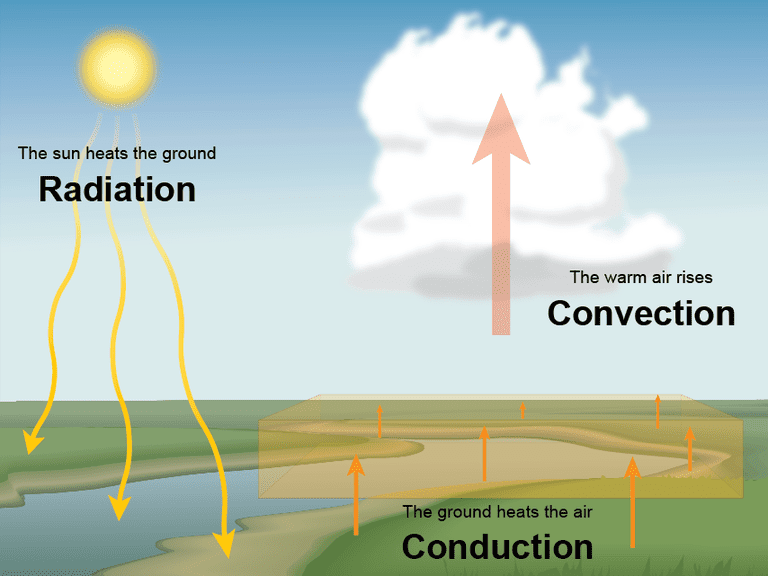
As you know, the heat source for planet earth is the sun (yellow dwarf star). Energy from the sun is transferred through space and through the earth’s atmosphere to the earth’s surface. Since this energy warms the earth’s surface and atmosphere, some of it is or becomes heat energy. There are three ways heat is transferred into and through the atmosphere (source: Weather):

  • radiation
  • conduction
  • convection
The process responsible for the release of heat energy by the earth to the atmosphere
Simple Illustration of radiation, conduction, and convection


Conduction: the release of heat energy by the earth to the atmosphere

conduction is one of the three main ways that heat energy moves from place to place

How can Droughts be Triggered by Human Activities in South Africa?

How can Droughts be Triggered by Human Activities in South Africa? Droughts in South Africa, like in many other regions, can be influenced by a combination of natural climate variability and human activities. While it’s challenging to attribute a single drought event solely to human activities, several factors associated with human influence can contribute to drought conditions.

Human-induced Drought

While nature plays its part in causing periods of reduced precipitation known as meteorological droughts; it is essential to recognize that certain actions taken by humans significantly contribute to triggering or worsening these arid situations.

The Role Human Activities Play

    1. Over-Farming

      One major factor contributing to human-induced drought is over-farming. Excessive cultivation without proper land management leads to soil degradation which reduces its ability for moisture retention during rainfalls.

    2. Excessive Irrigation

      Another activity responsible for triggering man-made droughts is excessive irrigation practices where more water than necessary gets used for agricultural purposes leading not only wastage but also depleting local water sources like rivers or underground aquifers.

    3. Deforestation

      Deforestation disrupts the delicate balance between trees’ transpiration process (where they release moisture into the atmosphere), reducing overall humidity levels within an area thus affecting regional climate patterns negatively.

    4. Erosion

      Erosion caused primarily through unsustainable farming methods strips away fertile topsoil layers making them less capable of retaining water, exacerbating drought conditions.

Here are some ways in which human activities may contribute to drought in South Africa:

  1. Climate Change:
    • Greenhouse gas emissions from human activities, such as burning fossil fuels and deforestation, contribute to global climate change. This can alter precipitation patterns, increase temperatures, and lead to more frequent and severe droughts.
  2. Land Use Changes:
    • Altering the landscape through activities like deforestation, urbanization, and changes in agricultural practices can affect local and regional climate patterns. Deforestation, for example, can reduce transpiration, leading to changes in atmospheric moisture levels and precipitation patterns.
  3. Water Management Practices:
    • Mismanagement of water resources, inefficient irrigation practices, and over-extraction of groundwater can deplete water sources, leading to water scarcity and drought conditions.
  4. Population Growth:
    • Rapid population growth can put additional stress on water resources as more water is needed for drinking, agriculture, and industrial purposes. Increased demand without proper water management can exacerbate drought conditions.
  5. Pollution:
    • Pollution of water sources, such as rivers and lakes, can degrade water quality and reduce the availability of freshwater. This can affect ecosystems and the overall water balance in a region.
  6. Deforestation:
    • Deforestation not only contributes to climate change but also reduces the ability of ecosystems to retain moisture. Trees play a crucial role in maintaining local and regional hydrological cycles, and their removal can lead to decreased precipitation and increased runoff.
  7. Urbanization:
    • Rapid urbanization can create “urban heat islands,” where cities experience higher temperatures than surrounding rural areas. This can influence local weather patterns and contribute to changes in precipitation, potentially leading to drought conditions.

Frequently Asked Questions

Question 1: What are the main human activities that trigger drought?

Answer:
Human activities can directly contribute to triggering and exacerbating drought conditions. Some of the main activities include:

  • Over-farming: Excessive cultivation without proper soil management practices depletes moisture in the ground, leading to reduced water availability for plants and increased vulnerability to drought.
  • Excessive irrigation: Inefficient or excessive use of water for agricultural purposes can lead to a depletion of groundwater resources, reducing overall water availability during dry periods.
  • Deforestation: Clearing forests disrupts natural rainfall patterns by removing trees that help retain moisture in the atmosphere through transpiration. This reduction in vegetation cover contributes to drier conditions and increases susceptibility to drought.
  • Erosion: Human-induced erosion reduces soil quality, making it less capable of retaining rainwater. As a result, more precipitation runs off instead of being absorbed into the ground.

Question 2: How does climate change contribute to drought?

Answer:
Climate change plays a significant role in increasing both frequency and severity of drought events globally due primarily to rising global temperatures caused by greenhouse gas emissions. Here’s how climate change contributes:

  • Altered weather patterns: A warming planet affects atmospheric circulation systems, resulting in changes such as shifts in snowfall patterns and alterations in distribution of rainfall. These changes can lead to drought conditions in certain regions where there is already limited rainfall.
  • Water cycle disruption: The increase in temperature accelerates evaporation rates from land surfaces, worsening drying trends. Additionally, the warmer air holds more moisture, making it difficult for precipitation to reach the ground as rain, rather than being lost through evapotranspiration. This imbalance between evaporation and precipitation contributes to drier soils and scarcer water resources during periods of low or below-average rainfall.
  • Increased intensity of sudden weather events: Intense rainfall events, often associated with climate change, can disrupt the natural water cycle by causing flooding rather than allowing for gradual infiltration of moisture into the soil. This can lead to rapid runoff of water, resulting in a lack of sustained moisture for plants and contributing to drought conditions.

Question 3: What are the different types of drought?

Answer:
Drought can be categorized into three main types:

  1. Meteorological Drought: This type refers to prolonged periods with less than average precipitation. It is characterized by below-normal rainfall or snowfall over an extended period. This reduction in precipitation leads to drier soil conditions and decreased availability of surface water sources.
  2. Agricultural Drought: Agricultural drought occurs when there is insufficient moisture available for crop production or range ecology. The impact extends beyond just reduced yields; it affects overall agricultural productivity, livestock health, and food security within affected regions.
  3. Hydrological Drought: Hydrological drought happens when water reserves, such as aquifers, lakes, reservoirs, fall below the statistical average. This means that even if meteorological conditions improve, the deficit remains as groundwater levels take longer timeframes to replenish. Water scarcity becomes more pronounced during hydrological events as it affects water supply for drinking, agricultural purposes, and other human activities.

Question 4: What can be done to mitigate the impact of drought?

Answer:
Mitigating the devastating impacts of drought on communities and economies requires a multi-faceted approach. Here are some strategies:

  • Implement sustainable farming practices such as precision irrigation techniques, reduced tillage methods, and improved soil management to conserve water resources.
  • Promote afforestation and revegetation efforts which help restore natural rainfall patterns and support watershed health.
  • Develop efficient rainwater harvesting systems at individual, household, community, and regional levels to capture and store rainwater for future use.
  • Invest in water infrastructure projects such as dams, reservoirs, and pipelines that can help regulate the distribution of water during dry periods.
  • Encourage responsible consumption practices at both individual and industrial levels by promoting efficient use of water in daily activities.

Question 5: How can individuals contribute to drought prevention and relief efforts?

Answer:
Individuals can play an important role in drought prevention and relief efforts. Here are some actions individuals can take:

  1. Conserve Water: Practice mindful water usage by fixing leaks promptly, reducing shower time, capturing rainwater to use for irrigation purposes, and using appliances with high-efficiency ratings.
  2. Support Sustainable Agriculture Practices: Eat locally sourced food that follows environmentally friendly farming practices. These include organic farming methods, water-smart irrigation techniques, crop rotation strategies, etc.
  3. Raise Awareness: Educate others about the causes, effects, and solutions related to drought. Encourage the community to adopt water-saving habits and support initiatives focused on drought help and relief efforts such as fundraisers or volunteer work with relevant organizations or NGOs working on the issue.
  4. Advocate for Policy Change: Lobby government officials and decision-makers to prioritize investment in sustainable infrastructure projects, demand stricter regulations around groundwater usage, promote afforestation programs, take action against illegal deforestation, etc.

Do you know what Gas makes up most of the earth’s atmosphere?

Do you know what Gas makes up most of the earth’s atmosphere? The air we breathe, the invisible embrace that envelops our planet, is a complex mixture of gases that sustains life as we know it. Among this celestial blend, one gas stands out as the unassuming yet mighty leader—nitrogen. In this exploration, we’ll unravel the secrets of Earth’s atmospheric composition and shed light on the crucial role played by nitrogen.

Do you know what Gas makes up most of the earth’s atmosphere?

The most abundantly present gas in the atmosphere by far is nitrogen, which accounts for about 78% of the mass of dry air. While the second most abundant gas in the atmosphere is Oxygen, present at levels of 20 to 21%.

List of available gases in the atmosphere and their percentages

Gas NameChemical FormulaPercent Volume
NitrogenN278.08%
OxygenO220.95%
*WaterH2O0 to 4%
ArgonAr0.93%
*Carbon DioxideCO20.0360%
NeonNe0.0018%
HeliumHe0.0005%
*MethaneCH40.00017%
HydrogenH20.00005%
*Nitrous OxideN2O0.00003%
*OzoneO30.000004%