Home Blog Page 159

Three ocean currents which are formed when the south equatorial current reaches a continent

Three ocean currents which are formed when the south equatorial current reaches a continent When the South Equatorial Current (SEC) reaches a continent, it can split into several ocean currents due to the influence of the coastline, local topography, and other factors. The specific currents formed can vary depending on the geography of the region. Here are three examples of ocean currents that can be formed when the South Equatorial Current interacts with a continent:

What are Ocean Currents?

What a re ocean crrent? Well, according to National Geographic, ocean currents are the continuous, predictable, directional movement of seawater driven by gravity, wind (Coriolis Effect), and water density. Ocean water moves in two directions: horizontally and vertically. Horizontal movements are referred to as currents, while vertical changes are called upwellings or downwellings. This abiotic system is responsible for the transfer of heat, variations in biodiversity, and Earth’s climate system.

Three ocean currents which are formed when the south equatorial current reaches African continent

The three ocean currents which are formed when the south equatorial current reaches are all part of the South Equatorial Current, which can be divided into three branches:

  • The Southern South Equatorial Current (SSEC),
  • the Central South Equatorial Current (CSEC), and
  • the Northern South Equatorial Current (NSEC)
  1. West Australian Current (WAC):
    • Location: Along the western coast of Australia.
    • Formation: The South Equatorial Current splits into two branches as it approaches the Australian continent. The northern branch continues as the North Australian Current, while the southern branch turns southward, becoming the West Australian Current.
  2. Brazil Current:
    • Location: Along the eastern coast of South America, particularly off Brazil.
    • Formation: The South Equatorial Current flows westward across the South Atlantic Ocean. As it reaches the eastern coast of South America, it divides, with a portion turning southward along the coast, forming the Brazil Current.
  3. Peru (Humboldt) Current:
    • Location: Along the western coast of South America, off Peru and northern Chile.
    • Formation: The South Equatorial Current splits when it encounters the west coast of South America. The northern branch becomes the Panama Current, while the southern branch turns southward along the coast, forming the cold and nutrient-rich Peru (or Humboldt) Current.


Rural Settlement Grade 12 Geography Revision Notes

Rural Settlement Grade 12 Geography Revision Notes Rural settlements are areas with a low population density and are usually associated with agricultural activities.

What is Rural settlement in South Africa?

What characterises a rural settlement in South Africa are the following:

  • Farmstead: A single farm and outbuildings
  • Hamlet: A loose grouping of a few farmsteads
  • Village: A denser grouping of many farmsteads

Rural settlements are the smallest settlements which are unifunctional. They are farmsteads, hamlets or villages, where primary activities (farming, fishing, forestry or mining) take place.

Land use in rural settlement in South Africa

The largest land use in South Africa is agriculture. Approximately 12, 1% of the land is used for both commercial and subsistence cultivation of crops.

Although rural communities focus on primary economic activities (farming and forestry), there are a number of different ways in which the land in these settlements can be used.

DON’T MISS: How to Pass Geography Grade 12 NSC With Distinction

Subsistence farming involves using the land to grow crops and breed animals that are a source of food for the family living on the farm. The aim is not to sell the goods, but to consume them.

Commercial farming is practised where the land is used to grow crops or breed animals that are then sold as food sources to other markets. The main aim of this rural land use is to generate income for the farmers. Commercial farming can be either intensive or extensive. Commercial farming can be divided into:

  • Stock farming: Animals, for example, cows, chicken, sheep, pigs.
  • Crop farming: Cultivation of land, for example, maize, wheat, fruit, vegetables.
  • Mixed farming: A combination of stock and crop farming.

Rural Settlement Grade 12 Geography Video Lesson

Rural Settlement Geography Grade 12 main questions and answers

Question: What is agenda 21 local examples in South Africa?

Answer:

  • Including local communities in all decisions made.
  • Using local resources wisely.
  • Including indigenous knowledge.
  • Developing the local community and improving the quality of life of people alongside conservation strategies.

Question: Give two examples of important break of bulk points

Answer:

Where one type of transport is replaced by another type, e.g:

  • Harbour: docks where goods are transfer from boat to truck.
  • Airport: the ramp of a airport where goods are unloaded from trucks into planes.

Question: What is Informal settlement in South Africa?

Answer: An informal or unplanned area that is occupied by people who do not have access to formal housing and who erect dwellings on open land, usually on the outskirts of a town. Buildings are made of cardboard, zinc, plastic or wood, or any available materials. It is also sometimes called a squatter camp or shanty town.

Question: List village shapes which are common in South Africa

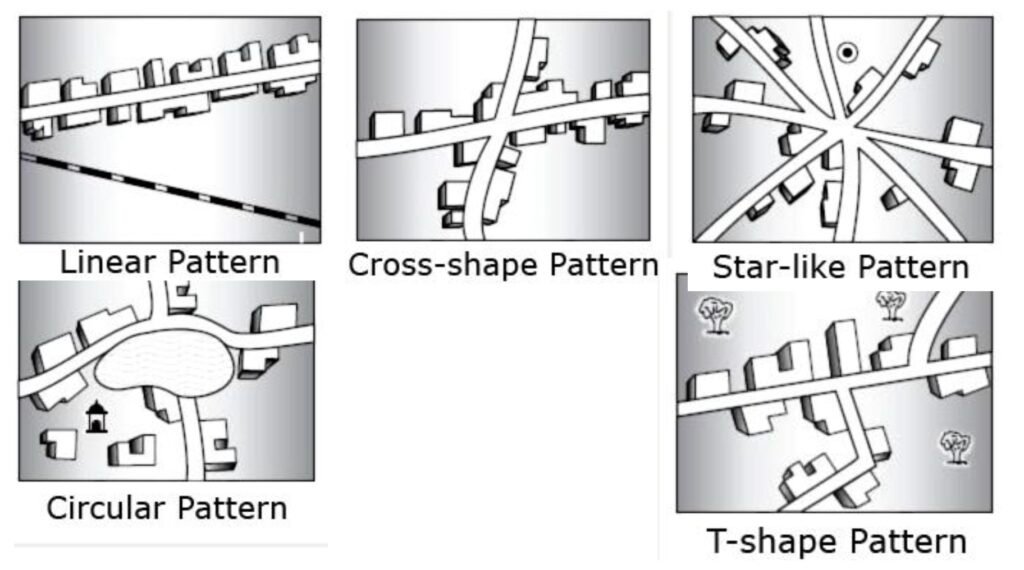
Answer: Rural villages are classified as:

  1. Round – develop around a market place or some shared / communal land
  2. Linear – develops along rivers, roads, coastlines, railways or in thermal belts in valleys.
  3. Cross road – settlement develop in the form a cross to allow every one access to the road.
  4. T-shape – settlement develop in the form a T along a road junction to allow every one access to the road.
  5. Star-shaped – many roads connect and the settlement spread out along these toads.
List village shapes which are common in South Africa

How site and situation affects rural settlement in South Africa

Site of settlements are determined by the following:

  • Running water for domestic and agricultural use
  • Availability of building material e.g. wood, rocks, grass, mud, clay
  • Flat land to build on
  • Grazing land
  • Fertile soil for crop farming

Downloadable Rural Settlement Grade 12 Geography Notes for Revision


Study Guides

The weather that occurs as a result of the cold front in South Africa

The weather that occurs as a result of the cold front in South Africa In South Africa, a cold front typically brings a change in weather conditions, marked by a drop in temperature and other associated atmospheric changes. When a cold front passes through the region, it displaces warmer air masses, leading to various weather phenomena.

The weather that occurs as a result of the cold front in South Africa

Here are some common effects of a cold front in South Africa:

    1. Temperature Drop: One of the most noticeable effects is a decrease in temperature. As the cold front moves in, it replaces warm air with colder air, leading to a sudden drop in temperatures.
    2. Rainfall: Cold fronts are often associated with precipitation. In South Africa, this can result in rain, thunderstorms, or even snowfall in higher-altitude regions during the winter months.
    3. Wind: The passage of a cold front is usually accompanied by a shift in wind direction and an increase in wind speed. The wind tends to be stronger and gustier as the front passes through.
    4. Pressure Changes: There is typically a drop in atmospheric pressure as a cold front approaches, which can have various effects on weather patterns.
    5. Cloud Formation: Clouds often accompany cold fronts. Depending on the atmospheric conditions, different types of clouds may form, including cumulus and cumulonimbus clouds, leading to stormy weather.
    6. Clearing Skies: Once the cold front has passed, the skies may clear, and weather conditions may stabilize. However, this can also depend on the specific atmospheric conditions and the speed at which the front is moving.

Conclusion

It’s important to note that the specific impact of a cold front can vary depending on the time of year, geographical location, and the characteristics of the air masses involved. South Africa’s climate is diverse, with regions experiencing different weather patterns, so the effects of a cold front may vary across the country.

Global air circulation Notes for Grade 12

Global air circulation Notes for Grade 12 Here are some key points on global air circulation that you might find useful for Grade 12 studies:

Here’s an overview of global air circulation:

1. Hadley Cell:

  • Location: Near the equator (0-30 degrees latitude).
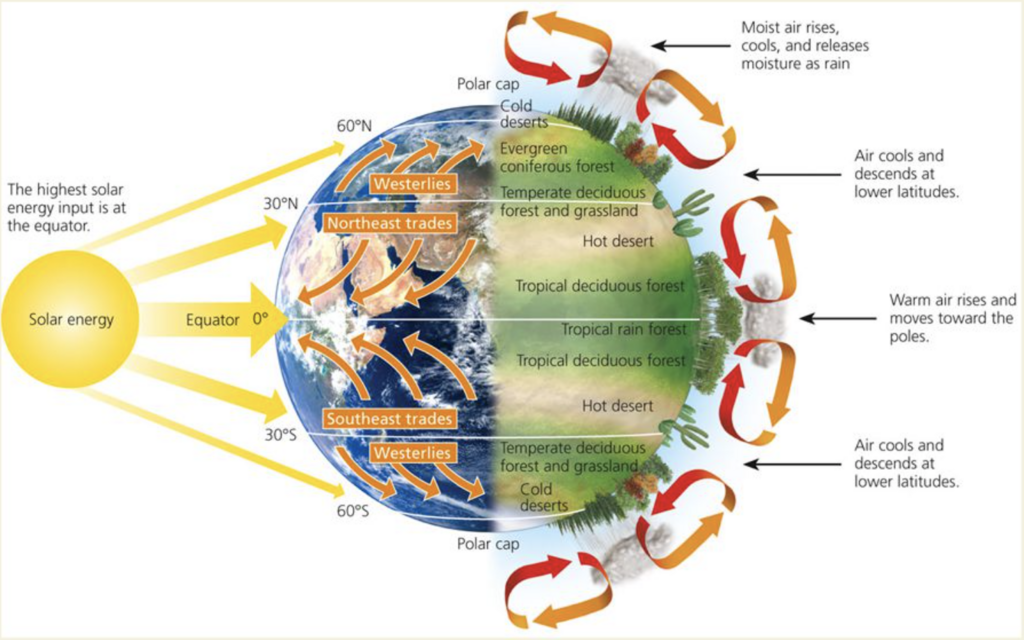
  • Description: The Sun’s intense heat at the equator causes air to rise, creating a low-pressure zone. As the air rises, it cools and releases moisture, forming clouds and precipitation. The rising air moves towards the poles aloft, creating the Hadley cell.

2. Ferrel Cell:

  • Location: 30-60 degrees latitude in both hemispheres.
  • Description: At these latitudes, the descending air from the Hadley cell creates high pressure. This air moves towards the poles near the surface. The Coriolis effect deflects this air, creating the westerlies (prevailing winds from the west).

3. Polar Cell:

  • Location: Polar regions (60-90 degrees latitude).
  • Description: Near the poles, cold air descends, creating a polar high-pressure zone. This air moves towards lower latitudes along the surface, creating the polar easterlies.

4. Coriolis Effect:

  • Description: The rotation of the Earth causes moving air or water to be deflected to the right in the Northern Hemisphere and to the left in the Southern Hemisphere. This effect influences the direction of global winds and ocean currents.

5. Intertropical Convergence Zone (ITCZ):

  • Location: Near the equator.
  • Description: The meeting point of trade winds from the Northern and Southern Hemispheres. It is characterized by low pressure, rising air, and frequent precipitation.

6. Trade Winds:

  • Location: Between the equator and 30 degrees latitude.
  • Description: Prevailing easterly winds in the tropics that move from east to west.

7. Westerlies:

  • Location: Between 30 and 60 degrees latitude.
  • Description: Prevailing winds from the west, moving from west to east.

8. Polar Easterlies:

  • Location: Near the poles.
  • Description: Cold easterly winds that blow from the polar high-pressure areas towards lower latitudes.

9. Monsoons:

  • Description: Seasonal reversal of wind patterns, often associated with large-scale land-sea temperature differences. For example, the Indian subcontinent experiences a monsoon with a shift in wind direction between summer and winter.

Winds related to global air circulation

There are three global wind systems that are related to the global circulation:

  • The tropical easterlies
  • The westerlies
  • The polar easterlies

What causes the circulation of air in the atmosphere

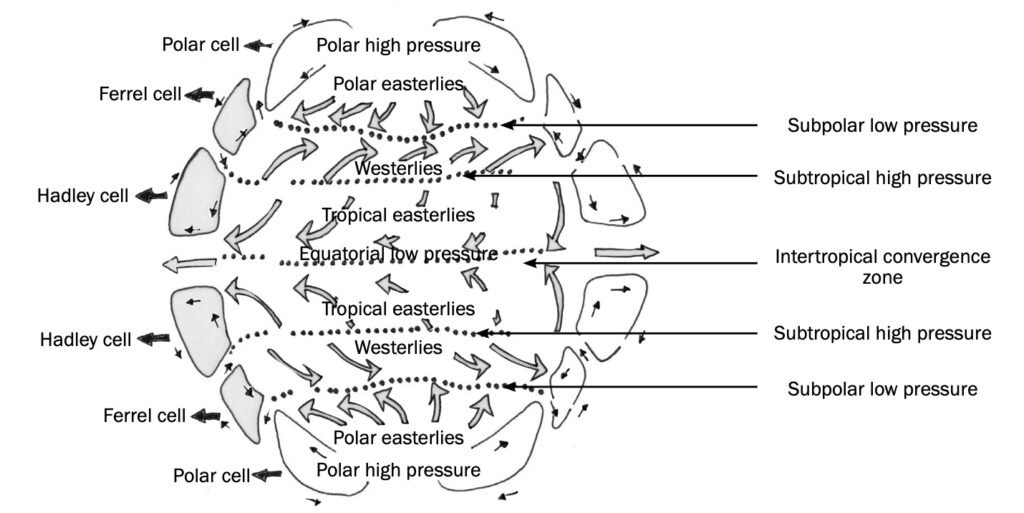
A force called Coriolis force causes global winds to move to the left in the southern hemisphere and to the right in the northern hemisphere. The tri-cellular arrangement, the pressure belts and the global winds together form the global air circulation.

The global air circulation diagram

Below is the global air circulation diagram

Global air circulation

What are the 3 types of atmospheric circulation cells called?

The 3 types of atmospheric circulation cells called:

  • Polar cell – The smallest and weakest cells are the Polar cells, which extend from between 60 and 70 degrees north and south, to the poles.
  • Ferrel cell – Ferrel cell refers to a model that belongs to the mid-latitude region of the Earth’s wind flow
  • Hadley cell – low-latitude overturning circulations that have air rising at the equator and air sinking at roughly 30° latitude.
What are the 3 types of atmospheric circulation cells called
Global air circulation Notes for Grade 12

Understanding global air circulation is crucial for comprehending weather patterns, climate zones, and the distribution of heat and moisture around the planet. It plays a significant role in shaping regional climates and weather events.

Synoptic weather map interpretation Grade 12 Notes

Synoptic weather map interpretation Grade 12 Notes Interpreting synoptic weather maps is a crucial skill for understanding and predicting weather patterns.

Here are some key points and steps to consider when interpreting synoptic weather maps:

To better understand weather patterns and weather phenomena you need to be able to interpret the synoptic weather map.

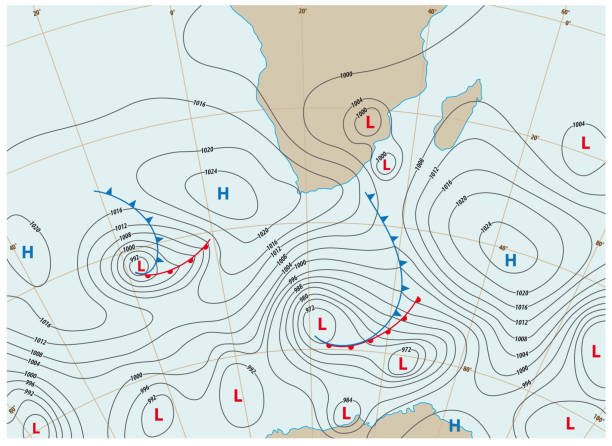
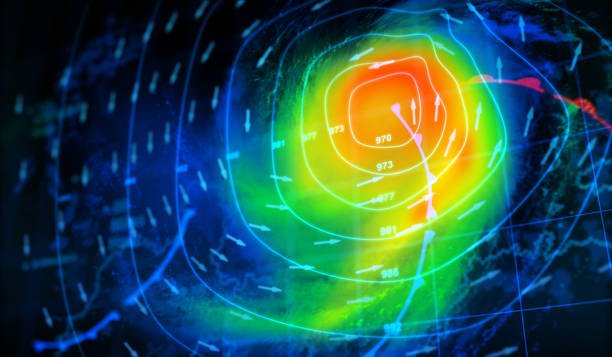
A synoptic weather map shows weather conditions and phenomena (temperature, precipitation,wind speed and direction, atmospheric pressure and cloud coverage) over a wide area at a given time based on worldwide observations recorded at the same time (from weather stations, airplanes, weather balloons and satellites).


Understanding isobars

Isobars are lines on a weather map joining together places of equal atmospheric pressure.

  • These lines join points of equal pressure (all along one isobar the pressure is the same).
  • The pressure is measured in hectopascals (hpa)/millibars (mb).
  • The isobars form patterns (shapes formed by many isobars).

Synoptic Weather Map Exam Tips


Synoptic Weather Map Exam Tips

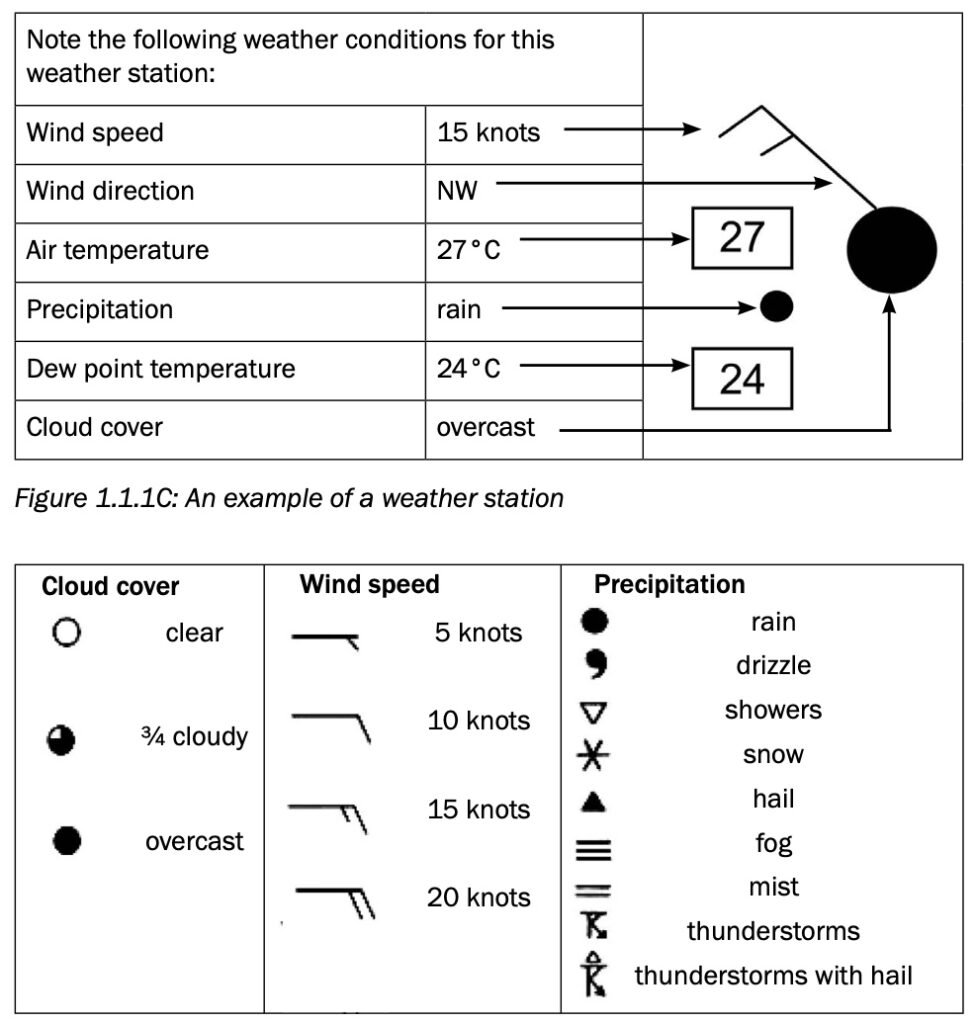
In the exam, you may be asked to describe the weather of a particular place on the synoptic weather map by referring to the weather station. You will need to comment on the following weather elements:

  • Cloud cover interpretation
  • Wind direction interpretation
  • Wind speed interpretation
  • Air temperature interpretation
  • Dew point temperature interpretation
  • Precipitation (any form of water falling from the sky, e.g. rain, hail,snow and ice) interpretations.

Video Lesson:

Important Weather symbols: Match weather symbols to words

In the Geography Grade 12 exam, you may be asked to match weather symbols to words. Below are the most common weather symbols that grade 12 learners should know:

Match weather symbols to words

Synoptic weather map interpretation Grade 12 pdf notes for downloads

Synoptic weather map interpretation Grade 12 Notes

Geografie (Geography) CAPS Document – Lesson Plans for FET Phase Grade 10 – 12

Geografie (Geography) CAPS Document – Lesson Plans for FET Phase Grade 10 – 12 Geography, the study of the Earth and its features, plays a crucial role in shaping our understanding of the world around us. For students in the Further Education and Training (FET) Phase, specifically grades 10 to 12, the Geography CAPS (Curriculum and Assessment Policy Statement) document serves as a comprehensive guide to navigating the diverse landscapes of our planet. In this blog post, we will delve into the key aspects of the Geography CAPS document, highlighting the importance of lesson plans tailored for FET Phase students.

Understanding the CAPS Document:

The Curriculum and Assessment Policy Statement (CAPS) document is the foundation upon which the South African curriculum is built. Specifically designed for the FET Phase, the Geography CAPS document provides a structured framework for educators to create engaging and informative lesson plans. It is not merely a set of guidelines but rather a dynamic tool that empowers teachers to instill a deep appreciation for the world’s geographical features and processes in their students.

Lesson Plans for FET Phase Grade 10-12:

  1. Holistic Approach: The Geography CAPS document encourages a holistic approach to learning, emphasizing the interconnectedness of physical, human, and environmental aspects. Lesson plans should reflect this integrated perspective, fostering a comprehensive understanding of the subject matter.
  2. Critical Thinking: The FET Phase is a critical period in a student’s academic journey, where critical thinking and analytical skills are honed. Geography lesson plans should not only focus on imparting factual knowledge but also on developing students’ ability to analyze information, make connections, and think critically about global issues.
  3. Practical Application: Geography is a subject that comes to life through practical application. Lesson plans should incorporate hands-on activities, fieldwork, and the use of modern technology to allow students to explore geographical concepts in a real-world context. This approach not only enhances learning but also instills a sense of curiosity and wonder.
  4. Current Affairs and Global Issues: Given the dynamic nature of the world, Geography lesson plans should integrate current affairs and global issues. This not only keeps the content relevant but also encourages students to engage with the world around them and become informed global citizens.
  5. Assessment Strategies: The CAPS document emphasizes continuous assessment as a means of evaluating students’ progress. Lesson plans should include varied assessment strategies, such as projects, presentations, and examinations, to gauge the depth of understanding and skills development.

The document contains the prescribed learning content as well as the weekly and annual teaching plans for Geografie (Geography) for FET Phase (Grade 10, Grade 11, and Grade 12), which includes:

  • Informal Assessments
  • Daily Assessments
  • Moderation and Marking of Assessments
  • Tasks and Projects
  • Investigations
  • Practical Work, and
  • Demonstrations

The document gives a clear indication of what topics and learning outcomes are required for Term 1, Term 2, Term 3, and Term 4.

Contents of the Geografie (Geography) CAPS Document for FET Phase Grade 10 – 12: Lesson Plans Details

Geografie (Geography) Technology Grade 10

  • Weekly lesson plans for Term 1, Term 2, Term 3, and Term 4
  • Assessment Guidelines: Daily Assessments, Informal Assessments, Formal Assessments
  • Exams Guidelines

Geografie (Geography) Technology Grade 11

  • Weekly lesson plans for Term 1, Term 2, Term 3, and Term 4
  • Assessment Guidelines: Daily Assessments, Informal Assessments, Formal Assessments
  • Exams Guidelines

Geografie (Geography) Grade 10

  • Weekly lesson plans for Term 1, Term 2, Term 3, and Term 4
  • Assessment Guidelines: Daily Assessments, Informal Assessments, Formal Assessments
  • Exams Guideline

Download the Geografie (Geography)  CAPS Document for FET Phase Grade 10 – 12


Below you can download the Geografie (Geography) CAPS Document for FET Phase (Grade 10, Grade 11, and Grade 12) in pdf format.

Geography Grade 12 Climatology Notes with Questions and Answers

Geography Grade 12 Climatology Notes with Questions and Answers Welcome, geography enthusiasts, to a fascinating journey through the intricate world of Climatology. As Grade 12 students, you are on the brink of mastering the complexities of weather patterns, atmospheric phenomena, and the delicate balance that sustains our planet. In this blog post, we’ll delve into essential Climatology notes, explore challenging questions, and provide insightful answers to help you solidify your understanding.

Understanding Climatology:

Climatology is the branch of geography that focuses on the long-term study of weather conditions and atmospheric patterns in a particular region. To grasp the nuances of this field, let’s break down key concepts:

  1. Atmospheric Circulation:
    • Notes: Learn about the Hadley, Ferrel, and Polar cells, and how they influence global wind patterns.
    • Question: Explain the impact of Coriolis effect on wind direction in different hemispheres.
  2. Climate Classifications:
    • Notes: Understand the Köppen climate classification system, which categorizes climates based on temperature and precipitation.
    • Question: Compare and contrast the characteristics of tropical rainforests and tundras using the Köppen classification.
  3. Factors Influencing Climate:
    • Notes: Explore the role of latitude, altitude, proximity to water bodies, and ocean currents in shaping regional climates.
    • Question: Analyze how the El Niño and La Niña phenomena affect global climate patterns.
  4. Climate Change:
    • Notes: Investigate the causes and consequences of climate change, including the greenhouse effect and rising sea levels.
    • Question: Propose sustainable measures to mitigate the impact of climate change on vulnerable regions.

DON’T MISS: How to Pass Geography Grade 12 NSC With Distinction

Challenging Questions and In-depth Answers:

  1. Question: Describe the relationship between climate change and extreme weather events.
    • Answer: Climate change intensifies extreme weather events by altering temperature and precipitation patterns. This leads to more frequent and severe events such as hurricanes, droughts, and heatwaves.
  2. Question: How does the presence of mountain ranges influence the climate on the windward and leeward sides?
    • Answer: Windward sides of mountains experience orographic rainfall, leading to lush vegetation. In contrast, leeward sides, in the rain shadow, are often dry due to descending air masses.
  3. Question: Discuss the impact of urbanization on local climates.
    • Answer: Urban heat islands form as cities absorb and retain heat. This can lead to higher temperatures, altered precipitation patterns, and increased air pollution in urban areas.

Climatology Grade 12 Notes Pdf Download


sa-weather-map
sa-weather-map
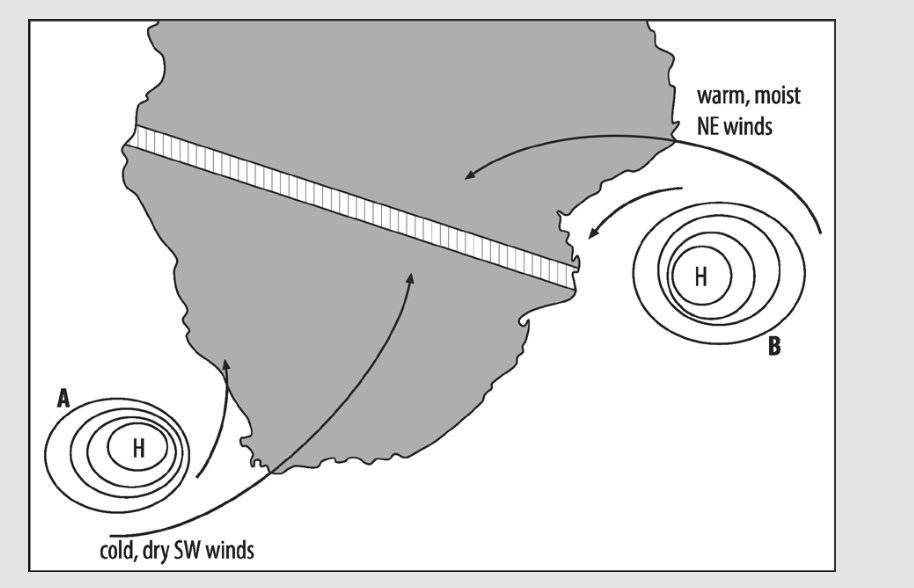
  1. Identify: (a) high-pressure cells A and B (b) the season.
  2. Give the reason for the difference in moisture content of the two winds. (2)
  3. What is the name for the band of low pressure that stretches over the interior and along which the thunderstorms form? (1)
  4. Explain why thunderstorms and rain occur along the band. (2)
  5. On which side of the band of low pressure do the line thunderstorms form – the eastern or western side? (1)
  6. Suggest two negative impacts line thunderstorms have on farming. (2)
  7. Classify the rain from a line thunderstorm as frontal, convection or orographic.

Answers

  1. (a)A = South Atlantic High. B = South Indian High 3 (2) b) summer 3 (1)
  1. The air mass that forms over the warm Mozambique/Agulhas Current 3 of the
    Indian Ocean holds more moisture than the
    air mass that forms over the cold Benguela Current 3 of the Atlantic Ocean. (2)
  2. moisture trough 3 (1)
  3. Warm, moist air is forced to rise fast and high 3. There is extensive cooling and condensation 3. (2)
  4. eastern side 3 (1)
  5. Any two: They bring rain, but heavy rain and hail can cause flooding 3, soil erosion
    3, and crop and livestock damage 3.
    Lightning causes fires 3. (2)
  6. convection

Downloadable Content for Geography Grade 12 Climatology

Geography CAPS Document – Lesson Plans for FET Phase Grade 10 – 12

Geography CAPS Document – Lesson Plans for FET Phase Grade 10 – 12 Geography, the study of our planet’s landscapes, environments, and the interplay between human societies and their surroundings, is a subject that holds the key to understanding the world we live in. For educators guiding students through the Further Education and Training (FET) Phase in Grades 10-12, the Geography CAPS (Curriculum and Assessment Policy Statement) document serves as a compass, providing a comprehensive guide to crafting lesson plans that foster both knowledge and critical thinking skills.

Contents of the CAPS Document Geography CAPS Document for FET Phase Grade 10 – 12: Lesson Plans Details

Geography Grade 10

  • Weekly lesson plans for Term 1, Term 2, Term 3, and Term 4
  • Assessment Guidelines: Daily Assessments, Informal Assessments, Formal Assessments
  • Exams Guidelines

Geography Grade 11

  • Weekly lesson plans for Term 1, Term 2, Term 3, and Term 4
  • Assessment Guidelines: Daily Assessments, Informal Assessments, Formal Assessments
  • Exams Guidelines

Geography Grade 10

  • Weekly lesson plans for Term 1, Term 2, Term 3, and Term 4
  • Assessment Guidelines: Daily Assessments, Informal Assessments, Formal Assessments
  • Exams Guidelines

During Grades 10, 11 and 12 learners are guided towards developing the following Geography knowledge, skills and attitudes:

  • explaining and interpreting both physical and human geographical processes;
  • describing and explaining the dynamic interrelationship between the physical and human worlds;
  • developing knowledge about where places are, and the nature of a range of different places at different scales;
  • practising essential transferable skills – literacy, numeracy, oracy and graphicacy;
  • promoting the use of new technologies, such as information Communication Technology (iCT) and Geographi- cal information Systems (GiS);
  • developing a commitment towards sustainable development;
  • creating awareness and sensitivity to inequality in the world;
  • ostering empathy, tolerance and fairness; and
  • making and justifying informed decisions and judgements about social and environmental issues.

The document contains the prescribed learning content as well as the weekly and annual teaching plans for Geography for FET Phase (Grade 10, Grade 11, and Grade 12), which includes:

  • Informal Assessments
  • Daily Assessments
  • Moderation and Marking of Assessments
  • Tasks and Projects
  • Investigations
  • Practical Work, and
  • Demonstrations

The document gives a clear indication of what topics and learning outcomes are required for Term 1, Term 2, Term 3, and Term 4.

Download the Geography  CAPS Document for FET Phase Grade 10 – 12

Below you can download the Geography CAPS Document for FET Phase (Grade 10, Grade 11, and Grade 12) in pdf format.

CLIMATE AND WEATHER GRADE 12 NOTES – GEOGRAPHY STUDY GUIDES

CLIMATE AND WEATHER GRADE 12 NOTES – GEOGRAPHY STUDY GUIDES Below are some key points and topics that are often covered in Grade 12 Geography when studying climate and weather.

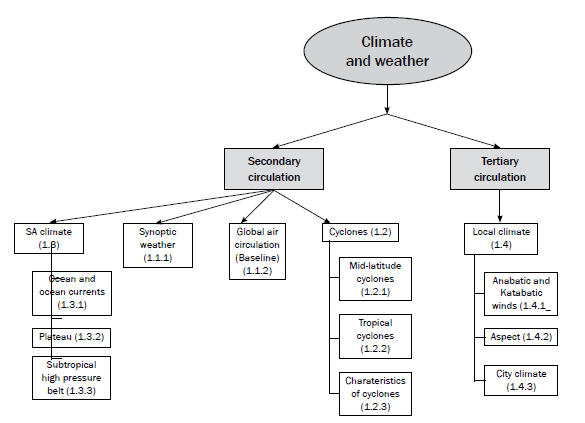
This chapter covers secondary (regional) and tertiary (local) circulations or weather patterns. This knowledge will enable you to analyse weather patterns and the microclimate of cities and valleys in the exam.
1Key concepts
If you know and understand the definitions in this chapter, you will be able to answer most of the questions in the climate and weather (climatology) section of the final exam. Use your mobile notes to learn these concepts well (see page x for instructions on how to make them). Adding pictures to your mobile notes will help you remember the concepts.

CONCEPT DEFINITION 
Anabatic windsWarm winds that blow up a valley slope during the day.
Anticyclone (high pressure)Forms as a result of sinking air. Air movement is anticlockwise, divergent (outwards), subsiding (sinking) in the southern hemisphere, e.g. South Atlantic High, South Indian High and Kalahari High.
AspectThe direction in which a slope faces.
Berg windsHot, dry winds that blow from the interior of South Africa to coastal areas.
Climate changeLong-term changes to the global climate, resulting in unusual and extreme (stronger) weather conditions.
Cyclone (low pressure)Forms as a result of rising air. Air movement is clockwise, convergent (inwards), rising (convection) in the southern hemisphere, e.g. coastal low, tropical cyclone, mid-latitude cyclone.
Heat islandHigher temperatures in urban areas than the surrounding rural area. There are many causes of heat island including pollution.
Inversion layerZone where sinking cold air meets with the rising warm air. A layer of the atmosphere in which temperature increases with height.
Inter-tropical convergence zone (ITCZ)An area along the equator where the tropical easterlies from both hemispheres meet.
Katabatic windsCold winds that blow down a valley slope at night.
Polar EasterliesWinds that blow from the pole towards subpolar low pressure belts (90° to 60°).
Temperature inversionTemperature increasing with height.
Thermal beltZone of warmer temperature above the valley floor.
Tropical easterlies/trade windsWinds that blow from the subtropical high belts towards the equatorial low pressure belt (0° to 30°).
WesterliesWinds that blow from the subtropical high pressure belts to the subpolar low pressure belts (30° to 60°).

1.1 Introduction

Our focus will be on the South African climate, mid-latitude cyclones, tropical cyclones, sub-tropical anticyclones and local climate (valley and city climate). But first we need to understand synoptic weather charts (maps), and satellite images.
1.1.1 Synoptic weather map interpretation
To better understand weather patterns and weather phenomena you need to be able to interpret the synoptic weather map. A synoptic weather map shows weather conditions and phenomena (temperature, precipitation, wind speed and direction, atmospheric pressure and cloud coverage) over a wide area at a given time based on worldwide observations recorded at the same time (from weather stations, airplanes, weather balloons and satellites).
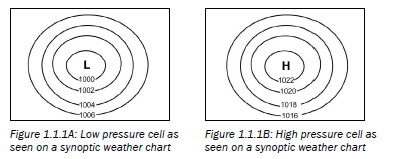
On a synoptic weather map there are lines called isobars:

  • These lines join points of equal pressure (all along one isobar the pressure is the same).
  • The pressure is measured in hectopascals (hpa)/millibars (mb).
  • The isobars form patterns (shapes formed by many isobars).
    Figures 1.1.1A shows a low pressure and high pressure cell

Synoptic weather maps are very often tested in the exam.
2
Note that the pressure reading decreases towards the centre of a Low and increases towards the centre of a High.
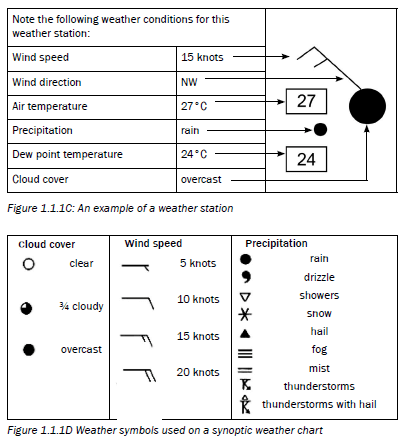
Figure 1.1.1C on page 4 shows a simple weather station. It describes the weather of a particular place that is found on a synoptic weather map. In the exam, you may be asked to describe the weather of a particular place on the synoptic weather map by referring to the weather station. You will need to comment on the following weather elements:

  • Cloud cover
  • Wind direction
  • Wind speed
  • Air temperature
  • Dew point temperature
  • Precipitation (any form of water falling from the sky, e.g. rain, hail, snow and ice)
3

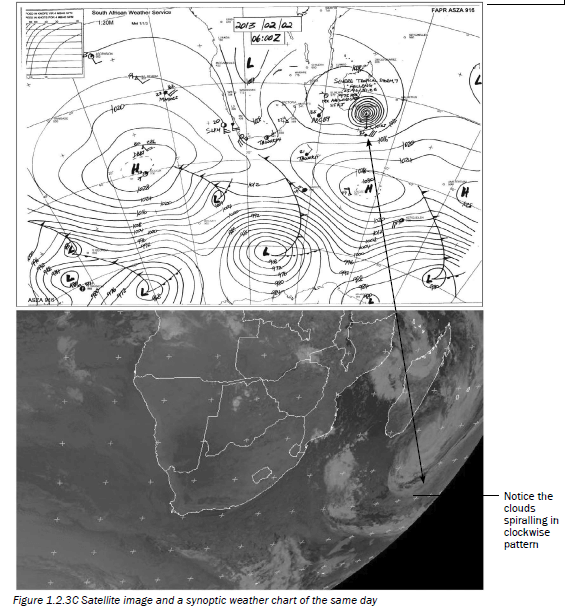
When answering questions based on a synoptic weather chart in the exam, you will be given either a summer synoptic chart (see Figure 1.1.1E) or a winter synoptic chart (see Figure 1.1.1F).
4
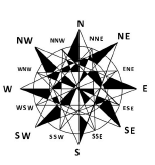
Remember your compass points to determine wind direction.
Make sure you know the weather symbols shown in Figure 1.1.1D (right). They will help you to write this type of question.
Summer synoptic chart
Figure 1.1.1E shows a typical summer synoptic weather chart of South Africa. The features of a summer synoptic chart to note are:

  1. Tropical cyclone (look for the symbol on the synoptic chart)
  2. Low pressure over the land (see the low pressure cell in Figure 1.1.1E)
  3. The date
  4. South Indian high pressure found south east of South Africa is further south (see the high pressure cell in Figure 1.1.1E)
  5. Generally high temperatures over the land
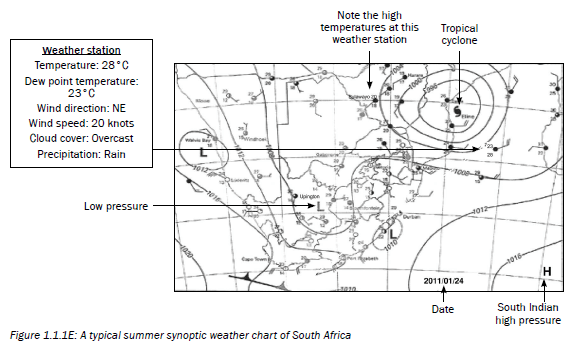
5 1

Make sure you know which features to look out for on the chart you are given.
Winter synoptic weather chart
Figure 1.1.1F shows a typical winter synoptic weather chart of South Africa.
The features of a winter synoptic weather chart to note are:

  1. Cold fronts moving over the land
  2. Dominant Kalahari high pressure over the land (look for a large high pressure cell over the land)
  3. The date
  4. South Indian high pressure and the South Atlantic high pressure are closer to the land and further north
  5. Generally low temperatures over the land
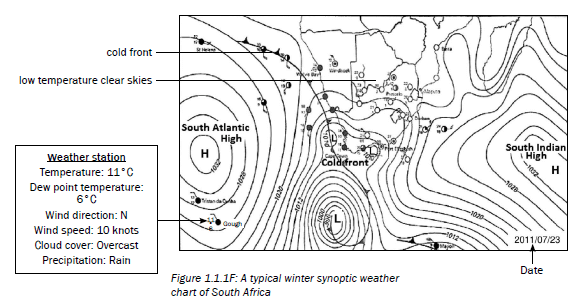
6

1.1.2 Global air circulation
These are winds that cover large areas over the Earth’s surface. There are three global wind systems:

  • The tropical easterlies
  • The westerlies
  • The polar easterlies

A force called Coriolis force causes global winds to move to the left in the southern hemisphere and to the right in the northern hemisphere.
The tri-cellular arrangement, the pressure belts and the global winds together form the global air circulation. This is shown in Figure 1.1.2 below.
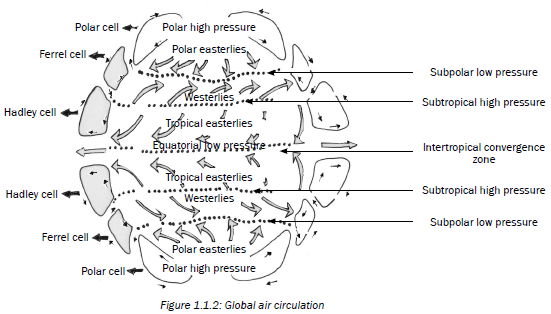
7Learn to redraw Figure 1.1.2 and label it from memory.

1.2 Cyclones

1.2.1 Mid-latitude cyclones
In this section, we look at mid-latitude cyclones in more detail. We will focus on the cross-section through a mature mid-latitude cyclone and the weather that occurs as a result of the cold front. This is the most frequently tested section as South Africa is mostly affected by the passage of cold fronts.
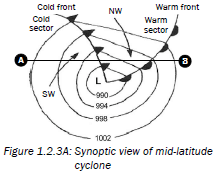
Figure 1.2.1A shows a cross-section through a mid-latitude cyclone. You must be able to label and sketch the cross-section from a synoptic view, as shown in Figure 1.2.3A (see page 10, table 1.1).
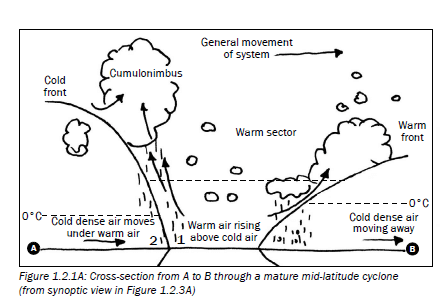
8
Learn to redraw Figure 1.2.1A and label it. You must be able to describe the weather that occurs with a mid-latitude cyclone.
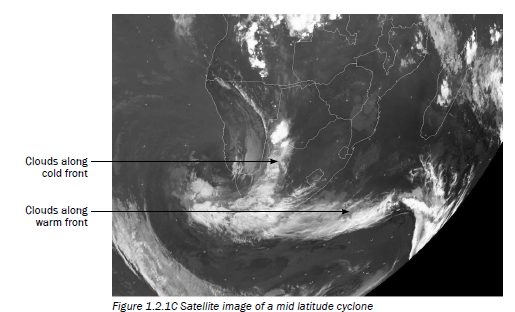
As a mid-latitude cyclone moves towards South Africa, it is the cold front that mostly affects our weather (see Figure 1.2.1C on page 8).

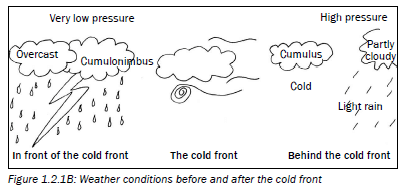
Weather in front of the cold front (see point 1 in Figure 1.2.1A above):

  • Cool temperatures
  • Very low pressure
  • Overcast conditions, cumulonimbus clouds
  • Thunderstorms

Weather behind the cold front (see point 2 in Figure 1.2.1A above):

  • Cold temperatures
  • High pressure
  • Partly cloudy conditions, cumulus clouds
  • Light rain

Note that as a mid-latitude cyclone moves from west to east, we experience the warm air mass in front of the cold front first, then the air behind the cold front. This can be seen in Figure 1.2.1A (above) as you move over from point 1 to 2.
Figure 1.2.1B (below) shows the weather conditions before and after the cold front.
9
101.2.2 Tropical cyclones
A tropical cyclone is a type of low pressure system which generally forms in the tropics (between 5°C and 30°C North and South). It is accompanied by thunderstorms and a circulation of winds near the Earth’s surface, which is clockwise in the southern hemisphere and counter-clockwise in the northern hemisphere. Tropical cyclones are also known as hurricanes in America; typhoons in China and Japan; and willywillies in Australia. Tropical cyclones are given names alphabetically within the season in which they occured. For example, ‘Alfred’ will denote that it is the first tropical cyclone to occur in that season.
We will now look at tropical cyclones in more detail by focusing on the cross-section through a mature tropical cyclone.

In order for the tropical cyclone to occur there should be:

  • temperature of 27°C and more
  • Coriolis force
  • enough moisture
  • less function

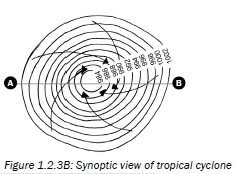
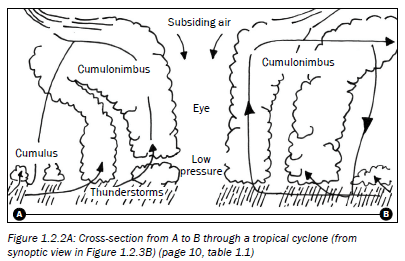
Figure 1.2.2A shows a crosssection through a tropical cyclone. You must be able to label and sketch the cross-section from a synoptic view as shown in Figure 1.2.3A (see page 10, table 1.1).
11
Make sure you are able to draw Figure
1.2.2A and label it correctly.
1.2.3 Characteristics of mid-latitude cyclones and tropical cyclones

1. Multiple-choice questions
Example:
Another name for a mid-latitude cyclone is:

  1. Temperate cyclone
  2. Tropical storm
  3. Typhoon
  4. Tropical cyclone
    (Correct answer is underlined)

2. Short answer questions
Example:
List two characteristics of a tropical cyclone.
Answer:

  1. Accompanied by thunderstorms
  2. Eye in the centre
  3. Draw a cross-section from A to B

For example, see Figures 1.2.2A and 1.2.3B.

Table 1.1 compares the characteristics of mid-latitude cyclones and tropical cyclones.

CHARACTERISTICS  
Mid-latitude cyclone Tropical cyclone 
Other namesFrontal depression, temperate cyclone, extra tropical cycloneHurricane, typhoon, Willywillies (named alphabetically at the beginning of each season)
Formation40–60o N and Saround 5o N and S
Occurrence30–60o N and SOver tropical oceans 5–30o N and S
MovementWest to east (driven/pushed by Westerlies)East to west (driven/pushed by Easterlies)
SeasonAll year round in both hemispheres; affects South Africa in winterMid- to late summer, early autumn
Identifying featuresWarm front, warm sector, cold front, cold sectorStormy weather in the vortex; the eye is a calm, intense low pressure area
WeatherWeather associated with a cold front: overcast, low temperatures, strong winds, heavy rainWarm to hot, violent winds; intense thunderstorm activity
Areas affectedWestern side of continents in mid-latitudesEastern side of continents in tropical latitudes
Synoptic representation of the cyclones on a weather map1213


14

You must know the characteristics of each cyclone. In the exam these characteristics are typically asked in one of three ways:

1.3 Factors affecting the South African climate

There are three factors that have the greatest impact on South Africa’s climate:

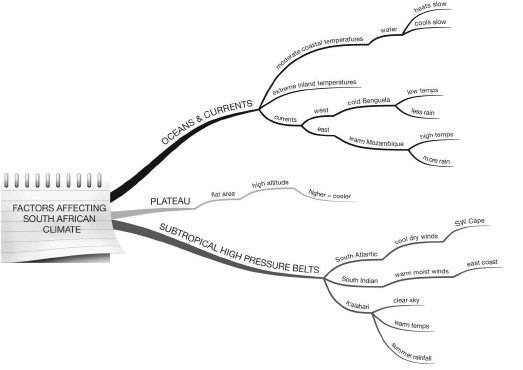
  • South Africa is surrounded by oceans and ocean currents.
  • South Africa is mostly found on a plateau.
  • South Africa is affected by the subtropical high pressure belt.

These three factors cause the typical weather we experience in each season. Let us look at each factor in more detail.
1.3.1 The impact of the ocean and the ocean currents on South Africa’s climate
Much of South Africa is surrounded by oceans. The oceans affect the temperature at the coast and inland as follows:

  • Water heats up slowly and cools down slowly.
  • This moderates temperatures along the coastline (i.e. the minimum and maximum temperatures are not very far apart) – also known as maritime.
  • This causes temperatures inland to be extreme (i.e. the minimum and maximum temperatures are very far apart) – also known as continental.

For example, in winter the temperature in Johannesburg is a maximum of 25°C and a minimum of 1°C (extreme), whereas in Durban the maximums 24°C and the minimum is 15°C (moderate).
15The warm Agulhas current flows along the south coast. However, you do not need to know how it affects the country’s climate.
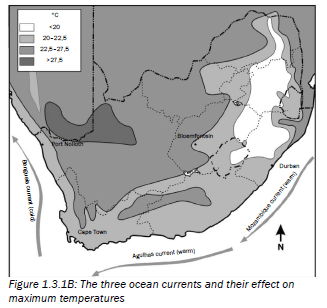
The ocean currents also affect the temperatures and rainfall:

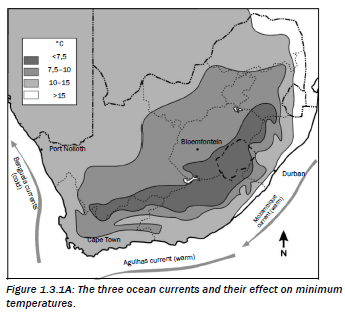
  • The currents on our east and west coasts have the greatest impact on South Africa’s climate.
  • The warm Mozambique current flows along our east coast.
  • The cold Benguela current flows along our west coast.
  • The warm Mozambique current causes high temperatures and more rain on the east coast.
  • The cold Benguela current causes low temperatures and less rain on our west coast.

Because of the influence of these currents, temperatures are higher on the east coast than on the west coast. Figure 1.3.1A shows the ocean currents that affect South Africa’s climate and the resultant minimum temperatures.
16
Figure 1.3.1B shows the ocean currents that affect South Africa’s climate and the resultant maximum temperatures.
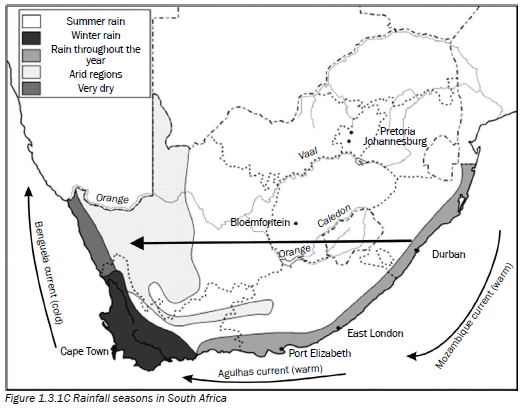
Figure 1.3.1C shows the seasons in which rainfall is received in South Africa. The black arrow shows how rainfall decreases from east to west across the country mainly due to the Mozambique and Benguela currents.

  • The east coast gets rain all year round, so it will have a higher rainfall.
  • The west coast is an arid (desert) region so it receives very little rain.
17
18

To prepare well for the exam and to understand this topic better, find out the cause of the winter rainfall in the south-western Cape.
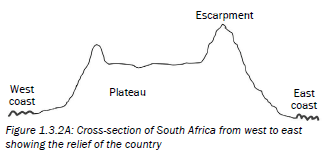
1.3.2 The impact of the plateau on South Africa’s climate South Africa is situated mostly on a plateau (a flat area found at a high altitude).
Figure 1.3.2A below is a cross-section of South Africa from west to east showing the relief (landscape) of the country.
The higher you go, the cooler it gets. Therefore, places on the plateau (high altitude) will experience lower temperatures than places at a lower altitude.
Places in the Lowveld (Mpumalanga) have higher temperatures than places on the Highveld (Gauteng and Free State).
19
1.3.3 The impact of the subtropical high pressure belt on South Africa’s climate
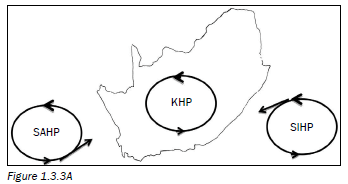
South Africa is affected by three high pressure cells:

  • South Atlantic high pressure (SAHP)
  • South Indian high pressure (SIHP)
  • Kalahari high pressure (KHP)

To prepare well for the exam and understand this topic better, find out how the Kalahari high pressure causes the plateau to receive summer rainfall only.
Figure 1.3.3A below shows the position of the three high pressure cells in and around South Africa.
20

  • The South Atlantic high pressure causes cool, dry winds to blow onto the south-western Cape.
  • The South Indian high pressure causes warm, moist winds to blow onto the east coast.
  • The Kalahari high pressure has the greatest impact on South Africa’s climate:
    • It causes generally clear skies and warm temperatures because the air is descending and dry (in winter).
    • It results in only summer rainfall occurring on the plateau.

Activity 1
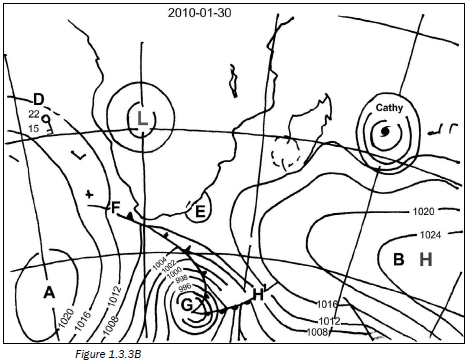
Study the synoptic weather chart in Figure 1.3.3B below and answer the questions that follow.
21

  1. Name the high pressure cells labelled A and B. (2 × 2 = 4)
  2. Give TWO pieces of evidence from the map that this is a summer map. (2 × 2 = 4)
  3. Identify the low pressure cell labelled E. (1 × 2 = 2)
  4. The letter G indicates a mid-latitude cyclone.
    1. Name the fronts labelled F and H. (2 × 2 = 4)
    2. In which direction does this cyclone generally move? (1 × 2 = 2)
    3. Describe how front F will affect the weather of Cape Town. (3 × 2 = 6)
  5. Refer to the cyclone named Cathy.
    1. What type of cyclone is Cathy? (1 × 2 = 2)
    2. State how many cyclones have occurred for this season, including Cathy. (1 × 2 = 2)
    3. In which direction does this cyclone move? (1 × 2 = 2)
    4. List TWO conditions necessary for this cyclone to form. (2 × 2 = 4)
  6. Refer to the weather station labelled D and describe the weather in terms of: cloud cover, wind speed, wind direction, air temperature, dewpoint temperature. (4 × 2 = 8)
    [40]
Answers to activity 1

    1. South Atlantic high pressure
    2. South Indian high pressure (4)
  1. A tropical cyclone can be seen on the map.
    Mid-latitude cyclones are seen south of South Africa.
    The South Indian and South Atlantic high pressures are south of South Africa.
    A low pressure cell can be seen over the centre of South Africa.
    The date: 30/01/201033 (any 2) (4)
  2. Coastal low pressure (2)
    1. F – Cold front; H – Warm front (4)
    2. In an easterly direction/from west to east (2)
    3. Temperatures will decrease; pressure will increase;
      Cumulonimbus clouds and thunderstorms will occur (6)
    1. Tropical cyclone (2)
    2. Three (2)
    3. Westerly/from east to west (2)
    4. Temperature must be above 27°C; Humidity must be high; There must only be light and variable wind;
      The atmosphere must be unstable; There must be a wide area of low pressure with closed isobars; It must be between 5°S and 25°S (needs Coriolis force);
      Little surface friction (any 2) (4)
  3. Cloud cover: Clear skies; Wind speed: 10 knots;
    Wind direction: SSE; Air temperature: 22°C;
    Dewpoint temperature: 15 °C (8)
    [40] 

1.4 Local climate (valley and city climate)

Valley climate occurs on a local scale and lasts for a few hours. In this section we will focus on:

  • Anabatic and katabatic winds
  • Aspect

Anabatic means ‘moving upward’ and katabatic means ‘going downhill’.
1.4.1 Anabatic and katabatic winds
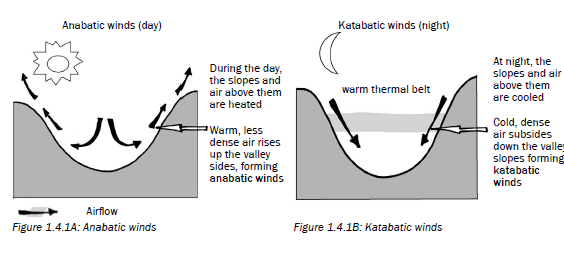
The structure of a valley and the heating and cooling that occurs during a day cause anabatic and katabatic winds to occur. This is shown in Figures 1.4.1A and 1.4.1B.
In the exam, you may be asked to draw, label or describe how anabatic or katabatic winds form in valleys. Learn to redraw and label Figures 1.4.1A and 1.4.1B below.
22Effect of anabatic winds on settlements

  • Anabatic winds take pollution out of the valley.

Effects of katabatic winds on settlements

  • Katabatic winds trap pollution in the valley.
  • Katabatic winds bring cold temperatures to the valley.

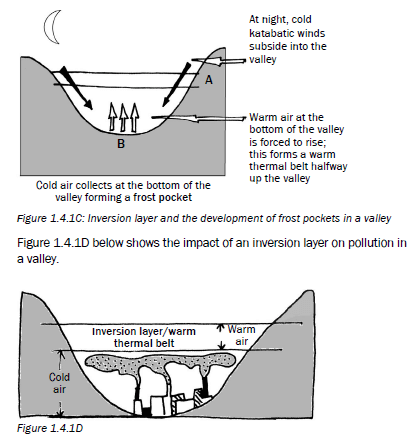
Katabatic winds lead to the development of the thermal belt (zone of warmer temperature above the valley floor) and a frost pocket (an area of very cold temperatures at the bottom of a valley where frost occurs) in a valley at night. This is shown in Figure 1.4.1C.
23
Effects of warm thermal belt on settlement and farming

  • People will build their houses halfway up the slope of a valley to be in the warmer thermal belt (point A on Figure 1.4.1C).
  • Crops which need warm, frost-free conditions will be planted in the thermal belt, for example sugar cane (point A on Figure 1.4.1C).

Effects of frost pockets on settlement and farming

  • Crops which can withstand cold conditions (such as frost) can be planted at the bottom of the valley, for example potatoes (point B on Figure 1.4.1C).
  • Pollution is trapped in the cold air below the temperature inversion at night, as shown in Figure 1.4.1D.

1.4.2 Aspect
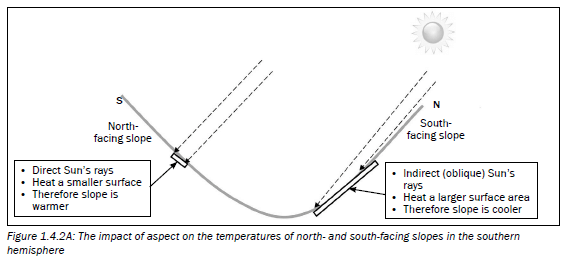
Aspect refers to the direction in which a slope faces. This determines whether the Sun’s rays will hit the side of the valley directly or indirectly (obliquely). We will focus on how aspect influences the temperatures of north- and south-facing slopes in the southern hemisphere.
In the exam, you may be asked to draw, label or describe how the thermal belt and a frost pocket form in valleys. Learn to redraw and label Figure 1.4.1C.
Let us look at how the Sun’s rays affect slope temperatures in the southern hemisphere:

  • North-facing slopes receive the direct rays of the Sun, making them warmer.
  • South-facing slopes receive the indirect rays of the Sun, making them cooler.

Figure 1.4.2A shows how aspect influences the temperatures of north- and south-facing slopes in the southern hemisphere.
24Activity 2
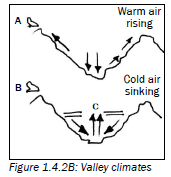
Figure 1.4.2B (left) illustrates valley climates. Study the diagram and answer the questions that follow.
25

  1. Name the valley winds depicted in A and B. (2 × 2 = 4)
  2. State ONE advantage of the wind labelled A. (1 × 2 = 2)
  3. Name the layer labelled C. (1 × 2 = 2)
  4. Explain how the wind labelled B influences:
    1. Farming in the valley (2 × 2 = 4)
    2. Industry in the valley (2 × 2 = 4)
      [16]
Answers to activity 2

    1. Anabatic wind/upslope wind
    2. Katabatic wind/downslope wind/gravity wind(4)
  1. It can carry pollution out of the valley. (2)
  2. Inversion layer/thermal belt (2)
    1. Winds bring cold air into the valley.
      These winds cause a frost pocket to form.
      The frost can kill the crops. (4)
    2. Cold conditions make working conditions in the industry difficult.
      Pollution produced by the industry will be trapped in the valley. (4)
      [16]

In the exam, you may be asked to draw, label or describe how aspect affects the temperature on a north- or south-facing slope in the southern hemisphere.
Answers to activity 2 continued
1.4.3 City climates
Urban areas (cities) experience a different climate compared to the surrounding rural areas. This results in the formation of a heat island over the city. In this section, we will focus on the causes of a heat island. An urban heat island is when the city has warmer temperatures than the surrounding rural areas.
In the exam, you may be asked how the temperatures change as you move towards the centre of the city. Figure 1.4.3A shows how the temperatures increase the closer you get to the city centre (also called the Central Business District, or CBD). Note also the lower temperatures over the park.
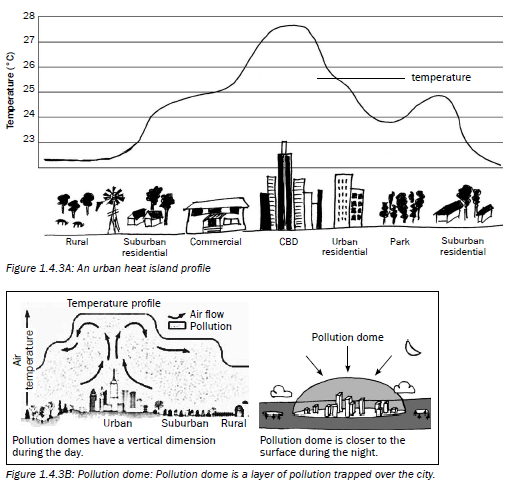
26In the exam, you may be asked to say what causes a city to be warmer.
Table 1.2 below lists the factors that cause higher temperatures in the city.

DON’T MISS: How to Pass Geography Grade 12 NSC With Distinction

Factors that cause heat island Explanation 
Artificial (human-made) surfacesSurfaces like tar absorb more heat.
Surface area (the sides of the buildings add to the surface area)With a greater area, more heat is absorbed.
PollutionMore factories and cars release more pollution, which traps the heat.
Artificial heat sources (not from the sun, human-made sources)Factories, cars and air conditioners release heat into the air.

Table 1.2: Factors that cause a heat island
Sustainable ways to reduce the urban heat island effects

  • Promote greenbelts (plan and have more parks or recreational areas with trees and plants).
  • Plant more trees in the city.
  • Increase vegetation cycles by planting rooftop gardens.
  • The new buildings should not be built with material like glass or any reflecting material.
  • The height of the buildings should have a limit.
  • Have laws that force the factories to reduce the amount of pollution they produce.
  • Improve and encourage people to use public transport.
  • Promote lift clubs to work or to school.

Impact of River Rejuvenation on Economic Activities: Geomorphology

Impact of River Rejuvenation on Economic Activities: Geomorphology River rejuvenation refers to the process of restoring a river’s natural characteristics, often involving changes in its geomorphology (the study of the form and processes of the Earth’s surface). The impact of river rejuvenation on economic activities can be significant and multifaceted.

Here are some ways in which geomorphological changes in a river can affect economic activities:

  1. Flood Control and Infrastructure Stability:
    • River rejuvenation projects often involve the construction of embankments, levees, or other structures to control flooding. This can protect infrastructure such as roads, bridges, and agricultural land, reducing the economic losses associated with floods.
  2. Improved Water Quality:
    • Rejuvenation efforts may include measures to reduce pollution and sedimentation in the river. This can enhance water quality, benefiting industries that rely on clean water, such as fisheries, tourism, and agriculture.
  3. Agricultural Productivity:
    • Changes in river geomorphology can influence the availability of water for irrigation. River rejuvenation projects may enhance soil fertility by depositing nutrient-rich sediment, positively impacting agricultural productivity and the economy dependent on it.
  4. Navigation and Trade:
    • Rivers are vital for transportation and trade. Improving the navigability of a river through geomorphological changes can boost the efficiency of shipping and transport, reducing costs for businesses that rely on waterborne transportation.
  5. Tourism and Recreation:
    • Rejuvenated rivers can attract tourists and outdoor enthusiasts. The restoration of natural habitats, creation of parks, and improvements in water quality can contribute to recreational activities, fostering tourism and supporting local economies.
  6. Biodiversity Conservation:
    • Geomorphological changes that restore natural riverine habitats contribute to biodiversity conservation. This can benefit eco-tourism and industries related to sustainable resource use.
  7. Hydropower Generation:
    • Rivers are often harnessed for hydropower generation. River rejuvenation projects may optimize the river’s flow, potentially enhancing the efficiency of existing hydropower infrastructure or creating opportunities for new developments.
  8. Resilience to Climate Change:
    • River rejuvenation can increase a region’s resilience to the impacts of climate change, such as extreme weather events. This, in turn, helps safeguard economic activities that may be vulnerable to climate-related disruptions.
  9. Fishing Industry:
    • Changes in river geomorphology can influence fish habitats and migration patterns. Restoration efforts that enhance these aspects can benefit the fishing industry, supporting livelihoods and local economies.

How River Rejuvenation process impact the Economic Activities

Now let’s look at how the river rejuvenation process impacts the economic activities of a country. River rejuvenation process causes the following to form: canyons and georges, waterfall, river terrace. Now lets look at how these land features affect the economy:

DON’T MISS: How to Pass Geography Grade 12 NSC With Distinction

Canyons and gorges impact on the economy

  • Canyons are important to paleontology, or the study of fossils.
  • The existence of canyons and georges in a country boosts the tourism sector of the economy. Tourists come to see the canyons, spend their money, buy local products which ultimately create employment

The impact of Waterfall in the economy

  • Waterfalls attract tourists who end up buying our local produce and hence we earn money.
  • The Waterfalls can also be used to produce hydro electricity power.
  • Fishing can be carried out on waterfalls and the fish sold to get income and improve on the living standards of people.

The benefits of a river terrace:

  • Terraces reduce slope length, reducing the power of flowing water to erode soil.
  • By limiting soil erosion, terraces also improve water quality by reducing sediment and phosphorus delivered to streams, rivers, and lakes.