The impact of climate change on the economy of South Africa Essay Question Type Climate change is a global challenge that transcends geographic boundaries, affecting nations across the world in various ways. South Africa, with its diverse ecosystems and economic activities, is particularly vulnerable to the impacts of climate change.This essay aims to explore and analyze the multifaceted effects of climate change on the economy of South Africa.
The impact of climate change on the economy of South Africa Essay Question Type
Body:
Agriculture and Food Security:
Discuss how changing weather patterns, increased temperatures, and irregular rainfall affect agricultural productivity.
Explore the impact on key crops and livestock, and how it contributes to food insecurity.
Examine the economic consequences of reduced agricultural output, including job losses and increased food prices.
Water Scarcity and Drought:
Investigate the rising frequency and severity of droughts in South Africa.
Analyze the economic repercussions of water scarcity, especially on industries heavily dependent on water resources such as mining and agriculture.
Discuss how water shortages can lead to increased competition and conflicts, both domestically and internationally.
Natural Disasters and Infrastructure Damage:
Explore the economic consequences of extreme weather events such as floods, storms, and wildfires.
Discuss the impact on infrastructure, including damage to roads, bridges, and buildings.
Examine the costs associated with rebuilding and recovery efforts, and the strain on the national budget.
Health and Labor Productivity:
Investigate how climate change contributes to the spread of diseases and impacts public health.
Discuss the economic implications of increased healthcare costs and decreased labor productivity due to heat stress and other health issues.
Tourism Industry:
Examine the effects of climate change on South Africa’s tourism sector, considering factors such as changing landscapes, wildlife migration patterns, and extreme weather events.
Discuss how shifts in tourism patterns can impact the economy, including job losses and revenue reduction.
Explore the potential for economic growth through the development of renewable energy sources in response to climate change.
Discuss government initiatives and private sector investments in renewable energy projects.
Examine the potential for job creation and economic diversification in the renewable energy sector.
Conclusion:
Summarize the key points discussed in the essay, emphasizing the interconnectedness of climate change and the South African economy. Highlight the urgent need for comprehensive strategies to mitigate and adapt to the impacts of climate change, emphasizing sustainable practices and international cooperation. Conclude by underlining the importance of proactive measures to safeguard South Africa’s economic resilience in the face of a changing climate.
Rural and Urban Settlement Geography Grade 12 Notes Pdf Download Rural and urban settlement geography is a branch of geography that focuses on the study of the spatial distribution, organization, and development of human settlements. In grade 12, you will typically learn about the characteristics, differences, and similarities between rural and urban settlements.
Understanding the factors that shape their landscapes, economies, and societies.
Rural Settlements:
Definition and Characteristics:
Rural settlements are areas where people engage in agricultural activities and typically live in small communities.
Characteristics include a lower population density, reliance on natural resources, and a close-knit social structure.
Types of Rural Settlements:
Dispersed: Houses are spread over a wide area, often due to agricultural activities.
Nucleated: Dwellings are clustered, fostering a sense of community and shared resources.
Linear: Settlements follow a linear pattern, often along a road or river.
Factors Influencing Rural Settlements:
Physical factors: Topography, climate, and soil fertility.
Economic factors: Agriculture, mining, and forestry.
Social factors: Tradition, culture, and community ties.
Challenges in Rural Settlements:
Limited access to healthcare and education.
Economic dependence on agriculture.
Migration to urban areas for better opportunities.
Urban Settlements:
Definition and Characteristics:
Urban settlements are characterized by high population density, diverse economic activities, and advanced infrastructure.
Features include skyscrapers, commercial centers, and a mix of residential and industrial zones.
Types of Urban Settlements:
Metropolitan: Large cities with extensive infrastructure, cultural institutions, and economic diversity.
Suburban: Residential areas on the outskirts of cities, often characterized by a mix of housing types.
Industrial: Cities dominated by manufacturing and industrial activities.
Factors Influencing Urban Settlements:
Economic factors: Industrialization, commerce, and job opportunities.
Social factors: Education, healthcare, and cultural amenities.
Political factors: Government policies, urban planning, and governance.
Challenges in Urban Settlements:
Overcrowding and congestion.
Environmental degradation.
Socio-economic disparities.
Comparative Analysis:
Population Dynamics:
Rural settlements generally have lower populations with a focus on sustainable agriculture.
Urban settlements witness a higher influx of people seeking diverse economic opportunities.
Economic Structure:
Rural areas often rely on traditional occupations like farming and fishing.
Urban areas showcase a diverse economic landscape with services, manufacturing, and technology sectors.
Infrastructure and Services:
Rural settlements may lack advanced infrastructure and services.
Urban areas boast better facilities such as transportation, education, and healthcare.
Here are some key topics:
Definition and Characteristics of Rural and Urban Settlements: You will learn about the basic definitions of rural and urban settlements, as well as their distinguishing features, such as population size, density, land use, economic activities, social organization, and physical environment.
Location and Site Factors: You will study the factors that determine the location and site of rural and urban settlements, including topography, climate, water supply, transportation, communication, and proximity to resources.
Land Use and Housing: You will examine the different types of land use and housing patterns found in rural and urban settlements, such as agricultural land, residential areas, industrial zones, and commercial districts. You will also explore the factors that influence land use and housing decisions, such as zoning regulations, cultural norms, and economic conditions.
Economic Activities and Services: You will explore the various economic activities and services that exist in rural and urban settlements, including farming, mining, manufacturing, trade, finance, and tourism. You will also analyze the factors that contribute to the growth and decline of these activities and services.
Social Organization and Infrastructure: You will investigate the social organization and infrastructure of rural and urban settlements, including governance, community development, education, healthcare, and transportation. You will also assess the challenges and opportunities faced by rural and urban communities in providing these services.
Environmental Issues and Sustainability: You will examine the environmental issues and sustainability challenges associated with rural and urban settlements, such as land degradation, pollution, climate change, and resource depletion. You will also explore the strategies and policies that can promote sustainable development in rural and urban areas.
Rural and Urban Settlement Geography Grade 12 Notes PDF download
Rural and urban settlement geography in grade 12 focuses on the study of the spatial distribution, organization, and development of human settlements. By the end of the course, you should have a solid understanding of the similarities and differences between rural and urban settlements, as well as the factors that shape their growth and development.
What is a Settlement?
Settlement: An Introduction
In the field of geography, a settlement is defined as a grouping of people, buildings, communication networks, and activities that function as a single unified system on a daily basis. This definition encompasses a wide range of human settlements, including rural villages, small towns, suburban areas, and large cities.
People
The people who live in a settlement are an essential component of its social and cultural fabric. Settlements can vary greatly in size and population, from a few hundred people in a rural village to millions in a megacity. The population of a settlement can influence its economic, political, and environmental dynamics, and it can also shape its social structure, values, and beliefs.
Buildings
Buildings are the physical structures that make up a settlement’s built environment. They can range from traditional mud huts and thatched-roof houses to modern skyscrapers and high-rise apartments. The type of buildings in a settlement can reflect its historical, cultural, and economic context, and they can also influence its energy consumption, urban form, and aesthetics.
Communication Networks
Communication networks are the channels through which information, goods, and people flow within and between settlements. These networks can include roads, railways, airports, ports, and digital infrastructure such as the internet and mobile phones. The efficiency and accessibility of a settlement’s communication networks can have significant impacts on its economic development, social integration, and environmental sustainability.
Activities
Activities refer to the various economic, social, and cultural practices that take place in a settlement. These can include farming, mining, manufacturing, trade, finance, education, healthcare, entertainment, and religion. The diversity and complexity of a settlement’s activities can reflect its economic specialization, social diversity, and cultural heritage, and they can also shape its spatial organization and urban dynamics.
Settlements are complex and dynamic systems that reflect the interplay of people, buildings, communication networks, and activities. Understanding the characteristics and functions of settlements is essential for analyzing the spatial patterns, social dynamics, and environmental impacts of human activities, and for developing sustainable and equitable policies and practices that promote human well-being and planetary health.
How are settlements classified according to size?
Settlements can be classified based on their size and population. The classification of settlements can vary depending on the country or region, but there are some common categories used worldwide. The following are the common classifications of settlements according to their size:
RURAL
Isolated Farmsteads: Isolated farmsteads are settlements that consist of a single farm or homestead, located in a remote rural area. These settlements are typically isolated and do not have any other nearby settlements.
Hamlet: Hamlets are small settlements that typically have a population of fewer than 100 people. They are typically located in rural areas and may have a few shops or services, but they lack the amenities and facilities of larger settlements.
Village: Villages are larger than hamlets and typically have a population of several hundred to a few thousand people. They may have a variety of services and amenities, such as schools, shops, healthcare facilities, and community centers. Villages are usually located in rural areas and serve as hubs for nearby farms and smaller settlements.
URBAN
Town: Towns are larger settlements than villages and typically have a population of several thousand to tens of thousands of people. They are usually located in rural or suburban areas and may serve as commercial, administrative, or cultural centers for their region. Towns typically have a more diverse economy and a wider range of services and amenities than villages.
City: Cities are the largest type of settlement and typically have a population of tens of thousands to millions of people. They are usually located in urban areas and serve as centers for business, finance, culture, and politics. Cities have a diverse economy and a wide range of services and amenities, such as universities, hospitals, museums, and shopping centers.
Metropolis: Metropolises are the largest and most influential cities in a region or country. They typically have a population of millions of people and serve as centers for global trade, finance, and culture. Metropolises have a diverse and complex economy, a high level of infrastructure and services, and a significant impact on regional and national development.
Conurbation: A conurbation is a large urban area that consists of several adjacent cities or towns. Conurbations typically have a population of millions of people and a high level of economic and cultural integration. They may also have complex transportation and communication networks that facilitate the movement of people and goods within and between settlements.
Megalopolis: A megalopolis is a very large urban region that consists of several adjacent conurbations. Megalopolises typically have a population of tens of millions of people and are characterized by high levels of economic and cultural integration. They may also have significant environmental and social challenges related to their size and complexity.
Settlements can be classified based on their size and population, with rural settlements ranging from isolated farmsteads to villages and towns, and urban settlements ranging from cities to metropolises, conurbations, and megalopolises.
How do you distinguish between urban and rural settlements?
Urban and rural settlements can be distinguished from each other based on several key characteristics. Some of the main differences between urban and rural settlements are:
Population density: Urban settlements are characterized by high population density, with many people living in a relatively small area. Rural settlements, on the other hand, have a lower population density, with fewer people living in a larger area.
Land use: Urban settlements are typically characterized by a high degree of land use intensity, with buildings, roads, and other infrastructure covering a significant portion of the land. Rural settlements, on the other hand, have a lower degree of land use intensity, with larger areas of land used for agriculture, forestry, or other natural resource-based activities.
Economic activities: Urban settlements are typically centers of commerce, trade, and industry, with a wide range of economic activities and services available. Rural settlements, on the other hand, are more likely to be based on agriculture, forestry, or other natural resource-based activities.
Infrastructure: Urban settlements generally have a higher level of infrastructure, such as roads, public transport, and utilities, than rural settlements. This is because the high population density in urban areas makes it more efficient and cost-effective to provide these services to a larger number of people. Rural settlements often have less infrastructure, and services such as water and electricity may be provided by individual households rather than by a centralized system.
Social characteristics: Urban settlements are typically characterized by a more diverse population, with people from different ethnic and cultural backgrounds living in close proximity to each other. Rural settlements, on the other hand, are often more homogenous, with a more uniform population.
Environmental characteristics: Urban settlements are more likely to be affected by environmental problems such as air pollution, noise pollution, and waste management issues, due to the higher density of people and infrastructure. Rural settlements, on the other hand, are more likely to be affected by natural hazards such as floods, wildfires, and landslides.
The main differences between urban and rural settlements are population density, land use, economic activities, infrastructure, social characteristics, and environmental characteristics. While these characteristics can help distinguish between urban and rural settlements, it is important to note that there can be significant variation within each category, and some settlements may exhibit characteristics of both urban and rural areas.
Why are dispersed settlements better from an economic point of view, as compared to nucleated?
From an economic point of view, dispersed settlements can have some advantages over nucleated settlements. Here is a comparison in a table format:
Characteristics
Dispersed Settlements
Nucleated Settlements
Land use
Spread out over a larger area,
allowing for more agriculture and natural resource-based activities
Concentrated in
a smaller area,
limiting the amount of land available for agriculture and natural resource-based activities
Transportation
Less congestion and
lower transportation
costs as homes and businesses are spread out
More congestion
and higher transportation
costs as homes and businesses are concentrated in a smaller area
Infrastructure
Lower infrastructure
costs as homes
and businesses are spread out, reducing the need for expensive centralized services
Higher infrastructure costs
as homes and businesses are
concentrated, r
equiring more centralized services
Economic Diversity
Greater economic diversity
as different types of
businesses and industries can be spread out over a larger area
Limited economic diversity
as businesses and industries tend to cluster around the town or city center
Cost of Living
Lower cost of living
due to less competition
for housing and resources
Higher cost of living due to greater competition for housing and resources
Social Interaction
Less social interaction
due to greater physical distance between homes and businesses
Greater social interaction due to the concentration of homes and
businesses in a smaller area
Dispersed settlements can have some advantages from an economic point of view, such as more land for agriculture and natural resource-based activities, lower transportation and infrastructure costs, greater economic diversity, and lower cost of living. However, they may also have some disadvantages, such as less social interaction and a greater need for personal transportation. Ultimately, the optimal settlement pattern depends on a variety of factors, including geography, climate, culture, and economic goals.
Notes
People and Places – Processes and Spatial Patterns:
Sustainability-related strategies and urban settlements
Structures and Patterns of Urban Settlements, Human-Environment Interactions and Sustainability Strategies.
Transport and trade – the importance and challenges of the informal sector
Globalisation and trade: food security in southern Africa
The weather that occurs as a result of the cold front in South Africa South Africa experiences a variety of weather conditions, and the impact of a cold front on the weather can vary depending on the region and the time of year. In general, a cold front occurs when a mass of cold air moves into an area, displacing warmer air. This movement can lead to changes in temperature, precipitation, and wind patterns.
Weather in front of the cold front
Cool temperatures
Very low pressure
Overcast conditions, cumulonimbus clouds
Thunderstorms
Weather behind the cold front
Cold temperatures
High pressure
Partly cloudy conditions, cumulus clouds
Light rain
Note that as a mid-latitude cyclone moves from west to east, we experience the warm air mass in front of the cold front first, then the air behind the cold front.
Conclusion
It’s important to note that South Africa has diverse climates, ranging from arid to temperate and subtropical, and the impact of a cold front can vary across different regions. Coastal areas may experience more significant temperature changes, while inland regions may see more pronounced shifts in wind patterns and precipitation.
The South African Weather Service provides detailed and region-specific forecasts, and checking local weather reports can provide more accurate and up-to-date information on the effects of a cold front in a particular area.
The Purpose and Significance of the National Water Act 1998: Summary The National Water Act of South Africa, Act 36 of 1998, is a crucial piece of legislation that governs the management and use of water resources in the country. The primary goal of the Act is to ensure the sustainable and equitable use of water while protecting and conserving water resources.
Background
Before the National Water Act, South Africa’s water management was based on the riparian principle, which granted water rights to landowners adjacent to rivers and other water sources. This system led to vast disparities in water access, as the majority of the population did not own land, especially during the apartheid era. The Act was thus introduced to address these inequalities and create a more equitable and sustainable framework for water resource management.
Equitable access: The Act aims to ensure that all South Africans have access to water, regardless of their socio-economic background or land ownership status. This is achieved by establishing a system of water use licenses, which grants access to water resources based on need and availability.
Sustainable use: The Act promotes the sustainable use of water resources by setting limits on the amount of water that can be withdrawn from various sources, and by requiring users to justify their water use based on efficiency and necessity.
Environmental protection: Recognizing the importance of water for maintaining ecosystems and biodiversity, the Act seeks to protect water resources by establishing a Reserve. This reserve ensures that sufficient water is available for maintaining ecological functions and supporting human basic needs.
Integrated water resource management: The Act encourages a holistic approach to water management, which considers the interdependence of different water uses and users. This is achieved through the establishment of Catchment Management Agencies (CMAs), responsible for developing and implementing catchment management strategies.
Public participation: The Act fosters public involvement in water management decisions by providing opportunities for stakeholders, including local communities and water users, to participate in the decision-making process.
Implementing the National Water Act has not been without challenges. Some of these include:
Inadequate funding: Limited resources have hampered the ability of CMAs and other implementing agencies to carry out their mandates effectively.
Capacity constraints: A lack of skilled personnel and institutional capacity has hindered the full implementation of the Act, particularly in managing complex water resource issues and licensing processes.
Enforcement and compliance: Ensuring that all water users comply with the Act and its regulations has proven difficult, especially in cases of illegal water use and non-payment for water services.
The National Water Act 1998 is a groundbreaking piece of legislation that has transformed the way water resources are managed in South Africa. By promoting equitable access, sustainability, and environmental protection, the Act has laid the foundation for a more just and resilient water management system. While challenges remain in its implementation, the National Water Act remains a beacon of progress in the pursuit of water security for all South Africans.
Historical imbalances in water distribution in South Africa: An Overview
Historical imbalances in water distribution in South Africa have roots in the apartheid era, during which the majority of the population, particularly black communities, were marginalized and denied access to basic services like water. Since the end of apartheid in 1994, the South African government has been working to address these imbalances and promote sustainable and equitable water management.
The Lesotho Highlands Water Project (LHWP): The LHWP is a large-scale water transfer and hydropower project between South Africa and Lesotho. The project was initiated to secure a reliable and sustainable water supply for South Africa, particularly the Gauteng Province, which is the economic heartland of the country. The project has the added benefit of generating hydropower for Lesotho. The LHWP promotes equitable water management by ensuring that the benefits of the project are shared between the two countries.
The Working for Water (WfW) program: Launched in 1995, the WfW program aims to address the problem of invasive alien plant species that pose a significant threat to South Africa’s water resources. By clearing these invasive plants, the program helps to protect water catchments and increase the availability of water. The WfW program also creates jobs and provides training opportunities for disadvantaged communities, thereby promoting social and economic equity.
The National Water Act of 1998: The act aimed to address historical imbalances in water distribution by prioritizing basic human needs and ensuring that water resources are managed equitably and sustainably. The act established a legal framework for managing water resources in the country, focusing on the protection of water quality and the prevention of pollution.
The Strategic Water Source Areas (SWSAs): The South African government has identified 22 SWSAs that are crucial for the country’s water security. These areas provide 50% of the country’s surface water, although they only make up 8% of the land area. The government has implemented various measures to protect these areas from degradation, pollution, and over-extraction of water, ensuring that water resources are managed sustainably and equitably.
The Water Research Commission (WRC): The WRC was established in 1971 to support research and development in the water sector. The commission plays a critical role in promoting sustainable water management in South Africa by funding research projects that contribute to better water management practices, new technologies, and policies.
The National Water and Sanitation Master Plan: Launched in 2019, the plan provides a comprehensive roadmap for addressing water and sanitation challenges in South Africa. It focuses on equitable access to water and sanitation services, as well as promoting sustainable water management to ensure that the country’s water resources are protected and managed efficiently.
These examples illustrate the efforts made by South Africa to address historical imbalances in water distribution, promote sustainable and equitable water management, and protect the environment.
The 4 Causes of Overpopulation in South Africa The South African population, like many other countries, keeps on growing. While the population keeps on increasing, the supply of resources is constantly falling behind the demand. On this page, we explore the main causes of overpopulation in South Africa. It is important to note that the causes of overpopulation in South Africa are not that different from the causes all over the world.
How many people live in South Africa?
According to Statistics South Africa (Stats SA) 2019, the South African population is seating on 58,78 million and more. Approximately 51,2% (approximately 30 million) of the population is female. The black African population is in the majority (47,4 million) and constitutes approximately 81% of the total South African population.
Overpopulation in Africa Video
The 4 main Causes of Overpopulation in South Africa
Below are some of the main causes of overpopulation in South Africa:
Poverty – in South Africa, some of the poorest of the poor view social grants for kids as a great motivation to continue having kids.
Less mortality rate – due to the great medical advances, the mortality rate continues to drop all over the world, including in South Africa. South Africa in particular, has seen a significant mortality drop in the groups of people who are infected with HIV since 2007 until now.
Not using contraceptives – many females in South Africa still need to be educated about the proper use of contraceptives to prevent unwanted pregnancies.
Urbanisation – Urbanisation in South Africa is one of the main causes of overpopulation in urban areas such as Johannesburg, Durban, Cape Town, and Pretoria.
Apart from the listed four causes of overpopulation in South Africa, Immigration is a huge problem in South Africa. Many immigrants from foreign countries came to South Africa illegally and are not willing to go back to their countries. They come to South Africa to seek better employment opportunities.
It is only logical that an increase in the world’s population will cause additional strains on resources. More people means an increased demand for food, water, housing, energy, healthcare, transportation, and more. And all that consumption contributes to ecological degradation, increased conflicts, and a higher risk of large-scale disasters like pandemics.
Ecological Degradation
An increase in population will inevitably create pressures leading to more deforestation, decreased biodiversity, and spikes in pollution and emissions, which will exacerbate climate change. Ultimately, unless we take action to help minimize further population growth heading into the remainder of this century, many scientists believe the additional stress on the planet will lead to ecological disruption and collapse so severe it threatens the viability of life on Earth as we know it.
Each spike in the global population has a measurable impact on the planet’s health. According to estimates in a study by Wynes and Nicholas (2017), a family having one fewer child could reduce emissions by 58.6 tonnes CO2-equivalent per year in developed countries.
Increased Conflicts
The scarcity brought about by environmental disruption and overpopulation has the potential to trigger an increase in violence and political unrest. We’re already seeing wars fought over water, land, and energy resources in the Middle East and other regions, and the turmoil is likely to increase as the global population grows even larger.
Higher Risk of Disasters and Pandemics
Many of the recent novel pathogens that have devastated humans around the world, including COVID-19, Zika virus, Ebola, and West Nile virus, originated in animals or insects before passing to humans. Part of the reason the world is entering “a period of increased outbreak activity” is because humans are destroying wildlife habitats and coming into contact with wild animals on a more regular basis. Now that we’re in the midst of a pandemic, it has become clear how difficult it is to social distance in a world occupied by nearly 8 billion people.
Why are fold mountains found along the west coast of many continents Fold mountains are commonly found along the west coast of many continents due to the tectonic processes associated with convergent plate boundaries. Convergent plate boundaries occur when two tectonic plates move toward each other. There are three main types of convergent plate boundaries: oceanic-continental, oceanic-oceanic, and continental-continental.
Oceanic-Continental Convergence:
One of the most common scenarios leading to the formation of fold mountains along the west coast is the collision between an oceanic plate and a continental plate.
When an oceanic plate subducts beneath a continental plate, it forms a subduction zone. As the oceanic plate descends into the mantle, intense heat and pressure cause partial melting and the formation of magma.
This magma is less dense than the surrounding mantle and rises through the continental crust, leading to volcanic activity.
The intense compression and deformation associated with this collision also result in the folding and uplifting of the continental crust, forming fold mountains along the continental margin.
Examples:
The Andes in South America are an example of fold mountains formed by the subduction of the Nazca Plate beneath the South American Plate.
The Cascades in North America are another example, where the Juan de Fuca Plate is subducting beneath the North American Plate.
Tectonic Activity and Uplift:
The intense tectonic activity associated with convergent boundaries leads to the compression, folding, and uplifting of the crust, forming mountain ranges.
The west coasts of many continents are often sites of these convergent boundaries, resulting in the development of fold mountains along these regions.
Types of Rocks formed when heat or pressure is added composition and texture, resulting in the formation of metamorphic rocks. Metamorphic rocks are classified based on their texture and mineral composition. Here are the main types of metamorphic rocks formed under heat and pressure:
Types of Rocks formed when heat or pressure is added
Three types of rocks
There are three types of rocks that are studied in Geography and Geology, which are:
Sedimentary rocks,
Igneous rocks and
Metamorphic rocks.
Rocks are classified based on the way they form.
How Metamorphic rocks form
Out of the three rocks types, metamorphoric rocks are the ones that only form when rocks are subjected to high heat, high pressure, hot mineral-rich fluids or, more commonly, some combination of these factors.
Here are the main types of metamorphic rocks formed under heat and pressure:
Slate:
Texture: Fine-grained
Parent Rock: Shale
Formation: Low-grade metamorphism of shale
Schist:
Texture: Medium to coarse-grained
Parent Rock: Shale, phyllite, or other schists
Formation: Intermediate to high-grade metamorphism
Gneiss:
Texture: Coarse-grained, banded
Parent Rock: Granite, shale, or schist
Formation: High-grade metamorphism
Marble:
Texture: Non-foliated, granular
Parent Rock: Limestone or dolostone
Formation: Metamorphism of carbonate rocks
Quartzite:
Texture: Non-foliated, granular
Parent Rock: Sandstone
Formation: Metamorphism of sandstone
Phyllite:
Texture: Fine-grained, sheen or glossy appearance
Parent Rock: Slate
Formation: Intermediate-grade metamorphism
Anthracite Coal:
Texture: Non-foliated
Parent Rock: Bituminous coal
Formation: High-grade metamorphism of coal
Hornfels:
Texture: Fine-grained, typically lacks foliation
Parent Rock: Various rocks (igneous, sedimentary, or other metamorphic rocks)
Formation: Contact metamorphism due to high temperatures from nearby molten rock (magma)
Conclusion
Metamorphic rocks form as a result of the alteration of pre-existing rocks (called parent rocks) under the influence of heat and/or pressure. The specific type of metamorphic rock that forms depends on factors such as the intensity of heat and pressure, mineral composition of the parent rock, and the presence of fluids during the metamorphic process.
Asthenosphere – the layer of the earth that is in a semi-molten state The asthenosphere is a region in the upper part of the Earth’s mantle, situated below the lithosphere. It is characterized by its semi-molten or partially molten state, which allows it to deform and flow over geological timescales. This layer is composed of solid rock that can flow slowly over time due to the high temperature and pressure conditions. The asthenosphere plays a crucial role in the movement of tectonic plates.
The lithosphere, which includes the Earth’s crust and the rigid upper part of the mantle, is broken into tectonic plates. These plates “float” on the semi-fluid asthenosphere. The movement of these plates, driven by processes like mantle convection, results in various geological phenomena such as earthquakes, volcanic activity, and the creation of mountain ranges.
A question may come in your Geography exam asking you to identify the layer of the earth that is in a semi-molten state.
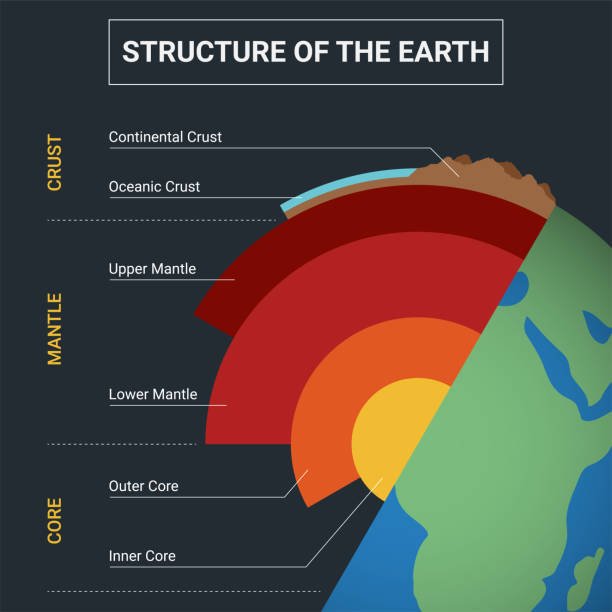
First of all, it is important to understand the structure of the earth. The earth’s structure consists of the following layers:
Crust: Continental Crust, Oceanic Crust
Mantle: Upper Mantle, Lower Mantle
Core: Outer Core, Inner Core
identify the layer of the earth that is in a semi-molten state
The layer of the earth that is in a semi-molten state is called asthenosphere found in the upper mantle. The upper mantle extends from the crust to a depth of about 410 kilometers. The asthenosphere is the denser, weaker layer beneath the lithospheric mantle. It lies between about 100 kilometers (62 miles) and 410 kilometers (255 miles) beneath Earth’s surface. The temperature and pressure of the asthenosphere are so high that rocks soften and partly melt, becoming semi-molten.
The Path of the Tropical Cyclone Eloise: Satellite Image Map Tropical cyclones, also known as hurricanes or typhoons in different regions, form over warm ocean waters near the equator. Their paths are influenced by a combination of atmospheric and oceanic conditions.
The Path of the Tropical Cyclone Eloise: Satellite Image Map
Tropical Cyclone Eloise was a powerful storm that wreaked havoc across parts of Southern Africa in January 2021. As one of the most destructive cyclones to hit the region in recent years, Eloise caused widespread damage, loss of life, and long-lasting impacts on affected countries. This article delves into the background, development, and aftermath of Tropical Cyclone Eloise, highlighting the importance of disaster preparedness and climate change awareness.
Background and Development of the Tropical Cyclone Eloise
Tropical Cyclone Eloise formed as a low-pressure system in the Indian Ocean on January 14, 2021, and quickly intensified into a tropical storm on January 15. Over the next few days, Eloise continued to strengthen as it moved westward, eventually reaching peak intensity as a Category 2 tropical cyclone on January 22, with maximum sustained winds of 100 mph (160 km/h).
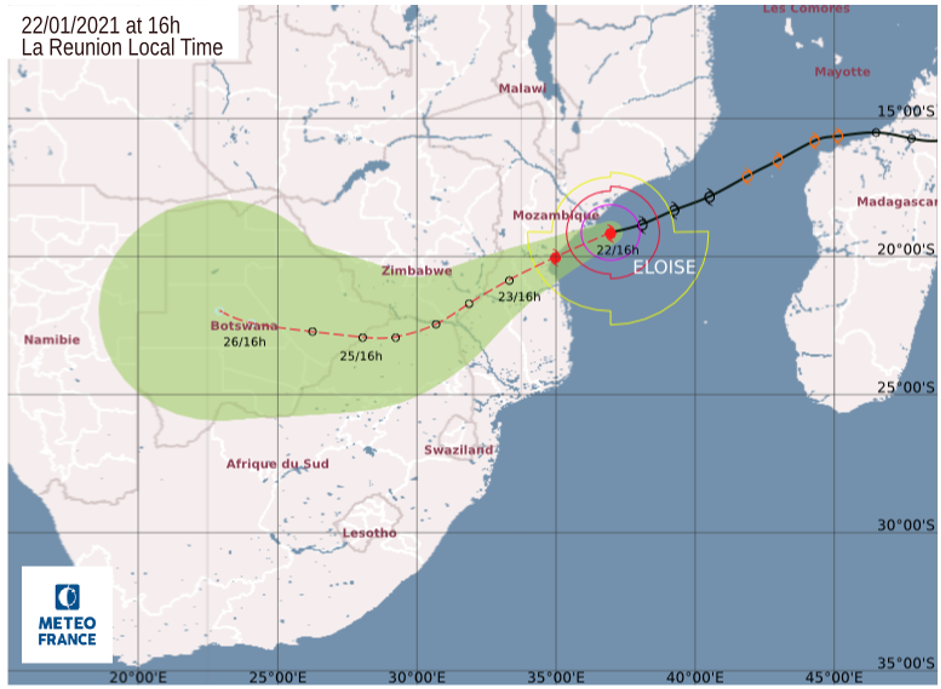
The Path of the Tropical Cyclone Eloise on a Map (Satellite Image Map)
Eloise developed into a tropical depression on 16 January, and strengthened into a tropical storm on 17 January.
On the following day, the storm intensified to a severe tropical storm. Late on 19 January, Eloise made landfall in northern Madagascar as a moderate tropical storm.
The storm traversed the island of Madagascar and entered the Mozambique Channel in the early hours of 21 January.
After moving southwestward across the Mozambique Channel for an additional 2 days, Eloise strengthened into a Category 1-equivalent cyclone, due to low wind shear and high sea surface temperatures.
Early on 23 January, Eloise peaked as a Category 2-equivalent tropical cyclone with 10-minute sustained winds of 150 km/h), 1-minute sustained winds of 165 km/h, and a minimum central pressure of 967millibars.
Shortly afterward, Eloise made landfall just north of Beira, Mozambique, before rapidly weakening into a moderate tropical storm.
She then moved south-westwards over Zimbabwe and Botswana before dissipating over southern Botswana on 26 January 2021.
Tropical Cyclone Eloise Impact on Southern Africa
Eloise made landfall in central Mozambique on January 23, bringing torrential rainfall and strong winds to the region. The cyclone caused widespread damage to infrastructure, homes, and agricultural lands, resulting in significant loss of life and displacement of communities. Mozambique, Zimbabwe, Eswatini, and South Africa were the hardest hit countries.
Mozambique
The coastal city of Beira, already dealing with the aftermath of Cyclone Idai in 2019, bore the brunt of Eloise’s impact. Heavy rainfall and storm surges led to widespread flooding, damaged infrastructure, and destroyed homes, leaving thousands of people homeless. The floods also affected agricultural lands, exacerbating food insecurity in a country already grappling with economic challenges.
Zimbabwe
Eloise brought heavy rainfall to eastern Zimbabwe, causing rivers to overflow and triggering flash floods and landslides. Infrastructure, including bridges and roads, was severely damaged, isolating communities and hindering rescue efforts. The storm’s impact on agriculture compounded the effects of pre-existing food shortages in the country.
Eswatini
Although Eswatini is a smaller country, Eloise still managed to cause significant damage. Heavy rainfall led to flash floods and landslides, causing damage to homes, infrastructure, and agricultural lands. The storm also disrupted access to essential services, such as healthcare and education.
South Africa
Eloise brought heavy rainfall to northeastern South Africa, causing floods and landslides that damaged roads, bridges, and homes. The storm also had a significant impact on agriculture, particularly the fruit industry, which faced heavy crop losses.
Aftermath and Lessons Learned
The aftermath of Tropical Cyclone Eloise highlighted the vulnerability of Southern African countries to extreme weather events and the importance of disaster preparedness. In the wake of the storm, humanitarian aid poured in from various international organizations, including the United Nations and the World Food Programme, to assist in the recovery process.
Eloise also emphasized the need for better early warning systems, infrastructure improvements, and community-level disaster preparedness strategies. In light of the increasing frequency and intensity of tropical cyclones attributed to climate change, it is essential for countries in the region to invest in climate adaptation and resilience measures.
Conclusion
Tropical Cyclone Eloise was a stark reminder of the devastating impacts that extreme weather events can have on vulnerable communities. As the world grapples with the ongoing challenges of climate change, it is vital to prioritize the development of disaster preparedness strategies and climate adaptation measures to protect lives, livelihoods, and ecosystems in the face of increasingly intense and frequent storms.
Geography Grade 12 NSC Paper 1 and Paper 2 Exam Topics and Structure Guide Syllabus Are you grade 12 Student? if yes this article is direct concern here you will get Geography Grade 12 NSC Paper 1 and Paper 2 Exam Topics and Structure Guide Syllabus.
Paper 1 Geography Grade 12 Exam Topics
Marks: 225
Time: 3 hours
Learners must answer any three questions.
Section A:
Question 1
Short objective-type questions for 15 marks to cover content on Climate and weather and Geomorphology.
Climate and weather for 30 marks
Geomorphology for 30 marks
Question 2
Short objective-type questions for 15 marks to cover content on Climate and weather and Geomorphology.
Climate and weather for 30 marks
Geomorphology for 30 marks
Section B:
Question 3
Short objective type questions for 15 marks to cover content on Settlement and Economic Geography.
Settlement Geography for 30 marks
Economic Geography for 30 marks
Question 4
Short objective type questions for 15 marks to cover content on Settlement and Economic Geography.