Home Blog Page 165

THE SOFT VOICE OF THE SERPENT BY NADINE GORDIMER – ENGLISH FIRST ADDITIONAL LANGUAGE PAPER 2: LITERATURE; SHORT STORIES GRADE 12 STUDY GUIDE AND NOTES

THE SOFT VOICE OF THE SERPENT BY NADINE GORDIMER – ENGLISH FIRST ADDITIONAL LANGUAGE PAPER 2: LITERATURE; SHORT STORIES GRADE 12 STUDY GUIDE AND NOTES Soft Voice of the Serpent is a short story with two central themes: one of deception and the other of the importance of disabled people accepting their situation.

The Soft Voice of the Serpent by Nadine Gordimer

Nadine Gordimer (1923-2014) was a South African writer who wrote many short stories and novels. Most of her work concerns the political situation in South Africa. She often spoke out against apartheid and censorship. The Soft Voice of the Serpent comes from her first collection of short stories, published in 1952. She won many international prizes for her work. In 1991 she won the most important prize a writer can win, the Nobel Prize for Literature.

1. Summary

A 26-year-old man has lost his leg. While he is trying to get used to this situation, his wife often wheels him into the garden. As he sits in the garden he thinks about his missing leg. He hopes that one day he will be so used to the loss of his leg that it will feel like it has always been gone.
In the garden one morning, when his wife gets up to fetch some tea, she accidently knocks a locust. The young man watches the locust try to move, and he notices that it has lost a leg. He feels that he and the locust are experiencing the same situation – they both have to cope without a leg. The realisation that he is not alone makes him feel much happier.
When his wife returns with the tea, he shows her the locust and jokes about the fact that they both have a leg missing. The wife tries to touch the locust with a stick and causes it to suddenly fly away. The man realises that he had forgotten that, unlike him, locusts can fly. Once again he feels alone.

2. Title

The title of the story brings to mind the biblical story about Adam and Eve in the Garden of Eden. In the Bible story the serpent tempts Eve to do what she has been told not to do, with the result that she and Adam are thrown out of Eden. The use of alliteration in the title (the repetition of “s”) reminds us of the hissing sound that snakes make.
In Gordimer’s story the locust is like the serpent. It tempts the man in the story into feeling that he can cope with his situation. Just as Adam makes a mistake by believing in the serpent, so the man makes a mistake in believing that the locust can help him cope.These biblical references indicate that the story is an allegory.In an allegory the characters and events become symbols because they also express a deeper, often spiritual or moral, meaning. The symbolism of the locust and garden is moral. The garden in which the man sits is like Eden as it is a peaceful, beautiful place where he can think and come to terms with his disability.

3. Themes

The man who has lost his leg is struggling to come to terms with his situation. He finds some comfort when he notices that the locust is also struggling to cope without one of its legs. At the end of the story the man realises that he must not depend on others, but must learn to cope on his own.

The themes in the story include:

  • Loss and how we deal with it: The man in the story feels a connection with the locust when he realises they share the same
  • Hope and the loss of hope: The locust’s struggle to walk and its persistence gives him However, the sense of hope is lost again at the end of the story when the locust flies away.

4. How is the story told?

4.1 Setting

The story is set in a garden, where the man’s wife wheels him every day. The garden reminds us of Eden. Just as Adam was in Eden before entering the wider world, so the man can adjust before going out into the world with one leg:

Perhaps there was something in this of the old Eden idea; the tender human adjusting himself to himself in the soothing impersonal presence of trees and grass and earth, before going out into the stare of the world.

4.2 Structure and plot development

At the start of the story we learn what the complication is: the man has to get used to having only one leg. Sitting out in the garden in a wheelchair every day gives him a lot of time to think about his missing leg. He reads a book in order to distract himself and not to feel overwhelmed by his loss.
The tension rises in the story through the man’s mental struggle to get used to the loss of his leg. This is mirrored by his wife’s reaction to the sudden arrival of a locust. She is afraid of it and jumps up, knocking it away. When she goes inside, the man notices that the locust has lost a leg and is struggling to walk. He immediately identifies with the locust’s physical defect. In some ways, his identification with the insect contrasts with his relationship with his wife. She caused the locust to lose its leg, and so he uses the locust’s dilemma to make fun of her. He teases her by saying:

“Don’t encourage it to self-pity”

The climax of the story takes place when the locust suddenly flies away. The situation does not have a happy resolution because the man feels foolish and let down when he remembers that locusts can fly and he can’t. Perhaps he also realises that he has to face his situation alone.

4.3 Characterisation

The main characters in the story are the man and his wife.
The man is the main character or protagonist in the story. He has recently lost his leg and is having to face a new life without it. Mostly, he shares little about his internal emotional and mental conflict with his wife.
The wife is the antagonist in the story. She tries to support her husband by taking him into the garden and looking after him. She does not speak to her husband directly about the loss of his leg. She is, however, the cause of the locust losing its leg; and of the locust flying away. By doing so, she deprives him of hope and some comfort through a sense of shared experience with the locust. He has to face his loss alone again.
The locust is also a character in the story. The writer emphasises this by the way the other characters refer to the locust:

It looked like some little person out of a Disney cartoon.
“isn’t he a funny old man?”
“The poor old thing”

The man identifies strongly with the insect. He studies it very closely. It comes to represent his own suffering and challenges. By talking about the locust the man and his wife are able to talk indirectly about the man’s loss.

4.4 Style

The writer does not give the characters names or describe what they look like, because the main focus is on the complication – the man trying to cope with the loss of his leg. Neither the man nor the woman makes direct references to the lost leg; in fact, at the beginning of the story, they hardly talk at all. The man’s distress is internal – he tries to come to terms with his condition in his mind. Although he feels very fearful and powerless he does not talk about it to his wife.
After a couple of weeks the man starts to take more notice of his surroundings in the garden: the trees, the birds. Then he studies a locust very closely. The description of the locust in the story is very detailed. The writer does this to help the reader feel empathy for the locust, just as the man has empathy for it when he realises it, too, has lost a leg.
The only dialogue between the man and his wife is about the locust. The locust becomes a symbol of what the man is experiencing – his anxiety, his need to cope and become independent, and his hopefulness when he sees how well the locust is coping without a leg. Their identification with the locust is shown in the way they talk about the locust. The man says:

“I’ve been watching it, and honestly, it’s uncanny. I can see it feels just like I do!”
“Funny thing is, it’s even the same leg, the left one.” She looked round at him and smiled.
“I know,” he nodded, laughing. “The two of us …” And then he shook his head and, smiling, said it again: “The two of us.”

The writer emphasises the link between the man and the locust by repeating the line “The two of us.”

4.5 Narrator and point of view

The narrator is not one of the characters in the story. The narrative is told using the third person. The narrator refers to the characters as “he”, “she” or “they”.

4.6 Diction and figurative language

The writer uses descriptions of nature to show the man’s internal feelings. The man remembers when he was a young carefree boy, swinging in a tree, and this memory gives him hope:

A first slight wind lifted again in the slack, furled sail of himself; he felt it belly gently, so gently he could just feel it, lifting inside him.

Here, the writer uses the metaphor of a sail on a boat opening in the wind, to describe his feeling of hope.
The writer uses figurative imagery in the description of the locust. Its body is compared to an aeroplane in this simile:

flimsy paper stretched over a frame of matchstick, like a small boy’s home-made aeroplane.

The locust’s movements are compared to a man’s in another simile:

Just as a man might take out a handkerchief and pass it over his brow.

The woman compares the locust to an old man in an extended use of personification:

“Shame, isn’t he a funny old man”
“The poor old thing”

The woman does not realise that her pity for the locust is an extension of her unspoken pity for her husband. He does not want her pity and his irritation becomes clear in his use of sarcasm in response to her comments about the locust :

“Don’t encourage it to self-pity”
“Get another little chair made for him and you can wheel him out here with me.”
“Or maybe he could be taught to use crutches.”

4.7 Tone and mood

At the beginning of the story the tone is gentle and calm. The garden is seen as a good place for the man to recover:

the tender human adjusting himself to himself in the soothing impersonal presence of trees and grass and earth

However, the tone changes slightly when the writer describes how difficult it is for the wife to push the man’s wheelchair into the garden, indicating that she is also having difficulty adjusting to his situation. As we witness the mental and emotional struggle the man faces, the tone becomes gloomy.
Later, the wife causes the locust to lose its leg. When the man watches the locust struggling to cope without its leg he gains a sense of hope that he, too, will overcome his loss. His tone of speech becomes more hopeful.
However, when his wife begins to express sympathy with the locust, the man becomes irritable and sarcastic. This tension rises until, at the end of the story, the locust flies off and there is a pause:

There was a moment of silence.

The tone changes here and becomes hopeless again, as the man is left again with a feeling of loss and he says to her in a harsh tone: Don’t be a fool.
Mood: How does this story make you feel? Happy, sad, angry or indifferent? What are the reasons it makes you feel this way?

 Summary
The Soft Voice of the Serpent by Nadine Gordimer

  1. Title
    • Allegory: the biblical reference changes characters and events into symbols of morality.
    • Alliteration: The repetition of “s” sound reminds us of a snake.
  2. Themes
    • Loss and how we deal with it
    • Hope and the loss of hope
  3. How is the story told?
    3.1 Setting

    • In a garden, which reminds us of the Bible’s Garden of Eden
      3.2 Structure and plot development
    •  Complication: The man getting used to having only one leg
    • Tension: The man’s mental struggle to deal with his loss
    • Contrast: The man’s identification with the locust in contrast to his distance from his wife
    • Climax: The locust flying away
    • Resolution: The man realising he can’t fly and feeling alone with his loss again
      3.3 Characterisation
    • Protagonist: The man is the main character in the story.
    • Antagonist: The wife, who cannot connect with her husband and hurts the locust.
    • The locust: Represents the suffering of the man
      3.4 Style
    • Internal thoughts and feelings of the man: His silent thoughts and feelings
    • Dialogue: The only dialogue between the man and his wife is about the locust.
      3.5 Narrator and point of view
    • Third person
      3.6 Diction and figurative language
    • “A first slight wind lifted again in the slack, furled sail of himself”
      Metaphor
    • “flimsy paper stretched over a frame of matchstick, like a small boy’s home-made aeroplane.”
      Simile
    • “Just as a man might take out a handkerchief and pass it over his brow.”
      Simile
    • Shame, isn’t he a funny old man”; “The poor old thing”
      Personification
    • “Or maybe he could be taught to use crutches.”
      Sarcasm
      3.7 Tone and mood
    •  Tone: Begins with a gentle and calm tone; changes to a gloomy tone as the man struggles with his loss; becomes hopeful when the man sees the locust; ends with a hopeless and harsh tone when the locust flies away.
    • Mood: How does this story make you feel? Happy, sad, angry or indifferent? Give reasons for your answer.

Activity 5

Read the extract below and answer the questions that follow.

Extract A

[The lady wheels the man into the garden.]

A first slight wind lifted again in the slack, furled sail of himself; he felt it belly gently, so gently he could just feel it, lifting inside him.So she wheeled him along, pushing hard and not particularly well with her thin pretty arms – but he would not for anything complain of the way she did it or suggest that the nurse might do better, for he knew that would hurt her – and when they came to a spot that he liked, she put the brake on the chair and settled him there for the morning. That was the first time and now he sat there every day. He read a lot, but his attention was arrested sometimes,
quite suddenly and compellingly, by the sunken place under the rug where his leg used to be. There was his one leg, and next to it, the rug flapped loose. Then looking, he felt his leg not there; he felt it go, slowly, from the toe to the thigh. He felt that he had no leg. After a few minutes he went back to his book. He never let the realisation quite reach him; he let himself realise it physically, but he never quite let it get at him. He felt it pressing up, coming, coming, dark, crushing, ready to burst – but he always turned away, just in time, back to his book.
  1. Complete the following sentences by filling in the missing words. Write down only the word(s) next to the question number (1(a) – 1(d)).
    The man is being pushed in a (a) … by his (b) … He spends much time (c) … in the garden. Sometimes he thinks about the (d) … he lost.  (4)
  2. Refer to “slack, furled sail of himself” (line 1).
    1. Identify the figure of speech used (1)
    2. Explain why the writer has used this figure of (2)
  3. How do you know that the woman is not good at pushing the man?     (1)
  4. The man does not complain about how the woman pushes him. What does this tell you about him? State TWO (2)
  5. Using your own words, briefly describe how the man feels about his loss. State TWO points.  (2)
  6. Refer to lines 14-15. (“He felt it … ready to burst.”)
    What does the use of the word “crushing” tell you about the man’s feelings?    (2)
  7. In your view, should the man keep quiet about how he feels about his loss? Give a reason for your answer.      (2)  [16]

Answers to Activity 5 

    1. wheelchair ✓
    2. wife ✓
    3. reading ✓
    4. leg ✓
    1. metaphor ✓
    2. To show that he feels just like a sail that has lost its ✓✓
  1. She has to push hard. ✓/She is not doing particularly well. ✓/Her arms are thin. ✓/The man actually thinks that the nurse may do better. ✓
  2. He is sensitive. ✓
    He is tolerant. ✓
    He is patient. ✓
  3. Emotionally he has not come to terms with his loss and he feels a sense of helplessness/sadness/hopelessness. ✓✓
  4. It emphasises the impact the loss has on him. ✓
    He feels devastated. ✓
    He is extremely hurt. ✓
  5. No. It is better for him to share his feelings. It helps with the healing process. ✓✓
    OR
    Yes. He needs to come to terms with his loss./He must accept his loss before anybody else can help him. ✓✓

Activity 6

Read the extract below and answer the questions that follow.

Extract B

[They talk about the locust.]

“Get another little chair made for him and you can wheel him out here with me.”
“Yes,” she laughed. “Only for him it would have to be a kind of little cart, with wheels.”
“Or maybe he could be taught to use crutches. I’m sure the farmers would like to know that he was being kept active.”
“The poor old thing,” she said, bending over the locust again. And reaching back somewhere into an inquisitive childhood she picked up a thin wand of twig and prodded the locust, very gently. “Funny thing is, it’s even the same leg, the left one.” She looked round at him and smiled.
“I know,” he nodded, laughing. “The two of us …” And then he shook his head and, smiling, said it again: “The two of us.”
She was laughing and just then she flicked the twig more sharply than she meant to and at the touch of it there was a sudden flurried papery whirr, and the locust flew away.
She stood there with the stick in her hand, half afraid of the creature again, and appealed, unnerved as a child, “What happened. What happened.”
There was a moment of silence. “Don’t be a fool,” he said irritably.
They had forgotten that locusts can fly.
  1. In line 1 the man says that the locust needs a “little chair”.
    1. Why does the locust need a chair? (1)
    2. Who does the man think is responsible for the locust’s injury? (1)
    3. Do you think he is being serious when he suggests that the woman should wheel the locust around? Explain your (2)
  2. What point is the man making in his statement in lines 5–6 when he says, “I’m sure the … being kept active”.                      (2)
  3. Choose the correct answer to complete the following sentence:
    When the man refers to “The two of us” in line 12, he means the …

    1. man and the locust.
    2. woman and the locust.
    3. man and the woman.
    4. man and his nurse.                                                                   (1)
  4. At the end of the story the locust flies
    1. Explain how the man’s mood (2)
    2. Why does his mood change in this way? (2)
  5. Is the following statement TRUE or FALSE? Give a reason for your answer.
    In the title of the story the serpent refers to a real snake in the garden. (2)
  6. Consider the story as a whole. The woman experiences mixed feelings towards the What are these feelings? (2)
  7. Do you admire the woman? Discuss your (2)
  8. The main theme of the story is about coming to terms with one’s How can disabled people be helped to come to terms with their loss? Discuss your view stating at least TWO points. (2) [17]
Answers to Activity 6

    1. The locust has lost its leg✓
    2. The woman / his wife ✓
    3. No. He is merely making a joke. He knows very well that it is not possible. ✓✓
      OR
      Yes. He is using the locust to point out/emphasise his own disability/difficulty in moving around. ✓✓       (2)
  1. Locusts are pests (that destroy crops). The farmers would be happy that the locust was kept busy elsewhere. ✓✓   (2)
  2. A /the man and the locust✓ (1)
    1. His mood changes from happiness to irritation✓
      He was joking at first but he later became nasty/angry. ✓
      He was happy but once the locust flew off he became unhappy. ✓ (2)
    2. He realises that the locust is able to fly✓
      The locust is able to move but he cannot. ✓
      Although the has locust lost a leg just like he has, the locust can fly away but he is still stuck in the wheelchair. ✓       (2)
  3. False. The serpent refers to the locust. ✓
    It refers to the temptation in the Garden of Eden. ✓
    It refers to the temptation that there is hope in end. ✓
    (False hope for the man). ✓
    Everything can be fixed in the end. ✓                                            (2)
  4. At first she is afraid of the locust and then she feels sorry for the locust. ✓
    She feels sorry for the locust and then becomes afraid of the locust. ✓                      (2)
  5. Yes. She takes good care of her husband. /She is patient / tolerant. ✓✓
    OR
    No. ✓ It is her duty to take care of him even if he is disabled. ✓✓              (2)
  6. They should be helped ✓
    They should be helped to become independent. ✓
    They should be counselled. ✓
    They should not be treated like outcasts. ✓                                  (2)  [17]

Words to know

Definitions of words from the short story:
ferventlyeagerly
furled sailsail that is folded up
arrestedstopped, put on hold
compellinglyforcefully, powerfully
unobtrusivenot noticed, not obvious
annealmentstrengthening, healing
lugubrioussad
hypnoticmaking somebody feel controlled, unable to get away or look away
dreadfear
armourmetal clothing worn in battle
kinshipconnection, similarity
pulsations of a heartbeating of a heart
effacedwithdrawn
aperturehole, opening
reproachfullydisapprovingly
loathedhated
compassionsympathy, pity
solemnserious
inquisitivecurious
unnervedafraid

RELATIVES BY CHRIS VAN WYK – ENGLISH FIRST ADDITIONAL LANGUAGE PAPER 2: LITERATURE; SHORT STORIES GRADE 12 STUDY GUIDE AND NOTES

RELATIVES BY CHRIS VAN WYK – ENGLISH FIRST ADDITIONAL LANGUAGE PAPER 2: LITERATURE; SHORT STORIES GRADE 12 STUDY GUIDE AND NOTES Relatives by Chris van Wyk is a short story told in the first person view, about a man travelling from Cape Town back to Johannesburg after visiting relatives in Carnarvon, there is a variety of different encounters that he experiences such as; a comic, tragic, friendly, and stressful.

Relatives by Chris van Wyk

Christopher van Wyk (1957–2014) wrote poetry, stories and autobiographical works. He is best known for his autobiographical novels Shirley, Goodness and Mercy and Eggs to Lay and Chickens to Hatch, as well as a children’s illustrated version of Nelson Mandela’s Long Walk to Freedom. As in Relatives, many of Van Wyk’s stories are based on family relationships and the community he came from. In 1996 he won the Sanlam Literary Award for this short story.

1. Summary

In the story a 21-year-old writer goes down to the Cape. He spends a week in Cape Town, then visits his family in Carnarvon. After two weeks he gets bored and decides to return by train to Johannesburg.
In a train compartment he meets three friendly men and they exchange stories. When they leave the train the writer is left in the compartment with two brothers who are not friendly. As time passes the writer realises that the brothers are juvenile delinquents (boys from a reformatory). The writer is afraid of them as they discuss how they will kill their brother’s murderer when they get to Johannesburg.
While the writer is thinking about how to get away from the brothers and find another compartment to sleep in one of the brothers asks him about his grandmother. They tell him that he is related to them. The writer is very relieved, as they no longer pose a threat to him.
Three years later the writer reads in the newspaper that the brothers have died in gang-related violence, just like their elder brother.

2. Title

The title “Relatives” shows that the story is about what family means to people. At first, the writer was afraid of the two boys, who were strangers to him. When he finds out that they are relatives, as their grandmothers were sisters, he loses his fear of them. They no longer seem like enemies to him, as he has a connection to them.

3. Themes

The main themes of the story are:

  • The importance of memories and family: The writer tells us that in Carnarvon his relatives spend a lot of time together, having long meals and discussions about family history. Note how the fear that  the writer feels disappears as soon as he discovers that the two brothers on the train are his relatives, and therefore, they cannot be a threat.
  • The power of stories to entertain and teach us about The story also has stories within it, for example, the story of Georgie that the writer relates.
  • Coincidences: The first is that both stories (Georgie’s story and the brothers’ story) that are told on the train concern The next is that the gangster brothers have family ties with the writer, so they are his relatives.
  • Crime and gang violence: The brothers are clearly already involved in crime as they are in a They want to take revenge for the death of their brother by killing their brother’s murderer. The cycle of gang violence tragically results in their own death.

4. How is the story told?

4.1 Setting

The main setting is a compartment on a train travelling between Johannesburg and Cape Town where the young writer chats to people.

4.2 Structure and plot development

We are introduced to the writer, who is an aspiring (inexperienced) 21-year-old writer who decides to visit his family in Carnavon in the Northern Cape to get information about his roots. He wants to write a “family saga” (history of his family).
After two weeks he becomes bored with the dry, dusty place and conversations that are repeated over and over and decides to return home to Johannesburg.
On the train back to Johannesburg he meets:

  • Three friendly carpenters or builders, laughing and drinking beer (“their conversation was full of the hammers and nails of their profession”); and
  • Two quiet brothers who sit huddled in a corner and refuse to join in the conversation.

The three friendly young men ask him about his journey to the Cape, and he tells them a story about it which he had already told his relatives in Carnarvon. He believes that the story is excellent because he feels that it has all the necessary basic features of a good story, passing what he calls his litmus test.
The writer tells them the story of Georgie, whom he met on the way from Johannesburg to Cape Town. Georgie told him a story about how he had killed a man (the story within the story), as a warning to the writer not to try to steal his luggage.

The comic ending and anti-climax of this story (Georgie is publicly slapped in the face by his wife) is thoroughly enjoyed by the young men.

Up until this point the writer is relaxed and enjoying the journey and the company. Then there is a complication. As the writer puts it:

But then my journey took an unexpected turn.

Quite suddenly, and without much warning, the three friendly men leave the train. The writer is left in the compartment with the two unfriendly brothers.
The rising tension in the story begins when the writer looks at the brothers more closely and realises that they are wearing the khaki uniforms worn by juvenile delinquents. He also realises they do not have a guard with them. Suddenly their behaviour changes and they begin to act aggressively – they start talking loudly, swearing, spreading their luggage all over the compartment and littering.
Then they start discussing their brother, who was killed by a gang in Coronationville, Johannesburg. They are on their way to attend his funeral and swear to take revenge on his killer. The brutal and violent way they plan to take revenge scares the writer terribly.
The conflict in the story grows:

  • The writer is now scared to be alone with the
  • They start looking at him straight in the eye, scaring him even
  • He thinks about asking for a transfer to another compartment, but is too afraid to leave his luggage

The tension within the writer is now so great he cannot even eat.
The story reaches an amazing climax when one of the brothers recognises him as “that clever boy who used to read books and write stuff”. Their grandmothers were sisters, so in fact the writer and the two brothers are relatives. From then on he begins to relax and enjoy the journey.
The resolution to the main story and the story told by the brothers comes three years later, when the narrator reads in the newspaper about “rampant gang crime in the streets of Western Township and adjacent Coronationville”. The two brothers who had “never reached twenty-one” had been stabbed to death in the violence, and were now “in the same graveyard as their brother, killed three years ago”.

4.3 Characterisation

The narrator is the writer. He is the protagonist, as he is the main character. The two brothers, his relatives, are the antagonists in the story.
The brothers contrast with the writer in every way. For example, while the writer tells a funny story about a man who pretended to be a murderer, the brothers are plotting a murder in real life.

In a train compartment (which is the main setting for the story) the different passengers also form a contrast to one another.

The three young men who are carpenters or builders are very friendly to the young writer. It is to them the writer tells the story about Georgie.

4.4 Style

The story makes use of the stylistic device of “a story within a story”. The bigger story is of the young writer visiting his relatives in Carnarvon to write a family saga. This is the outer frame of the story. His experiences with the people in his compartment on the train back to Johannesburg form the inner frame of the story. The centre frame is the story of Georgie, which the writer tells to his companions as comic relief.

4.5 Narrator and point of view

The narrator is the main character in the story. The story is told from the first person point of view (“I”).

4.6 Diction and figurative language

The way the writer uses language conveys meaning in the story. For example, at the beginning, when the narrator is visiting his elderly uncle, the description of the old men emphasises the slow pace of their lives:

conversations consisting of long, trailing life histories that made the old men in their elbow patches stammer and squint into the past from behind their thick spectacles

The conversational, chatty tone of the characters when telling their stories together with the use of dialect is very effective. For example, in the story of Georgie, his wife greets him by saying: “Ses maande en djy skryf niks, phone niks, not a blerry word van djou.” The Cape Coloured use of a combination of English and Afrikaans is very effective, as it gives us a sense of the rhythms and pronunciation of this speech.
The narrator’s fear is conveyed not only through his thoughts, but also by using many short sentences, which are very dramatic. For example:

I began to worry
He knows what I’m thinking, I thought.
My companions glared at me again.
I had no appetite.

The final sentence of the story, in particular, is very clear in its message about the unfortunate effect of gang crime: “They had never reached twenty- one.”
The reader is given insight into the characters through the vivid descriptions of their appearance. For example, the two brothers are described as having “sandy hair that had been cut so short that the hairs grew in sharp italic spikes”. Here, a metaphor is used to compare the short, bristly quality of their hair to italic writing.
In the line, “When the train slithered out…”, a metaphor is used to compare the train to a snake sliding along the ground.

4.7 Tone and mood

In the story the writer uses dialogue and descriptions to show how the tone changes in the story. For example, when the narrator meets the young men on the train the tone of their conversation is friendly and happy:

their conversation was … punctuated with laughter and inane arguments.

In contrast, the two brothers’ conversation has a dark tone – it is full of swearing and details about how they will murder their brother’s killer:

They no longer muttered but spoke loudly, spicing their conversation with vulgarities.

The light-hearted tone at the beginning of the story changes to a dark and sombre tone as the story goes on. The story ends on a note of sadness, as it brings to mind the theme of the tragedy of gang crime. The death of the young brothers highlights the tragic waste of life that is the result of gang violence.
Mood: How does this story make you feel? Happy, sad, angry or indifferent? What are the reasons it makes you feel this way?

Summary
Relatives by Chris van Wyk

  1. Title
    • The writer no longer feels threatened once he knows he’s related to the juvenile delinquents.
  2. Themes
    • The importance of memories and family
    • The power of stories to entertain and teach
    • Coincidences
    • Crime and gang violence
  3. How is the story told?
    3.1 Setting

    • Mainly the compartment of a train
      3.2 Structure and plot development
    • “Georgie’s” story: Story within a story, with a comic ending and anti-climax
    • Complication: The three friendly men leaving the train unexpectedly
    • Rising tension: The writer realises that the two brothers are juvenile delinquents.
    • Conflict: The increasingly vulgar and loud behaviour of the two brothers
    • Tension: The writer becomes so anxious he cannot even eat.
    • Climax: One of the brothers recognises the writer as a relative.
    • Resolution: Newspaper article about the death of the two brothers in gang crime
      3.3 Characterisation
    • Protagonist: The narrator is the writer and the main character.
    • Antagonists: The two brothers (the relatives)
    • The three young men: Their friendliness contrasts with the behaviour of the brothers.
      3.4 Style
    • Stories within a story: The outer frame of the story is the trip to Carnarvon.
    • The inner frame is the writer’s experiences in the train compartment coming home to Johannesburg.
    • The centre frame is Georgie’s story.
      3.5 Narrator and point of view
    • First person
      3.6 Diction and figurative language
    • Ses maande en djy skryf niks, phone niks, not a blerry word van djou
      Dialect
    • “I began to worry”; “I had no appetite”; “They had never reached twenty-one.”
      Short sentences for dramatic effect
    • “sandy hair that had been cut so short that the hairs grew in sharp italic spikes”
      Metaphor
    • “the train slithered out”
      Metaphor
      3.7 Tone and mood
    • Tone: Starts off friendly and happy but becomes darker as the two brothers get louder; ends with a gloomy and sad tone.
    • Mood: How does this story make you feel? Happy, sad, angry or indifferent? Give reasons for your answer.

Activity 7

Read the extract below and answer the questions that follow.

Extract A

[The narrator is remembering his journey.]

Then followed an hour’s drive to Carnarvon by way of long, hot, dusty, potholed roads past waving, poor people on foot or pushing bicycles, and carrying bundles of wood or things wrapped in newspaper.
Carnarvon was a place in the middle of nowhere where nothing happened. Simple breakfasts, lunches and suppers were linked together by chains of cigarettes and conversations consisting of long, trailing life histories that made the old men in their elbow patches stammer and squint into the past from behind their thick spectacles, as they dredged up anecdotes from the dry riverbeds of history.
Oh, how wonderful it was listening to those minutely detailed sagas. But after two weeks I was bored out of my wits. The novel could wait, I decided as I packed up and was driven back to Hutchinson Station. The train from Cape Town – the very same one that had brought me there two weeks before – slid into the station. I bade Uncle Henkie goodbye with a promise that I would feature him prominently and truthfully in my novel.
When the train slithered out, I turned to the passengers in the compartment with whom I was going to spend the next sixteen hours or so on the way to Johannesburg.
  1. Read the following statement and complete the sentences by filling in the missing Write only the words next to the question number (1(a) and1(b)).
    The narrator (person who is telling the story) is visiting Carnarvon because he wants to write a novel about his family (a) … Before going to Carnarvon, he spends a week in (b) …    (2)
  2. What are “chains of cigarettes” in line 7? (1)
  3. In lines 10–11, “the dry riverbeds of history” are mentioned
    1. Identify the figure of speech used here (1)
    2. Explain why the writer has used this figure of speech  (2)
  4. The narrator is surprised and pleased by the way the three big men in the compartment treat
    State TWO ways in which these men make him feel like an old friend. (2)
  5. Explain how the narrator feels about the other two passengers in the compartment at this point in the State TWO points. (2)
  6. When the three men leave, the behaviour of the two boys changes
    Give TWO reasons for the change in the boys’ behaviour.   (2)
  7. Give TWO reasons why the narrator decides not to ask the conductor to move him to another compartment. (2)
  8. Is the following statement TRUE or FALSE? Write “true” or “false” and give a reason for your answer.
    Before they tell him, the narrator is certain that the two boys are brothers.   (2)
  9. The narrator in this story researches his family Do you think it is a good idea for one to do this? Discuss your view.        (2) [18]
Answers to Activity 7

    1. history/roots/background/saga ✓
    2. Cape Town ✓ (2)
  1. Cigarettes smoked immediately after one another/in close ✓ (1)
    1. Metaphor ✓ (1)
    2. Historical facts are hard to find, just like water is hard to find in a dry riverbed. ✓
      OR
      History is as boring as a dry riverbed is dry and lifeless. ✓
      OR
      He wanted to convey/emphasise/show that historical facts are hard to find/boring ✓ (2)
  2. They smile at him. ✓
    They ask him about his visit/journey to Cape Town. ✓
    They listen to his conversation with real interest. ✓
    One of them offers him a beer. ✓
    They laugh at his story (about Georgie Abrahams). ✓
    When they leave, they shake his hand/slap his back. ✓                (2)
  3. He is scared of them✓
    They are not to be trusted. ✓
    He is worried that they might harm him. ✓
    He is afraid that they might steal his luggage. ✓
    He feels indifferent. ✓                                                                  (2)
  4. They are no longer outnumbered ✓
    They realise the narrator is scared. ✓
    The narrator is, more or less, the same age as the boys. ✓
    They are bullies, exploiting the fact that he is young and  scared. ✓         (2)
  5. He is afraid that they will steal his luggage while he is ✓
    He is afraid that they will know why he is going to the conductor. ✓        (2)
  6. True. They look exactly alike/identical./They have identical lips and eyes/features. ✓✓     (2)
  7. Yes. It is good to know one’s background/heritage. You might come across family members you never knew. ✓✓   (2)
    OR
    No. You may discover some disturbing facts. It is better to leave the past alone and start afresh. ✓✓    (2) [18]

Activity 8

Read the extract below and answer the questions that follow.

Extract B

[The narrator tells his fellow passengers about Georgie Abrahams.]

He threw the remains of the dead man out of the window in the dead of night, and wiped the blood carefully from the windowpane, the green leather seat, the floor. When the conductor questioned the whereabouts of the missing man, Georgie merely shrugged and uttered a melodious “How should I know? Nobody asked me to take care of him.”
But even as Georgie was relating this tale of theft and murder in all its horrific detail, I knew it was a lie, simply a more elaborate version of my mother’s dire warnings to yours truly at seven, “If you eat in bed you’ll grow horns”, or the more convincing “Go to bed with wet hair and you’ll suffer from a smelly nose for the rest of your life”. Georgie was in fact warning me to stay clear of his luggage! And the story had quite an amusing ending. When we reached Cape Town Station, a toothless woman in a lopsided jersey, stretched to twice its original size (which used to be XL) welcomed the murderer home with an unceremonious slap across his face, while I looked on together with a brood of his startled children who didn’t know if they should laugh with delight at their papa’s homecoming, or cry for the humiliating onslaught he was being subjected to.
Ses maande en djy skryf niks, phone niks, not a blerry word van djou!”
  1. Why was Georgie’s wife angry with him when she met him at the station? State TWO points.      (2)
  2. Does the writer want his readers to believe that Georgie killed the man? Give a reason for your answer (2)
  3. After listening to the story of Georgie Abrahams the people in the compartment have different reactions.
    Describe the different reactions the friendly men and the two boys have (2)
    Why is the narrator not surprised by the boys’ reaction? (1)
  4. Read the following statement and complete the sentences by filling in the missing words. Write only the words next to the question number (4(a) and 4(b)).
    The two boys are on their way to their a) … funeral. He was a b) … leader in Coronationville.   (2)
  5. The narrator discovers that he is related to the two boys
    1. How does this fact change his feelings towards them?
    2. How does the boys’ behaviour change because of this new-found relationship?       (2)
  6. Choose the correct answer to complete the following sentence
    Write only the answer (A–D).      (1)
    One of the themes in this story is …

    1. romantic love.
    2. sibling rivalry.
    3. fear.
    4. greed.                                                                                           (1)
  7. Explain what makes the ending of the story (2)
  8. Discuss your views on the following statement:
    Family background does not determine what you will become in life.  (2) [17]
Answers to Activity 8

  1. He had been away from home for 6 months/a long time✓
    He never wrote or phoned/made contact./She never heard from him. ✓          (2)
  2. No. He tells the story of Georgie’s wife slapping him in public – something a cold-blooded murderer would not allow. ✓✓
    OR
    No. The narrator states that he knew it was a lie/just a warning to him to leave Georgie’s luggage alone. ✓✓ (2)
  3. The friendly men laugh/chuckle/enjoy the story/his accent ✓
    The boys refuse to laugh (although they listen to the story). ✓        (2)
    The young writer is actually telling the story to the other three/is trying to ignore the boys. ✓      (1)
    1. brother’s ✓ (1)
    2. gang ✓ (1)
    1. He is no longer afraid of the /He becomes more relaxed/ at ease./His appetite returns. ✓        (1)
    2. They invite him to share their supper/meal. ✓
      They strike up a conversation with him. ✓
    3. They recognise him as aunty Ria’s grandchild/clever boy. ✓
      They become friendly. ✓      (2)
  4. C/fear ✓ (1)
  5. Both boys are killed✓
    They are still very young/not even 21. ✓
    OR
    They die a violent death at a young age. ✓                                   (2)
  6. The support of family strengthens one and often makes success easier to achieve. The three characters in this story come from the same family yet they all turn out  differently✓
    OR
    Your background does not necessarily determine your success or failure in life. People can rise above their circumstances. ✓       (2) [17]

Words to know

Definitions of words from the short story:
family sagafamily history
meanderingrambling, winding
dredged up anecdotesremembered old stories
prominentlyimportantly
exuberantenergetic, full of life
inanefoolish, silly
superciliousarrogant, proud
undertonesquiet talk
connivingplotting, scheming
fugitivespeople running away from the law
flamboyantvivid, colourful
elementarybasic
vulgaritiesswear words
juvenile delinquentsyoung criminals
catererperson who serves food
rampantout of control
futilityuselessness

ESSAYS GRADE 12 NOTES – LITERATURE STUDY GUIDE


Section A

Essays

To write a successful exam essay, you need to give yourself time to plan your ideas and write a draft. Once you have edited and corrected your draft, your final essay should be a well-structured and interesting piece of writing.
In this section, you will learn how to express yourself using the rules that will earn you marks in the final Grade 12 exam.

1. All about essays

1.1 The structure of an essay

An essay must have an introduction, a body and a conclusion.

Introduction
The introduction is the first paragraph of an essay. It should catch the reader’s attention and suggest what the essay is about (the topic).

Body
The longest part of an essay is the body of the essay. It is divided into paragraphs. Each paragraph usually contains one main idea about the essay topic.

Conclusion
The last paragraph in an essay is the conclusion. It brings the essay to an end. No new information is given in the conclusion, but it often brings together some key points or ideas.

Vocab

  • Coherent – expressed in a clear way that is easily understood
  • Logical order – Arranging information so that the points follow each other in an order that makes sense.
Essay structure

  • The points you make in your paragraphs need to be relevant to the topic, and make sense.
  • Aim to write a coherent essay. This means that the ideas in the essay link together so a reader can read and understand the essay easily.
  • Your sentences and paragraphs need to be in a logical order so that your ideas are easy to follow and to understand
  • Your sentences and paragraphs must be written using correct grammar and no spelling or punctuation errors.

1.2 Steps for writing an essay in the exams

There are four main steps involved in writing an exam essay:

Step 1: Choose your topic and type of essay
Step 2: Plan your essay
Step 3: Write and edit your draft essay
Step 4: Write your final essay

Step 1: Choose your topic and type of essay
Topic
In the essay section of the exam, there will be about eight topics. You need to choose one of these topics on which to write your essay. You only need to write one essay.

Essay type
A particular topic may suit one type of essay better than another type of essay. For example, if a topic asks whether you agree or disagree, then use the argumentative essay type. The table below shows brief descriptions of the five essay types. See pages 9 to 38 for more information on each essay type.

The five essay types
 1Narrative essayIt tells a story; will have the word story in the topic; has characters, setting, plot
 2Descriptive essayIt describes an experience, an event or a place
 3Reflective essayIt shows how you think or feel about a topic. It shows your emotions, hopes and dreams
 4Discursive essayIt must present BOTH sides of an issue based on the topic.
 5Argumentative essayIt must support ONE side of an issue based on the topic
Hint:

Choosing an essay topic in the exam

  • Read carefully through all the essay topics in your exam paper.
  • Read through the essay topics a second time. Cross out those topics that do not interest you.
  • Choose the topic which you have the most to write about.
  • Focus your attention on the topic you have chosen. Decide which essay type best suits the topic you have chosen. Start planning your essay based on your chosen topic.

Step 2: Plan your essay
Decide which type of essay you think is most suitable for the essay topic.
Remind yourself of the features of this type of essay.
Plan your essay by writing down your ideas for the content of the essay. The content refers to the main ideas (points or details) in your essay – what it is mainly about. It must be relevant to the topic.
Once you have written down a few ideas, you can organise them by numbering them. This will show the order of your paragraphs for the structure of your essay.
There are many different ways to plan an essay. For example, you could use a mind map. Use the planning method that works best for you. There are examples of planning tools on pages 5 and 6.

Essay content planning

  • The content of your essay needs to show that you have understood the essay topic.
  • Your ideas must be relevant to the essay topic. Avoid repeating the same ideas in your essay. Write a new paragraph for each idea in the body of your essay, based on your planning. Aim to include a variety of interesting ideas in your essay.
  • You need to show evidence that you have planned your essay. The examiner will want to see your crossed-out planning notes or mind map in your exam answer book.
  •  Make sure you understand the features of the type of essay you have chosen (narrative, descriptive, reflective, discursive or argumentative). This will help focus your ideas and planning.

Ways to plan an essay

A plan helps you think about what ideas you want to include in your essay. It also helps you put your ideas into a clear structure. You will earn marks for showing your planning.
You can use a mind map or an ideas list to plan your essay.

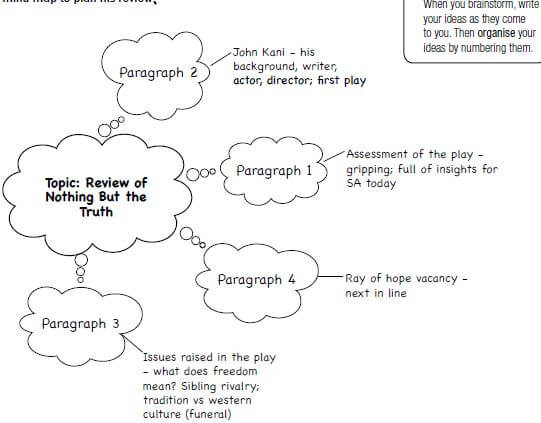
1. Mind maps
These are diagrams of ideas. The title is in the center with branches coming from it showing thoughts and ideas. Below is an example of a mind map.
mind map


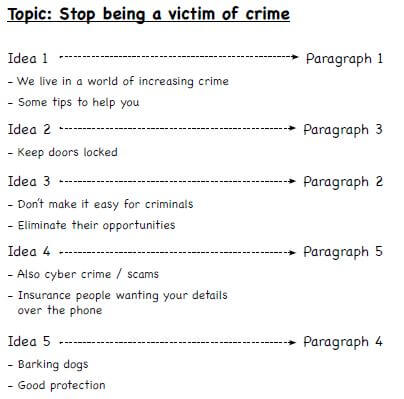
2. Idea lists
These help you to quickly write down ideas for each paragraph. Write down your ideas as they come to you and then organise them in a logical order. Below is an example.
idealist
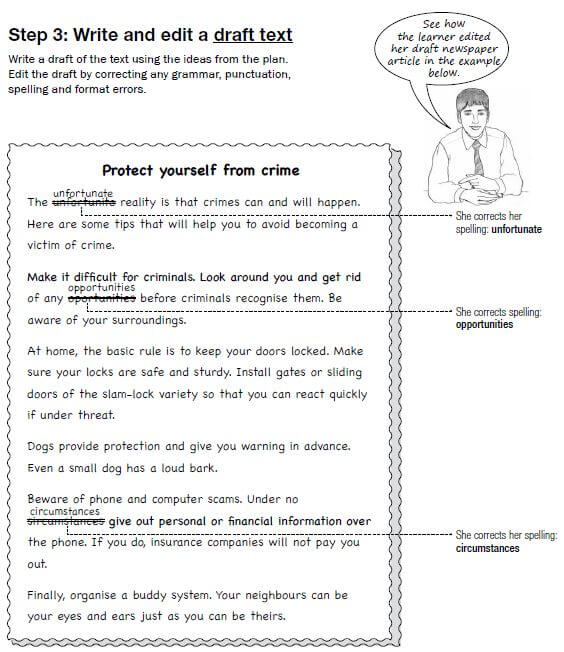
Step 3: Write and edit your draft essay
Write a draft of your essay, using the ideas from your plan.
Read through each sentence carefully to proofread it. Look for any spelling, punctuation or other language mistakes. Edit your draft by correcting these mistakes and making any other changes you think are needed.
This will improve your language and writing style in your final essay.
Count the number of words in your essay and make any changes to meet the word limit. For example, you may need to add some words or use fewer words.

NOTE:

  • An essay must be between 250 to 300 words long.
Hint:
Essay proofreading and editing

  • Check your grammar, spelling and punctuation are correct
  • Check that you have chosen a variety of words that are appropriate for your topic
  • It is important to show the marker that you have edited your draft
  • The way you write your essay creates a style of writing. The words you chose and the length of your sentences are two examples of how a writing style is created.
  • Think about your audience to help you chose the right register for your essay. Register can be formal. For example; if your audience is a teacher or informal if your andience is for example a friend.
  • The tone of the essay is the feling the write gives the writing. For example, the tone could be playful or serious.

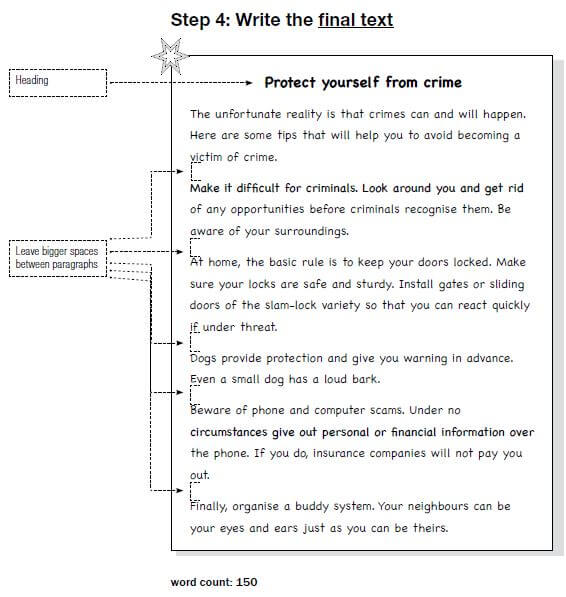
Step 4: Write your final essay
Write your final essay by rewriting your draft. Make sure that you make all the changes you marked in your draft so that your final essay has no mistakes and clearly expresses all your best ideas.
When you have finished your final essay, cross out your planning and draft essay. If you do not do this, the examiner may mark your draft and not your final essay.

Hint:
Final essay

  • To improve you final essay, you must rewrite your draft so that it shows all the corrections and improvements yo u have made. Keep looking back at your drafts as you write your final essay so that you can copy it correctly.
  • Your writing muct be clear and neat so that it is easy for the marker to read. Do your best not to make new mistakes as you write your final essay.
  • The essay must be within the word limit. The total number of words in your essay must not be less than 250 words and not more than 300 words. Do not include the words of your essay title in the  word count.

2. The five essay types

There are different types or genres of essays. Each type is written for a different purpose. To prepare for the exam, you need to revise how to write five types of essay:

  1. Narrative essays
  2. Descriptive essays
  3. Reflective essays
  4. Discursive essays
  5. Argumentative essays

The main features of each type of essay and guidelines for writing each type of essay are given in this section. To prepare for the exam, practice writing the different types of essays.

2.1 Narrative essays

A narrative essay tells a story or describes a sequence of events. It can be written from any perspective (first person or third person narrative). The first person narrator will use the pronouns “I” or “we”, while the third person narrator will use pronouns such as “he”, “she”, “they” and “them”.
A narrative essay can include dialogue (speech between characters in the story) and often includes interesting descriptions. This helps the reader to imagine what is happening, so the story comes alive.

Hint:
In a narrative essay, you must tell a story

  • Introduce the characters and setting (where and when  the story happens). Narrate what happens (the plot). End your essay with an interesting ending (conclusion)
  • Describe what things look, sound, taste or smell like. Use language creatively by using adjectives and adverbs. These will make your descriptions more exciting.
  • Use different lengths of sentences and paragraphs to create different effects. For example, short sentences create drama and tension: “He heard footsteps. They came closer. The door slowly opened.”
  • It can be useful to include words that show the time passing. For example: “Early that evening….” or “The next day…..”

A learner’s example of a narrative essay using the four steps
Step 1: Choose the topic and type of essay

  • This learner chose this essay topic because it fitted a narrative essay type:
    I am an old desk in a classroom and this is my story…

Note: Write a narratiove if the word “story” is in the description. Always give your essay a title.

Step 2: Plan the essay
The learner used a mind map to plan her essay.
mind map narrative

Step 3: Write and edit the draft essay
Editing means checking your draft and correcting any grammar, punctuation and spelling errors. You can also change your word choice to make your writing stronger.
draft essay narrative

Step 4: Write the final essay
Note:  By including her edits from her draft essay, the learner greatly improved her final essay.

I am an old desk in a classroom and this is my story…
Hello there! My name is Pine. I am an old, broken-down desk, situated at the back of a science classroom. Nobody sits on me anymore. My bits and pieces are scattered around the whole school.
You may think that I am kind of silly-looking and old. In fact, I am very special; legends have sat on me. You don’t know them all but one may stand out in particular – Mark Shuttleworth! He makes my wooden heart beat stronger with pride and he makes me forget about back pain… caused by those rotten, rusted nails!
The other legends you won’t know, but they stayed special to me. I felt their pain when they failed a test. My age- lines grinned and smiled and rejoiced with them when they excelled! I know they made it far and move forests today, but as for me …
I am still here …
The engravings on my head show my life’s story. The story of loneliness. Frustration. Excitement. Pain. (Notice the word “pain” is very similar to my name). And of course, love…
Did I mention that I am a double desk? A desk for two? I have seen all kinds of love: childish love, forbidden love and great love. I know everything there is to know about
science because I have learned it over and over again. But, I don’t understand love.
Love is mystical. Love is kind. Love is blind …
I see the new generations grow older. They grow bolder. They will always be stronger. And my heart grows fonder … Maybe I really know what love is.

word count: 262

Main features of a narrative essay that are shown in this learner’s story

FeaturesExamples in the essay
Characters

  • People in the story
Pine, learners (including famous people), and lovers, who used the desk
Plot

  • What happens in the story, the order of events
The story has a strong story line. The desk remembers people who have used it, and how they made it feel. It ends with the climax – as the desk realises that it loves learners who use it.
Setting

  • Where and when the story happens
The science classroom.
Theme

  • The main ideas shown in the story
The movement of learners through the classroom – they move on as they grow up, but the desk remains. The meaning of love.
Structure

  • The organization of paragraphs
From the past to the present, looking ahead to the future; from the concrete to the abstract.
Creative use of languageStrong, interesting words are used, for example: age-lines, legends, scattered move forests, rejoice, excelled, rotten, frustration, forbidden love, mystical. Short sentences and paragraphs add impact.

Activity: Writing a narrative essay

Here are some narrative essay topics to help you to practice your writing skills:

  1. Write a story that includes the following words:
    Suddenly there was absolute silence…
    NOTE: The words given in the topic MUST be included somewhere in your essay.
  2. Write a story that begins with the following words:
    It was the greatest day of my life.
    NOTE: The words given in the topic MUST be used in the first sentence of your introduction.

2.2 Descriptive essays

In a descriptive essay, the writer describes an experience, an event, a situation, an object or a person. The purpose is to allow the reader to imagine what is being described as clearly as possible. Writing a descriptive essay is like creating a picture with words, rather than telling a story.

Hint:
In a descriptive essay, you must describe an experience or event

  •  Write about what you know and have experienced in some way. It is difficult to describe something you know nothing about.
  • A descriptive essay is often told from a first person perspective.
  • Explain what you will be writing about in the introduction. For example, a descriptive essay about a concert could begin with the words: “The concert was on Saturday night in…” Avoid beginning your introduction with: ” I am  going to describe my visit to the clinic…”
  • Describe what things look, sound , taste and smell like by using figurative language, such as similes, metaphors, personification and alliteration. For example: “Her rough voice cut through the silence like sandpaper scarping over a metal surface.”

A learner’s example of a descriptive essay using the four steps

Step 1: Choose the topic and type of essay

This learner chose this essay topic because it fitted a descriptive essay type:
The scene in the waiting area of a clinic OR a doctor’s surgery.
Note; The word scene in the topic sentence suggests that a descriptive essay is appropriate for this topic

Step 2: Plan the essay
The learner used a mind map to plan his essay.
descriptive essay plan

Step 3: Write and edit the draft essay
Editing means checking your draft and correcting any grammar, punctuation and spelling errors. You can also change your word choice to make your writing stronger.
descriptive draft
Step 4: Write the final essay

The scene in the waiting area of a clinic

A clinic waiting area is possibly one of the most awkward places to be. You come in through the door, go to reception to tell the friendly lady that you are here for an appointment with the doctor and as you go to take a seat, you politely nod to all the other people.
With all this friendliness you would think that some people would be talking to each other, but for some unknown reason there is a silence among the adults. The only voices you hear are the receptionists talking on the phone and the little kid who is nagging his mum if he can go build a puzzle or play with the toys.
A few characters will always be found in the waiting area. For example, there will almost always be a kid with a sports injury accompanied by his hysterical mother. And then there’s also the person with flu-like symptoms even in the middle of the summer.
And lastly, there is the person who just calmly sits and reads one of the magazines that are three years old, but appear to be in perfect condition.
As you sit there in your boredom unable to figure out what could be wrong with the calm and collected man, you decide to read one of those magazines. ‘Home and Décor’ is the magazine closest to you, ironically enough, since you find this magazine in a clinic which is coloured pale green and grey, but you decide to read through it anyway. And at that moment when you find a great article, you hear the receptionist calling, “Mr.. ………, could you follow me to the doctor’s office, please?”

word count: 271

Main features of a descriptive essay that are shown in this learner’s essay

FeaturesExamples in the essay
Characters

  • People in the story
 Receptionist, the child, the mother, other people waiting in the queue
Plot

  • What happens in the story, the order of events
Description and observation of events from the moment of registration with the receptionist up to the point where the patient is called to see the doctor.
Setting

  • Where and when the story happens
 The waiting area of the clinic.
Theme

  • The main ideas shown in the story
 Awkwardness of being in a small public space with strangers.
Structure

  • The organization of paragraphs
The events move from the arrival up to the point when the doctor is ready to see the patient.
Creative use of language Strong, interesting words are used, for example; hysterical, flu-like symptoms, calm and collected man, coloured pale green and grey.

Activity: Writing a descriptive essay
Here are some descriptive essay topics to help you to practise your writing skills:

  1. Write an essay on the following topic:
    Life with my neighbors
  2. Write an essay on the following topic :
    It was a dream come true!
    NOTE: The words given in the topic MUST be included somewhere in your essay.
  3. Write an essay on the following topic :
    An amazing performance.

2.3 Reflective essays

A reflective essay is written to explain what the writer thinks, and/or feels, about an object, an idea, a situation or an experience. It is subjective (based on the writer’s personal experience) and uses first person pronouns (“I”, “we”, “us”).
A reflective essay usually includes the writer’s emotional reactions or feelings. It could be about, for example, a dream, your hopes for the future or a past event.

  • ESSAYS GRADE 12 NOTES – LITERATURE STUDY GUIDE

Subjective – Your own personal feelings and point of view

In a reflective essay, you write your thoughts, hopes and dreams about the essay topic

  • Write about what you know, or have experience – this will make it easier to write well about the ideas, thoughts or feelings you express.
  • Choose interesting words, similes or metaphors that describe emotions, or your point of view.
  • You may use a flashback technique. This means that  your essay begins in the present and something causes you to reflect on a past event. You describe past events throughout the essay and return to the present in the final paragraph.
  • For example, “I floated with the sounds of that simple song, back to the schoolroom where our lives had been blank pages waiting to be filled.”

A learner’s example of a reflective essay using the four steps

Step 1: Choose the topic and type of essay
This learner chose this essay topic because it fitted a reflective essay type:
Things I would like to achieve by the time I am 30.
A reflective essay will be about what you think and feel about a topic. It shows your emotions, hopes and dreams.

Step 2: Plan the essay
The learner used a mind map to plan her essay.
reflective essay plan

Step 3: Write and edit the draft essay
Editing means checking your draft and correcting any grammar, punctuation and spelling errors. You can also change your word choice to make your writing stronger.
reflective draft

Step 4: Write the final essay

Note: Leave a line between each paragraph to make your essay easy to read.

Things I would like to achieve by the time I am 30

There are a number of things success is not. It’s not money or power, although I have to admit these do have a certain ring to them. Success is bounding out of the door in the mornings because you can’t bear to contain the excitement of going to work (a bit pretentious, but you get the point). Success is bringing together people with universal dreams and inspiring the people you work with to walk the extra mile.
I want that – I want success. I used to sit in front of the television watching ‘Pinki and the Brain’ and every single day Pinki asked Brain, “What are we going to do today?” and Brain would answer with such determination, “Today we’ll conquer the world”. I guess it must have brainwashed me somehow, for now I strive for the same thing.
You know how they say that people reach their prime when they reach 30, “just enough ignorance still to have energy and just enough smarts to use the energy wisely”. At 30,
* intend †o be confidently walking †o †he door of my office, marked “Senior Auditor”. Never once have I dreamt about the whole suburban living, a white picket fence with two- poin†-five angelic children. No, * dream of making a name for myself on the corporate ladder.
This isn’t some futile dream I’ll give up half way through. I’ll reach the top and I know this because dreamers have to be doers in order to be achievers. Recently deceased Steve Jobs once said, “Those who are crazy enough to think they can conquer the world are the ones who usually do.”

word count: 260

Main features of a reflective essay that are shown in this learner’s essay

FeaturesExamples in the essay
Characters

  • People in the story
 The speaker (the writer) is the main person in this story, as it is about personal hopes and dreams. Steve Jobs is quoted as an inspiring person.
IntroductionThe writer introduces the main idea for the essay – “success”.
BodyThe writer’s viewpoint is supported by examples of what personal success means to the writer.
Creative use of languageStrong, interesting words are used, for example; success is bounding out of the door, universal dreams, walks the extra mile, conquer the world, brainwashed, a white picket fence with two-point0five angelic children.

Activity: Writing a reflective essay

Here are some reflective essay topics to help you to practise your writing skills:

  1. Write an essay that includes the following words:
    ‘I wish I hadn’t …’
    NOTE: The words given in the topic MUST be included somewhere in your essay.
  2. Write an essay that includes the following words:
    As I looked at that photograph …
    NOTE: The words given in the topic MUST be included somewhere in your essay.
  3. Write an essay that includes the following words:
    This experience has made me realise that …
    NOTE: The words given in the topic MUST be included somewhere in your essay.

2.4 Discursive essays

The word “discursive” comes from the word “discourse” which means the sharing of thoughts and ideas.
A discursive essay presents both sides of an argument. Its purpose is to tell the reader about various sides of a topic. This could be the advantages and disadvantages of something, or the reasons for or against a particular point of view.
It must be objective (looking at both sides equally), and give a balanced view. In the conclusion, the writer usually gives a summary of the main points, and suggests, or recommends, some action or way forward.
In the conclusion, the writer may state the opinion, or view, with which he or she personally agrees. However, the reasons for that decision must be clearly shown in the essay.

Objective – giving a general point of view

Hint:
hint In a discursive essay, you must show both sides of the topic

  •  Give both sides of an issue – the advantages and disadvantages. Give a balanced account of the views, without favoring one view. You will not be giving your opinion but presenting two opposite points of view.
  • Give reasons to support each view, and link them together. For example use words like because; this shows; however; therefore; so;
  • Use the present tense.
  • Be clear and objective. Avoid using personal pronouns (I, me, we) and avoid describing personal emotions

A learner’s example of a discursive essay using the four steps

Step 1: Choose the topic and type of essay
This learner chose this essay topic because it fitted a discursive essay type:
Freedom of choice has both advantages and disadvantages
Discuss this statement.

  • In a discursive essay you must present
    BOTH sides of an issue. For example, the advantages AND disadvantages of a topic.

Step 2: Plan the essay
The learner used a list to plan his essay.
TOPIC: Freedom of choice – advantages and disadvantages
plan discursive essay
Step 3: Write and edit the draft essay
Editing means checking your draft and correcting any grammar, punctuation and spelling errors. You can also change your word choice to make your writing stronger.
discursive draft

Step 4: Write the final essay

Freedom of choice has advantages and disadvantages
South Africa has become one of the most democratic countries in Africa. We, as South Africans, are privileged to be able
to enjoy many rights that enable us to live freely and democratically in our country. One of the many rights we share is the freedom of choice. All citizens are free to choose whatever they want to eat, wear and listen to, among other choices. However, freedom of choice has both advantages and disadvantages.
Freedom of choice gives one a sense of individuality. Nothing feels as satisfyingly good as being able to make our own choices without being obliged to satisfy the government or anybody else. It prevents people from entering into situations that are uncomfortable for them and instead allows them to make choices that suit their own needs. Knowing that you are no† restricted by anything is definitely an advantage.
However, there are not always advantages to having freedom of choice. The fact that all citizens have the freedom to make their own choices can be dangerous. The choices people make are not always good and tend to violate other people’s rights as well. Perhaps the most common example would be the freedom a woman has to choose to terminate a pregnancy. It has been argued that by this choice, an unborn baby’s right to life is violated, besides the fact that the woman also puts her own health in danger.
There are pros and cons to everything. Nothing is ever completely and comfortably positive. It has become clear that while freedom of choice is great, we cannot be sure that it has not come with its own disadvantages. It seems right to conclude that it is every citizen’s responsibility to exercise his or her freedom of choice wisely. After all, every right comes with a responsibility.

Word count: 300

FeaturesExamples in the essay
Content The writer presents two sides of the argument, and makes a judgement at the end of the essay
IntroductionThe writer introduces the main idea for the essay  – freedom of choice.
Body The writer presents both the advantages and disadvantages of freedom of choice. The writer organises the paragraphs by presenting arguments for, followed by arguments against, the topic. The concluding line shows the writer’s personal view.
Creative use of languageStrong, interesting words are used, for example; Freedom of choice gives one a sense of individuality; the choices people make are not always good and tend to violate other people’s rights as well; an unborn baby’s right to life is being violated; nothing is ever completely and comfortably positive.

Activity: Writing a discursive essay

Here are some descriptive essay topics to help you to practise your writing skills:

  1. Sport can unite or divide people.
    Discuss your views.
  2. Do subjects offered at school prepare you for life?
    Discuss your views.
  3. Wearing school uniform is very important.
    Do you agree?
    Discuss your views on wearing school uniform.

2.5 Argumentative essays

In an argumentative essay, the writer expresses his or her opinion or viewpoint on a topic. The purpose of the essay is to try to convince, or persuade, the reader to agree with that opinion. The writer’s opinion about the topic is clear throughout the essay. It is a subjective essay, and strong personal opinions may be expressed.

In an argumentative essay, you must express your personal opinion about the topic

  •  Use present tense
  • Beginby stating your opinion of the topic. Do not state that you agree or disagree with the topic, but rather present your point of view in the introduction.
  • Giving reasons to support your view, and link them together in a logical way. For example, use linking words like; because; this shows; however; therefore.
  • End the essay with a strong conclusion that clearly, and convincingly, states your opinio. It may repeat the same idea given in your introduction, but written in  a different way.

In an argumentative essay you must take a stand on a topic and then support your point of view.

A learner’s example of an argumentative essay using the four steps

Step 1: Choose the topic and type of essay
This learner chose this essay topic because it fitted an argumentative essay type:
Today young people are influenced more by their friends than by their parents.
Do you agree?

Step 2: Plan the essay
This learner used a list to plan her essay.

Topic: Influences on youth
argumemntative essay plan

Step 3: Write and edit the draft essay

Editing means checking your draft and correcting any grammar, punctuation and spelling errors.
You can also change your word choice to make your writing stronger.
argumentative essay draft

Step 4: Write the final essay

Today Young People Are More Influenced By Their
Friends than by Their Parents
Are young people influenced more by their peers than their parents? In a modern world, most certainly! Rapid change has taken place over the past 10 years in our modern world. Family values and norms have a question mark behind them. Parenthood is not exactly what it used to be.
How can you explain why a grade seven boy would share a cigarette with his friends in a portable toilet on the school premises? A number of factors need to be considered to explain such actions: peer pressure, growing population numbers and time.
There are definitely many factors that contribute †o †he influence of peers dwarfing †he influence of parents on youth. One reason is the number of people in the world. With growing populations, it is becoming more difficult †o be unique and special. This is a big problem for teenagers, because they want to be seen and recognised. Peer influences provide a solution where parent influences do not. By doing what †heir friends want to do, youth make their voices heard. Peers: 1 Parents: 0.
Another big contributor †o peer influence is †time. Teenagers spend much more time with their friends. Apart from the time spent together at school, many afternoons are spent together watching television. It is thus obvious that much more time
is spent with friends than with family. The more time spent with peers, †he more influence †hey have on youths. Peers: 2 Parents: 0.
*I† is thus understandable why so many youths are influencing by their friends. The facts show that in a modern society, this movement is inevitable. But it does not excuse any form of misbehavior against parents. It most certainly does not excuse parents from doing their job.

Word count: 282

Main features of an argumentative essay that are shown in this learner’s essay

FeaturesExamples in the essay
ContentThe writer begins with a general statement and moves on to explain her point of view. The viewpoint is supported with good reasons.
IntroductionThe writer introduces the main idea for the essay by giving some background to the topic.
BodyThe writer supports her viewpoint with examples. Related facts are combined within paragraphs. Use is made of connecting words to back up the argument. For example, How else can you explain; but; thus
Creative use of languageStrong, interesting words are used. For example, values and norms; peers; dwarfing the influence of parents; in a modern society this movement is inevitable.

Activity: Writing an argumentative essay

Here are some argumentative essay topics to help you to practise your writing skills:

  1. Most teenagers today do not pay much attention to leading a healthy life.
    Do you agree?
  2.  Technology has changed the lives of teenagers.
    Do you agree?
  3. Should alcohol and cigarettes be advertised in the mass media?
    Discuss your views.

2.6 Writing an essay from a picture

There is always a question in the exam that asks you to write an essay based on a picture. You only need to write an essay about ONE of the pictures. Choose which picture you are going to write about. Then you need to decide what type of essay you are going to write. The content of your essay must link with the picture.
Looking closely at the picture, identify information you can use in your essay. For example, the picture below shows a man who is:

  • Laughing/smiling
  • Dressed smartly in a shirt and tie
  • Holding a baby
  • Speaking/listening on the telephone
  • Writing something in a book/diary

There are five different types of essay that could be written about this picture, as shown below.

 first picture1. A narrative essay

  • For example; Tell a story about the man and how he came to be in this situation. Or imagine that you are the character in the picture and tell the story in the first person or from your point of view.
 2. A reflective essay

  • For example; Write an essay about what you feel or think about when you look at this picture. Does it remind you of a person that you know or an experience that you have had.
 3. A descriptive essay

  • For example; Write a description about this situation, the sounds the baby is making, who the man is listening to on the phone, the place he is in.
 4. A discursive essay

  • Write about both sides of an issue the picture suggests. For example; In today’s world, men also have to help with child care. However, there are advantages and disadvantages to this……
 5. An argumentative essay

  • Express your opinion about an issue the picture suggests. For example;  Many people say that men are not good at looking after babies. I disagree because…

A learner’s example of an essay from a picture using the four steps

Step 1: Choose the topic and type of essay
This learner chose to write a reflective essay based on this picture of a watch:
watch
Step 2: Plan the essay
This learner used a mind map to plan his essay.
picture plan

Step 3: Write and edit the draft essay
picture draft

Step 4: Write the final essay

Seconds, minutes, hours…
Time had always been her biggest obstacle. Bigger than the rocks she had to climb over to get to the river – the only escape she had from her troubled surroundings. Bigger than the barrels of water she had to carry on her head, when it felt like the heat of the sun was going to consume her frail body. Bigger than the weight she felt lying on her body after the sun had gone to bed and her mother laid her head to rest after the long day.
Time was strange and unkind to her in many ways. It always ran away whenever she enjoyed something, like a midnight swim in the river or the hours spent learning at school. Yet it always seemed to linger longer when her deepest wish was to escape from her current situation.
Time. Some call it a gift. She calls it a jail that keeps her caught up in a routine of wishing it away but wanting to hold onto it for just a while longer. The hands that point out the time, point at her in return. They point out what happened in the past, constantly reminding her of her own weakness.
Seconds become minutes. Minutes become hours. Her redemption seems light years away, while the past feels so close that she can smell the burnt food on the gas burner mixing with the smell of sweat and her own fear.
Although years have passed, sometimes she feels six years old again. She hears the door open just as it did many times in the past and she wishes that time would grant her one last favour – to turn the hours into minutes and the minutes into seconds. Seconds away from freedom is where she still longs to be.

Word count: 297

FeaturesExamples in the essay
ContentThe writer has interpreted the picture in a figurative way. That is, the watch reminds the writer of time and how it is linked to the events in someone’s life.
IntroductionThe writer introduces the main idea for the essay by giving some background to the topic – time
BodyIn each paragraph, the writer talks about a different aspects of time in the woman’s life; and how it did not work in her favour – it was a jail, not a gift. The essay ends with the character wishing that time would go faster, so she can escape from her current situation and be free of her past.
Creative use of languageStrong, interesting figurative language is used, for example: the metaphor ‘ hands of time’ can refer to the watch as well as to what happens to the character in the story. Alliteration is used in ‘linger longer’ to emphasise the slow passing of time.

Activity: Writing an essay from a picture

Choose ONE of the pictures below and write an essay on a topic that comes to mind. Write the question number and give your essay a suitable title/heading.
Note: There must be a clear link between your essay and the picture you have chosen. Use your imagination when answering questions based on pictures. You can interpret them in any way.
brokenheart         happy children

2.7 Essay checklist

FeaturesExamples in the essayYesNoDon’t know
Essay instructionsI understand the exam instructions for writing an essay.
Essay topicI understand the essay topic I have chosen.
Essay typeI understand the features of the essay type I have chosen:

  • Narrative essays
  • Descriptive essays
  • Reflective essays
  • Discursive essays
  • Argumentative essays
Content and planning
PlanningI can show evidence of essay planning.
ContentEach point in my plan is relevant to the essay topic.
I will use these points in my essay.
Purpose/audience

I understand the purpose of the essay type I have chosen.
I understand the audience for the essay type I have chosen.

Structure
Sentences

I have not repeated sentences in my paragraphs,
I have used full sentences.

ParagraphsMy ideas link and are well organised in paragraphs.
Each paragraph contains a new idea. Ideas are not repeated.
The ideas in the paragraphs link to the essay topic.
Essay structureThe first paragraph of my essay introduces the topic.
The body of my essay has a few paragraphs related to the topic.
The last paragraph is clearly the conclusion or ending of the essay.
Language, style and editing
Choice of words/dictionI have chosen my words carefully to make my essay interesting.
Verb tensesI have used the correct tenses (past, present or future)
ConcordMy nouns and verbs are in agreement
SpellingMy spelling is correct
PunctuationMy sentences start with a capital letter and end with a punctuation mark.
I have used apostrophes correctly.

3. What is expected from you in the exam?

In the exam, you must write one essay that is no less than 250 and no
more than 300 words long (about 1 to 1 1/2 pages).
The essay is worth 50 marks out of 100 marks in the exam – half the total marks for Paper 3. Examiners will give marks for your essay based on:

  • Content and planning (30 marks)
  • Language, style and editing (15 marks)
  • Structure (5 marks)

The rubric on the next two pages is a table the examiners use to mark your essay. It shows the five levels of achievement that the examiners can award an essay, from the lowest achievement (Inadequate column) to the highest achievement (Exceptional column).
The table also describes the skills the examiner looks for when marking. For example, when marking an essay’s content, the examiner will assess how well the ideas relate to the topic, and whether they are well planned and organised.
The rubric is a useful guide for you to use when practising your essay writing because it reminds you of the skills the examiner will be assessing when marking your exam.

Criteria Exceptional Skilful Moderate Elementary Inadequate 
CONTENT & PLANNING
(Response and ideas)
Organisation of ideas for planning;
Awareness of purpose, audience and context
30 MARKS
Upper level 27–30 22–2315-17 9-113-5
  • Outstanding/Striking response beyond normal expectations
  • Intelligent, thought-provoking and mature ideas
  • Exceptionally well organised and coherent, including introduction, body and conclusion
  • Very well-crafted response
  • Fully relevant and interesting ideas with evidence of maturity
  • Very well organised and coherent, including
    introduction, body and conclusion
  • Satisfactory response -Ideas are reasonably coherent and convincing
  • Reasonably organised and coherent, including introduction, body and conclusion
  • Inconsistently coherent response
  • Unclear ideas and unoriginal
  • Little evidence of organisation and coherence
  • Totally irrelevant response
  • Confused and unfocused ideas
  • Vague and repetitive
  • Unorganised and incoherent
Lower level24-2618-2012-146-80–2 
  • Excellent response but lacks the exceptionally striking qualities of the outstanding essay
  • Mature and intelligent ideas
  • Skilfully organised and coherent, including introduction, body and conclusion
  • Well-crafted response
  • Relevant and interesting ideas
  • Well organised and coherent, including
    introduction, body and conclusion
  • Satisfactory response but some lapses in clarity
  • Ideas are fairly coherent and convincing
  • Some degree of organisation and coherence, including introduction, body and conclusion
  • Largely irrelevant response
  • Ideas tend to be disconnected and confusing
  • Hardly any evidence of organisation and coherence
  • No attempt to respond to the topicCompletely irrelevant and inappropriate
  • Unfocused and muddled
LANGUAGE, STYLE & EDITING
Tone, register, style, vocabulary appropriate to purpose/effect and context;
Word choice;
Language use and conventions, punctuation, grammar, spelling
15 MARKS
Upper level12-138-9 4-5 0-1 
  • Tone, register, style and vocabulary highly appropriate to purpose, audience and context
  • Exceptionally impressive use of language,
  • Compelling and rhetorically effective in tone
  • Virtually error-free in grammar and spelling
  • Very skilfully crafted
  •  Tone, register, style and vocabulary very appropriate to purpose, audience and context
  • Language is effective and a consistently appropriate tone is used
  • Largely error-free in grammar and spelling
  • Very well crafted
  • Tone, register, style and vocabulary appropriate to purpose, audience and context
  • Appropriate use of language to convey meaning
  • Rhetorical devices used to enhance content
  • Tone, register, style and vocabulary less appropriate to purpose, audience and context
  • Very basic use of language
  • Diction is inappropriate
  • Very limited vocabulary
  • Language incomprehensible
  • Tone, register, style and vocabulary not appropriate to purpose, audience and context
  • Vocabulary limitations so extreme as to make comprehension impossible
Lower level 131074
  • Language excellent and rhetorically effective in tone
  • Virtually error-free in grammar and spelling
  • Skilfully crafted
  • Language engaging and generally effective
  • Appropriate and effective tone
  • Few errors in grammar and spelling
  • Well-crafted
  • Adequate use of language with some inconsistencies
  • Tone generally appropriate and limited use of rhetorical devices
  • Inadequate use of language
  • Little or no variety in sentences
  • Exceptionally limited vocabulary
STRUCTURE
Features of text;
Paragraph development and sentence
construction
5 MARKS
54320-1
  • Excellent development of topic
  • Exceptional detail
  • Sentences, paragraphs exceptionally well-constructed
  • Logical development of details
  • Coherent
  • Sentences, paragraphs logical, varied
  • Relevant details developed
  • Sentences, paragraphs well-constructed
  • Essay still makes sense
  • Some valid points
  • Sentences and paragraphs faulty
  • Essay still makes some sense
  • Necessary point lacking
  • Sentences an paragraphs faulty
  • Essay lacks sense

MANHOOD BY JOHN WAIN – ENGLISH FIRST ADDITIONAL LANGUAGE PAPER 2: LITERATURE; SHORT STORIES GRADE 12 STUDY GUIDE AND NOTES

MANHOOD BY JOHN WAIN – ENGLISH FIRST ADDITIONAL LANGUAGE PAPER 2: LITERATURE; SHORT STORIES GRADE 12 STUDY GUIDE AND NOTES The short story “Manhood” by John Wain presents the faulty relationship between a father (Mr Willison) and his son (Rob Willison). They are presented riding their bicycles up a hill, with Mr Willison encouraging his son to cope with his fatigue and keep on cycling.

Manhood by John Wain

John Wain was born in England in 1925 and became a university lecturer before he became a writer. He wrote poetry, plays, short stories and novels. He mainly wrote about ordinary people and their problems. His criticism of society resulted in him being called one of the ‘angry young men’ of the 1950-60s. He died in 1994.

1. Summary

There are three characters in the story: Mr Willison, Mrs Willison and their thirteen-year-old son, Rob. Mr Willison is determined that Rob should become good at sports and develop his body, because he never had that chance when he was young. Mrs Willison doesn’t agree with this plan.
The story begins when the father and son are going for a bike ride and the father pushes his son to cycle further, even though the boy is tired and wants to rest. He encourages the boy by saying there is a surprise waiting for him at home – he has bought a boxing “punch-ball” so that his son can practise boxing. The boy is exhausted when they return home. The mother is annoyed with the father as she feels that he is pushing the boy too hard.
The father wants Rob to train with the “punch-ball” so that he can get strong enough to be selected for the rugby team at school. Rob tells him that the team has already been chosen and he has not been selected. The father’s disappointment is relieved when Rob says that he has been selected to box for the school instead. The mother is very angry that her husband wants the boy to box, as she feels that it is a dangerous sport. The father, however, is very happy about it and looks forward to the boxing tournament with great excitement. He puts all his energy into training his son every day.
On the day of the boxing tournament Rob complains of stomach pains. His mother wants to get a doctor but, instead of calling the doctor, the father phones one of Rob’s teachers and discovers that the school does not do boxing. The story ends with Mr Willison realising that Rob has lied about the boxing tournament.

2. Title

The story title, Manhood, points to the main theme of the story – questioning what manhood and masculinity mean. Different versions of masculinity are offered in the story. On the one hand we have the father’s version, which sees manhood in terms of physical strength and skill. Contrasted with that is the version that the father was offered when he was young. This involved a man working hard and getting qualifications so that he could have a secure job. The mother, however, doesn’t mind that her husband is not “manly” and thinks that her son should not be pushed so hard physically as he is still only a boy.

Note:

  • Manhood – the state of being an adult man, rather than a boy.
  • Masculinity – having qualities traditionally associated with men

3. Themes

Besides the theme of ‘manhood’, another theme is how people’s failure to communicate openly and clearly can lead to unfortunate events. The theme of lack of communication is evident when Mr Willison shows no insight into the fact that he should not force his own will on Rob and live his dreams through him.
Another main theme in the story is that the boy is dominated by the power of his father. But Rob is too young and immature to stand up to his father, so he tried to please him, even though he is deceitful in doing so.

4. How is the story told?

4.1 Setting

The story starts with Mr Willison and Rob taking a bicycle ride in the country. This event shows how the father pushes his son beyond his physical limits. He forces Rob to continue riding even when the boy is exhausted. The rest of the story takes place in the home of the Willisons, where the tension between Mr and Mrs Willison rises.

4.2 Structure and plot development

From the start of the story it is clear that Mr Willison has an inferiority complex (feels that he is a failure) because of his lack of training in sports when he was young, and that he was not able to develop his physique (his physical body). He becomes obsessed with the idea that Rob will only become a man by being good at sports. With this in mind he constantly advises, instructs and encourages his son to do the things he never had the chance to do when he was young.
Mr Willison puts Rob under a lot of pressure to exercise and train. Rob is passive and does not stand up to his father, but Mrs Willison does not like it. She complains about it and tries to protect her son. This creates the rising tension in the story. The complication in the story is that Rob’s mother and father have opposing ideas about what is best for Rob. This creates conflict in the relationship between them. An example of this is when each of the parents talks of “my big night”. To the mother, “my big night” means the night her son was born, the most important event in her life. This contrasts with the father, whose “my big night” means the night his son will take part in a boxing tournament and make him proud. He feels he is getting a second chance to live his life again, through his son.

The climax of the story is the day of the tournament, when Rob complains of stomach pains just before the tournament. He and his mother think that he is suffering from appendicitis (infection of the appendix). Instead of getting the doctor the father phones one of Rob’s teachers only to discover that the school does not do boxing. Clearly, Rob has lied to his father.
There is no resolution to this story as we are not told what the father says to his son after finding out the truth about the boxing tournament. The story ends with an anti-climax, as the father “put down the telephone, hesitated, then turned and began slowly to climb the stairs”. The words “hesitated” and “slowly” tell us clearly of his disappointment when he realises that his son has been lying to him. It could also be that he realises why Rob lied to him and he climbed the stairs in a sad and accepting way. He was not angry with his son but is perhaps embarrassed for having forced his son to lie when Rob found himself in such a difficult situation.

4.3 Characterisation

There are three characters in the story:
Mr Willison is the protagonist in the story, as he is the central character and controls the actions that take place. Mrs Willison opposes his plans and actions, so she is the antagonist in the story, while Rob is caught in the middle between his parents.
Mr Willison wants the best for Rob, but his attitude causes Rob to resort to deceit and telling lies in the end, even though he tries to please his father. Rob is passive and submissive – he doesn’t stand up for himself but knows he will get support from his mother against his father’s plans. It could be argued that he is too scared and weak.
Mr Willison is strong-willed and obsessed with training Rob. This one-sided view stops him from realising that Rob is not interested in sport. If he was a more mature and sensitive father he might have understood his son better and not pushed and manipulated him. Perhaps then he would not have allowed such a situation to develop. His attitude could be said to have made the boy submissive and ultimately dishonest. Perhaps Mr Willison has missed the point, which is that being a man involves good sense as well as physical strength.
Throughout the story Mrs Willison is opposed to her husband’s behaviour towards and treatment of their son. It could be argued that Mrs Willison was being too protective of Rob and not allowing him to stand on his own feet.

4.4 Style

The main stylistic device that the writer uses to show us more about the characters is through their dialogue rather than through descriptions or the thoughts of the characters. An example of how the dialogue shows the tension between the characters is when Mr and Mrs Willison have a disagreement about what is best for Rob:

“What nonsense. You’re taller than I am and I’m –”
“No son of mine is going to grow up with the same wretched physical heritage that I –”
“No, he’ll just have heart disease through over-taxing his strength, because you haven’t got the common sense to –”

Notice how they don’t allow each other to finish their sentences, adding to the sense of tension and mis-communication between them.

4.5 Narrator and point of view

The narrator is not one of the characters in the story, so the narrative is told using the third person. The narrator refers to the characters as he, she or they. This third person point of view helps the reader see the story from a wider perspective than from only one character’s view point.

Note:

  • The narration or narrative means the story. The narrator is the person telling the story, the story-teller.

4.6 Diction and figurative language

The words the writer uses and the way they are used also help to carry meaning in the story. For example, Mr Willison’s enthusiasm for training Rob is shown in the way he orders Rob about:

“Don’t lie there,” said his father. “You’ll catch cold.” “I’m all right. I’m warm.”
“Come and sit on this. When you’re overheated, that’s just when you’re prone to –”
“I’m all right, Dad. I want to lie here. My back aches.”
“Your back needs strengthening, that’s why it aches. It’s a pity we don’t live near a river where you could get some rowing.”

And later, he forces Rob to punch the punch-ball:

“Take a punch at it,” Mr Willison urged.
“Let’s go and eat.”
“Go on. One punch before you go in. I haven’t seen you hit it yet.”

Mr Willison’s relationship with Rob is based on the son being forced to do what his father wants him to do, without being able to negotiate.
By his use of words the writer indicates that Rob is not completely happy and just puts up with all the good intentions of his father. The writer describes the boy: “falling silent”; Rob “lay like a sullen corpse” (simile); he “looked horribly like the victim of an accident” (simile); “A slender shadow”. Rob never really tells his father honestly how he feels and this leads to further deception later.
Mrs Willison opposes Mr Willison’s plans for Rob. The tension between them is shown by words such as: “glaring hot-eyed at each other”; and “her eyes brimming with angry tears”.
At the end of the story Mr Willison comes to a realisation when he phones Rob’s teacher. The use of the words: “With lead in his heart and ice on his fingers” help to emphasise his shock. He realises that Rob has lied to him, to them all – and that he may partly be to blame. He also realises that he has failed to fulfil his dream.

Note:

  • Diction – the choice of words a writer uses to create meaning.

4.7 Tone and mood

Throughout the story the writer makes us aware of how Mr Willison tries to keep Rob’s coaching on track by the tone of his upbeat and encouraging advice (often from what he has read, not what he himself has experienced):

“When fatigue sets in, the thing to do is to keep going until it wears off. Then you get your second wind and your second endurance.”
“If you hit with your left hand and then catch it on the rebound with your right, it’s excellent ring training.”
“No boxer ever went into a big fight without spending an hour or two in bed, resting.”

However, ironically, his tone is not uplifting, but rather creates a note of tension in the story, as Rob does not respond positively to his father’s wishes. Rob is sullen, sulky, silent and mostly not as keen on his father’s plan as the father would like.
The angry and worried tone of Mrs Willison’s words to the father also adds to the unease and tension in the story:

Grace Willison put down the teapot, her lips compressed, and looked from one to the other. “Boxing?” she repeated.
“Boxing,” Mr Willison replied calmly.
“Over my dead body,” said Mrs Willison. “That’s one sport I’m definite that he’s never going in for.”

As the story proceeds she becomes very angry with Mr Willison and the reader realises that their relationship is at a crisis point:

“Go away, please,” said Mrs Willison, sinking back with closed eyes.
“Just go right away and don’t come near me until it’s all over.”
Grace!”
“Please. Please leave me alone. I can’t bear to look at you and I can’t bear to hear you.”

The tone of the last line of the story contrasts with how Mr Willison is characterised earlier in the story:

He put down the telephone, hesitated, then turned and began slowly to climb the stairs.

He is no longer full of energy and enthusiasm. The story ends with a gloomy tone.
Mood: How does this story make you feel? Happy, sad, angry or indifferent? What are the reasons it makes you feel this way?

Summary
Manhood by John Wain

  1. Title
    • “Manhood” points to the question being asked: what is manhood and masculinity?
  2. Themes
    • The meaning of “manhood” and “masculinity”
    • Power of the father in the family
    • Lack of communication in the family
  3. How is the story told?
    3.1 Setting
    On a country road in Britain; and in the family’s house.
    3.2 Structure and plot development

    •  Rising tension: Mr Willison puts Rob under pressure; Rob is passive; Mrs Willison resists
    • Complication and conflict: The parents have conflicting ideas about what is best for Rob
    • Contrasts: “My big night”– for Mrs Willison it’s the night she gave birth to Rob; for Mr Willison, the night of his son’s boxing tournament
    • Climax: The day of the boxing tournament, when Rob complains of stomach pains
    • Resolution: None – Rob’s lie about the boxing tournament is unresolved. The conflict between his parents is also unresolved.
    • Anti-climax: Mr Willison “put down the telephone, hesitated, then turned and began slowly to climb the stairs”.
      3.3 Characterisation
    • Protagonist: Mr Willison (Rob’s father) controls the action in the story.
    • Antagonist: Mrs Willison (Rob’s mother) opposes Mr Willison’s actions.
    • Caught in the middle: Rob, the son of Mr and Mrs Willison.
      3.4 Style
    • Dialogue: Main stylistic device to establish character; unfinished sentences show lack of communication between them.
      3.5 Narrator and point of view
    •  Third person
      3.6 Diction and figurative language
    • Rob lay like a sullen corpse
      Simile
    • He looked horribly like the victim of an accident
      Simile
    • A slender shadow
      Metaphor
    • With lead in his heart and ice on his fingers
      Imagery stressing Mr Willison’s shock as he realises his dream has failed
      3.7 Tone and mood
    • Tone: Begins being upbeat and encouraging (although Rob appears quite defeated); unease and tension grow through the story; tone becomes angry when Mrs Willison confronts her husband on the night of the boxing tournament; ends with a gloomy tone.
    • Mood: How does this story make you feel? Happy, sad, angry or indifferent? Give reasons for your answer.

Activity 1

Read the extract below and answer the questions that follow.
Extract A

“When do they pick the team?” Mr Willison asked. “I should have thought they’d have done it by now.”
“They have done it,” said Rob. He bent down to pick up his socks from under a chair.
“They have? And you —”
“I wasn’t selected,” said the boy, looking intently at the socks as if trying to detect minute differences in colour and weave.
Mr Willison opened his mouth, closed it again, and stood for a moment looking out of the window. Then he gently laid his hand on his son’s shoulder.“Bad luck,” he said quietly.
  1. To which sports team is Mr Willison referring in line 1? (1)
  2. Mr Willison opened his mouth, closed it again, and stood for a moment looking out of the window
    Choose the correct word to show Mr Willison’s feelings when he says. ‘Bad luck’.

    1. Pleased
    2. Disappointed
    3. Furious
    4. Disinterested       (1)
  3. Why does Mr Willison insist that his son train as a sportsman?  Give two reasons for your answer.  (2) [4]

Answers to Activity 1

  1. The rugby team ✓ (1)
  2. B Disappointed ✓ (1)
  3. He wants his son to be a strong man. He wants his son to have a chance to build himself up physically because he never had that opportunity when he was young. ✓✓ (2) [4]

Activity 2

Read the extract below and answer the questions that follow.
Extract B

Mrs Willison did not lift her eyes from the television set as he entered. “All ready now, Mother,” said Mr Willison. “He’s going to rest in bed now, and go along at about six o’clock.” I’ll go with him and wait till the doors open to be sure of a ringside seat.” He sat down on the sofa beside his wife, and tried to put his arm round her. “Come on, love,” he said coaxingly. “Don’t spoil my big night.”
She turned to him and he was startled to see her eyes brimming with angry tears. “What about my big night?” she asked, her voice harsh. “Fourteen years ago, remember? When he came into the world.”
“Well, what about it?” Mr Willison parried, uneasily aware that the television set was quacking and signaling on the fringe of his attention, turning the scene from clumsy tragedy into a clumsier farce.
“Why didn’t you tell me then?” she sobbed. “Why did you let me have a son if all you were interested in was having him punched to death by a lot of rough bullet-headed louts who —”
“Take a grip on yourself, Grace. A punch on the nose won’t hurt him.”
“You’re an unnatural father,” she keened.
  1. Where are Mr Willison and his son planning to go at six o’clock? (1)
  2. Why does Mr Willison say it is his “big night”? Give TWO reasons for your answer.     (2)
  3. What happened on Mrs Willison’s big night? (1)
  4. What is Mrs Willison’s attitude at this stage? Give a reason for your answer.            (2)
  5. Whom do you think is right, the father or the mother? Give a reason for your answer?
  6. Answer TRUE or FALSE and give a reason for your answer: Mr Willison’s big night is successful.     (2) [9]

Answers to Activity 2 

  1. They are planning to go to the boxing tournament at his son’s school. ✓ (1)
  2. He has been looking forward to watching his son take part in a sports tournament. ✓ He wants his son to be a good sportsman. ✓ (2)
  3. Her son Rob was born. ✓ (1)
  4. Mrs Willison does not want her son to box because she thinks it is dangerous. ✓✓ (2)
  5. The father is right because it is important for boys to do sports if they want to be proper men. ✓
    OR
    The mother is right because the father is forcing the child to do something dangerous. ✓ (1)
  6. FALSE – His son was lying as there is no boxing tournament. ✓✓ (2) [9]

Words to know

Definitions of words from the short story:
free-wheelingriding without pedalling
haunchesthighs
fatiguetiredness, exhaustion
endurancestamina
sullen corpsesulky, stubborn dead body
clamberedclimbed
doggedlywith determination
physiquebody
pronelikely
rebelliondefiance
simultaneouslyhappening at the same time
mittensgloves
landmarkan important event
tournamentcompetition
trialstests
acutestsharpest, smartest
satchelschool bag
to limber uploosen up, prepare
keenedwailed, said sadly
loutsthugs
compelforce
appendicitisinfection in the appendix, an organ in the body
jabberingchattering, chatting
defensiveapologetic
queriesquestions

THE LUNCHEON BY W. SOMERSET MAUGHAM – ENGLISH FIRST ADDITIONAL LANGUAGE PAPER 2: LITERATURE; SHORT STORIES GRADE 12 STUDY GUIDE AND NOTES

THE LUNCHEON BY W. SOMERSET MAUGHAM – ENGLISH FIRST ADDITIONAL LANGUAGE PAPER 2: LITERATURE; SHORT STORIES GRADE 12 STUDY GUIDE AND NOTES It is a story about a lunch date with a lady who is an admirer of Maugham’s stories. She wins the author’s favor and expresses her wish to meet him at a high class restaurant called Foyot. In the story, the author exposes the false motives of modest eating habits, of the middle classes with a touch of humor.

The Luncheon by W. Somerset Maugham

William Somerset Maugham was born in 1874 in Paris. His parents died when he was young and he was sent to live with an aunt in England. He travelled in Europe and eventually trained as a doctor. However, his first novel, Liza of Lambeth, was so successful that he took to writing full-time. He wrote many plays, short stories and novels. He was a very popular writer in his time and one of the most highly-paid writers during the 1930s. He travelled widely and later settled in the south of France. Many of his novels and stories, such as Being Julia and The Painted Veil, have been made into films. He died in 1965.

1. Summary

When the story begins a writer is at the theatre one night where he meets a woman whom he has not seen for 20 years. At that time she had admired a novel he had just published. At the theatre she reminds him of their first meeting 20 years ago.
The writer thinks back to that time, when he was poor and he had to make very little money last for a whole month. The woman had sent him a letter complimenting him on his writing and inviting him to take her to lunch when she was in Paris, where the young writer lived. The luncheon took place at Foyot’s, a very expensive restaurant. Nevertheless, he felt flattered that she wanted to meet him. When the menu came he was startled, as the prices were much higher than he had expected.
Therefore, he was relieved when his guest said that she only ever ate one thing for luncheon. Unfortunately, she went on to order some of the most expensive things on the menu – caviare, salmon, asparagus, peaches, ice cream and champagne. The more food she ordered, the more the writer got into a panic. He tried to economise by only ordering a mutton chop for himself.
As the meal proceeded he began to imagine how he would react if the bill was too large for him to pay. First he thought of claiming that someone had picked his pocket. Then he thought that he would leave his watch at the restaurant and come back later and pay. Finally, when the bill arrived and he paid it, he realised that he had no more money to live off for the rest of the month.
Now, 20 years later, the writer tells us that he had “revenge at last” because the woman now weighs 21 stone (the equivalent of 136 kilograms).

2. Title

The story title, The Luncheon highlights the importance of that particular event for the writer. It was a very stressful occasion for him, and ended with him having no money to live on for the rest of the month. By remembering this luncheon the writer remembers how young and immature he was at that time. He remembers how flattered he was that the woman showed so much interest in him; and how he agreed to everything she requested – her choice of restaurant, her choice of food – as he was too immature to oppose her.
A luncheon is defined as a formal meal, but it is usually a small one. The woman’s huge meal contrasts with the tiny meal the writer had.

3. Themes

The main themes of story of The Luncheon are the conflict between truth and lies and the contrast between appearance and reality. At the restaurant the woman repeatedly says that she only eats one thing for lunch, but she contradicts herself by ordering more food. At their meeting 20 years later the woman tells the writer: “You asked me to luncheon”. The reality is that she had suggested that the writer “give her a little luncheon at Foyot’s”.
Twenty years ago the writer may have pretended to be more successful than he really was; but he was too proud to let the woman know that he could not afford the meal, so he kept up appearances. He even lied about never drinking champagne, so that he could save some money.

Note:

  •  Keeping up appearances – pretending to be something you are not; giving an appearance or illusion

4. How is the story told?

4.1 Setting

The main story takes place at Foyot’s, a very expensive restaurant in Paris where French senators dined, and where the writer knew that he would struggle to pay for the meal.

4.2 Structure and plot development

The writer uses the present tense to begin the story, but then takes us back in time to the memory of the earlier meeting with the woman. This literary device is known as a flashback. The main action or plot of the story takes place in the flashback to a past event – the luncheon. The story is structured so that only the beginning and end of the story are told in the present tense.
At that time, 20 years before, the young writer knew the restaurant was too expensive for him, which was confirmed when he saw the prices on the menu. The woman, however, kept ordering expensive things to eat, creating the rising tension in the story as the young man became more stressed. The complication is that the young writer was too afraid to stop the woman ordering more food, even though he knew he could not afford it.

The conflict in the story is created by the tension between the writer’s panic and embarrassment and the woman’s greedy desire to enjoy her meal at his expense.

The writer experienced a great deal of anxiety and panic about how he would pay the huge bill at the end of the meal. As the meal proceeded he began to imagine how he would react if the bill was too large for him to pay. First he thought of claiming that someone had picked his pocket, then he thought that he would leave his watch at the restaurant and pay later to get it back. The climax of the story occurs when the bill finally arrives. He found that he could manage to pay it, but would have no more money left for the rest of the month.
Now, 20 years later, the story finally reaches a resolution as it ends with an ironic ‘twist in the tale’. The narrator tells us that he had “revenge at last” because the woman was now very overweight.

Note:

  • A flashback allows the writer to show events that happened before the time of the present narration.
  • A twist in the tale is also known as an ironic twist or plot twist. It is an unexpected change in the outcomes or ending of the story.

4.3 Characterisation

There are three characters in the story – the young writer, the woman he takes to lunch and the waiter at the restaurant. The writer is the protagonist, the main character. The woman is the antagonist, as she stands in opposition to him and creates the tension in the story. The young writer is very scared of the forty-year-old woman so he allows himself to be manipulated into buying her an expensive meal. He is too proud to tell her that he cannot afford the restaurant, being a young, inexperienced and upcoming writer. His youth and inexperience contrast with the woman’s ruthless, selfish behaviour. He admits that he is flattered that she had admired his writing:

“she seemed inclined to talk about me”

The writer says he was “prepared to be an attentive listener”. This shows how he is easily seduced by flattery.
In the story we only see the woman from the writer’s point of view. He describes the woman in unpleasant terms:

“She was not so young as I expected and in appearance imposing rather than attractive.”

She seemed to have a big mouth and more teeth than she needed and he is repulsed by the sight of her eating the asparagus:

“I watched the abandoned woman thrust them down her throat in large voluptuous mouthfuls”

Apart from the fact that the woman is not truthful, she is also bossy, as she constantly tells him that he is wrong to eat what she refers to as a “heavy luncheon” and to fill his stomach with “a lot of meat”. She has no sensitivity, as she does not see that one chop is not a “heavy luncheon”, in contrast to what she has eaten.
The woman has no understanding of or insight into the writer’s dilemma. When he leaves only a small tip for the waiter (which is the only money he has left), she thinks he is mean. At the end of the luncheon she does not understand that the writer is telling the truth when he says he will “eat nothing for dinner”. It appears to her that he is joking and she, therefore, calls him a “humorist”. At the end of the story we see that the woman has never admitted the truth to herself about her eating habits, because after 20 years of excessive eating she is now obese.
At the end of the story we see how, 20 years later, the writer has changed and feels differently about the woman’s behaviour. He is not, as he admits a “vindictive” man, as he did not do anything to her, or say anything to show how unfairly she had treated him. However, he is comforted that circumstances (“the immortal gods”) made her pay for her greedy self-indulgence. Now he can look at her without fear or anger, but with “complacency” (self-satisfaction), because clearly years of eating so much have resulted in her being very overweight.
The only other character mentioned in the story is the waiter. The writer feels that he is “ingratiating” and “false”, which makes him seem as if he only wants to please the woman. The waiter has a “priest-like face”, which gives the appearance that he is very serious, and perhaps also intimidating to the young man. It seems that the young man was in such a panic about paying the bill that he thought the waiter was working against him by encouraging the woman to order expensive food. In reality, he was perhaps simply being a good, attentive waiter.
Note:

  • Flattery – Excessive and insincere praise
  • Obese – Extremly fat
  • The waiter may have encouraged the woman to order more food, so he could get a bigger tip. The higher the bill, the bigger the tip would be.

4.4 Style

In the story the writer emphasises how the woman contradicts herself by saying one thing but doing another. The repetition of her words: “I never eat more than one thing” or “I never eat anything for luncheon” are used each time just before she decides she wants to order something else to eat. The narrator does this to indicate how the meal progressed. The more food she ordered, the more he began to panic.
In contrast, the writer only orders a mutton chop and drinks water instead of champagne. The contrast between the two characters and what they eat highlights the differences in their experience of the meal. Both were not being truthful, but for different reasons: the woman was not telling the truth because she was pretending she was not greedy and the writer was not telling the truth because he was too proud and afraid to tell her that he did not have much money.
The more food the woman orders the more anxious the writer becomes. The tension builds in the story very effectively so that the reader also starts feeling anxious, until the point in the story when the bill finally arrives.

4.5 Narrator and point of view

The story is narrated from a first person perspective. The narrator is the older writer, remembering an event that took place 20 years before. He is able to see how young and immature he was at the time; and how manipulated he was by the woman.

Note:

  • The writer uses I to indicate the first person point of view

4.6 Diction and figurative language

Some examples of figures of speech in the story include:

  • Irony
    The writer makes use of irony a great deal in the story. Irony is when the narrator suggests that the situation appears to be the opposite of what it really is. For example, it is ironic that the woman often repeats that she does not eat much even when she orders many dishes and certainly eats much more than “one thing”.
    She goes on to criticise the writer for filling himself up on meat even though all he ate was one chop.
    At the end of the luncheon the writer tells her that he will not eat again that day. Ironically, this is one time when he is telling the truth, but she thinks he is joking.
  • Similes
    The descriptions of the food in the story are very vivid because of the figurative language used.
    In one effective simile the writer compares the effect of the smell of the asparagus on him to the effect of the delicious smell of temple sacrifices to God made by the Jews in ancient times:
    The smell of the melted butter tickled my nostrils as the nostrils of Jehovah were tickled by the burned offerings of the virtuous Semites.
  • Metaphor
    One effective metaphor is the comparison of peaches to the rosy skin of a young girl, or to the colour found in an Italian landscape: “They had the blush of an innocent girl; they had the rich tone of an Italian landscape.”
  • Cliché
    A cliché is an expression that is unoriginal and is so often repeated that its original effect is lost. Clichés, however, are expressions which tell a truth. In this story they are used effectively to express the writer’s emotional state during the luncheon. Here are some examples of clichés from the story:

    • “How time does ”
    • “I was earning barely enough money to keep body and soul ”
    • The prices were “beyond my means”.
    • My mouth “watered”.
    • “My heart sank”

4.7 Tone and mood

At the beginning of the luncheon the tone is friendly and polite. The narrator is feeling generous and encourages the woman to order food at the restaurant. As the story progresses he becomes more depressed and the tone becomes anxious, as reflected in these words:

“My heart sank a little.”
“I fancy I turned a trifle pale.”
“Panic seized me.”

The tone lifts again in the last paragraph of the story when the narrator tells us that the woman, 20 years later, has become very overweight. This ‘twist in the tale’ is told in a light-hearted way that contrasts with his anxiety in the rest of the story.
Mood: How does this story make you feel? Happy, sad, angry or indifferent? What are the reasons it makes you feel this way?

Summary 
The Luncheon by W. Somerset Maugham

  1. Title
    • By calling it The Luncheon the author highlights the importance to him of that lunch date.
  2. Themes
    • Conflict between truth and lies
    • Contrast between appearance and reality
  3. How is the story told?
    3.1 Setting

    • Mainly in Foyot’s the expensive restaurant in Paris
      3.2 Structure and plot development
    • Flashback: From the present to a past event
    • Rising tension: The woman ordering expensive things to eat
    • Complication: The young writer is too afraid to stop the woman ordering more food
    • Conflict: Tension between the writer’s panic and embarrassment and the woman’s greed
    • Climax: The arrival of the bill
    • Resolution: The ironic ‘twist in the tale’ when the writer sees the obese woman 20 years later
      3.3 Characterisation
    • Protagonist: The writer is the main character.
    • Antagonist: The woman stands in opposition to him.
    • The waiter: Serious and “false”
      3.4 Style
    • Repetition: The woman’s words, “I never eat more than one thing”.
    • Contradiction: Her words (above) contradict her actions.
    • Tension: This contradiction builds the tension in the story.
      3.5 Narrator and point of view
    • First person
      3.6 Diction and figurative language
    • I’ll eat nothing for dinner tonight.”
      Irony
    • “The smell of the melted butter tickled my nostrils as the nostrils of Jehovah were tickled by the burned offerings of the virtuous Semites.”
      Simile
    • “They had the blush of an innocent girl; they had the rich tone of an Italian landscape.”
      Metaphor
    • “How time does fly”; The prices were “beyond my means”.
      Clichés
      3.7 Tone and mood
    • Tone: Begins with a friendly and polite tone; becomes anxious as tension mounts; and ends with a light-hearted tone.
    • Mood: How does this story make you feel? Happy, sad, angry or indifferent? Give reasons for your answer.

Activity 3 

Read the extract below and answer the questions that follow.

Extract A

[The narrator and his guest are about to order their meals.]

I was startled when the bill of fare was brought, for the prices were beyond my means. But she reassured me.
“I never eat anything for luncheon,” she said. “Oh, don’t say that!” I answered generously.
“I never eat more than one thing. I think people eat far too much nowadays. A little fish, perhaps. I wonder if they have any salmon.”
Well, it was early in the year for salmon and it was not on the bill of fare, but I asked the waiter if there was any. Yes, a beautiful salmon had just come in, it was the first they had had. I ordered it for my guest. The waiter asked her if she would have something while it was being cooked.
“No,” she answered, “I never eat more than one thing. Unless you have a little caviare. I never mind caviare.”
My heart sank a little. I knew I could not afford caviare, but I could not very well tell her that. I told the waiter by all means to bring caviare. For myself I chose the cheapest dish on the menu and that was a mutton chop.
  1. Describe the events that lead to the narrator and his guest having lunch (2)
  2. Refer to lines 1-2 (“I was startled … I had ”).
    1. Explain what the word “startled” suggests about the kind of restaurants the narrator usually (2)
    2. Write down the more commonly used word for “bill of fare”. (1)
    3. Choose the correct answer to complete the following sentence:
      The real reason that the narrator agrees to take the guest out for lunch is because he is …

      1. flattered.
      2. forced.
      3. intimidated.
      4. kind.                                                                                                (1)
  3. Refer to the following sentence in line 2: “But she reassured me.”
    From your knowledge of the story as a whole, explain why the guest is NOT reassuring.      (2)
  4. Complete the following sentences by using the words provided in the list below.
    sensitive; polite; sincere; manipulative

    The narrator and his guest are different in character. The narrator is a) … while his guest is b) …       (2)

  5. Is the following statement TRUE or FALSE? Using your own words, give a reason for your answer.
    The narrator does not order asparagus for himself because he hates it.            (2)
  6. Refer to line 13 (“My heart sank a ”).
    1. Identify the figure of speech used (1)
    2. Explain why the narrator has used this figure of (2)
  7. Consider the story as a whole.
    If you were the narrator, what would you have done in this situation?      (2) [17]
Answers to Activity 3 

  1. The guest said that she had read his book and wanted to discuss it. ✓ She suggested he take her to lunch at Foyot’s. ✓                (2)
  2. a)  The narrator never visits any restaurant because he cannot afford to. ✓✓
    OR
    The narrator goes to cheaper restaurants because that is what he can afford. ✓✓
    OR
    The narrator hardly ever goes to such expensive restaurants because he cannot afford them. ✓✓ (2)
    b). Menu/price list ✓ (1)
    c) . A /flattered ✓  (1)
  3. She keeps ordering more expensive dishes causing the narrator to become more anxious. ✓✓ (2)
    1. polite ✓
    2. manipulative ✓ (2)
  4. False. (He loves it but) he cannot afford it. ✓/He will need his money to pay for her meal. ✓ (2)
    1. metaphor ✓  (1)
    2. The writer shows that the fear/panic the narrator experiences is similar to a sinking man/ship. ✓✓ (2)
  5. I would politely tell her that I do not have enough money and that she can only order certain dishes. ✓✓ (2)  [17]

Activity 4 

Read the extract below and answer the questions that follow.

Extract B

[The narrator and his guest are finishing their meal.]

“You see, you’ve filled your stomach with a lot of meat” – my one miserable little chop – “and you can’t eat any more. But I’ve just had a snack and I shall enjoy a peach.”
The bill came and when I paid it I found that I had only enough for a quite inadequate tip. Her eyes rested for an instant on the three francs I left for the waiter and I knew that she thought me mean.
But when I walked out of the restaurant I had the whole month before me and not a penny in my pocket.
“Follow my example,” she said as we shook hands, “and never eat more than one thing for luncheon.”
“I’ll do better than that,” I retorted. “I’ll eat nothing for dinner tonight.”
“Humorist!” she cried gaily, jumping into a cab. “You’re quite a humorist!”
But I have had my revenge at last. I do not believe that I am a vindictive man, but when the immortal gods take a hand in the matter it is pardonable to observe the result with complacency.
Today she weighs twenty-one stone.
  1. Refer to paragraph 1
    Quote ONE word to show that the narrator has not enjoyed his meal.         (1)
  2. Consider the story as a whole.
    Is the guest telling the truth when she says, “But I’ve just had a snack…”? Explain your answer.      (2)
  3. Refer to paragraph
    Why does the narrator become even more anxious when his guest takes a peach, in particular? State TWO points.  (2)
  4. Why does the narrator feel the tip he leaves for the waiter is “inadequate”? (1)
  5. Refer to line 9 (“Follow my example …”).
    Explain why it would not be good to follow the guest’s example.
    State TWO points.                                                                                                       (2)
  6. Refer to line 11 (“I’ll eat nothing for dinner tonight ”).
    Using your own words, explain the following:

    1. How the guest understands these words (1)
    2. What the narrator means (1)
  7. Refer to the last paragraph (lines 15-18).
    1. Write down ONE word to describe how the narrator feels (1)
    2. Explain why the narrator’s desire for revenge is “pardonable”. (2)
  8. From your knowledge of the story as a whole, do you think the narrator is a “mean” person? Explain your answer (2)
  9. The narrator is to blame for what happens at the restaurant
    Do you agree? Discuss your view.                                                  (2)
  10. Explain why the title The Luncheon is suitable (1) [18]
Answers to Activity 4

  1. “miserable” ✓ (1)
  2. She orders salmon, caviar, giant asparagus, champagne, a peach, ice cream and coffee, amounting to a full meal. ✓✓                   (2)
  3. Peaches are not in season and, therefore, very expensive ✓✓ (2)
  4. It is only three francs✓/The amount is very small. ✓ /She glances at it suggesting that it is inadequate. ✓                   (1)
  5. The guest contradicts herself. ✓ She goes against what she says ✓ She becomes fat. ✓ She suffers from obesity because she followed her own example. ✓Her example is not worthy of being followed. ✓                                       (2)
  6. a) She thinks he is being funny/joking. ✓ (1)
    b). He has no money left/cannot afford food/he hasspent all his money on her. ✓                                                (1)
  7. a) Smug/satisfied/complacent/triumphant/victorious. ✓ (1)
    b). He was not responsible for her weight gain/for what happened to her ✓
    She brought it upon herself/the immortal gods had a hand in it/it was fate. ✓                                                        (2)
  8. yes. He should not punish the waiter for his guest’s behaviour, he should have returned with a better tip.
    OR
    No. He really did not have enough money to give the waiter a better tip. ✓✓                                (2)
  9. yes. He is trying to impress his guest by pretending to be rich. ✓✓
    OR
    No. He was trying to be polite to his guest by not stopping her from ordering all the expensive dishes. ✓✓                                      (2)
  10. The title is suitable because the entire story is about the luncheon. /It is suitable because the word “luncheon” refers to a formal lunch and this is what the story is about. ✓                       (1)[18]

Words to know 

Definitions of words from the short story:
bill of faremenu, price list
caviareexpensive fish eggs
effusiveenthusiastic
airy gesturelight-hearted wave of the hand
mortifyinghumiliating, make feel ashamed
succulentjuicy
voluptuousself-indulgent
discourseddiscussed, talked
ingratiatingtrying to please
intimidatingscary, frightening
contradictgo against, oppose
manipulativeinfluence, control
flatteredfeeling pleased after being complimented
humoristjoker

LITERATURE OVERVIEW GRADE 12 NOTES – STUDY GUIDE


Overview of the English First Additional Language Paper 3: Writing Exam

The Paper 3: Writing exam is 2 ½ hours long. There are THREE sections. You must answer ONE question from EACH of the three sections. The total of the marks for the exam is 100.

Here is a summary of the three sections in the Paper 3: Writing exam:

SectionText typesWhat marks are awarded forNumber of marks
Section AEssays
  • Content and planning
  • Language, style and editing
  • Structure
30 marks
15 marks
5 marks

Total: 50 marks

Section BLonger transactional texts
  • Content and planning
  • Language, style and editing
18 marks
12 marks

Total: 30 marks

Section CShorter transactional texts
  • Content and planning
  • Language, style and editing
12 marks
8 marks

Total: 20 marks

It is recommended that you spend the following amount of time on each section:

  • Section A: Essays (50 marks) 80 minutes
  • Section B: Longer transactional texts (30 marks) 40 minutes
  • Section C: Shorter transactional texts (20 marks) 30 minutes
  • You must show your planning and draft version of all your work. The plan must appear BEFORE each text. Make sure that the planning and draft version of your final work is clearly labelled as such. It is advisable to draw a line through your planning.
  • Give each text type that you write a suitable title or heading. Do not include the title or heading in the word count.
  • Make sure you number your answers correctly, according to the numbering system used in the question paper.
  • Start each section on a new page.

Question words

Here are examples of question types found in the exam.

Question typeWhat you need to do
Literal: Questions about information that is clearly given in the text or extract from the text
Name characters/places/things …Write the specific names of characters,

places, etc.

State the facts/reasons/ideas …Write down the information without any discussion or comments.
Give two reasons for/why …Write two reasons (this means the same as ‘state’).
Identify the reasons …Write down the reasons.
Describe the place/character/ what happens when …Write the main characteristics of something, for example: What does a place look/feel/smell like? Is a particular character kind/rude/aggressive …
What happened when …Write what happened.
Why did this happen …Given reasons for what happened.
Who did …Write down who is responsible for the action.
To whom does xx refer …Write the name of the relevant character/ person.
Reorganisation: Questions that need you to bring together different pieces of information in an organised way.
Summarise the main points/ideas

Write the main points, without a lot of detail.
Group the common elements …Join the same things together.
Give an outline of …..Write the main points, without a lot of detail.
Inference: Questions that need you to interpret (make meaning of) the text using information that may not be clearly stated. This process involves thinking about what happened in different parts of the text; and using your own knowledge to help you understand the text.
Explain how this idea links …Identify the links.
Compare the attitudes/actions of

character x with character y …

Point out the similarities and differences.
What do the words … suggest/ reveal about /what does this situation tell you about …State what you think the meaning is,

based on your understanding of the text.

How does x react when ….

Describe how something affected

State how you know that x is …

Write down the character’s/person’s reaction or what the character/person did or felt.
What did x mean by the expression …Explain why the character/person used

those particular words.

Is the following statement true or false?Write ‘true’ or ‘false’ next to the question number. You must give a reason for your answer.
Choose the correct answer to complete the following sentence (multiple choice question).A list of answers is given, labelled A–D. Write only the letter (A, B, C or D) next to the question number.
Complete the following sentence

by filling in the missing words …

Write the missing word next to the question number.
Quote a line from the extract to

prove your answer.

Write the relevant line of text using the same words and punctuation you see in the extract. Put quotation marks (“ ” inverted commas) around the quote.
Evaluation Questions that require you to make a judgement based on your knowledge and understanding of the text and your own experience.
Discuss your view/a character’s feelings/a theme …Consider all the information and reach a conclusion.
Do you think that …There is no ‘right’ or ‘wrong’ answer to these questions, but you must give a reason for your opinion based on information given in the text.
Do you agree with …
In your opinion, what …
Give your views on …
Appreciation Questions that ask about your emotional response to what

happens and how the text is written.

How would you feel if you were x

when …

There is no ‘right’ or ‘wrong’ answer to these questions, but you must give a reason for your opinion based on information given in the text.
Discuss your response to …
Do you feel sorry for …
Discuss the use of the writer’s style, diction and figurative language, dialogue …To answer this type of question, ask yourself: Does the style help me to feel/ imagine what is happening or how someone is feeling? Why/why not? Give a reason for your answer.

Words to Know

These are words about writing and text types that you should learn.
abbreviationswords which are shortened, e. g. prof (professor). Do not use contractions in formal writing.
active voicethe subject of a sentence carries out the action e.g. the team won the game.
advertisementa notice or announcement in a public medium such as newspapers, radio or television, which promotes a product, service, or event
agendaa list of items to be discussed at a meeting
argumentative essayan essay which strongly supports one side of an argument
articlea piece of writing published in a newspaper or magazine
audiencethe person or people who are expected to read a particular piece of writing
charactersthe people who play a part/feature in an essay, story or play
climaxthe high point of a piece of writing. A story builds up to a climax
colloquialinformal, everyday language e.g. okay, guys
contractionswords which are joined and therefore shortened e.g. didn’t (did not). An

apostrophe must be placed where a letter/letters have been left out. Contractions should not be used in formal writing.

covering letterthe letter which is sent with a CV
curriculum vitae (CV)a document which lists a person’s personal details. A CV is submitted with an application for a job.
descriptive essayan essay which focuses on describing a person, a place or experience
dialoguea conversation between two or more people
diarya written record of a person’s experiences and thoughts
directionsinformation explaining how to go somewhere
discursive essayan essay which considers an argument from many points of view
drafta first version of a piece of writing
editto read a text carefully and correct errors in it
eulogya speech given at a funeral in praise of someone
figures of speechexpressions which are not meant to be taken literally e.g. similes, metaphors, alliteration, onomatopoeia. The purpose of figures of speech is to add detail and life to writing.
first personI, me, we ,us
flyeran advertisement on a piece of paper which can be given to people
formatthe way a piece of writing is set out on a page e.g. a letter has a format (address/es, date etc)
genretype of writing e.g. play, poem, narrative essay
graphicsdrawings used to give more detail, to attract the reader, or to explain something e.g. most printed advertisements have written information, as well as graphics
instructionswords used to explain how to do something e.g. to build a model aeroplane,

or to assemble a computer

interviewa situation in which one person (the interviewer) asks another person

(interviewee) questions

invitation carda polite request in writing for someone to attend a function e.g. a prize-

giving, or party

ironysomething which is the opposite of what is expected e.g. she found maths difficult at school, so it is an irony that she is now an accountant.
key wordsthe most important words in a piece of writing. You may be asked to underline key words to improve your understanding of a passage.
languagethe way in which something is written. It includes grammar, such as punctuation, correct use of verbs, etc.
minutesthe written record of a meeting
narrative essayan essay which tells a story
narratorthe person who tells a story
obituarya piece of writing about the life and personal qualities of someone who has

recently died

objectivea neutral, unbiased attitude
passive voicethe object of a sentence becomes the subject e.g. the game was won by the

team.

perspectivea particular way of thinking. People look at life from different perspectives.
plotthe main points of a story
point of viewa particular attitude or way of looking at a matter
postcarda card for sending a message by post without an envelope. Only a small

amount of information can fit onto a postcard.

postera large printed written notice, or picture used to advertise or to decorate. Posters may display only writing, only a picture, or a combination of pictures and writing. Movies are often advertised on posters.
practice/practisepractice (noun) e.g. there will be a soccer practice this evening; practise (verb) e.g. I practise writing essays every week.
reflective essayan essay in which the writer thinks about an experience, or feelings about a

topic

registerthe use of different language styles to suit different speakers and audiences. Language can be formal (e.g. how do you do?) or informal (e.g. hi/howzit) depending on who is speaking and who is being addressed.
reporta factual account of an event such as an accident which has taken place, often after an investigation.
reviewa piece of writing which considers the good and bad points of e.g. a book, play or restaurant
rubrica detailed explanation of how a piece of work will be assessed
settingthe place where events take place in a piece of writing
structurethe way in which a piece of writing is put together. There should be an introduction, body and conclusion.
styleThe way in which something is written e.g. formal, informative
subjectivefrom a particular point of view; often emotional and one-sided
texta piece of writing. This could be e.g. a novel, an article in a newspaper, a

poem, etc. A visual text is a picture.

third personhe, she, it, they
tonethe emotional message contained in a text e.g. the tone of the letter is angry

and critical.

transactional writingwriting intended for a particular function, such as to inform or persuade
Here are the correct spellings of useful words.
Learn to spell these words correctly before you take the exam.
accommodate/accommodation
achieve
acquaintance
acquire
advertisement
advice – noun – e.g. My father gave me good advice.
advise – verb – e.g. I asked my father to advise me.
argument
beautiful
beginning
business
calendar
commitment
committed
committee
conscience
conscious
dairy
deceive
definitely
definition
diary
disappear
disappoint – HINT: when you add a prefix onto a word, simply add the prefix to

the word disappoint

embarrass/embarrassment
environment
exaggerate
excitement
existence
favourite
finally
foreign
friend
glamorous
government
grammar
guarantee
humorous
immediately
independent
interrupt
laboratory
licence – noun e.g. I have a driver’s licence.
license – verb e.g. I must remember to license my car.
mischievous
necessary
noticeable
obedience
occasion
occurrence
original/originally
peace
piece
practically
practice – noun e.g. He did not attend singing practice.
practise – verb e.g. He practises singing each day.
privilege
probably
proceed
publicly
receive
recommend
referred/referring
scared
scarred
separate
sincerely
successful
thorough
through
tomorrow
truly
unnecessary – HINT: when you add a prefix onto a word, simply add the prefix to the word – unnecessary
until
unusual – HINT: when you add a prefix onto a word, simply add the prefix to the word = unusual
usual
weight
wherever

Letter to the Press Format Grade 12


Writing a letter to the press

A letter to the press (such as newspapers) is a formal letter with its own features and format rules.

Hint:
Letter to the press

  • The content of this type of letter usually deals with the writer’s view or opinion about a subject currently being debated in a newspaper.  The purpose of it is for the writer to express his or her opinion about something, for publication in the newspaper.
  • The letter is addressed to the editor of the newspaper, but the main audience of the letter is the readers of that newspaper.
  • A letter to the press has its own format. Pay close attention to where you lay out information such as addresses and the subject line, and the type of greeting and salutation you use.

 eg: A learner’s example of a letter to the press using the four steps

Step 1: Choose the text type and topic
The learner chose to write this letter to the press in the exam:

Respond to a letter in your local newspaper. In this letter a reader argues that the death penalty should be re-introduced.
Take a position in which you either support or reject the reader’s views.

Step 2: Plan the text
Find the key words in the question to help you think of the contents of the letter. The key words in this question are death penalty and support or reject.
The learner has used a list to plan her letter.
plan letter to the press
draft letter to the press
final letter to press

Activity: Writing a letter to the press

Here are some letter to the press topics to help you to practise your writing skills:

  1. Write a letter to the press in which you support or disagree with raising the age at which a person can obtain a driver’s licence from 18 to 21.
  2. Write a letter to the press in which you take a stand on the issue of violence against women. Propose a way of dealing with people who abuse women.

2.4. Category A checklist

FeaturesDetails of the featureYesNoDon’t know
Exam instructionsI understand the exam instruction for writing a letter
Letter topicI understand the letter topic I have chosen.
Letter typeI understand the features of the letter type I have chosen:

  • Formal letter
  • Informal letter
  • Letter to the press
Content, planning and format
PlanningI can show evidence of planning my letter.
ContentEach point in  my plan is relevant to the letter topic.
I will use these points in my letter.
Purpose/audience

I understand the purpose of the letter type I have chosen
I understand the audience for the letter type I have chosen

Letter structureThe first paragraph of my letter introduces the topic. The paragraphs in the body of my letter relate to the topic. The last paragraph concludes the ideas in my letter.
Sentences

I have not repeated sentences in my paragraphs.
I have used full sentences.

ParagraphsMy ideas link and are well-organised in paragraphs.
Each paragraph contains a new idea. Ideas are not repeated.
The ideas in the paragraphs link to the letter topic.
FormatI have used the correct format for the type of letter I have chosen:

  • The address or addresses are in the correct place.
  • The date is in the correct place.
  • The kind of salutation is the correct one.
  • I have included a subject line, if appropriate.
  • I have signed and written my name, as appropriate.
  • I have left lines open between paragraphs.
Language, style and editing
Choice of words/dictionI have chosen my words carefully to make my letter interesting. My letter has the correct register (formal or informal) for the type of letter i have written.
Verb tensesI have used tenses correctly (past, present or future).
ConcordMy nouns and verbs are in agreement.
SpellingMy spelling is correct.
PunctuationMy sentences start with a capital letter and end with a punctuation mark.
I have used apostrophes correctly.

LONGER TRANSACTIONAL TEXTS GRADE 12 NOTES – LITERATURE STUDY GUIDE

LONGER TRANSACTIONAL TEXTS GRADE 12 NOTES – LITERATURE STUDY GUIDE Literature at the Grade 12 level is an exhilarating journey into the nuances of human experience, emotions, and societal dilemmas. Among the plethora of texts encountered, transactional texts stand as pillars of intellectual exploration and literary mastery.

Section B: Longer transactional texts

A transactional text is a written exchange of information, or a written record of communication between people. This type of writing has a specific purpose and format, such as conducting business, or sharing news.
In this section, you will learn the features of each type of longer transactional text that will earn you marks in the final Grade 12 exam.
There are four categories of longer transactional text.

1. Steps for writing longer transactional texts

There are four main steps for writing a longer transactional text in an exam:

Step 1: Choose your text type
Step 2: Plan your topic
Step 3: Write a draft of your text and edit it
Step 4: Write your final text

Step 1: Choose your text type and topic
There are four categories of longer transactional texts. The exam has one question for each of these four categories. You only have to answer ONE of the questions. Choose the text type format you know best.

Longer transactional texts
Category A
  1. Formal letter
  2. Informal letter
  3. Letter to the press
Category B

4. CV and covering letter
5.Obituary

Category C

6. Review
7.Newspaper article
8.Magazine article.
9.Agenda and minutes of a meeting.
10.Formal and informal report

Category D

11. Dialogue
12.Written interview
13.Written formal and informal speech.

Hint:
Choosing a longer transactional text in the exam

  • Read carefully through all the questions in Section B of the exam paper.
  • Read through the questions a second time. Cross out those that do not interest you.
  • Choose the text type of which you know the format and about which you have the most to write about.
  • Focus your attention on the topic you have chosen. Remind yourself of the format of the text type you have chosen. Start planning your text based on you chosen topic.

Step 2: Plan your topic
Remind yourself of the correct format for the text type you have chosen.
Plan your text by writing down your ideas for the content. Remember that your ideas must be relevant to the topic, and the text type you have chosen.

There are many different ways to plan your text. For example, you could use a mind map. Use the planning method that works best for you. There are examples of planning tools on page 46.
Once you have written down a few ideas, you can organise them by numbering them in a logical order. This is the order in which you will structure your ideas in paragraphs in your text.
Logical order – Arranging information so that the points follow each other in an order that makes sense.

Hint:
Content, planning and format

  • The content of your text needs to be relevant to the topic you choose. Avoid repeating the same ideas. In text types such as letters, articles and interviews, put each new idea into a new paragraph.
  • You need to show evidence that you have planned your text. The examiner will want to see your crossed-out planning notes or mind map in your exam answer book.
  • Make sure you know the correct format of the text type you have chosen. This will help focus your ideas and your planning.

Ways to plan a longer transactional text

A plan helps you think about what ideas you want to include in your text. It also helps you put your ideas into a clear structure. You will earn marks for showing your planning.
You can use a mind map or an ideas list to plan your text.

1. Mind maps
These are diagrams of ideas. The title is in the centre with branches coming from it showing thoughts and ideas. Below is an example of a mind map.
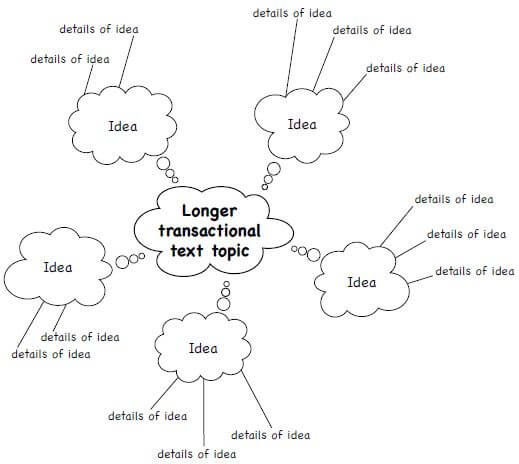
mind map longer transactional2. Idea lists
These help you to quickly write down ideas for each paragraph. Your idea list can be a random or a numbered list. Below are examples of these two different idea lists.
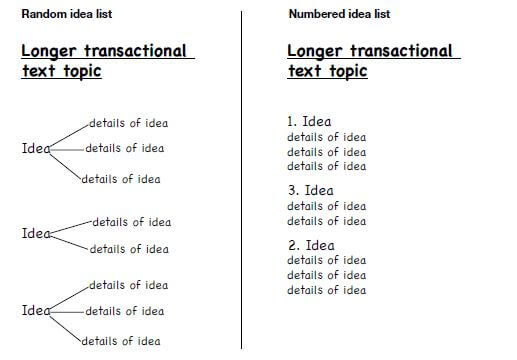
lt listStep 3: Write and edit your draft text
Write a draft of your text, using the ideas from your plan.
Check that the format is right for the text type you have chosen.
Read through each sentence carefully to proofread it. Look for any spelling, punctuation or other language mistakes. Edit your draft by correcting these mistakes and making any other changes you think are needed. This will improve your final text.
Count the number of words in your text and make any changes to meet the word limit. For example, you may need to add some words or use fewer words.
Note – The content of a longer transaction text is between 120-150 words long. In a letter do not add the address and greetings as part of the word count.

Hint:
Language, style and editing.

  • Check that your grammar, spelling and punctuation are correct. Check  that you have chosen a variety of words that are appropriate for your topic
  • It is important to show the marker that you have edited your draft.
  • Think about the purpose and audience of the text type you have chosen. This will guide the register you use in your text.

Step 4: Write your final text
Write your final text by rewriting your draft. Make sure that you make all the changes you marked in your draft so that your final text has no mistakes and clearly expresses all your best ideas. Check again that the text is in the correct format for the text type.
When you have finished your final text, cross out your planning and draft text. If you do not do this, the examiner may mark your draft and not your final text.

Hint:
Final text

  • Rewrite your draft so that it shows all the corrections and improvements you have made. Keep looking back at your drafts as you write your final text so that you copy it correctly.
  • Your writing must be clear ad neat so that it is  easy for the marker to read. Do your best not to make new mistakes as you write your final text.
  • The text must be no shorter than 120 words and no longer than 150 words.

Important differences between formal and informal writing

Formal writingInformal writing
  • Register: Formal
    Expression is formal and polite
  • For example: You are invited to attend a celebration in honor of …
    It is a great pleasure to meet you …
  • Register: Informal
    Expression is informal, chatty and conversational.
  • For example: Please come to a party for …
    Pleased to meet  you…..
  • Words: Written in full; no contractions; no abbreviations
    For example: Write cannot instead of can’t.
    Write holidays instead of hols.
  • Words:  Contractions are acceptable
  • For example: can’s. it’s, don’t.
  • Sentences: Written in full; grammatically correct; no slang
  • For example: Joshua is a pleasant man.
  • Sentences: May use informal of colloquial language.
  • For example: Joshua is a great guy.
  • Use of third person:
  • For example: The Grade 12s are concerned about their examinations
  • Use of first person:
  • For example: We are worried about the exams
  • Passive voice:
  • For example: A complaint has been made by  the parents.
  • Active voice:
  • For example: The parents have made a complaint.

2. Category A

Category A in the exam paper covers the following:

  • Formal letter
  • Informal or friendly letter
  • Formal and informal letter to the press

Each one of these letters has a different format, serves a different purpose and has a different register. For example, the register of a letter to a place of business is formal, while the register of a letter to a friend is informal.

2.1 Writing a formal letter

A formal letter is a communication used in official or important situations, or with people you do not know well.

Hint;
Formal letter

  • A formal letter can have a range of audiences and purposes. For example, it can be a letter of complaint; a business letter; a letter of application; or a covering letter to accompany your CV.
  • The tone of a formal letter must be polite and business-like. A formal register is always used.
  •  A formal letter has its own format. Make sure you lay out your information correctly, such as the addresses; the greeting; the subject line; and the salutations and signature at the end.

eg: A learner’s example of a formal letter using the four steps

Step 1: Choose the text type and topic
This learner chose this question on a formal letter:

An international company is offering a limited number of bursaries to Grade 12 learners for further studies.
Write a letter to the Manager: Human Resources of this company, applying for one of these bursaries. Mention the career you want to study towards and state clearly why you deserve this bursary.

Step 2: Plan the text
Read through the question carefully and look for the key words that would help you think about the contents of your letter. Note these key words in the question above: bursaries, career and deserve this bursary.
The learner used a mind map to plan her formal letter.
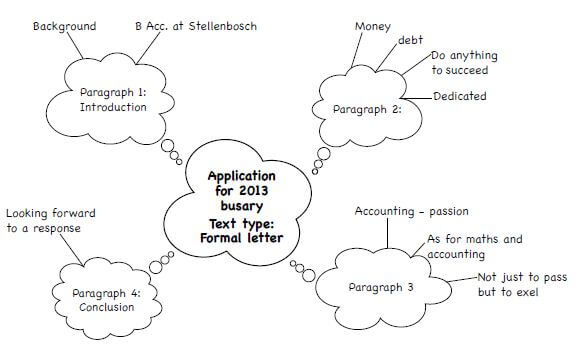
bursary plan
bursary draft
bursary final

Activity: Writing a formal letter
Here are some formal letter topics to help you to practise your writing skills:

  1. Recently your youth club/religious organisation hosted a successful sports day for your community. A local company sponsored prizes for the event.
    You are the chairperson of the organising committee of this event. Write a letter to the manager of the company, telling him/ her about the success of the event and thanking him/her for the sponsorship.
    Note – in question 1 there are two things you must do in your letter: Talk about the success of the event and thank the chairperson for sponsoring the event.
  2. Recently you needed a certain item which you were unable to obtain from stores in your area. However, a shop assistant at a certain store helped you to obtain the item.
    Write a letter to the manager of that store, giving details about
    how the shop assistant helped you and expressing your gratitude.

2.2 Writing an informal letter

An informal letter also called a friendly letter is usually written to friends or family members.

Hint:
Informal letter

  • Informal letters can serve a range of purposes. They can inform; thank; congratulate; offer sympathy; motivate; sympathise; or give advice.
  • The tone of an informal letter must be friendly and chatty. An informal register is always used.
  • An informal letter has its own format. Pay close attention to where you lay out information such as the address, and the type of greeting and salutation you use.

eg: A learner’s example of an informal letter using the four steps

Step 1: Choose the text type and topic
This learner chose this question on an informal or friendly letter:

Your friend has experienced a major disappointment. At the moment he/she is very depressed.
Write a letter to encourage and support your friend.

Step 2: Plan the text
Read the question carefully and find the key words in the question to help
you think of the contents of the letter.
Note the words disappointment and depressed and encourage and support in the question above. The learner used these key words in the mind map to plan his friendly letter.
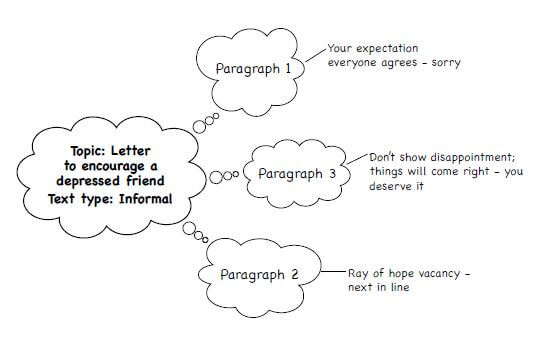
plan friendly letter
draft friendly letter
final friendly
Word count: 146

Activity: Writing an informal letter

Here are some informal letter topics to help you to practise your writing skills:

  1. Your best friend has been selected to represent the province in a certain code of sport.
    Write a letter to congratulate him/her on this achievement and to wish him/her well.
  2. You have won two tickets to a soccer/rugby/cricket match in another province.
    Write a letter inviting a friend to accompany you. Include details such as travel and accommodation arrangements.

2.3 Writing a letter to the press

A letter to the press (such as newspapers) is a formal letter with its own features and format rules.

Hint:
Letter to the press

  • The content of this type of letter usually deals with the writer’s view or opinion about a subject currently being debated in a newspaper.  The purpose of it is for the writer to express his or her opinion about something, for publication in the newspaper.
  • The letter is addressed to the editor of the newspaper, but the main audience of the letter is the readers of that newspaper.
  • A letter to the press has its own format. Pay close attention to where you lay out information such as addresses and the subject line, and the type of greeting and salutation you use.

 eg: A learner’s example of a letter to the press using the four steps

Step 1: Choose the text type and topic
The learner chose to write this letter to the press in the exam:

Respond to a letter in your local newspaper. In this letter a reader argues that the death penalty should be re-introduced.
Take a position in which you either support or reject the reader’s views.

Step 2: Plan the text
Find the key words in the question to help you think of the contents of the letter. The key words in this question are death penalty and support or reject.
The learner has used a list to plan her letter.
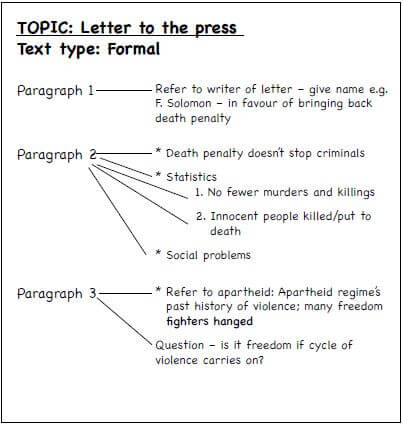
plan letter to the press
draft letter to the press
final letter to press

Activity: Writing a letter to the press

Here are some letter to the press topics to help you to practise your writing skills:

  1. Write a letter to the press in which you support or disagree with raising the age at which a person can obtain a driver’s licence from 18 to 21.
  2. Write a letter to the press in which you take a stand on the issue of violence against women. Propose a way of dealing with people who abuse women.

2.4. Category A checklist

FeaturesDetails of the featureYesNoDon’t know
Exam instructionsI understand the exam instruction for writing a letter
Letter topicI understand the letter topic I have chosen.
Letter typeI understand the features of the letter type I have chosen:

  • Formal letter
  • Informal letter
  • Letter to the press
Content, planning and format
PlanningI can show evidence of planning my letter.
ContentEach point in  my plan is relevant to the letter topic.
I will use these points in my letter.
Purpose/audience

I understand the purpose of the letter type I have chosen
I understand the audience for the letter type I have chosen

Letter structureThe first paragraph of my letter introduces the topic. The paragraphs in the body of my letter relate to the topic. The last paragraph concludes the ideas in my letter.
Sentences

I have not repeated sentences in my paragraphs.
I have used full sentences.

ParagraphsMy ideas link and are well-organised in paragraphs.
Each paragraph contains a new idea. Ideas are not repeated.
The ideas in the paragraphs link to the letter topic.
FormatI have used the correct format for the type of letter I have chosen:

  • The address or addresses are in the correct place.
  • The date is in the correct place.
  • The kind of salutation is the correct one.
  • I have included a subject line, if appropriate.
  • I have signed and written my name, as appropriate.
  • I have left lines open between paragraphs.
Language, style and editing
Choice of words/dictionI have chosen my words carefully to make my letter interesting. My letter has the correct register (formal or informal) for the type of letter i have written.
Verb tensesI have used tenses correctly (past, present or future).
ConcordMy nouns and verbs are in agreement.
SpellingMy spelling is correct.
PunctuationMy sentences start with a capital letter and end with a punctuation mark.
I have used apostrophes correctly.

3. Category B

Category B in the exam covers the following:

  • Curriculum vitae (CV) and covering letter
  • Obituary

Each of these texts has a different format, serves a different purpose and has a different register.

3.1 Writing a CV

A CV is the document you send to businesses when you are applying for a job. It briefly shows the potential employer important information about you, and why you are suitable for the job. This information includes details about your education, qualifications, and previous work experience.
A covering letter is a letter which you send with your CV when applying for a job. A well-written covering letter will improve your chances of being given the job.

Hint:
CV and covering letter

  •  Use formal language ( do not use contractions or slang) and register.
  • The audience for your CV and covering letter is your potential employer.
  • The tone in the CV and covering letter must be factual and direct.
  • The covering letter is a formal letter and uses a formal and polite register.
  • The letter explains briefly why you are applying for the job.

eg: A learner’s example of a CV using the four steps

Step 1: Choose the text type and topic
This learner chose this question on a CV:

You are applying for a job at a supermarket. Write the CV that you will submit. It is not necessary to write a covering letter.

Step 2: Plan the text
Look for the key words in the question that would help you with the content. In the question above, the key words are apply for a job and supermarket. The learner used a mind map to plan his CV.
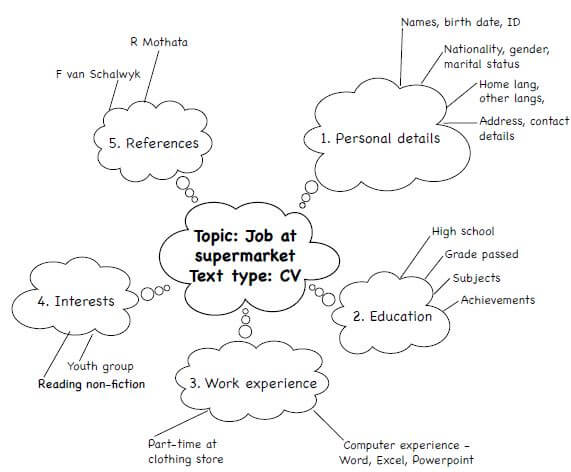
cv plan
cv draft
cv final

Activity: Writing a CV

Here are some CV topics to help you to practise for the exam:

  1. You are in your final year of Grade 12. You intend applying for part-time work. Write the CV that will accompany your application.
  2. You have recently completed a Bachelor of Arts degree in journalism. You have applied for a job at a local newspaper as a journalist. Write the CV that will accompany your application.

3.2 CV checklist

FeaturesDetails of the featureYesNoDon’t know
Text typeI understand the features of a CV and covering letter.
TopicI understand the topic I have chosen.
Content, planning and format
PlanningI can show evidence of planning.
ContentEach point in plan is relevant  to my topic.
I will use these points in my text.
Purpose / Audience

I understand the purpose of a CV and covering letter.
I understand the audience  for my CV and covering letter.

FormatMy CV is correctly laid out:

  • I have written a main heading.
  • My information is organised under the correct sub-headings (personal information; education; employment; interests; and referees).
  • I have listed each piece of information and given it a heading with a colon.

My covering letter uses the correct formal letter features.

Language, style and editing
Choice of words / dictionI have chosen my words carefully to make my CV and covering letter informative and clear.
My ideas link to the topic.
My covering letter has the correct formal register.
LanguageI have checked and corrected my grammar, spelling and punctuation.

3.3 Writing an obituary

An obituary is a text about a person who has recently died. It may be published as an article in a newspaper, or read aloud at a funeral.

Hint:
Obituary

  • An obituary gives basic facts of the deceased person’s life, such as the person’s birth date, the date of death, and where he or she lived. Details of the person’s family may also be included.
  • Stories and memories about the person are included.
  • If appropriate, favorite sayings of the person may be quoted.
  • The tone is sad because a person has died, but also uplifting because it is a celebration of that person’s life.
  • Personal feelings about the deceased person can be included.

eg: A learner’s example of an obituary using the four steps

Step 1: Choose the text type and topic
This learner chose this question on an obituary:

A well-known person in your community has passed away. This person was actively involved in charity work.
Write a suitable obituary, paying tribute to the person.

Step 2: Plan the text
Read the question carefully and note the key words that would help you brainstorm the content of your answer. In the question above, the key words are well-known in your community and charity work.
This learner has used a mind map to plan her essay.
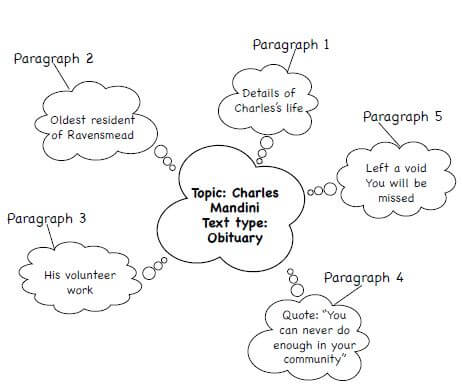
orbituary plan
Step 3: Write and edit a draft text
Write a draft of the text using the ideas from the plan.
Edit the draft by correcting any grammar, punctuation, spelling and format errors.
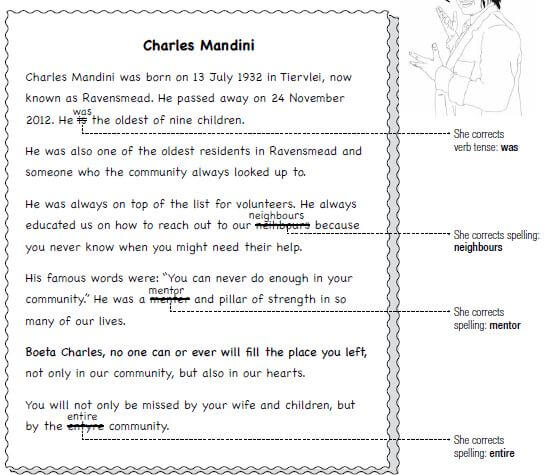
orbituary draft

orbituary final

Activity: Writing an obituary

Here are some topics to help to practise writing obituaries:

  1. A well-known member of your church has died. He/she was responsible for looking after the youth, and frequently helped boys and girls who were in trouble. Write the obituary for this person.
  2. A respected and favourite teacher has died. The principal has approached you as a member of the Learners’ Representative Council to write an obituary. Write the obituary for this teacher.

3.4. Obituary checklist

FeaturesDetails of the featureYesNoDon’t know
Text typeI understand the features of an obituary.
TopicI understand the topic I have chosen.
Content, planning and format
PlanningI can show evidence of planning.
ContentEach point in plan is relevant  to my topic.
I will use these points in my text.
Purpose / Audience

I understand the purpose of an obituary.
I understand the audience  for an obituary.

FormatMy obituary. is correctly laid out:

  • I have written a main heading.
  • I have left a line open between each paragraph.
Language, style and editing
Choice of words / dictionI have chosen my words carefully to make my obituary interesting.
My ideas link to the topic.
LanguageI have checked and corrected my grammar, spelling and punctuation.

4. Category C

Category C in the exam covers the following texts:

  • Review
  • Newspaper article
  • Magazine article
  • Agenda and minutes of a meeting
  • Formal report

Each one of these texts has a different format, serves a different purpose and has a different register.

4.1 Writing a review

A review is a written assessment or account of something. Reviews may be assessments of an artwork; a movie; a book; a restaurant; a performance (a play or a concert); a CD or DVD; or a place.

Hint:
A review

  • You need to show some knowledge of what you are reviewing by giving facts about it or describing aspects of it.
  • You should give your opinion about what you are reviewing. Always give the reasons for your opinion.
  • Reviews can include both positive (good) and negative (bad) points about what you are reviewing. The conclusion of your review  should conclude whether your assessment is mostly positive, or mostly negative.
  • Use creative and interesting language to express your opinion.

eg: A learner’s example of a review using the four steps

Step 1: Choose the text type and topic
This learner chose this question on a review:

Write a review of one of your literature setworks.

Step 2: Plan the text
The learner decided to write a review of Nothing But the Truth, and used a mind map to plan his review.
review plan
Step 3: Write and edit a draft text
Write a draft of the text using the ideas from the plan. Edit the draft by correcting any grammar, punctuation, spelling and format errors.
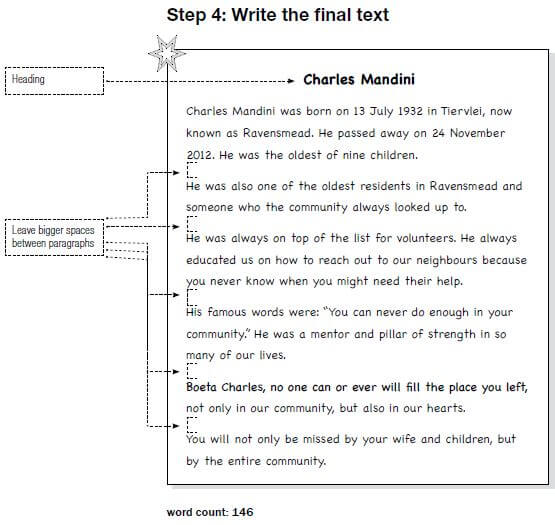
review draft
review final

Activity: Writing a review

Here are some topics to help you to practise writing reviews:

  1. Your high school puts on a play every year. You are a member of the school’s annual magazine committee and have been asked to write a review of this production. Write this review.
  2. Your family often visits a nearby restaurant. A local newspaper is holding a competition for its readers in which they are asked to submit a review. You decide to submit a review of this restaurant.
  3. Write a review of your favourite movie / TV series / radio programme.

4.2 Review checklist

FeaturesDetails of the featureYesNoDon’t know
Text typeI understand the features of a review
TopicI understand the topic I have chosen.
Content, planning and format
PlanningI can show evidence of planning.
ContentEach point in plan is relevant  to my topic.
I will use these points in my text.
Purpose / Audience

I understand the purpose of a review.
I understand the audience  for a review.

FormatMy review is correctly laid out:

  • I have written a main heading.
  • I have left a line open between each paragraph.
Language, style and editing
Choice of words / dictionI have chosen my words carefully to make my review interesting.
My ideas link to the topic.
LanguageI have checked and corrected my grammar, spelling and punctuation.

4.3 Writing a newspaper article

A newspaper article is a piece of writing in a newspaper about a particular subject. Its purpose is to inform or entertain the public.

Hint:
Newspaper article

  • Newspaper are read by people who want information that is easy to read and well presented.
  • There are different kinds of newspaper articles. Some give opinions. Some give advice. Some just present facts.
  • Present the information briefly and logically,.
  • Newspaper articles usually give answers to these questions: who, what, where, when, why, how. Check that your newspaper articles does so.

eg: A learner’s example of a newspaper article using the four steps

Step 1: Choose the text type and topic
This learner chose this question on a newspaper article:

There has been an increase in various types of crime in your area.
Write an article for publication in your local newspaper suggesting ways to avoid becoming a victim of crime.

Step 2: Plan the text
Identify the key words to use in your planning – local newspaper and victim of crime. Then order your ideas logically. The learner used a list to plan her newspaper article.

draft news article
news article draft
news article final

Activity: Writing a newspaper article

Here are some topics to help you to practise writing newspaper articles:

  1. The local newspaper has approached you as a learner in Grade 12 at the local high school. The newspaper would like you to write an article on the pressure of final examinations. Write this article.
  2. An intersection near your house is very dangerous and a number of accidents have occurred there. Your local newspaper has asked you to write an article for the newspaper about this problem.
  3. Write a newspaper article using this headline: Bullying on the increase in local school.

4.4 Newspaper article checklist

FeaturesDetails of the featureYesNoDon’t know
Text typeI understand the features of a newspaper article.
TopicI understand the topic I have chosen.
Content, planning and format
PlanningI can show evidence of planning.
ContentEach point in plan is relevant  to my topic.
I will use these points in my text.
Purpose / Audience

I understand the purpose of a newspaper article.
I understand the audience  for a newspaper article.

FormatMy newspaper article is correctly laid out:

  • I have written a main heading.
  • I have left a line open between each paragraph.
Language, style and editing
Choice of words / dictionI have chosen my words carefully to make my newspaper article interesting.
My ideas link to the topic.
LanguageI have checked and corrected my grammar, spelling and punctuation.

4.5 Writing a magazine article

A magazine article is a piece of writing in a magazine about a particular subject. Like a newspaper article, it aims to entertain and inform the reader.
There are different kinds of magazine articles. Some give opinions. Some give advice. Some just present facts. Read the question carefully to make sure you write the right kind of article.

Hint:
Magazine article

  • Your article should include facts as well as insights.
  • Entertain your audience by writing in an interesting and engaging way.
  • Use descriptions and creative language that readers will enjoy reading.
  • Include quotes of other people’s words to make your article more interesting.
  • Give your article a catchy and creative title.
  • The register for a magazine article can be formal or more informal, depending on the purpose and audience of the article. Read the wuestion closely to make sure you chose the correct register for the topic you are answering.

eg: A learner’s example of a magazine article using the four steps

Step 1: Choose the text type and topic
This learner chose this question on a magazine article:
You are a committee member of your school magazine.
Write an article covering the sporting highlights of 2013.

Step 2: Plan the text
Identify the key words to use in your planning. In the question above,
the key words are school magazine and sporting highlights. The learner used a mind map to plan his magazine article.
maga article plan

Step 3: Write and edit a draft text
Write a draft of the text using the ideas from the plan. Edit the draft
by correcting any grammar, punctuation, spelling and format errors.
mag article draft
mag article final

Activity: Writing a magazine article

Here are some topics to help you to practise writing magazine articles:

  1. You have been approached by the editor of a teenage magazine to write an article on peer pressure. Your focus should be on its effects and how to deal with it. Write this article.
  2. You work on a part-time basis for a small teenage magazine. Your next assignment is to write on changing teenage fashion trends. Write this article.
  3. Many young people overcome difficult circumstances. Write a magazine article about one such person, either real or imaginary.

4.6 Magazine article checklist

FeaturesDetails of the featureYesNoDon’t know
Text typeI understand the features of a magazine article.
TopicI understand the topic I have chosen.
Content, planning and format
PlanningI can show evidence of planning.
ContentEach point in plan is relevant  to my topic.
I will use these points in my text.
Purpose / Audience

I understand the purpose of a magazine article.
I understand the audience  for a magazine article.

FormatMy magazine article is correctly laid out:

  • I have written a main heading.
  • I have left a line open between each paragraph.
Language, style and editing
Choice of words / dictionI have chosen my words carefully to make my magazine article interesting.
My ideas link to the topic.
LanguageI have checked and corrected my grammar, spelling and punctuation.

4.7 Writing an agenda and minutes of a meeting

An agenda is a list of the subjects that will be discussed, as well as the procedure that will be followed, at a meeting. The agenda is prepared before the meeting.
Minutes are a written record of what was discussed and decided at a meeting. Minutes are recorded as a meeting is happening.

Hint:
Agenda and minutes of a meeting.

  •  The items in an agenda are numbered in the sequence they will be discussed in the meeting.
  • When writing minutes, list the facts in point form. Number them in the order they were discussed. Use the past tense.
  • The register of the minutes is formal. They are a record of facts, and you should not give your opinion.
  • Make sure the details of the venue, date and time of the meeting are recorded on the top of both the agenda and the minutes.

eg: A learner’s example of an agenda and minutes using the four steps

Step 1: Choose the text type and topic
This learner chose this question on an agenda and minutes:

You are the secretary of your school’s Learners’ Representative Council. Write the agenda and minutes of a meeting in which the Council discussed latecomers.

Step 2: Plan the text
Identify the key words to use in your planning. In the question above, the key words are Learners’ Representative Council, agenda, minutes and latecomers.
The learner used a list to plan her agenda and minutes.
agenda plan

Step 3: Write and edit a draft text
Write a draft of the text using the ideas from the plan. Edit the draft by correcting any grammar, punctuation, spelling and format errors.
plan draft
agenda final

Activity: Writing an agenda and minutes

Here are some topics to help you to practise writing an agenda and minutes:

  1. As the chairperson of the Matric Committee, it is your task to organise the farewell assembly for the Grade 12s. You call a meeting of all the matrics and discuss this matter, taking various decisions. Write the agenda and minutes of this meeting
  2. You belong to a soccer / netball / athletics club. The next meeting of the committee is due to take place. Two issues are on the agenda: an increase in subscription fees, and the need to expand the clubhouse. Write the agenda and minutes of this meeting.

4.8 Agenda and minutes of a meeting checklist

FeaturesDetails of the featureYesNoDon’t know
Text typeI understand the features of an agenda and minutes.
TopicI understand the topic I have chosen.
Content, planning and format
PlanningI can show evidence of planning.
ContentEach point in plan is relevant  to my topic.
I will use these points in my text.
Purpose / Audience

I understand the purpose of an agenda and minutes.
I understand the audience  for an agenda and minutes.

FormatMy agenda and minutes are correctly laid out:

  • The agenda is written as a list with each new point numbered.
  • The minutes have the correct  sub-headings (opening of meeting; attendance; minutes of last meeting; new matters; date; closing of meeting).
Language, style and editing
Choice of words / dictionI have chosen my words carefully to make my agenda and minutes accurate and informative.
My ideas link to the topic.
LanguageI have checked and corrected my grammar, spelling and punctuation.

4.9 Writing a formal report

A formal report is a written description of a situation or event after an investigation. Formal reports contain information and ideas that can help to resolve difficult situations.

Hint:
Formal report

  • A report must be objective. It must state the facts about the situation that was investigated without giving personal opinions.
  • The report must explain the procedure and findings of the investigation. It must conclude with recommendations for future action.
  • The register must be formal. Use the past tense and the passive voice (It is decided….).

eg: A learner’s example of a formal report using the four steps

Step 1: Choose the text type and topic
This learner chose this question on a formal report:

You are the captain of a popular sporting code at your school. Your team participated in an interschool event during which one of your team members was seriously injured. Your school principal has requested a formal report from you on the incident and the action taken afterwards.
Write the report you will submit.

Step 2: Plan the text
Identify the key words to use in your planning. In the question above, the key words are interschool event, team member injured and action taken afterwards.
The learner has used a mind map to plan his report.
DRAFT REPORT

Step 3: Write and edit a draft text
Write a draft of the text using the ideas from the plan. Edit the draft by correcting any grammar, punctuation, spelling and format errors.
DRAFT REPORT ACTUAL
FINAL REPORT

Activity: Writing a formal report

Here are some topics to help you to practise writing formal reports:

  1. There have been complaints at school that the prices charged by the tuckshop for food and cold drinks are too high.
    The Deputy Principal has asked you to investigate this situation. Write the report that you will submit.
  2. You belong to a community club for the youth. Recently attendance at club events has dropped considerably.
    The youth leader, Mr N. Sithole, has asked you to investigate reasons for this situation. Write the report that you will submit.
4.10 Formal report checklist
FeaturesDetails of the featureYesNoDon’t know
Text typeI understand the features of a formal report.
TopicI understand the topic I have chosen.
Content, planning and format
PlanningI can show evidence of planning.
ContentEach point in plan is relevant  to my topic.
I will use these points in my text.
Purpose / Audience

I understand the purpose of a formal report.
I understand the audience  for a formal report.

FormatMy formal report is correctly laid out:

  • I have given my report a heading.
  • The report has the correct sub-headings (who it is addressed to; terms of reference; procedure; findings; conclusion; recommendations; signed and dated).
Language, style and editing
Choice of words / dictionI have chosen my words carefully to make my newspaper article interesting.report accurate and informative.
LanguageI have checked and corrected my grammar, spelling and punctuation.

5. Category D

Category D in the exam paper covers the following:

  • Dialogue
  • Written interview
  • Written formal and informal speech

Each one of these texts has a different format, serves a different purpose and has a different register.

5.1 Writing a dialogue

A dialogue is a conversation between two or more people. The people speak about a specific topic.

Hint:
Dialogue

  • A dialogue can be either formal or informal. If it is formal, the language must be polite, and no contractions should be used ( for example, write cannot instead of can’t).
  •  It is informal, the register is friendly, and contractions can be used. Use language that makes your dialogue sound like everyday speech between people.
  • Written dialogue looks similar to the text of a play. It can even include directions for the tone of voice and body language, just like a play. Remember to put the speaker’s name with a colon in front of it at the beginning of each new piece of dialogue.
  • Put any directions about movement or feelings in brackets.
  • Make sure the content of the dialogue keeps to the topic.

eg: A learner’s example of a dialogue using the four steps

Step 1: Choose the text type and topic
This learner chose this question on a dialogue:

A close friend has upset you in some way. Write out the dialogue that takes place between you and your friend, in which you discuss with him/her what he/she has done to upset you.
Note: Use the dialogue format.

Step 2: Plan the text
Identify the key words to use in your planning. In the question above, the key words are close friend, upset and discuss.
The learner used a list to plan her dialogue.

Topic: Argument between friends
Text type: Dialogue

  1. Mpho cross: Maths homework copied; didn’t ask
  2. Andile: Not so bad; I would do it for you
  3. Mpho: No privacy; no permission
  4. Andile: Sorry, please forgive
  5. Mpho: Alright, but ask next time!
  6. Andile: Ok, maybe shouldn’t copy – rather ask you to show me.

Step 3: Write and edit a draft text
Write a draft of the text using the ideas from the plan. Edit the draft by correcting any grammar, punctuation, spelling and format errors.
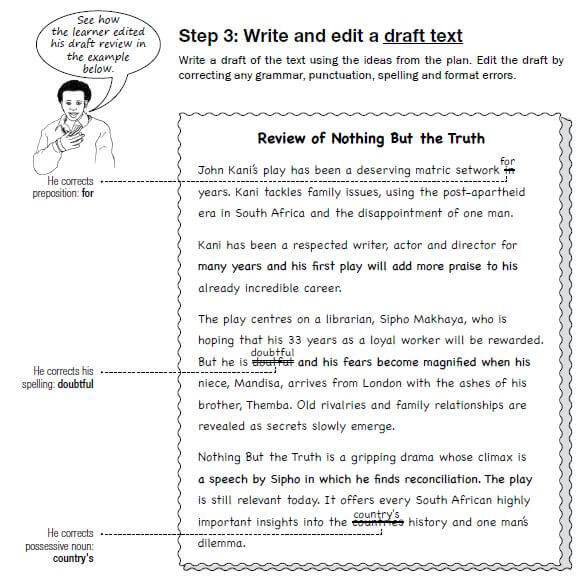
dialogue draft
dialogue final

Activity: Writing a dialogue

Here are some topics to help you to practise writing dialogues:

  1. Eleni and Precious are good friends. However, Precious is going to “bunk” a Science class because she does not understand the subject and also believes the teacher cannot explain anything. Eleni is trying to persuade her not to do this.
    Write the dialogue that takes place between the two friends.
  2. You and your brother share a room. His untidiness is proving to be a problem and you feel you need to tell him about your unhappiness. Write the dialogue that takes place between the two brothers.
5.2 Dialogue checklist
FeaturesDetails of the featureYesNoDon’t know
Text typeI understand the features of a dialogue.
TopicI understand the topic I have chosen.
Content, planning and format
PlanningI can show evidence of planning.
ContentEach point in plan is relevant  to my topic.
I will use these points in my text.
Purpose / Audience

I understand the purpose of a dialogue.
I understand the audience  for a dialogue.

FormatMy dialogue is correctly laid out:

  • I have given my dialogue a heading.
  • I have written the name of the speaker with a colon after his or her name.
  • I have included speech and action directions in brackets.
Language, style and editing
Choice of words / dictionI have chosen my words carefully to make my dialogue interesting and life-like.
My ideas link to the topic.
LanguageI have checked and corrected my grammar, spelling and punctuation.

5.3 Writing an interview

An interview is a formal meeting at which someone is asked questions, such as a job interview. It may also be a TV or radio interview.

Hint:
Interview

  • A written interview in the exam usually uses formal language. Avoid using slang and contractions (for example, write do not instead of don’t).
  • It is written in the format of a dialogue as a record of the actual words said by the people in the interview. Remember to put the speaker’s name with a colon in front of it at the beginning of each new piece of dialogue.
  • The purpose of an interview is to record exactly what each person said as accurately as possible.

eg: A learner’s example of an interview using the four steps

Step 1: Choose the text type and topic
This learner chose this question on an interview:

Your local municipality needs male and female administrative assistants. You have applied for one of these positions. The municipal manager has invited you to an interview. Write out the interview that takes place between the two of you.
NOTE: Use the dialogue format.

Step 2: Plan the text
Read the question carefully. Identify the key words to use in your planning. In this topic, the key words are administrative assistant, municipal manager, interview.
This learner used a mind map to plan his interview.
interview plan

Step 3: Write and edit a draft text
Write a draft of the text using the ideas from the plan. Edit the draft by correcting any grammar, punctuation, spelling and format errors.
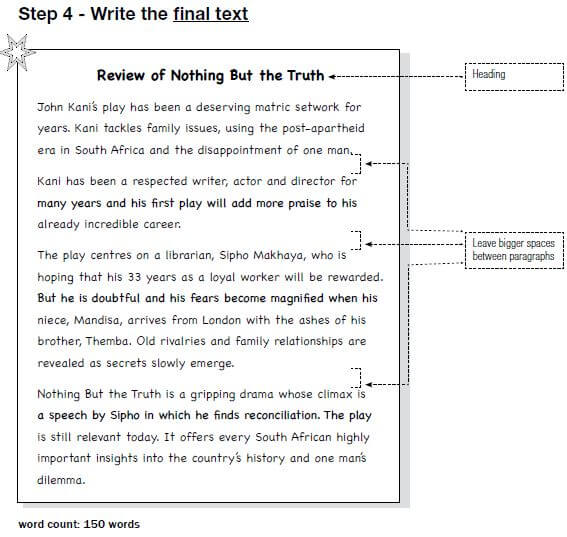
intervieew draft
interview final

Activity: Writing an interview

Here are some topics to help you to practise writing interviews:

  1. You have applied for a bursary from a government department to study at a tertiary institution. The director of this department has called you for an interview.
    Write down the interview that takes place between you and the director.
    NOTE: Use the dialogue format.
  2. You work for a local newspaper and your editor asks you to interview a well-known TV actor who lives near you. Write down the interview that takes place between you and the actor.
    NOTE: Use the dialogue format.
5.4 Interview checklist
FeaturesDetails of the featureYesNoDon’t know
Text typeI understand the features of an interview.
TopicI understand the topic I have chosen.
Content, planning and format
PlanningI can show evidence of planning.
ContentEach point in plan is relevant  to my topic.
I will use these points in my text.
Purpose / Audience

I understand the purpose of an interview.
I understand the audience  for an interview.

FormatMy interview is correctly laid out:

  • I have given my interview a heading.
  • I have written the name of the speaker with a colon after his or her name.
Language, style and editing
Choice of words / dictionI have chosen my words carefully to make interview interesting and life-like.
My ideas link to the topic.
LanguageI have checked and corrected my grammar, spelling and punctuation.

5.5 Writing a speech

A speech is a formal talk given to a group of people about a particular subject.

Hint:
Speech

  • A speech uses formal language. The register of the language is formal but friendly.
  • The tone of a speech should be polite and sincere.
  • In the introduction, the speech should acknowledge individuals or groups of people in the audience. The body of the speech should keep to the topic. The conclusion should thank the audience for their attention.
  • Make your speech come alive by using interesting and creative language. You should aim to inform and entertain your audience.

eg: A learner’s example of a speech using the four steps

Step 1: Choose the text type
This learner chose this question on a speech:

You have been selected to deliver a farewell speech on behalf  of the Grade 12 learners at your final school assembly.
Write out your speech.

Step 2: Plan the text
Read the question carefully. Note the key words in this topic are farewell speech and final school assembly.
This learner used a mind map to plan her speech.
speech plan

Step 3: Write and edit a draft text
Write a draft of the text using the ideas from the plan. Edit the draft by correcting any grammar, punctuation, spelling and format errors.
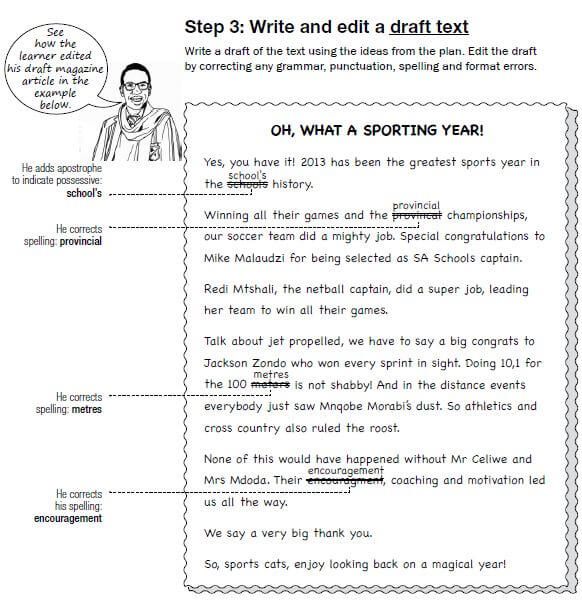
speech draft
speech final

Activity: Writing a speech

Here are some topics to help you to practise writing speeches:

  1.  A well-liked and respected Grade 12 teacher is leaving in the middle of the year. Your principal has asked you to deliver a farewell speech at the end-of-term assembly. Write this speech.
  2. You are the captain of a school sports team. The team has done well, thanks to a good coach. A function has been organised to celebrate the achievements of the team, and you have been asked to give a speech. Write this speech.
  3. A famous person is due to visit your school to deliver a motivational speech. Write the speech that will introduce this person to the school.

5.6 Speech checklist

FeaturesDetails of the featureYesNoDon’t know
Text typeI understand the features of a speech.
TopicI understand the topic I have chosen.
Content, planning and format
PlanningI can show evidence of planning.
ContentEach point in plan is relevant  to my topic.
I will use these points in my text.
Purpose / Audience

I understand the purpose of a speech.
I understand the audience  for a speech.

FormatMy speech is correctly laid out:

  • I have given my speech a heading.
  • I have left a line open between each paragraph.
Language, style and editing
Choice of words / dictionI have chosen my words carefully to make my speech interesting.
The register of my speech is appropriate to the topic.
My ideas link to the topic.
LanguageI have checked and corrected my grammar, spelling and punctuation.

6. What is expected from you in the exam?

In the exam, you must write one longer transactional text that is no less than 120 words long and no more than 150 words long.
The longer transactional text question is worth 30 marks out of 100 marks in the exam. Examiners will give marks for your longer transactional text based on:

  • Content, planning and format (18 marks)
  • Language, style and editing (12 marks)

The exam is 2 1/2 hours long and your should spend about 40 minutes on the longer transactional text question.
The rubric on the next page is a table the examiners use to mark your longer transactional text. It shows the five levels of achievement that the examiners can award a longer transactional text, from the lowest achievement (Inadequate column) to the highest achievement (Exceptional column).
The table also describes the skills the examiner looks for when marking. For example, when marking the text, the examiner will assess how well the ideas relate to the topic, whether they are well planned, and that the format used is correct for the text type.
The rubric is a useful guide for you to use when practising your longer transactional text writing because it reminds you of the skills the examiner will be assessing
when marking your work.

ASSESSMENT RUBRIC FOR LONGER TRANSACTIONAL TEXT – FIRST ADDITIONAL LANGUAGE [30 MARKS]

Criteria Exceptional Skillful Moderate Elementary Inadequate 
CONTENT, PLANNING & FORMAT
Response and ideas;
Organisation of ideas for planning;
Purpose, audience, features/conventions and context
18MARKS
 15-1811-148-105-70-4
  • Outstanding response beyond normal expectations
  • Intelligent and mature ideas
  • xtensive knowledge of features of the type of text
  • Writing maintains focus
  • Coherence in content and ideas
  • Highly elaborated and all details support the topic
  • Appropriate and accurate format
  • Very good response demonstrating good knowledge of features of the type of text
  • Maintains focus – no digressions
  • Coherent in content and ideas, very well elaborated and details support topic
  • Appropriate format with minor inaccuracies
  • Adequate response demonstrating knowledge of features of the type of text
  • Not completely focused – some digressions
  • Reasonably coherent in content and ideas
  • Some details support the topic
  • Generally appropriate format but with some inaccuracies
  • Basic response demonstrating some knowledge of features of the type of text
  • Some focus but writing digresses
  • Not always coherent in content and ideas Few details support the topic
  • Has vaguely applied necessary rules of format
  • Some critical oversights
  • Response reveals no knowledge of features of the type of text
  • Meaning is obscure with major digressions
  • Not coherent in content and ideas
  • Very few details support the topic
  • Has not applied necessary rules of format
LANGUAGE, STYLE & EDITING
Tone, register, style, purpose/effect, audience and context;
Language use and conventions;
Word choice;
Punctuation and spelling
12 MARKS  
10-128-96-74-5 0–3
  • Tone, register, style and vocabulary highly appropriate to purpose, audience and context
  • Grammatically accurate and well-constructed
  • Virtually error-free
  • Tone, register, style and vocabulary very appropriate to purpose, audience and context
  • Generally grammatically accurate and well-constructed
  • Very good vocabulary
  • Mostly free of errors
  • Tone, register, style and vocabulary appropriate to purpose, audience and context
  • Some grammatical errors
  • Adequate vocabulary
  • Errors do not impede meaning
  • Tone, register, style and vocabulary less appropriate to purpose, audience and context
  • Inaccurate grammar with numerous errors
  • Limited vocabulary
  • Meaning obscured
  • Tone, register, style and vocabulary do not correspond to purpose, audience and context
  • Error-ridden and confused
    • Vocabulary not suitable for purpose
  • Meaning seriously impaired
MARK RANGE25-3019-2314-179-120-7

SHORTER TRANSACTIONAL TEXTS GRADE 12 NOTES – LITERATURE STUDY GUIDE


Section C: Shorter transactional texts

This type of transactional text is a short written exchange of information, or a written record of communication. Each type of writing has a specific purpose and format, such as conducting business, or sharing news.
In this section, you will learn the features of each type of shorter transactional text that will earn you marks in the final Grade 12 exam. There are three categories of shorter transactional text as shown above.
The exam will contain one question from each of the three categories listed here.
You will only have to answer ONE of the questions.

1. Steps for writing shorter transactional texts

There are four steps involved in writing a shorter transactional text in an exam:

  • Step 1: Choose your text type
  • Step 2: Plan your topic
  • Step 3: Write a draft of your text and edit it
  • Step 4: Write your final text

Step 1: Choose your text type and topic
There are three categories of shorter transactional texts. The exam has one question for each of these three categories. You only have to answer ONE of the questions. Choose the text type format you know best.

The three categories of shorter transactional texts
1. Category A
  • Advertisement
  • Invitation card
  • Flyer
  • Poster
2. Category B
  • Diary entry
  • Postcard
3. Category C
  • Instructions
  • Directions
Hint
Choosing a shorter transactional text in the exam

  •  Read carefully through all the questions in Section C of the exam paper.
  • Readthrough the questions a second time. Cross out those that don’t interest you.
  • Choose the text type that you know the format of and about which you have the most to write.
  • Focus your attention on the topic you have chosen. Remind yourself of the format of the text type you have chosen. Start planning your text based on your chosen topic.

Step 2: Plan your topic
Remind yourself of the correct format for the text type you have chosen.
Plan your text by writing down your ideas for the content. Remember that your ideas must be relevant to the topic and the text type you have chosen.
There are many different ways to plan your text. For example, you could use a mind map. Use the planning method that works best for you. There are examples of planning tools on page 121.
Once you have written down a few ideas, you can organise them by numbering them in a logical order. This is the order in which your ideas will appear in your text.

Hint:
Content planning and format

  • The content of your text needs to be relevant to the topic you choose. Avoid repeating the same ideas.
  • You need to show evidence that you have planned your text. The examiner will want to see your crossed-out planning notes or mind map in your exam answer book.
  • Make sure you know the correct format of the text type you have chosen. This will help focus your ideas and your planning.
Ways to plan shorter transactional text

A plan helps you think about what ideas you want to include in your text. It also helps you put your ideas into a clear structure. You will earn marks for showing your planning.
You can use a mind map or an ideas list to plan your text.

1. Mind maps
These are diagrams of ideas. The title is in the centre with branches coming from it showing thoughts and ideas. Below is an example of a mind map.
mind map str

2. Idea lists
These help you to quickly write down ideas for each paragraph. Write down your ideas as they come to you and then organise them ideas in a logical order. Below is an example.
idea list stt

Step 3: Write and edit your draft text
Write a draft of your text, using the ideas from your plan.
Check that the format is right for the text type you have chosen.
Read through each sentence carefully to proofread it. Look for any spelling, punctuation or other language mistakes. Edit your draft by correcting these mistakes and making any other changes you think are needed. This will improve your final text.
Count the number of words in your text and make any changes to meet the word limit. For example, you may need to add some words or use fewer words.

Hint:
Language, style and editing

  • Check that your grammar, spelling and punctuation are correct. Check that you have chosen a variety of words that are appropriate for your topic.
  • It is important to show the marker that you have edited your draft. Think about the purpose and audience of the text type you have chosen. This will guide the register you use in your text.

Step 4: Write your final text
Write your final text by rewriting your draft. Make sure that you make all the changes you marked in your draft so that your final text is error-free and clearly expresses all your best ideas. Check again that the text is in the correct format for the text type.
When you have finished your final text, cross out your planning and draft text. If you do not do this, the examiner may mark your draft and not your final text.

Hint:
Final text

  • Rewrite your draft so that it shows all the corrections and improvements you have made. Keep looking back at your draft as you write your final text so that you can copy it correctly.
  • Your writing must be clear and neat so that it is easy for the marker to read. Do your best not to make new mistakes as you write your final text.
  • The text must be shorter than 80 words and no longer than 100 words.

Important differences between formal and informal writing

Formal writingInformal writing
  • Register: Formal
    Expression is formal and polite
  • For example: You are invited to attend a celebration in honor of …
    It is a great pleasure to meet you …
  • Register: Informal
    Expression is informal, chatty and conversational.
  • For example: Please come to a party for …
    Pleased to meet  you…..
  • Words: Written in full; no contractions; no abbreviations
    For example: Write cannot instead of can’t.
    Write holidays instead of hols.
  • Words:  Contractions are acceptable
  • For example: can’s. it’s, don’t.
  • Sentences: Written in full; grammatically correct; no slang
  • For example: Joshua is a pleasant man.
  • Sentences: May use informal of colloquial language.
  • For example: Joshua is a great guy.
  • Use of third person:
  • For example: The Grade 12s are concerned about their examinations
  • Use of first person:
  • For example: We are worried about the exams
  • Passive voice:
  • For example:

2. Category A

Category A in the exam paper covers the following texts:

  • Advertisement
  • Invitation card
  • Flyer
  • Poster

2.1 Writing an advertisement

Advertisements aim to sell products or services. They are found in electronic media, such as on TV, radio and websites; in the cinema; and through sms’s to cellphones.
They are also found in print media. Printed adverts can take the form of flyers, posters and billboards; catalogues and advertising supplements; and adverts placed in newspapers and magazines.

Hint:
Features of an advertisement

  • Use creative language to get the reader’s attention. Use figures of speech, puns and a catchy headline. Include information about the product or service.
  • Use a friendly and engaging tone. The aim is to persuade readers that they need the product or service.
  • You can include a special offer (such as a discount or free quote) to make readers feel they are getting a good deal. This makes them more likely to buy your product or service .
  • Use an interesting and eye-catching layout. Use different sized writing (fonts) to get the readers’ attention.

eg: A learner’s example of  an advertisement using the four steps

Step 1: Choose the text type
This learner chose this question on an advertisement:

Your family runs a home business making products such as toys, ethnic jewellery and clothing. Write out the advertisement to promote the sale of ONE of the products to tourists.
You should include the following in your advertisement: a brand name, a slogan, details of the product and where to find it.
Note: Do not include illustrations.

Step 2: Plan the text
Read the question carefully. Identify the key words to use in your planning.
In this topic, the key words are business, toys, tourists, brand name, slogan and details of product.
This learner used a mind map to plan his advertisement:
ad plan

advert planadvert planadvert planStep 3: Write and edit the draft text
Write a draft of the text using the ideas from the plan. Edit the draft by correcting any grammar, punctuation, spelling and format errors.
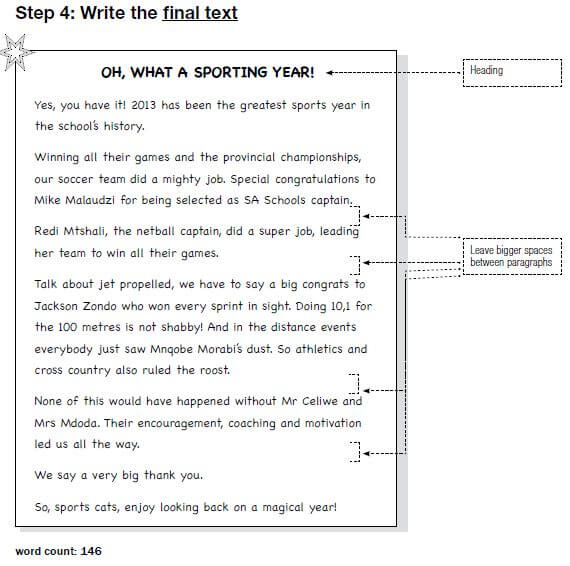
ad draft
ad final

Activity: Writing an advertisement

Here are some topics to help you to practise writing advertisements:

  1. Your neighbour is a businessman who has developed a new hair care product. He wishes to advertise the product in a national magazine. He has asked you to write the advertisement.
    Write this advertisement.
    Note: Do not include illustrations.
  2. You help your family run a small family business, but sales have recently decreased. Your father has asked you to write an advertisement that will promote the business.

2.2 Advertisement checklist

FeaturesDetails of the featureYesNoDon’t know
Text typeI understand the features of an advertisement.
TopicI understand the topic I have chosen.
Content, planning and format
PlanningI can show evidence of planning.
ContentEach point in plan is relevant  to my topic.
I will use these points in my text.
Purpose / AudienceI understand the purpose of an advertisement.
I understand the audience  for an advertisement.
FormatMy layout is eye catching and makes the information easy to understand.
Language, style and editing
Choice of words / dictionI have chosen my words carefully to make my  text interesting.
My ideas link to the topic.
LanguageI have checked and corrected my grammar, spelling and punctuation.

2.3 Writing an invitation card

An invitation card is a written request inviting someone to attend a specific occasion.

Hint:
Features of an invitation card

  • Use formal language
  • The invitation must briefly provide the information the guests need to know about the event to which you are inviting them.

 Eg: A learner’s example of an invitation card using the four steps
Step 1: Choose the text type and topic

This learner chose this question on an invitation card:

You have been asked to invite guests to your school’s prize-giving function. A former principal of the school will be the guest speaker.
Write out the invitation card you will send to the guests.
Note: Do not include illustrations or drawings.

Step 2: Plan the text
Read the question carefully. Identify the key words to use in your planning. In this topic, the key words are school’s prize-giving function, former principal, guest speaker and invitation card to guests.
This learner used a list to plan her invitation card.
invitation card plan
Step 3: Write and edit the draft text
Write a draft of the text using the ideas from the plan. Edit the draft by correcting any grammar, punctuation, spelling and format errors.
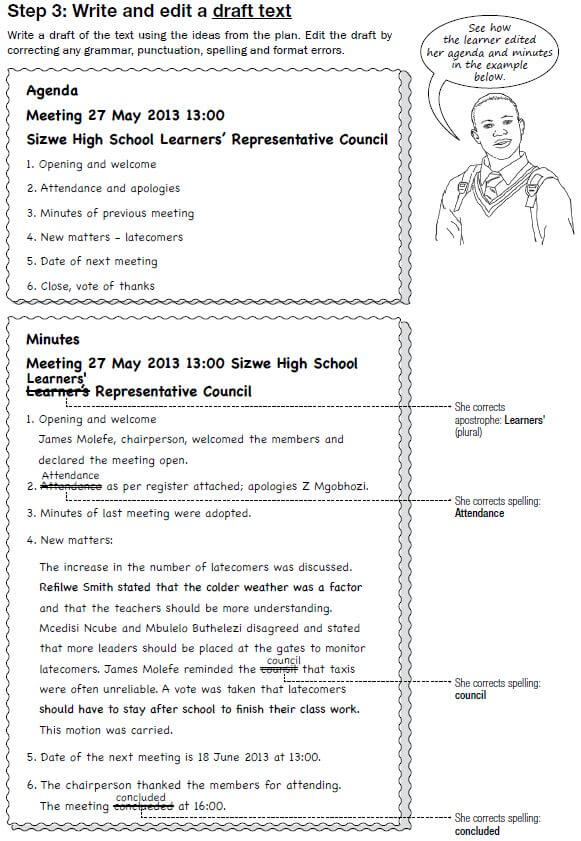
invitation card draft
invitation card final

Activity: Writing an invitation card

Here are some topics to help you to practise writing invitation cards:

  1. The couple living next door to you has been married for 50 years. They are planning to celebrate this by hosting a formal function. You have been asked to prepare the formal invitation.
    Write the invitation that will be sent to their families and friends.
    Note: Do NOT include illustrations.
  2. Your school’s Life Orientation teacher has invited a well-known personality to give a motivational talk to the learners at your school. As chairperson of your school’s Learners’ Representative Council, you wish to invite the chairpersons of the Learners’ Representative Councils of neighboring schools.
    Write the invitation you will send to them.

2.4 Invitation card checklist

FeaturesDetails of the featureYesNoDon’t know
Text typeI understand the features of an invitation card.
TopicI understand the topic I have chosen.
Content, planning and format
PlanningI can show evidence of planning.
ContentEach point in plan is relevant  to my topic.
I will use these points in my text.
Purpose / AudienceI understand the purpose of an invitation card.
I understand the audience  for my invitation card.
FormatMy invitation card has a clear heading and the details of the event are listed below using colons.
Language, style and editing
Choice of words / dictionI have chosen my words carefully to make my  text interesting.
My ideas link to the topic.
LanguageI have checked and corrected my grammar, spelling and punctuation.

2.5 Writing a flyer

A flyer is a cheap and simple form of advertising. It is usually a one-page leaflet that is handed out to people.

Hint:
Features of a flyer

  • Briefly state in simple language the most  important information the readers need to know about the product/service or event.
  • You can include a special offer (such as a discount or free quote) to make the readers feel they are getting a good deal. This makes them more likely to buy your product or use your service.
  • The layout  should be interesting and eye-catching. Use different sized writings (fonts) to get the readers’ attention.

eg: A learner’s example of a flyer using the four steps
Step 1: Choose the text type and topic
This learner chose this question on a flyer:

You employed a painter, Isaac Khumalo, to paint your house. His work was of a high standard. He now wishes to promote his business and has asked you to write a flyer. 
Write out this flyer.
Note: Do not include illustrations or drawings.

Step 2: Plan the text
Read the question carefully. Identify the key words to use in your planning. In this topic, the key words are painter, high standard, promote and flyer.
The learner has used a mind map to plan her flyer.
flyer plan
Step 3: Write and edit the draft text
Write a draft of the text using the ideas from the plan. Edit the draft by correcting any grammar, punctuation, spelling and format errors.
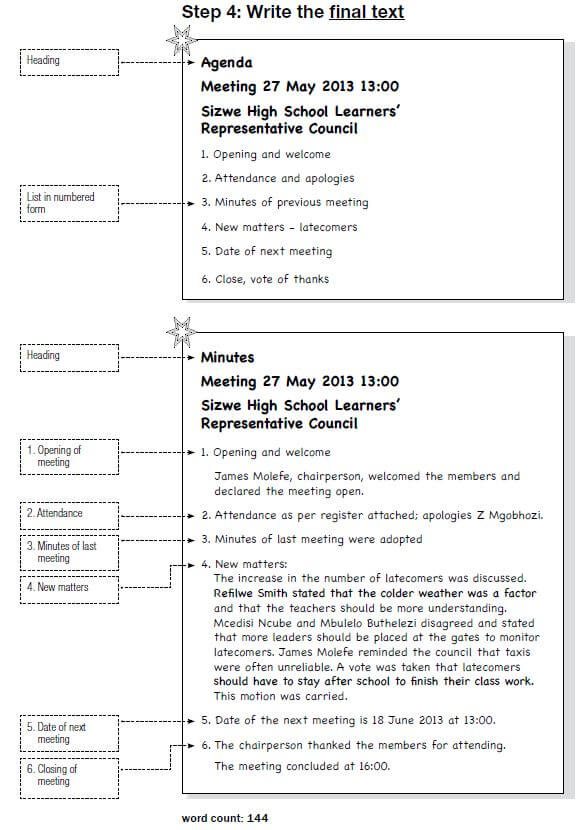
flyer draft
flyer final

Activity: Writing a flyer

Here are some topics to help you to practise writing flyers:

  1. You live next door to the Public Relations Officer for your town/ city/suburb. He/she is organising a flea market to raise funds to beautify the town/city/suburb. Write this flyer.
  2. You are a Grade 12 learner who is excellent at Maths. You wish to earn some pocket money by offering extra lessons. Write a flyer in which you advertise your services.
  3. Your uncle has a small gardening service. However, he needs more customers and he has asked you for help. Write a flyer in which you promote his business.

2.6 Flyer checklist

FeaturesDetails of the featureYesNoDon’t know
Text typeI understand the features of a flyer.
TopicI understand the topic I have chosen.
Content, planning and format
PlanningI can show evidence of planning.
ContentEach point in plan is relevant  to my topic.
I will use these points in my text.
Purpose / AudienceI understand the purpose of a flyer.
I understand the audience  for a flyer.
FormatMy flyer has a clear heading.
My layout is eye-catching and the information is easy to undersatnd.
Language, style and editing
Choice of words / dictionI have chosen my words carefully to make my  text interesting.
My ideas link to the topic.
LanguageI have checked and corrected my grammar, spelling and punctuation.

2.7 Writing a poster

A poster is a large printed notice in a public place. It is a simple form of advertising that uses bold lettering and an interesting layout to catch people’s attention.

Hint:
Features of a poster.

  • Briefly state in simple language the most important information the readers need to know about the product/ service/ event.
  • Use large lettering for the headline to catch the readers’ attention.

 eg: A learner’s example of a poster using the four steps
Step 1: Choose the text type and topic
This learner chose this question on a poster:

Your friends have formed a band and have been offered the opportunity to play at a local restaurant.
Write the poster that promotes their appearance at this venue.
Note: No drawings or illustrations are required.

Step 2: Plan the text
Read the question carefully. Identify the key words to use in your planning. In this topic, the key words are band, local restaurant and poster.
The learner has used a mind map to plan his poster.
poster plan
Step 3: Write and edit the draft text
Write a draft of the text using the ideas from the plan. Edit the draft by correcting any grammar, punctuation, spelling and format errors.
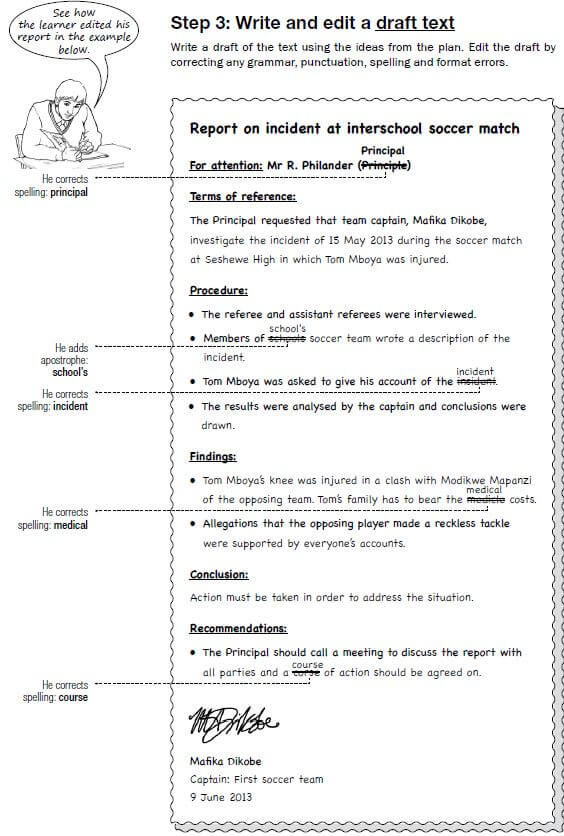
poster draft
poster final
advert draft 1

Activity: Writing a poster

Here are some topics to help you to practise writing posters:

  1. You live next door to the local councillor for your ward/suburb. He/she is organising a flea market to raise funds to beautify the suburb. Write out this poster.
    Note: No illustrations are required.
  2. Road deaths are a continual source of worry for traffic authorities. The campaign that they have come up with to make motorists obey the rules of the road and drive safely is called Arrive Alive.
    Write out a poster for Arrive Alive.
    Note: No illustrations are required.

2.8 Poster checklist

FeaturesDetails of the featureYesNoDon’t know
Text typeI understand the features of a poster.
TopicI understand the topic I have chosen.
Content, planning and format
PlanningI can show evidence of planning.
ContentEach point in plan is relevant  to my topic.
I will use these points in my text.
Purpose / AudienceI understand the purpose of a poster.
I understand the audience  for my poster.
FormatI have used a bold heading and laid out the information in a clear and eye-catching way.
Language, style and editing
Choice of words / dictionI have chosen my words carefully to make my  text interesting.
My ideas link to the topic.
LanguageI have checked and corrected my grammar, spelling and punctuation.

3. Category B

Category B in the exam paper covers the following texts:

  • Diary entry
  • Postcard

3.1 Writing a diary entry
A diary entry is a personal account of events, thoughts and feelings that the writer has experienced.

Hint:
Features of a diary entry

  • The language is informal and the tone is chatty. Feel free to express emotions.
  • Use the first person ie: I and me.
  • The audience fro a diary entry is usually only the writer

Eg: A learner’s example of a diary entry using the four steps
Step 1: Choose the text type and topic
This learner chose this question on a diary entry:

You are in Grade 12 and you have been experiencing mixed feelings about the final examinations.
Write down your diary entries for the following TWO days:

  • The day before the examination starts
  • The last day of the examination

Step 2: Plan the text
Read the question carefully. Identify the key words to use in your planning. In this topic, the key words are mixed feelings, final examinations, day before, last day of the examination and diary entries.
The learner has used a mind map to plan her diary entries.
diary entry plan
Step 3: Write and edit the draft text
Write a draft of the text using the ideas from the plan. Edit the draft by correcting any grammar, punctuation, spelling and format errors.
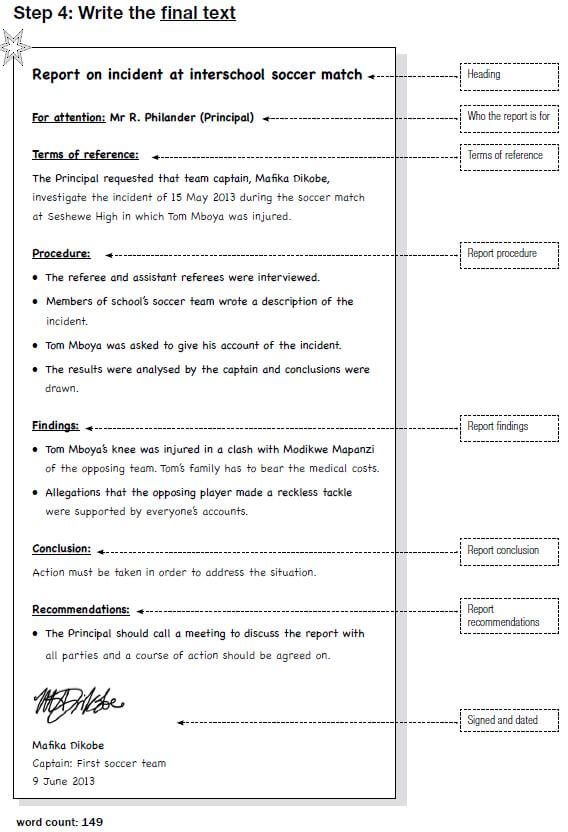
diary entry draft and final

Activity: Writing a diary entry

Here are some topics to help you to practise writing diary entries:

  1. You have gone through a difficult period recently. You recorded your experience in a diary.
    Write your diary for two of the difficult days.
  2. Imagine that you played very well in a sports match for the school. Write a dairy entry that describes your feelings.
  3. You and your best friend have had an argument. Write the diary entry for two consecutive days.

3.2 Diary entry checklist

FeaturesDetails of the featureYesNoDon’t know
Text typeI understand the features of a diary entry.
TopicI understand the topic I have chosen.
Content, planning and format
PlanningI can show evidence of planning.
ContentEach point in plan is relevant  to my topic.
I will use these points in my text.
Purpose / AudienceI understand the purpose of a diary entry.
I understand the audience  for my diary entry.
FormatI have put a date above each diary entry.
I have clearly separated each diary entry by leaving a line open.
Language, style and editing
Choice of words / dictionI have chosen my words carefully to make my  text interesting.
My ideas link to the topic.
LanguageI have checked and corrected my grammar, spelling and punctuation.

3.3 Writing a postcard

A postcard is a short message sent by post that briefly tells someone your news and lets them know you are thinking of them.

Hint:
Features of a postcard

  • The language is informal and the tone is chatty and friendly. Use interesting language to describe how and where you are.
  • Always put the date and place at the top of the postcard. If you are writing it to someone close to you, use an affectionate salutation at the end (lots of love).

 Eg: A learner’s example of a postcard using the four steps
Step 1: Choose the text type and topic
This learner chose this question on a postcard:

You are far away from home at a beautiful holiday resort.
Write the text (words) of a postcard that you would send to a family member describing your experiences.
Note: Do not include illustrations.

Step 2: Plan the text
Read the question carefully. Identify the key words to use in your planning. In this topic, the key words are postcard, far away from home, beautiful holiday resort, family member and your experiences.
The learner has used a mind map to plan his postcard.
postcard plan
Step 3: Write and edit the draft text
Write a draft of the text using the ideas from the plan. Edit the draft by correcting any grammar, punctuation, spelling and format errors.
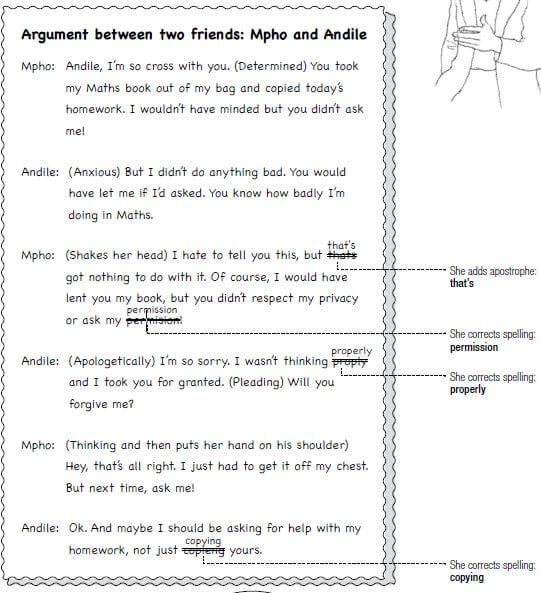
postcard draft
postcard final

Activity: Writing a postcard

Here are some topics to help you to practise writing postcards:

  1. You are on holiday with school friends after completing Grade 12.
    Write a postcard to your family indicating that all is well and that they need not worry about your fellow matriculants misbehaving.
  2. You are on holiday in a resort in South Africa. At the last moment you decide to stay on longer and then travel elsewhere. Your family, however, is expecting your return.
    Write a postcard to your family explaining your decision.
  3. You have been sponsored to stay on a farm and learn another language.
    Write a postcard to your sponsor telling him or her of your progress and your experiences.

3.4 Postcard checklist

FeaturesDetails of the featureYesNoDon’t know
Text typeI understand the features of a postcard.
TopicI understand the topic I have chosen.
Content, planning and format
PlanningI can show evidence of planning.
ContentEach point in plan is relevant  to my topic.
I will use these points in my text.
Purpose / AudienceI understand the purpose of a postcard.
I understand the audience  for my postcard.
FormatThe date and place are at the top of the postcard
I signed off with an appropriate salutation.
Language, style and editing
Choice of words / dictionI have chosen my words carefully to make my  text interesting.
My ideas link to the topic.
LanguageI have checked and corrected my grammar, spelling and punctuation.

4. Category C

Category C in the exam paper covers the following texts:

  • Instructions
  • Directions

4.1 Writing instructions
The purpose of instructions is to explain how something is done.

Hint:
Features of instructions

  •  Instructions explain how to do something step by step. All information should help the reader following these instructions to do what is being explained.
  • The language should be formal and the tone factual and informative.
  • Organise the instructions so they follow each other in a logical order in a point-form list.

eg: A learner’s example of instructions using the four steps
Step 1: Choose the text type and topic
This learner chose this question on instructions.

You have been asked by your sports coach to help if a mouth-to-mouth emergency situation occurs on the sports field. He has asked you to write a set of instructions on mouth-to-mouth artificial respiration.
These instructions will be distributed to all athletes. Write out this set of instructions.

Step 2: Plan the text
Read the question carefully. Identify the key words to use in your planning. In this topic, the key words are emergency situation; mouth-to-mouth artificial respiration; athletes; and set of instructions.
The learner has used a list to plan her instructions.
instructions plan
Step 3: Write and edit the draft text
Write a draft of the text using the ideas from the plan. Edit the draft by correcting any grammar, punctuation, spelling and format errors.
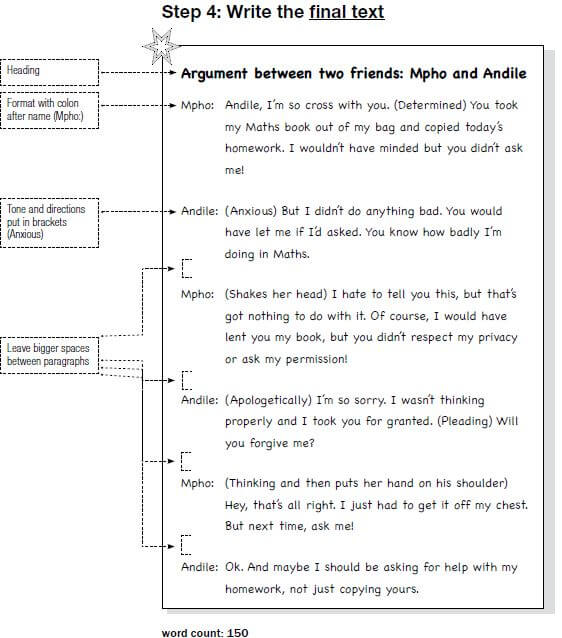
instructions draft
instructions final

Activity: Writing instructions

Here are some topics to help you to practise writing instructions:

  1. You have been asked to do a short oral presentation for a Life Orientation lesson on how to lead a healthy, balanced life. Write down a list of 6–7 tips you would give your classmates in your presentation.
  2. Your younger brother has asked you to help him cover his school exercise books. Write out a set of instructions that will enable him to carry out this task.
  3. Your school wishes to start a recycling programme. Your principal has asked you, as a member of the Learners’ Representative Council, for assistance. Write out a set of instructions that will be posted on the wall of every classroom.

4.2 Instructions checklist

FeaturesDetails of the featureYesNoDon’t know
Text typeI understand the features of instructions.
TopicI understand the topic I have chosen.
Content, planning and format
PlanningI can show evidence of planning.
ContentEach point in plan is relevant  to my topic.
I will use these points in my text.
Purpose / AudienceI understand the purpose of instructions.
I understand the audience  for my instructions.
FormatI have given my instructions a heading.
The instructions are written as a point-form list.
Language, style and editing
Choice of words / dictionI have chosen my words carefully to make my  text interesting.
My ideas link to the topic.
LanguageI have checked and corrected my grammar, spelling and punctuation.

4.3 Writing directions

Directions explain to someone how to get to a certain place.

Hint:
Features of directions

  • Directions explain how to get to a place in a step-by-step way. All information should help the reader following these instructions to get this place.
  • The language should be formal and the tone factual and informative.
  • Organise the directions so they follow each other in a logical order in point-form list.

 eg: A learner’s example of directions using the four steps
Step 1: Choose the text type and topic
This learner chose this question on directions:

You and your friends have decided to meet at your house to celebrate the end of the examinations. Write out the directions you will give your friends to travel from the school to your house.
Note: In your response, you must include some distances, turns and landmarks. Do not include sketches or maps.

  • If you live in an urban area, include landmarks like a fast-food outlet, an intersection or a park.
  • If you live in a rural area, include landmarks like a bridge, a river, or a road sign.

Step 2: Plan the text
Read the question carefully. Identify the key words to use in your planning. In this topic, the key words are your friends, directions, from the school to your house, distances, turns and landmarks.
The learner has used a list to plan his directions.
directions plan
Step 3: Write and edit the draft text
Write a draft of the text using the ideas from the plan. Edit the draft by correcting any grammar, punctuation, spelling and format errors.
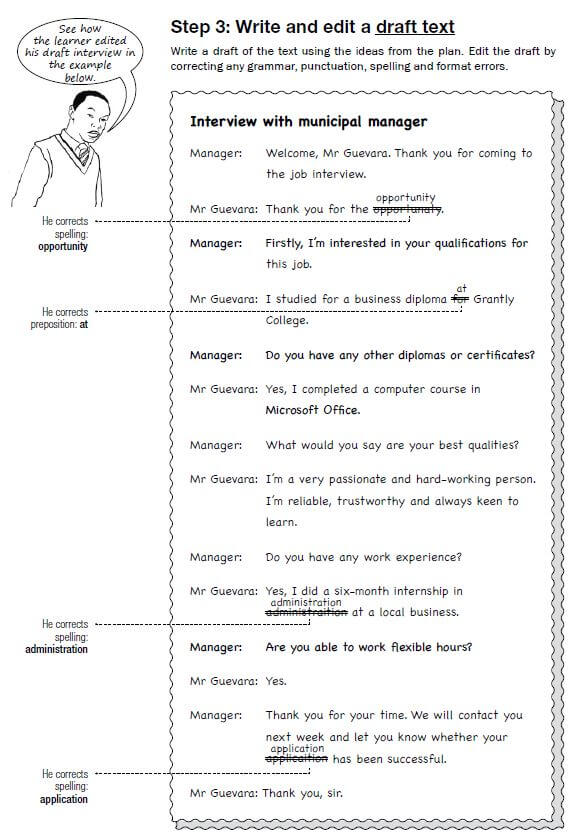
directions draft
directions final

Activity: Writing directions

Here are some directions topics to help you to practise your writing skills:

  1. A friend from another province will be in your town and would like to visit you at your home.
    Write the directions from a nearby bus stop to your house. You must include at least three turns and two landmarks (e.g. a school, a shop, a sports field) in your response.
    Note: do not include illustrations or drawings.
  2. Study the map on page 159. You are shopping at Lucky’s Supermarket (point X on the map) when a customer asks you for directions to the post office (point Y on the map).
    Write out the directions you will give to the customer. In your response you must refer to the streets and landmarks on the route you choose.
    directions question

4.4 Directions checklist

FeaturesDetails of the featureYesNoDon’t know
Text typeI understand the features of directions.
TopicI understand the topic I have chosen.
Content, planning and format
PlanningI can show evidence of planning.
ContentEach point in plan is relevant  to my topic.
I will use these points in my text.
Purpose / AudienceI understand the purpose of directions.
I understand the audience  for my directions.
FormatI have given my directions a heading.
The directions are written as a point-form list.
Language, style and editing
Choice of words / dictionI have chosen my words carefully to make my  text interesting.
My ideas link to the topic.
LanguageI have checked and corrected my grammar, spelling and punctuation.

What is expected from you in the exam?

In the exam, you must write one shorter transactional text that is no less than 80 words long and no more than 100 words long.
The shorter transactional text question is worth 20 marks out of 100 marks in the exam. Examiners will give marks for your shorter transactional text based on:

  • Content, planning and format (12 marks)
  • Language, style and editing (8 marks)

The exam is 2 1/2 hours long and you should spend about 30 minutes on the shorter transactional text question.
The rubric on the next page is a table the examiners use to mark your shorter transactional text. It shows the five levels of achievement that the examiners can award a shorter transactional text, from the lowest achievement (Inadequate column) to the highest achievement (Exceptional column).
The table also describes the skills the examiner looks for when marking. For example, when marking the text, the examiner will assess how well the ideas relate to the topic, whether they are well planned, and that the format used is correct for the text type.
The rubric is a useful guide for you to use when practicing your shorter transactional text writing because it reminds you of the skills the examiner will be assessing when marking your work.

ASESSMENT RUBRIC FOR SHORTER TRANSACTIONAL TEXT – FIRST ADDITIONAL LANGUAGE [20 MARKS]

Criteria Exceptional Skilful Moderate Elementary Inadequate 
CONTENT, PLANNING & FORMAT
Response and ideas;
Organisation of ideas for planning;
Purpose, audience, features/conventions and context
12MARKS
 10-128-96-74-50-3
  • Outstanding response beyond normal expectations
  • Intelligent and mature ideas
  • xtensive knowledge of features of the type of text
  • Writing maintains focus
  • Coherence in content and ideas
  • Highly elaborated and all details support the topic
  • Appropriate and accurate format
  • Very good response demonstrating good knowledge of features of the type of text
  • Maintains focus – no digressions
  • Coherent in content and ideas, very well elaborated and details support topic
  • Appropriate format with minor inaccuracies
  • Adequate response demonstrating knowledge of features of the type of text
  • Not completely focused – some digressions
  • Reasonably coherent in content and ideas
  • Some details support the topic
  • Generally appropriate format but with some inaccuracies
  • Basic response demonstrating some knowledge of features of the type of text
  • Some focus but writing digresses
  • Not always coherent in content and ideas Few details support the topic
  • Has vaguely applied necessary rules of format
  • Some critical oversights
  • Response reveals no knowledge of features of the type of text
  • Meaning is obscure with major digressions
  • Not coherent in content and ideas
  • Very few details support the topic
  • Has not applied necessary rules of format
LANGUAGE, STYLE & EDITING
Tone, register, style, purpose/effect, audience and context;
Language use and conventions;
Word choice;
Punctuation and spelling
8 MARKS
 7-85-643 0–2
  • Tone, register, style and vocabulary highly appropriate to purpose, audience and context
  • Grammatically accurate and well-constructed
  • Virtually error-free
  • Tone, register, style and vocabulary very appropriate to purpose, audience and context
  • Generally grammatically accurate and well-constructed
  • Very good vocabulary
  • Mostly free of errors
  • Tone, register, style and vocabulary appropriate to purpose, audience and context
  • Some grammatical errors
  • Adequate vocabulary
  • Errors do not impede meaning
  • Tone, register, style and vocabulary less appropriate to purpose, audience and context
  • Inaccurate grammar with numerous errors
  • Limited vocabulary
  • Meaning obscured
  • Tone, register, style and vocabulary do not correspond to purpose, audience and context
  • Error-ridden and confused
  • Vocabulary not suitable for purpose
    • Meaning seriously impaired
MARK RANGE17-2013-1510-117-80-5

AUTO WRECK BY KARL SHAPIRO GRADE 12 NOTES – LITERATURE; POETRY STUDY GUIDE

AUTO WRECK BY KARL SHAPIRO GRADE 12 NOTES – LITERATURE; POETRY STUDY GUIDE “Auto Wreck” is in free verse with four stanzas. There are two themes that run through the poem. The first is the detached efficiency of the ambulance in motion, contrasted by the second theme, the fragile, easily broken humans, who are cut down randomly and at times violently.

Auto wreck by Karl Shapiro

Auto wreck was written by Karl Shapiro (1913-2000). He was an American poet who began writing poetry when he was fighting in the Second World War (1939 – 1945). He sent his poems back to America, where his fiancée had them published. He wrote Auto wreck in 1941, during the war.
He is famous for writing poetry about ordinary things such as flies, cars, supermarkets and this car crash. Shapiro was awarded the Pulitzer Prize for Poetry in 1945 and was the American Poet Laureate in 1946 and 1947.

Note

  • An ‘auto-wreck’ is how Americans refer to a acar-crash.

1. Themes

The main theme of the poem is death, and the uncertainty of life.
The poem shows how uncertain and insecure life can be. None of us knows when and how we will die. The people in the cars were probably not thinking at all about life and death when suddenly the crash happened. In a moment, their lives have been changed by horrible injuries, or have been taken away altogether. The poet has no reasonable explanation for this.

Auto wreck by Karl Shapiro

Stanza 1Its quick soft silver bell beating, beating,
And down the dark one ruby flare
Pulsing out red light like an artery,
The ambulance at top speed floating down
Past beacons and illuminated clocks
Wings in a heavy curve, dips down,
And brakes speed, entering the crowd.


 5

Stanza 2The doors leap open, emptying light;
Stretchers are laid out, the mangled lifted
And stowed into the little hospital.
Then the bell, breaking the hush, tolls once,
And the ambulance with its terrible cargo
Rocking, slightly rocking, moves away,
As the doors, an afterthought, are closed.


10

Stanza 3We are deranged, walking among the cops
Who sweep glass and are large and composed.
One is still making notes under the light.
One with a bucket douches ponds of blood
Into the street and gutter.
One hangs lanterns on the wrecks that cling,
Empty husks of locusts, to iron poles.
15


20

Stanza 4Our throats were tight as tourniquets,
Our feet were bound with splints, but now,
Like convalescents intimate and gauche,
We speak through sickly smiles and warn
With the stubborn saw of common sense,
The grim joke and the banal resolution.
The traffic moves around with care,
But we remain, touching a wound
That opens to our richest horror.
25
 

 30

Stanza 5Already old, the question Who shall die?
Becomes unspoken Who is innocent?
For death in war is done by hands;
Suicide has cause and stillbirth, logic;
And cancer, simple as a flower, blooms,
But this invites the occult mind,
Cancels our physics with a sneer,
And spatters all we knew of denouement
Across the expedient and wicked stones.


 35

Words to know:

Definitions of words from the poem:
Stanza 1 (lines 1 – 14)
Line 2:rubyred
flarebright light warning of danger
Line 3:pulsingthrobbing
arterymain blood vessel
Line 5:beaconslighted signs or traffic lights
illuminatedlit up
Line 9:stretchersbeds for carrying the injured
mangledbadly injured
Line 10:stowedpacked away
little hospitalambulance
Line 11:hushquiet
tollssound a bell makes
Line 12:cargoload of victims of the crash
Line 14:afterthoughtsomething remembered later
Stanza 2 (lines 15 – 21)
Line 15:derangedvery upset, confused, disturbed
Line 16:composedcalm
Line 18:doucheswashes away
pondslarge pools
Line 20:wreckscrashed cars
clingstick to
Line 21:husksoutside covering
locustslarge insects like grasshoppers
Stanza 3 (lines 22 – 30)
Line 22:tourniquetsbandages wrapped very tightly to cut off blood supply and so stop bleeding
Line 23:splintssomething stiff that is tied against a broken bone to stop it moving
Line 24:convalescentspeople recovering from illness
intimateclose
gaucheawkward
Line 25:sicklyweak
Line 26:stubborndetermined
sawwise saying
Line 27:grimgloomy
banalordinary, of little importance, stereotyped
resolutionconclusion, decision
Stanza 4 (lines 31 – 39)
Line 32:innocentnot guilty
Line 34:suicidekilling oneself
stillbirthbaby born dead
logicreason
Line 36:occultmagic, the supernatural
Line 37:cancelsstops
physicsscience
sneermocking look
Line 38:spatterssplashes
denouementending of a story that explains everything
Line 39:expedientuseful
stonesthe road

 2. Type and form 

This is a descriptive poem that deals with thoughts and feelings, so it could be classed as a lyric poem.
The poem is written in free verse, a form of poetry that has no set rhyming pattern. The structure is informal: lines and stanzas may be of different lengths and usually there is no regular use of rhyme, or even no rhyme at all.

3. Analysis

Stanza 1 (lines 1 – 7)

Its quick soft silver bell beating, beating,
And down the dark one ruby flare
Pulsing out red light like an artery,
The ambulance at top speed floating down
Past beacons and illuminated clocks
Wings in a heavy curve, dips down,
And brakes speed, entering the crowd.

These lines describe the arrival of the ambulance at the scene of the car crash (auto wreck). In the 1940s, when this poem was written, ambulances had loud bells, not sirens as they have today. The first few words create a pleasant feeling with the description of the ambulance siren as a “soft silver bell”. Notice how the alliteration of the ‘s’ gives a gentle sound. The repetition of “beating, beating” to describe the strokes of the bell is a harsh contrast.
Then the poet refers to the “dark” of the night and the red “flare” (line 1) as the red light on top of the ambulance approaches. The use of the word “dark” instead of “night” helps to make the scene feel more grim and full of danger.

Note: flare- a light that a ship sends out, like a firework, to show that it is in danger and needs help

The poet then shocks us out of any comfortable feelings we have by using the simile “Pulsing out red light like an artery” in line 3 to describe the light. The flashing light is compared to blood shooting out (“pulsing”) from a blood vessel. This comparison makes us feel that the accident may involve serious injuries, even death. The ambulance speeds along, passing the lights of the signs and clocks on buildings in an ordinary street. The poet compares the ambulance that races to the accident to a large bird coming down to land in the metaphor “Wings… dips down” (line 6). The vehicle brakes and slows to a stop among the crowd of bystanders who always gather at the scene of an accident.

Stanza 2 (lines 8 – 14)

The doors leap open, emptying light;
Stretchers are laid out, the mangled lifted
And stowed into the little hospital.
Then the bell, breaking the hush, tolls once,
And the ambulance with its terrible cargo
Rocking, slightly rocking, moves away,
As the doors, an afterthought, are closed.

These lines describe how the accident victims are loaded into the ambulance and driven away. The poet shows the speed and urgency of the paramedics with the personification of the doors that “leap” or jump open, the way, probably, that the paramedics jump quickly out of the ambulance.
Many words the poet uses in stanza 1 – “quick”, “top speed”, “brakes speed”, “leap” – help to give a sense of emergency and haste to the scene. The scene is lit up by the light from inside the ambulance and we see that the victims are extremely badly injured as they are described as being “mangled” (line 9). The word “stowed” (line 10) means “packed away” and could suggest that these people are hurriedly packed into the ambulance as if they are just things or bodies, not living people.

Note: Mangled – twisted and broken

The metaphor “little hospital” (line 10) tells us that the ambulance is equipped to care for the injured. The poet now uses the word “tolls” (line 11) to describe the ambulance bell. This reminds us of a funeral, when the church bell is “tolled” and we suspect that some of the victims may be dying or even dead. This idea is supported when the poet refers to the victims, describes the injured people in the ambulance as “terrible cargo” (line 12).
The ambulance drives off before the doors are closed. This also gives a sense of urgency to the scene as it needs to hurry to save lives. The extended tolling bells also remind us of a funeral; and the “closing” doors suggest that lives may be also be lost (“closed” in line 14). The ambulance now almost becomes a hearse, a vehicle that transports the dead.

Note: The poet vividly describes the movement of the ambulance by using verbs such as ‘floating’, ‘dips’ and ‘rocking’.

Stanza 3 (lines 15 – 21)

We are deranged, walking among the cops
Who sweep glass and are large and composed.
One is still making notes under the light.
One with a bucket douches ponds of blood
Into the street and gutter.
One hangs lanterns on the wrecks that cling,
Empty husks of locusts, to iron poles.

The crowd is still wandering around at the scene. “Deranged” literally means ‘mentally disturbed’, which shows how much the accident has upset the onlookers. Note that the poet uses the informal word “cops” instead of ‘police’. In contrast to the onlookers, who are very upset, the policemen are calm as they carry out their duties. Could this be because the police are trained to be calm in an emergency and are used to accident scenes? One policeman washes the blood away with water (“douches”), another makes notes and a third one hangs warning lights (“lanterns”) on the remains of the crashed cars.
The hyperbole, “ponds of blood” (line 18), indicates that much blood has been spilled and tells us how badly the victims have been hurt – but notice how easily the signs of pain and suffering are removed with buckets of water. The broken wrecks of the cars are wrapped around the street poles.

The metaphor comparing the wrecked cars to “empty husks of locusts” (line 21) shows how badly the cars are damaged. The images of the husk and locust suggest the torn and broken metal of the cars. Locusts are also very destructive insects. They can eat and destroy crops very quickly; in the same way that an accident can happen quickly and cars can become wrecks.

Note: Husk – The dried-out covering of a plant like a mealie

Stanza 4 (lines 22 – 30)

Our throats were tight as tourniquets,
Our feet were bound with splints, but now,
Like convalescents intimate and gauche,
We speak through sickly smiles and warn
With the stubborn saw of common sense,
The grim joke and the banal resolution.
The traffic moves around with care,
But we remain, touching a wound
That opens to our richest horror.

Note: The stanza shows how shocked the onlookers are.

This stanza focuses on the feelings and reactions of the onlookers. The poet uses medical metaphors to describe the way they feel. Their throats feel as if they are tightly tied up by tourniquets. The shock and horror of the accident makes them unable to move freely, as if their bones have been broken and tied to splints to keep them from moving. These medical metaphors suggest that the onlookers, too, have been hurt (but in their minds, not their bodies). The metaphor “convalescents” (line 24) shows them slowly beginning to recover from the shock, but their smiles are “sickly” and false as they try to hide their horror. They try to make contact (“be intimate”) with one another in an awkward (“gauche”) way.
Some “warn/ With the stubborn saw of common sense” (line 26) – perhaps they are talking about how one should drive more carefully; others make “grim jokes” (line 27). Still others make a “banal resolution”, saying stereotypical things and perhaps using clichés such as, ‘You never know when your turn [to die] is coming’, or decide that they themselves will drive more carefully in future.
There are a number of oxymorons in stanza 3. The onlookers make “grim jokes” (line 27) and they cannot stop thinking about and looking at the accident. It fills their minds with “richest horror” (line 30). We can understand how the accident fills them with horror: the victims could have been themselves or their loved ones, and the accident fills them with the fear of death or dreadful injury.

Note: Oxymoron – Deliberately puts 2 words with opposite meaning together. ‘Grim’ means horrible or frightening, which is not something we associate with jokes. ‘Jokes’ have the connotation of laughter and fun.

Stanza 5 (lines 31 – 39)

Already old, the question Who shall die?
Becomes unspoken Who is innocent?
For death in war is done by hands;
Suicide has cause and stillbirth, logic;
And cancer, simple as a flower, blooms,
But this invites the occult mind,
Cancels our physics with a sneer,
And spatters all we knew of denouement
Across the expedient and wicked stones.

In the last stanza, the poet thinks about the mystery of death and its causes. None of us knows how or when we will die, or who will die next: this is the “old … question” that is in the minds of the onlookers. But this reminds them of another silent question: “Who is innocent?” (line 32). This rhetorical question asks who is responsible for the accident and why those particular people should have been the victims. The poet – and the onlookers – cannot answer the question. Death in an accident like this one does not seem to have a reasonable explanation and is confusing to ordinary people.

Note: Rhetorical question –  a question that doesn’t really need an answer.

The poet thinks there are reasons for other forms of death that we can understand: people kill one another in war; they kill themselves because of depression or despair; babies are born dead for medical reasons. Diseases like cancer are shown by the simile comparing the way cancer grows inside you to the way a flower blooms (line 35).
The poet feels the only explanation is an “occult” one: only fate – or perhaps God – can explain death in an accident like this. We like to think we can explain everything through science and reason (“physics”), but such accidents make our science useless and mock it (“cancels our physics with a sneer” in line 37). We like to think that life should be like a story in which everything is explained at the end (the “denouement”), but an accident like this is different, and has no easy explanation.
In the final metaphor the poet shows us that the idea of a “denouement” is destroyed, “spattered” like the blood of the victims all over the road. The description of the road (“stones”) is, as we all know, useful (“expedient”), but, being the scene of the accident, it is also personified as “wicked” (line 39) perhaps because without roads and cars there would be no car accidents.

4. Tone and mood

In stanzas 1, the tone is urgent and matter-of-fact as the cleaning up of the accident is described.
In stanza 2, 3 and 4, the tone is confused and horrified as the spectators realise how terrible the accident was.
In stanza 5, the tone is confused and uncertain at the uncertainties of life and death.
The mood of a poem is how it makes the reader feel. How does this poem make you feel? For example, happy, sad, angry, or indifferent.

Summary 
Auto wreck by Karl Shapiro

  1. Theme
    Death and the uncertainty of life.
  2. Type and form
    free verse 2
  3. Tone and mood
    Tone: Urgent, matter-of-fact, confused, horrified, fearful, uncertain
    Mood: How does this poem make you feel? Happy, sad, angry or indifferent? Always give reasons for your answer.

Activity 4 

Refer to the poem on page 31 and answer the questions below.

  1. Complete the following sentences by using the words provided in the list Write only the words next to the question number (1.1–1.3)
    police van; accident; dead; ambulance; break-down; injured

    This poem describes how the (1.1) … rushes to the scene of the (1.2) … The (1.3) … are picked up and taken to hospital.                                                           (3)

  2. Refer to stanza
    2.1 At what time of the day does this incident happen? (1)
    2.2 In lines 4-6 (“The ambulance at … and illuminated clocks”) the ambulance is compared to a bird. Quote TWO separate words that support this (1) (2)
  3. Choose the correct answer to complete the following Write only the answer (A-D).
    The word “mangled” in line 9 tells us that …

    1. The vehicles are badly damaged.
    2. Some of the bystanders are very upset.
    3. The policemen are emotionless.
    4. The accident victims are seriously injured.                       (1)
  4. Refer to lines 15 and 16 (“We are deranged … and composed”).
    Quote TWO separate words that show the difference in the reactions of the speaker and the policemen.                                                                             (2)
  5. Refer to line 25 (“We speak through sickly smiles …”).
    Explain why the onlookers have “sickly smiles”.                    (2)
  6. Refer to stanza
    Using your own words, name TWO things that the onlookers are concerned about.                                                            (2)
  7. Complete the following sentences by using the words provided in the list below.
    solution; confuses; reason; unnatural; clarifies; logical

    In the last stanza, the speaker argues that there is always a (7.1) … for Suicide, while stillbirth is (7.2) … However, a car crash (7.3)… the minds of ordinary people.  (3)

  8. Explain why the poet mentions war, suicide, stillbirth and cancer in a poem about a road (2)
  9. The poem was first published in Do you think it is still relevant today?
    Discuss your view.                                                                  (2)
  10. Has this poem changed your understanding of the causes of road deaths? Discuss your (2) [22]
Answers to activity 4

  1. 1.1 Ambulance ✓
    1.2 Accident ✓
    1.3  Injured ✓ (3)
  2. 2.1  At night / in the evening. ✓ (1)
    2.2  “floating”; “wings”; “dips” ✓✓ (2)
  3. D/the accident victims are seriously injured. ✓ (1)
  4. “deranged” ✓ and “composed” ✓ (2)
  5. It is a pretence/ a coping mechanism/ false appearance. ✓
    To hide their true feelings/ horror ✓ (2)
  6. Who has died/ who will die (next)/ who is responsible for this/ other accidents. ✓✓ (2)
  7. 7.1 Reason ✓
    7.2 Logical ✓
    7.3 Confuses ✓ (3)
  8. All these are logical reasons for death. ✓
    He is able to understand the cause of death for each of these, but not for road accidents./ No logical reasons are given for road accidents. ✓ (2)
  9. Yes. Road accidents are still very common/many lives are still lost because of road accidents. ✓✓
    OR
    No. There are many measures in place to reduce accidents. It is easy to establish the cause of accidents nowadays. ✓✓ (2)
  10. Yes, road deaths have definite causes, e.g. carelessness of drivers and pedestrians. ✓✓
    OR
    No, sometimes road deaths cannot be explained because they are often beyond human control. ✓✓ (2)  [22]