Home Blog Page 167

A PRAYER FOR ALL MY COUNTRYMEN POEM QUESTIONS AND ANSWERS GRADE 12

A PRAYER FOR ALL MY COUNTRYMEN POEM QUESTIONS AND ANSWERS GRADE 12 The poet surveys South Africa during the deepest, darkest days of apartheid and prays that God may intervene to bring about the salvation of its people.

A Prayer for all my Countrymen

by Guy Butler
Though now few eyes
can see beyond
this tragic time’s
complexities,
dear God, ordain
such deed be done,
such words be said,
that men will praise
Your image yet
when all these terrors
and hates are dead:

Through rotting days,
beaten, broken,
some stayed pure;
others learnt how
to grin and endure;
and here and there
a heart stayed warm,
a head grew clear.

QUESTIONS

Refer to the poem  A Prayer For All My Countrymen by Guy Butler and answer the questions below.

  1. What is the “tragic time” referred to in line 3? (1)
  2. Complete the following sentences by using the words provided in the list below. Write down only the words next to the question number (2.1-2.3).
     America; people; South Africa; pardon; prayer; men

    This poem is written as a (2.1) … for all the (2.2) … of (2.3) … (3)

  3. Refer to line 1 (“Though now few eyes”).
    To whom do the “few eyes” belong?                                       (1)
  4. Choose the correct answer to complete the following sentence: In line 4, the word “complexities” means …
    1. hardships and shortages.
    2. hardships and answers.
    3. answers and solutions.
    4. problems and difficulties.                                                   (1)
  5. Refer to lines 5-9 (“dear God ordain, … Your image yet”).
    Explain why the poet wants his countrymen to behave as described in these lines.                                       (2)
  6. Refer to lines 10 and 11 (“when all these terrors/and hates are dead”).
    Use ONE word to describe how the speaker feels about the future.                                                                               (1)
  7. Refer to the poem as a whole and give TWO examples of alliteration used.                                                                    (2)
  8. Refer to the second
    Using your own words, describe THREE different ways in which people reacted at that time.                                                   (3)
  9. Refer to the second
    Is the following statement TRUE or FALSE?
    Quote a line to support your answer.
    The speaker was one of the few people who enjoyed the period of time described in this poem.                                   (2)
  10. At the present time in our history do you think the poet’s prayer has been answered? Discuss your view.                      (2) [18]

Answers

  1. Apartheid ✓ (1)
  2. 2.1 Prayer ✓
    2.2 People ✓
    2.3 South Africa ✓  (3)
  3. The people or comrades who can see beyond the suffering. ✓ (1)
  4. D / problems and difficulties ✓ (1)
  5. He wants them to act and speak responsibly in a way that will  be acceptable to God and will set an example to others. ✓✓ (2)
  6. Hopeful/ positive/ optimistic ✓ (1)
  7. “tragic time’s” ✓
    “deed be done” ✓
    “beaten, broken” ✓
    “some stayed pure” ✓ (2)
  8. Some did not change/ some remained loyal. ✓
    Some pretended to cope/ be happy/ grinned and endured. ✓
    Some were balanced in their outlook/ remained hopeful/clear- headed and warm-hearted. ✓
    Some became clear-headed/ rational. ✓ (3)
  9. False. “Through rotting days” ✓✓
  10. Yes, some people have remained warm-hearted and clear- headed according to stanza two. These people help people in need. ✓✓
    OR
    No, reconciliation and forgiveness are not truly evident even after 1994. There is still a lot of racial prejudice. ✓✓ (2) [18]

THE SERF BY ROY CAMPBELL GRADE 12 NOTES – LITERATURE; POETRY STUDY GUIDE


The serf by Roy Campbell

The serf was written by Roy Campbell (1901-1957). Campbell was born in Durban and moved to Europe in his later life. He was a fluent Zulu speaker. Campbell was critical of the white colonial rulers of South Africa because he felt that they were arrogant and would not accept any ideas except their own.

1. Themes

The theme of the poem is power and oppression.
The poet watches a poor farm worker (a serf) ploughing a field. This ploughman is doing harsh work under difficult conditions. He has no power to change his life or job and works patiently and slowly. This man was once the proud warrior of a great tribe that lived on this land. Now he works on land belonging to a rich farmer.
The poet suggests that this worker’s close relationship to the land and his slow patience will mean that one day the land will belong to him again and he will defeat the powerful people who have taken his land.

Fun Fact:

  • Serf is the lowest farm worker in medieval Europe (5th- 15th century). Serfs were treated like slaves.

the serf

Words to know

Definitions of words from the poem:
Line 1:torridvery hot, scorching heat
Line 3:drivespushes forward like a machine
somnambulista person who walks while asleep
Line 4:greenrefers to the grass
crimsondeep purplish red
furrowa line cut in the soil
groovesa long narrow cut into the soil
Line 5:plaina field
Line 6:raspingscraping, scratching
share (also called a ploughshare)a tool for making furrows or grooves in the soil so that seeds can be planted
insultabuse, humiliation
Line 7:cloda lump of soil, clay or mud
Line 8:sheavesstems of maize or corn
Line 9:fallowempty, no crops planted
Line 10:strideslong steps or paces
Line 12:surlybad-tempered, rude

2. Type and form

The form of this poem is a Miltonic sonnet (also known as a Petrarchan or Italian sonnet). It has 14 lines made up of:

  • An octave of eight lines (which describes the problem).
  • A sestet (six lines at the end of the poem which give the solution).

The rhyme scheme is abab abab ccdeed.

Note:

  • In exam questions  form is sometimes called the style or type of poem. All three terms describe the layout of the poem on the page.

3. Analysis

Octave (lines 1 – 4)

His naked skin clothed in the torrid mist
That puffs in smoke around the patient hooves,
The ploughman drives, a slow somnambulist,
And through the green his crimson furrow grooves.

The octave introduces the problem of the poem as he describes the hard life of the serf. The poet uses a metaphor to describe the ploughman. In line 1, the ploughman is “clothed” in a “torrid mist”. There is so much dust coming from the feet of the animal pulling the plough that it is compared to a “mist” (a cloud) which makes it hard to see the ploughman. The dust is also compared to clothes as it falls onto his skin (line 3).
The poet says that the ploughman is a “slow somnambulist” (line 3). He compares the way the ploughman walks to the way people walk when they are asleep – slowly, as if they are in a dream. This is emphasised by the use of alliteration – the repeated “s” sounds in the words. The “s” sound also appears for emphasis in line 10, “the slow progress of his strides”.
The green grass of the field turns “crimson” (red) as the ploughshare cuts a line, “grooves”, into the earth and turns the red soil to the top of the “furrow” (line 4). The poet’s use of “green” in line 4 is an example of metonomy.

Note:

  • Metonomy – A figure of speech in which a thing or a concept is not called by its own name, but by the name of something associated with it in meaning. Here, the poet uses the word  green to refer to the grass
Octave (lines 5 – 8)

His heart, more deeply than he wounds the plain,
Long by the rasping share of insult torn,
Red clod, to which the war-cry once was rain
And tribal spears the fatal sheaves of corn,
Lies fallow now.

The problem presented in the first 4 lines of the octave continues as the poet explains that, not only is the ploughman poor and doing hard labour, he is also broken-hearted and sad. “His heart” is hurt (“torn”) “Long by the rasping share of insult” (lines 5-6). These insults would have been all the horrible things done to the ploughman and his people – losing his land, being forced to work like a slave, losing his pride.
In two metaphors (lines 5-6), “His heart, more deeply than he wounds the plain/Long by the rasping share of insult torn”, the action of ploughing through the soil is compared to wounding. It cuts the ground and the red soil which is brought up by the plough is the colour of blood. The ploughman’s heart is compared to the ground that he ploughs – his heart has been hurt and wounded by “insult” (line 6). This metaphor compares the ploughman’s heart to the red soil.

Now that his heart is sad, it is empty, without feeling. In line 9 (the first line of the sestet), his heart is compared to a field which “lies fallow now” (line 9) with no crops planted. The poet also uses a metaphor to explain how the ploughman was once a great warrior – the cries of war that were good for his heart are compared to rain, which is good for the “clod” (soil), in which seeds will be planted, and once, instead of “sheaves” of corn (line 8), this man had spears.
The poet uses an oxymoron, “fatal sheaves” in line 8. The word “sheaves” has connotations of growth and health; while the word “fatal” means resulting in death. This may mean that the planting of crops caused the end of a way of life for the warriors who used to hunt for their food.

Note:

  •  Poets use alliteration for two reasons
    • To emphasise certain words
    • To create the actual sound that the thing they are writing about makes
  • Oxymoron – combines 2 words that seem to contradict or oppose each other.
Sestet (lines 9 – 14)

But as the turf divides
I see in the slow progress of his strides
Over the toppled clods and falling flowers,
The timeless, surly patience of the serf
That moves the nearest to the naked earth
And ploughs down palaces, and thrones, and towers.

In the octave, the poet has told us the problem: the ploughman is tired, oppressed, working on land he does not own, and no longer a mighty warrior.
In the sestet, he now gives us the solution to this problem. As he watches the grass (“turf”) cut through by the blade of the ploughshare, the poet has a vision of the future. He believes that the slow, steady, patient “strides” (line 10) of the ploughman, who belongs to the land and to nature (the “naked earth”), will defeat his oppressors and break down their symbols of wealth and power: “palaces, and thrones, and towers” (line 14). The serf will one day be free again and own the land he works on.

The poet uses another oxymoron in line 10 – “surly patience”. Surly means bad-tempered or rude; and seems to be the opposite of “patience”, which means to quietly wait and endure what you are experiencing.
Note the alliteration used in line 11: “falling flowers”. The “f” sound emphasises how steadily and certainly the serf walks forward — towards making history turn to favour his people again.

4. Tone and mood

In the octave, the tone is despairing and depressing as it describes the hard labour and losses of the serf. The tone changes to become more urgent and hopeful in the sestet.
The mood of a poem is how it makes the reader feel. How does this poem make you feel? For example, happy, sad, angry, or indifferent.

Summary 
The serf by Roy Campbell

  1. Theme
    Power and oppression.
  2. Type and form
    milt 222
  3. Tone and moodTone: In the octave: despairing and depressing; in the sestet: urgent and hopeful.
    Mood: How does this poem make you feel? Happy, sad, angry or indifferent? Always give reasons for your answer.

Activity 8

Refer to the poem on page 69 and answer the questions below.

  1. Refer to lines 1-4 (“His naked skin … crimson furrow grooves”).
    Is the following statement TRUE or FALSE? Write “true” or “false” and quote a SINGLE word to support your answer.
    The serf is forced to work in very hot conditions.                  (2)
  2. In your own words, explain the meaning of line (2)
  3. Refer to lines 5-6 (“His heart, more … of insult torn”).
    3.1 Identify the figure of speech used (1)
    3.2 Explain why the poet uses this figure of (2)
  4. Choose the correct answer to complete the following In line 6 the words “rasping share of insult” refer to the …
    1. Ploughshare breaking the earth.
    2. Serf wounding the earth.
    3. Inhuman treatment of the serf.
    4. Serf insulting his master.                                                   (1)
  5. Refer to the last six lines of the poem (“Lies fallow now … thrones, and towers”).
    Discuss the speaker’s warning in these lines. State TWO points. (2)
  6. Complete the following sentences by using the words provided in the list Write only the words next to the question number (6.1–6.3)
     owner; labourer; ploughs; oppression; harvest; freedom

    This poem is about a farm (6.1) … who (6.2) … the earth. The serf represents patient revolutionaries whose sacrifice is responsible for human (6.3) …                  (3)

  7. Consider the poem as a whole. Do you feel sorry for the serf? Discuss your (2)
  8. Give TWO reasons why the title “The serf” is a suitable one for this poem.                                                                         (2)
  9. Is this poem a South African poem? Quote two consecutive words from the poem to support your (2)
  10. The word “naked” is used twice in the Complete the sentence below quoting phrases from the poem.
    The word naked has been used negatively to show that the serf is poor because he has only his “naked…(10.1) “ and it has been used positively to show that he belongs to the land and to nature the “naked…(10.2)”                                                 (2) [21]

Answers to Activity 8

  1. True, “torrid”. ✓✓ (2)
  2. The “green” grass is turned over as the ploughshare is pushed through it and the red colour of the soil is turned to the top. ✓✓        (2)
  3. 3.21Metaphor ✓ (1)
    3.2 His heart is being compared to a red clod/ ✓✓
    OR
    The poet shows that both his heart and the earth are damaged/ broken. ✓✓
    OR
    The poet shows that the field is being damaged and his heart is broken/he has been hurt. ✓✓                                                    (2)
  4. C / inhuman treatment of the ✓ (1)
  5. The speaker is warning the oppressors, the rich people in power at the time, that their wealth and power will be broken down and the serf will slowly defeat the oppressors and be ✓✓
    OR
    A revolution is coming because the labourers will revolt. ✓✓
    OR
    Danger is coming because the labourers will revolt. ✓✓                   (2)
  6. 6.1 labourer ✓
    6.2 ploughs ✓
    6.3 freedom ✓ (3)
  7. YES, because he is tired (“somnambulist”) and it is hot (“torrid”)/ he is poor (“naked”) and his heart is dry and sad (like a field without ‘rain’). ✓✓
    OR
    NO, he is patient (“surly patience”) and freedom will come to him one day and he will overthrow the oppressors (“break down palaces”) and have his land again. ✓✓
    OR
    NO, many people earn a living in a hard way. He should be grateful he has a job. ✓✓ (2)
  8. Serfs were poor and this worker has only a “naked skin”/ They were farm workers and he “ploughs” the field. ✓✓
    OR
    It is appropriate because “serf” means that you are owned by your master and subjected to hard labour, just as the serf in the poem is subjected to hard labour. ✓✓
    OR
    He is not allowed to leave/ seen as a possession/ not paid for his hard work. ✓✓         (2)
  9. “tribal spears” ✓✓ (2)
  10. The word “naked” has been used negatively to show that the serf is poor because he has only his “naked skin” ✓ and it has been used positively to show that he belongs to the land and to nature, the “naked earth” ✓. (2)  [21]

THE BIRTH OF SHAKA POEM QUESTIONS AND ANSWERS GRADE 12

THE BIRTH OF SHAKA POEM QUESTIONS AND ANSWERS GRADE 12 The Birth of Shaka’ by Oswald Mtshali is a free verse poem about a South African warrior and ruler by the name of Shaka. The poem is constructed almost as if it were a history lesson focusing on paying respects to Shaka’s life.

The Birth of Shaka

by Oswald Mbuyiseni Mtshali
His baby cry
was of a cub
tearing the neck
of the lioness
because he was fatherless.

The gods
boiled his blood
in a clay pot of passion
to course in his veins.

His heart was shaped into an ox shield
to foil every foe.

Ancestors forged
his muscles into
thongs as tough
as water bark
and nerves
as sharp as
syringa thorns.

His eyes were lanterns
that shone from the dark valleys of Zululand
to see white swallows
coming across the sea.
His cry to two assassin brothers:

“Lo! you can kill me
but you’ll never rule this land!”

QUESTIONS

Refer to the poem The Birth of Shaka by Oswald Mbuyiseni Mtshali and answer the questions below.

  1. Complete the following sentences by using the words provided in the list Write down only the words next to the question number (1.1 – 1.3).
    mourned; cruel; warrior; praised; father; loving

    In this poem Shaka, the Zulu king, is (1.1) … . He was a (1.2) … man, but a brave (1.3) …                                (3)

  2. Refer to lines 1 and 2 (“His baby cry/was of a cub …”).
    2.1 Identify the figure of speech used (1)
    2.2 Explain why the poet has used this figure of (2)
  3. Refer to lines 3 and 4 (“tearing the neck/of the lioness”).
    To whom does the word “lioness” refer?                                (1)
  4. Refer to stanza
    4.1 In your own words, explain how the gods created (1)
    4.2 State ONE of Shaka’s characteristics suggested by the use of the words “clay pot”.                                                        (1)
  5. Choose the correct answer to complete the following sentence: In line 11, the words “to foil every foe” mean to …
    1. free every prisoner.
    2. betray every enemy.
    3. stop every enemy.
    4. kill every prisoner.                                                             (1)
  6. Refer to lines 12 and 13 (“Ancestors forged his muscles …”).
    What does the use of the word “forged” in these lines tell the reader about Shaka’s physical abilities?                                                                                (2)
  7. Refer to stanza
    Quote TWO separate words to prove that Shaka was both physically and mentally strong.                              (2)
  8. Refer to stanza
    Is the following statement TRUE or FALSE? Quote a line to support your answer.
    Shaka could see what was going to happen in the future.      (2)
  9. In the first five stanzas the tone of the speaker shows admiration. Describe the tone in the last stanza (lines 24–25)                                                                          (1)
  10. What, in your view, are the qualities of a good leader?           (2) [19]

Answers 

1. 1.1.Praised ✓
1.2.Cruel ✓
1.3.Warrior ✓(3)
2.1.Metaphor ✓(1)
2.2.It compares baby Shaka to a lion cub. ✓✓
OR
To show that although Shaka was still a (newborn) baby, but he was already displaying a fierce/ vicious nature. ✓✓
(2)
3.Shaka’s mother OR Nandi ✓(1)
4.1They gave him an emotional/ passionate nature.
OR
They used a clay pot to boil his blood. ✓
(1)
4.2.He was only human/ fragile/ not perfect. ✓
OR
Like a clay pot, he represented/ contained traditional values.
OR
A clay pot represents strength and could mean that the ancestors/gods made him strong. ✓

(1)

5.C / stop every enemy ✓(1)
6.Steel/ metal is normally forged by heating and then shaping it. ✓✓
OR
This tells the reader that Shaka is very strong and has exceptional strength. ✓✓
(2)
7.“Tough” ✓, “sharp” ✓(2)
8.True. “His eyes were lanterns” ✓✓(2)
9.It becomes one of sadness. ✓/ It becomes a warning/ threatening/ prophetic/ defiant. ✓(1)
10.A good leader must have vision/ foresight/ must have a good reputation. ✓✓
OR
A good leader must not be concerned about popularity/ must not be afraid of being firm. ✓✓
(2)
[19]

MEMENTOS, 1 POEM QUESTIONS AND ANSWERS GRADE 12

MEMENTOS, 1 POEM QUESTIONS AND ANSWERS GRADE 12 “Mementos, 1” is a lyric poem that reflects upon memories of lost youth, love, and disillusionment. The poem opens with the speaker sorting through various mementos he has accumulated over the years, some commonplace and others personal.

Mementos, 1

by Wd Snodgrass
Sorting out letters and piles of my old
    Canceled checks, old clippings, and yellow note cards
That meant something once, I happened to find
    Your picture. That picture. I stopped there cold,
Like a man raking piles of dead leaves in his yard
             Who has turned up a severed hand.
Still, that first second, I was glad: you stand
    Just as you stood—shy, delicate, slender,
In that long gown of green lace netting and daisies
    That you wore to our first dance. The sight of you stunned
Us all. Well, our needs were different, then,
             And our ideals came easy.
Then through the war and those two long years
    Overseas, the Japanese dead in their shacks
Among dishes, dolls, and lost shoes; I carried
    This glimpse of you, there, to choke down my fear,
Prove it had been, that it might come back.
             That was before we got married.
—Before we drained out one another’s force
    With lies, self-denial, unspoken regret
And the sick eyes that blame; before the divorce
    And the treachery. Say it: before we met. Still,
I put back your picture. Someday, in due course,
             I will find that it’s still there.

QUESTIONS

Refer to the poem Mementos, 1 by Wd Snodgrass and answer the questions below.

  1. Complete the following sentences by using the words provided in the list below.
    stunned; mother; shocked; disappointed; ex-wife; glad

    The speaker is sorting out old papers when he finds a photograph of his (1.1) … Initially, he is (1.2) … but then he is (1.3) … to find it as it brings back old memories. (3)

  2. Refer to line 4 (“Your That picture. I stopped there cold,”).
    Explain why the words “That picture” are written in a different font (letter type).(1)
  3. Refer to lines 4-6 (“I stopped there … a severed ”).
    3.1 Identify the figure of speech used here
    3.2 Explain why the poet has used this figure of speech (2)
  4. Choose the correct answer to complete the following In line 10, the word “stunned” suggests that the girl was …
    1. gorgeous.
    2. scary.
    3. motionless.
    4. happy.                                                                                                (1)
  5. Refer to lines 11-12 (“Well, our needs … ideals came ”).
    Using your own words, say what the speaker and his wife’s lives were like when they were young.                    (1)
  6. Refer to stanza (3)
    6.1 Quote THREE separate words to show that not only soldiers were affected by the war.
    6.2 Explain what the photograph meant to the speaker during the war (1)
  7. Refer to the last
    7.1 Is the following statement TRUE or FALSE? Give a reason for your answer.
    The speaker’s wife was responsible for the breakdown of their marriage.                                                (2)
    7.2 What does the speaker’s decision to keep the photograph reveal about him? (1)
  8. In the first stanza, the tone of the speaker is one of shock
    What is the tone in the last stanza?                                       (1)
  9. After reading this poem, do you think it is a good idea to use old photographs as a way of remembering the past?
    Discuss your view.                                                                  (2) [18]

Answers 

  1. 1.1 Ex-wife ✓
    1.2 Shocked ✓
    1.3 Glad ✓ (3)
  2. It emphasises/shows the importance of the photo/It shocks him./It refers to a particular picture of relevance/ significance. ✓ (1)
  3. 3.1 Simile ✓ (1)
    3.2 Finding this photograph is as shocking/unexpected as finding a severed hand in your garden. ✓ (1)
  4. A /gorgeous ✓  (1)
  5. Simple/carefree/uncomplicated ✓  (1)
  6. 6.1 “shacks” ✓
    “dishes” ✓
    “dolls” ✓ (3)
    6.2  It helped him cope with his fears/it helped him to choke down his fears. ✓  (1)
  7. 7.1 False.
    Both of them were responsible. ✓✓
    OR
    They drained one another’s force. ✓✓ (2)
    7.2 He is not ready to let go./The photograph still has meaning for him./He has not come to terms with the divorce yet./He still has feelings for his ex-wife. ✓     (1)
  8. The tone becomes gentler/accepting/agreeable/forgiving. ✓ (1)
  9. Yes, people need real objects like photographs to remember the ✓✓
    OR
    No, memories should not depend on objects such as photographs. ✓✓     (2) [18]

THE SERF POEM QUESTIONS AND ANSWERS GRADE 12

THE SERF POEM QUESTIONS AND ANSWERS GRADE 12 The poem depicts a serf plowing a field, his arduous labor contrasted with the violence of war that once occurred on that same land. The imagery of “torrid mist” and “crimson furrow” evokes the harsh conditions of the serf’s existence, while the “slow somnambulist” suggests both his weariness and his unwavering duty.

The Serf

by Roy Campbell
His naked skin clothed in the torrid mist
That puffs in smoke around the patient hooves,
The ploughman drives, a slow somnambulist,
And through the green his crimson furrow grooves
His heart, more deeply than he wounds the plain,
Long by the rasping share of insult torn,
Red clod, to which the war-cry once was rain
And tribal spears the fatal sheaves of corn,
Lies fallow now.  But as the turf divides
I see in the slow progress of his strides
Over the toppled clods and falling flowers,
The timeless, surly patience of the serf
That moves the nearest to the naked earth
And ploughs down palaces, and thrones and towers.

QUESTIONS

Refer to the poem The Serf by Roy Campbell and answer the questions below.

  1. Refer to lines 1-4 (“His naked skin … crimson furrow grooves”).
    Is the following statement TRUE or FALSE? Write “true” or “false” and quote a SINGLE word to support your answer.
    The serf is forced to work in very hot conditions.                  (2)
  2. In your own words, explain the meaning of line (2)
  3. Refer to lines 5-6 (“His heart, more … of insult torn”).
    3.1 Identify the figure of speech used (1)
    3.2 Explain why the poet uses this figure of (2)
  4. Choose the correct answer to complete the following In line 6 the words “rasping share of insult” refer to the …
    1. Ploughshare breaking the earth.
    2. Serf wounding the earth.
    3. Inhuman treatment of the serf.
    4. Serf insulting his master.                                                   (1)
  5. Refer to the last six lines of the poem (“Lies fallow now … thrones, and towers”).
    Discuss the speaker’s warning in these lines. State TWO points. (2)
  6. Complete the following sentences by using the words provided in the list Write only the words next to the question number (6.1–6.3)
     owner; labourer; ploughs; oppression; harvest; freedom

    This poem is about a farm (6.1) … who (6.2) … the earth. The serf represents patient revolutionaries whose sacrifice is responsible for human (6.3) …                  (3)

  7. Consider the poem as a whole. Do you feel sorry for the serf? Discuss your (2)
  8. Give TWO reasons why the title “The serf” is a suitable one for this poem.                                                                         (2)
  9. Is this poem a South African poem? Quote two consecutive words from the poem to support your (2)
  10. The word “naked” is used twice in the Complete the sentence below quoting phrases from the poem.
    The word naked has been used negatively to show that the serf is poor because he has only his “naked…(10.1) “ and it has been used positively to show that he belongs to the land and to nature the “naked…(10.2)”                                                 (2) [21]

Answers 

  1. True, “torrid”. ✓✓ (2)
  2. The “green” grass is turned over as the ploughshare is pushed through it and the red colour of the soil is turned to the top. ✓✓        (2)
  3. 3.21Metaphor ✓ (1)
    3.2 His heart is being compared to a red clod/ ✓✓
    OR
    The poet shows that both his heart and the earth are damaged/ broken. ✓✓
    OR
    The poet shows that the field is being damaged and his heart is broken/he has been hurt. ✓✓                                                    (2)
  4. C / inhuman treatment of the ✓ (1)
  5. The speaker is warning the oppressors, the rich people in power at the time, that their wealth and power will be broken down and the serf will slowly defeat the oppressors and be ✓✓
    OR
    A revolution is coming because the labourers will revolt. ✓✓
    OR
    Danger is coming because the labourers will revolt. ✓✓                   (2)
  6. 6.1 labourer ✓
    6.2 ploughs ✓
    6.3 freedom ✓ (3)
  7. YES, because he is tired (“somnambulist”) and it is hot (“torrid”)/ he is poor (“naked”) and his heart is dry and sad (like a field without ‘rain’). ✓✓
    OR
    NO, he is patient (“surly patience”) and freedom will come to him one day and he will overthrow the oppressors (“break down palaces”) and have his land again. ✓✓
    OR
    NO, many people earn a living in a hard way. He should be grateful he has a job. ✓✓ (2)
  8. Serfs were poor and this worker has only a “naked skin”/ They were farm workers and he “ploughs” the field. ✓✓
    OR
    It is appropriate because “serf” means that you are owned by your master and subjected to hard labour, just as the serf in the poem is subjected to hard labour. ✓✓
    OR
    He is not allowed to leave/ seen as a possession/ not paid for his hard work. ✓✓         (2)
  9. “tribal spears” ✓✓ (2)
  10. The word “naked” has been used negatively to show that the serf is poor because he has only his “naked skin” ✓ and it has been used positively to show that he belongs to the land and to nature, the “naked earth” ✓. (2)  [21]

CHEETAH POEM QUESTIONS AND ANSWERS GRADE 12

CHEETAH POEM QUESTIONS AND ANSWERS GRADE 12 A cheetah is innocently lolling in the long grass. All around are buck, apparently unaware of its presence. Then, as hunger takes hold, the cheetah looks for its prey. Immediately the buck break into a stampede and the cheetah gives chase.

QUESTIONS

Refer to the poem Cheetah by Charles Eglington and answer the questions below.

  1.   Complete the following sentences by using the words provided in the list below.
     young; snarling; awkward; old; smiling; graceful

    The poet says that the cheetah is (1.1) … but it has (1.2) … movements and it appears to be (1.3) …         (3)

  2. What does the word “indolent” in line 1 tell you about the cheetah? State TWO (2)
  3. Choose the correct answer to complete the following In line 3 the speaker’s tone shows that he feels …
    1. the cheetah is better than the leopard.
    2. the leopard is better than the cheetah.
    3. the cheetah and the leopard are the same.
    4. the cheetah is quieter than the leopard.                           (1)
  4. Refer to the words “twilight barricade” in line
    4.1 Identify the figure of speech used (1)
    4.2 Explain why the poet uses this figure of (2)
  5. Which ONE WORD in stanza three shows that purpose of the hunt is to find food? (1)
  6. Quote two consecutive words in this stanza that contradict each other (oxymoron), and suggest that the hunt is not really a game? (2)
  7. Refer to line 14 (“And vibrant as a hunter’s bow”).
    7.1 Identify the figure of speech used (1)
    7.2 Explain why the poet has used this figure of (2)
  8. Refer to line 20 (“Compliance with the game of chance”).
    Do you think the use of the word “compliance” is suitable? Discuss your view.                                                  (2)
  9. What message does this poem have for you? (1) [18]

 Answers 

1.1Smiling/young/graceful/awkward ✓
1.2.Awkward/graceful ✓
1.3.Young/smiling ✓(3)
2.The cheetah is lazy/inactive/idle ✓✓(2)
3.B / the leopard is better than the cheetah. ✓(1)
4.1.Metaphor ✓(1)
4.2.Night/darkness will become his shield from his prey ✓✓
OR
Night/darkness will conceal/hide him from his prey ✓✓
OR
Night /darkness will contain his prey ✓✓
(2)
5.“prey” ✓(1)
6.“fatal play” ✓✓(2)
7.1.Simile ✓(1)
7.2.The poet compares the cheetah to a hunter’s bow. When it is hunting, the cheetah has the speed and force of a hunter’s bow and arrow. ✓✓
OR
To show that the cheetah is as fast/quick as a hunter’s bow (arrow) ✓✓
 (2)
8.Yes, when one sees no way out of a fatal situation, one gives in and accepts one’s fate. ✓✓
OR
No, although the herd knows that one of them is to be killed, they still try and escape. ✓✓
OR
No, one does not simply accept one’s fate when facing danger/ death/ There’s always a chance of survival if one tries to escape. ✓✓
 (2)
9
  • Cruelty of nature ✓
  • Survival of the fittest ✓
  • Appearances can be misleading ✓
  • The cycle of life/predators only kill for food ✓
  • In every situation in nature there is a killer and a victim. ✓
(1)
[18]


CHEETAH BY CHARLES EGLINGTON GRADE 12 NOTES – LITERATURE; POETRY STUDY GUIDE


Cheetah by Charles Eglington

This poem was written by Charles Eglington (1918-1971). Eglington was born in Johannesburg and graduated from Wits University. He spent his life working in the media as a newspaper journalist, a translator and also in radio. Many of his poems are about animals.

Fun fact

  • Did you know the cheetah is the world’s fastest animal – it can reach speeds of up to 96 kilometres per hour!

1. Themes

The main themes in this poem are that appearances can be misleading; and that in nature only the strongest survive.
The poet tells the story of an ordinary event among wild animals in nature – a hunter catching its prey. In the first part of the poem, the poet describes a young cheetah lying relaxed in the long grass of the bushveld, while a herd of buck grazes nearby. The buck do not know that the cheetah is close by.

The big cat is waiting for darkness before hunger makes it go out and hunt. Then the cheetah races forward towards the herd, which smells it and begins to run in panic. The chase is like a lottery, as the buck do not know which one of them will be caught. The cheetah leaps on one unlucky buck and kills it. (Cheetahs knock their prey down, jump on it and then bite its neck to kill it.)

Cheetah by Charles Eglington
Stanza 1Indolent and kitten-eyed,
This is the bushveld’s innocent
The stealthy leopard parodied
With grinning, gangling pup-content.
Stanza 2Slouching through the tawny grass5
Or loose-limbed lolling in the shade,
Purring for the sun to pass
And build a twilight barricade.
Stanza 3Around the vast arena where,
In scattered herds, his grazing prey10
Do not suspect in what wild fear
They’ll join with him in fatal play;
Stanza 4Till hunger draws slack sinews tight
As vibrant as a hunter’s bow;
Then, like a fleck of mottled light,15
He slides across the still plateau.
Stanza 5A tremor rakes the herds: they scent
The pungent breeze of his advance;
Heads rear and jerk in vigilant
Compliance with the game of chance.20
Stanza 6In which, of thousands, only one
Is centred in the cheetah’s eye;
They wheel and then stampede, for none
Knows which it is that has to die.
Stanza 7His stealth and swiftness fling a noose25
And as his loping strides begin
To blur with speed, he ropes the loose
Buck on the red horizon in.

Words to know 

Definitions of words from the poem:
Line 1:indolentlazy
Line 2:innocentharmless
Line 3:stealthyquiet, sneaky, secret, dangerous
parodiedcopy in a funny way
Line 4:grinningsmiling
ganglinglong-legged, awkward, clumsy
pup-contenthappy
Line 5:Slouchingmoving casually, relaxed
tawnyyellowish-brown
Line 6:loose-limbedwith relaxed legs
lollinglying back, relaxing
Line 7:purringsound made by a happy cat
Line 8:twilightearly evening
barricadebarrier, wall
Line 9:vastvery big
arenastadium, sports field
Line 10:scatteredspread out
grazingeating grass
preysomething or somebody who is being hunted
Line 11:do not suspecthave no thoughts, do not expect
Line 12:fatalending in death
Line 13:slackloose
sinewstough fibres that tie muscles to bone
Line 14:vibrantfull of life, energy
bowweapon used to shoot arrows
Line 15:flecktiny spot
mottledpatches of light and dark, full of shadows
Line 16:slidesmoves smoothly, swiftly, quietly
plateauflat raised ground
Line 17:tremorshaking, shiver
rakesmoves through
scentsmell
Line 18:pungentstrong smell
advancemoving towards them
Line 19:rearlift quickly
jerkpull up quickly
vigilantwatchful, senses danger
Line 20:compliancegiving in to, obeying the rules
Line 22:       centredin the middle of, focused, given attention
Line 23:       wheelturn
stampederun away in terror and panic
Line 25:       swiftnessquickness
flingthrow
noosecircle of rope
Line 26:       lopingrunning
stridesbig steps
Line 27:       blurlook unclear and fuzzy
Line 28:       horizonfar distance

2. Type and form

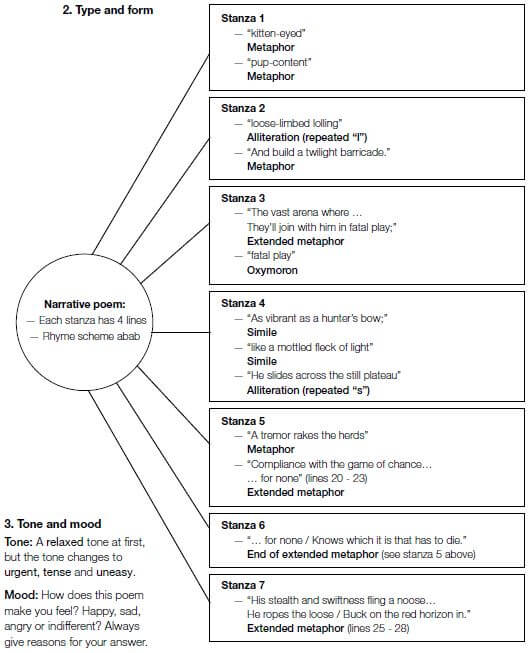
This is a narrative poem that tells the story of how the cheetah hunts its prey.
The poem has a formal structure (the way it is set out) with seven stanzas of four lines each (quatrains) that have a regular pattern of rhyme (abab).

Each of the seven stanzas tells a different part of the story. Some stanzas focus on the cheetah, others on the buck. In the last stanza, the two come together when the cheetah catches a buck. The poem’s structure (the form) and the hunt described in the poem (the content) are closely linked in an effective way.

3. Analysis

Stanza 1 (lines 1 – 4)

Indolent and kitten-eyed,
This is the bushveld’s innocent
The stealthy leopard parodied
With grinning, gangling pup-content.

In stanza one, the poet describes the cheetah as seeming to be harmless. The poet uses imagery as if he is describing a harmless young animal – the cheetah looks “innocent”. The metaphor “kitten-eyed” (line 1), compares the cheetah’s big eyes to those of a sweet kitten. The poet feels the leopard is a more impressive-looking animal and that the cheetah is a “parody” (or funny copy) of a leopard.
Both the leopard and the cheetah are big cats that have spots, but where the leopard is described as “stealthy” (line 2), which suggests it is secret and dangerous, the cheetah seems to smile in a rather silly way. The metaphor “pup-content” (line 4) compares it to a happy (and harmless) puppy.
The word “gangling” means it has long, loose legs that make it seem rather awkward and clumsy. The words for baby animals like “kitten” and “pup” suggest it is young, as does “gangling”, as teenage animals (including people) often seem to have long, thin bodies before they grow older, stronger and more muscular.

Stanza 2 (lines 5 – 8)

Slouching through the tawny grass
Or loose-limbed lolling in the shade,
Purring for the sun to pass
And build a twilight barricade.

The cheetah moves lazily and casually (“slouching” in line 5) through the grass or lies back, (“lolling” in line 6) in the shade during the day. Notice how the alliteration links the words “Loose-limbed lolling” in line 5, emphasising how relaxed the animal is.
The big cat purrs like a happy house cat as it waits patiently for the sun to set. Again, this makes the cheetah seem harmless, as cats purr when they are relaxed and content. At twilight it is growing dark and the metaphor “barricade” (line 8) compares the darkness to a wall or barrier that will hide the cheetah when it hunts. Barricades are often built across streets during wars or riots, so the poet’s diction (choice of words) creates a more uneasy tone with the use of “barricade”.

Up to now, the herd of buck and the cheetah seem relaxed. By including the word “barricade”, the poet introduces tension at the end of the stanza. The barricade interrupts the relaxed tone.

Stanza 3 (lines 9 – 12)

Around the vast arena where,
In scattered herds, his grazing prey
Do not suspect in what wild fear
They’ll join with him in fatal play;

The tension in the poem grows. The poet sets the scene for the hunt. The huge grasslands (“vast arena” line 9), the herds of buck that are spread about (“scattered”) as they graze and have no idea that there is a cheetah nearby waiting to kill one of them, its “prey” (line 10). In this stanza, the poet uses an extended metaphor which is carried on in the first and last lines of the stanza. The hunt is compared to a game that is played to the death in an “arena”. This game or “fatal play” (line 12) is an oxymoron, because “play” suggests a game, but “fatal” means deadly, so this game will end in a death.
This creates a visual image (a picture we can see in our minds) of the games in the Coliseum, the great sports stadium of ancient Rome, when spectators enjoyed watching men fight with swords and the loser was often killed. As we read, we feel fearful for the unsuspicious buck that do not know of the danger that is coming. We begin to sympathise with the “wild fear” (line 9) they will feel when the cheetah begins its chase. Notice how vividly and strikingly the poet’s diction in “wild fear” conveys the panic the buck are going to feel. The uneasy tone becomes stronger now.

Stanza 4 (lines 13 – 16)

Till hunger draws slack sinews tight
As vibrant as a hunter’s bow;
Then, like a fleck of mottled light,
He slides across the still plateau.

This stanza describes the cheetah as it attacks. The animal now changes from a harmless-seeming young animal into a dangerous predator (hunter) as it begins its chase. Unlike the ancient Romans, for whom killing was a sport, the cheetah hunts only to eat and survive.
When it starts to think about hunting its body changes from relaxed to tense. The poet uses a simile that compares it to a bow. When an archer (who shoots with bow and arrow) gets ready to shoot the arrow, he pulls back the string of the bow very tightly so that the arrow will shoot forward with great speed and power. In the same way, when the cheetah is hungry and ready to hunt, it tenses all the muscles in its body (“slack sinews tight” in line 13). As it jumps forward, the cheetah’s body bends in a curve like a bow and it is no longer “slack” (relaxed) but “vibrant” – filled with energy and life.
The poet uses a simile “like a mottled fleck of light” (line 15) to describe the cheetah’s speed, as its spotted body moves as fast as a flashing spot of light. It moves so smoothly and quickly that it seems to “slide” across the flat ground (line16). Notice how the alliteration of the hissing “s” sound in “slide/still” emphasises its speed. The cheetah’s movement is purposeful, controlled and confident.

Stanza 5 (lines 17 – 20)

A tremor rakes the herds: they scent
The pungent breeze of his advance;
Heads rear and jerk in vigilant
Compliance with the game of chance.

The poet now describes the reaction of the herd. The buck catch the strong (“pungent”) smell of the cheetah, perhaps carried to them on the wind. They all shiver (“tremor”) with fear (line 17). The metaphor “rakes” describes the way the shiver of fear (“tremor”) runs through the herd the way a rake (a garden instrument like a very big fork) can sweep along the ground.
All moving together at the same time, the buck at once raise their heads and become tense and watchful. In a metaphor the poet compares the buck to people taking part in a “game of chance” (line 20). They have no choice but “compliance” – they have to fit in with the rules of the “game” in which they know that any one of them might be attacked and killed by the cheetah. Unfortunately for the buck, the rules of nature are that some animals have to die so that others can survive.

Stanza 6 (lines 21 – 24)

In which, of thousands, only one
Is centred in the cheetah’s eye;
They wheel and then stampede, for none
Knows which it is that has to die.

Of all the thousands of buck, the cheetah sets his eyes on only one. All his attention is on one buck. The buck all turn round quickly, they “wheel” and “stampede” (line 23) to get away. When herd animals (such as cows, horses or buck) are afraid, they stampede – the whole herd runs away in a mass panic. Their movement is uncontrolled. They know one of them will die, but do not know which of them the cheetah has chosen to kill.
The rhyming of “eye” (line 22) and “die” (line 24) links these two words to emphasise that the buck has no chance of escape. The buck is in the cheetah’s sight.

Stanza 7 (lines 25 – 28)

His stealth and swiftness fling a noose
And as his loping strides begin
To blur with speed, he ropes the loose
Buck on the red horizon in.

In this last stanza, the poet returns to describing the cheetah. He again uses an extended metaphor, this time of a cowboy using a lasso.
The silent speed (“stealth and swiftness” in line 25) with which the cheetah runs towards the buck is compared to the rope and noose flying through the air. The cheetah’s long steps (“loping strides” in line 26) begin to go so fast that you cannot see the animal clearly; you see only a blur. The cowboy metaphor is continued when the cheetah leaps on the buck’s back to knock it to the ground, as this is compared to the rope pulling the animal in. The horizon is described as “red” (line 28). This could refer to the red of the setting sun but it also suggests that the land itself is stained with the blood of the dead buck.
Note that stanzas 6 and 7 are part of a continuous run-on line – this helps to suggest that the cheetah is gaining speed and its movements are not interrupted as it chases its prey.
There is a contrast between the description of the harmless looking cheetah in the first two stanzas and the dangerous hunter in the later stanzas.

Note:

  • Lasso – a long rope with a loop at the end called a noose. To catch a cow, the cowboy throws the rope so that the loop falls around the animal’s neck so that he can pull it in.
  • Run-in-line: the meaning runs on from one line to the next, without being broken by punctuation.

4. Tone and mood

The tone of the poem is relaxed, like the cheetah, at the start. It becomes more urgent and tense as the poem progresses, starting with the uneasy tone at the end of stanza 3. The tone of danger increases later in the poem as the poet describes the hunt.
The mood of a poem is how it makes the reader feel. How does this poem make you feel? For example, happy, sad, angry, or indifferent.

Summary
Cheetah by Charles Eglington

  1. Theme
    The main themes are that appearances can be misleading; and that in nature, only the strongest survive.
  2. Type and form
    Narrative poem

Activity 10 

Refer to the poem on page 87 and answer the questions below.

  1.   Complete the following sentences by using the words provided in the list below.
     young; snarling; awkward; old; smiling; graceful

    The poet says that the cheetah is (1.1) … but it has (1.2) … movements and it appears to be (1.3) …         (3)

  2. What does the word “indolent” in line 1 tell you about the cheetah? State TWO (2)
  3. Choose the correct answer to complete the following In line 3 the speaker’s tone shows that he feels …
    1. the cheetah is better than the leopard.
    2. the leopard is better than the cheetah.
    3. the cheetah and the leopard are the same.
    4. the cheetah is quieter than the leopard.                           (1)
  4. Refer to the words “twilight barricade” in line
    4.1 Identify the figure of speech used (1)
    4.2 Explain why the poet uses this figure of (2)
  5. Which ONE WORD in stanza three shows that purpose of the hunt is to find food? (1)
  6. Quote two consecutive words in this stanza that contradict each other (oxymoron), and suggest that the hunt is not really a game? (2)
  7. Refer to line 14 (“And vibrant as a hunter’s bow”).
    7.1 Identify the figure of speech used (1)
    7.2 Explain why the poet has used this figure of (2)
  8. Refer to line 20 (“Compliance with the game of chance”).
    Do you think the use of the word “compliance” is suitable? Discuss your view.                                                  (2)
  9. What message does this poem have for you? (1) [18]
 Answers to Activity 10
1.1Smiling/young/graceful/awkward ✓
1.2.Awkward/graceful ✓
1.3.Young/smiling ✓(3)
2.The cheetah is lazy/inactive/idle ✓✓(2)
3.B / the leopard is better than the cheetah. ✓(1)
4.1.Metaphor ✓(1)
4.2.Night/darkness will become his shield from his prey ✓✓
OR
Night/darkness will conceal/hide him from his prey ✓✓
OR
Night /darkness will contain his prey ✓✓
(2)
5.“prey” ✓(1)
6.“fatal play” ✓✓(2)
7.1.Simile ✓(1)
7.2.The poet compares the cheetah to a hunter’s bow. When it is hunting, the cheetah has the speed and force of a hunter’s bow and arrow. ✓✓
OR
To show that the cheetah is as fast/quick as a hunter’s bow (arrow) ✓✓
 (2)
8.Yes, when one sees no way out of a fatal situation, one gives in and accepts one’s fate. ✓✓
OR
No, although the herd knows that one of them is to be killed, they still try and escape. ✓✓
OR
No, one does not simply accept one’s fate when facing danger/ death/ There’s always a chance of survival if one tries to escape. ✓✓
 (2)
9
  • Cruelty of nature ✓
  • Survival of the fittest ✓
  • Appearances can be misleading ✓
  • The cycle of life/predators only kill for food ✓
  • In every situation in nature there is a killer and a victim. ✓
(1)
[18]

LITERATURE; POETRY OVERVIEW GRADE 12 NOTES – LITERATURE; POETRY STUDY GUIDE

LITERATURE; POETRY OVERVIEW GRADE 12 NOTES – LITERATURE; POETRY STUDY GUIDE Poetry is often described as the language of the soul, a form of expression that transcends mere words to capture the essence of emotions, experiences, and ideas. In Grade 12, students are encouraged to delve deeper into the various forms, styles, and techniques employed by poets across different eras and cultures.

Dear Grade 12 learner

This Mind the Gap study guide helps you to prepare for the end-of-year Grade 12 English First Additional Language (EFAL) Literature exam.
There are three exams for EFAL: Paper 1: Language in Context; Paper 2: Literature; and Paper 3: Writing.
There are nine great EFAL Mind the Gap study guides which cover Papers 1, 2 and 3.
Paper 2: Literature includes the study of novels, drama, short stories and poetry. A Mind the Gap study guide is available for each of the prescribed literature titles. Choose the study guide for the set works you studied in your EFAL class at school.
This study guide focuses on the 10 prescribed poems examined in Paper 2: Literature. You will need to study all 10 poems for the exam:

  1. Sonnet 116 by William Shakespeare
  2. Death be not proud by John Donne
  3. An elementary school classroom in a slum by Stephen Spender
  4. Auto wreck by Karl Shapiro
  5. On his blindness by John Milton
  6. A prayer for all my countrymen by Guy Butler
  7. The birth of Shaka by Oswald Mbuyiseni Mtshali
  8. The serf by Roy Campbell
  9. Mementos, 1 by WD Snodgrass
  10. Cheetah by Charles Eglington

How to use this study guide

There is one chapter for each poem. Each chapter includes a copy of the poem and information about:

  • The poet;
  • The themes;
  • Words you need to know to understand the poem;
  • Type and form;
  • Line-by-line analysis; and
  • Tone and mood.

All the above information is contained in a one-page summary. Use the 10 summaries to help you hold the 10 poems clearly in your mind.
You can test your understanding of each poem by completing the activities, then use the answers to mark your own work. The activities are based on the kinds of questions you will find in the exam.

Top 7 study tips

  1. Break your learning up into manageable sections. This will help your brain to focus. Take short breaks between studying one section and going onto the next.
  2. Have all your materials ready before you begin studying a section – pencils, pens, highlighters, paper, glass of water, etc.
  3. Be positive. It helps your brain hold on to the information.
  4. Your brain learns well with colours and pictures. Try to use them whenever you can.
  5. Repetition is the key to remembering information you have to learn. Keep going over the work until you can recall it with ease.
  6. Teach what you are learning to anyone who will listen. It is definitely worth reading your revision notes aloud.
  7. Sleeping for at least eight hours every night, eating healthy food and drinking plenty of water are all important things you need to do for your brain. Studying for exams is like exercise, so you must be prepared physically as well as mentally.

On the exam day

  1. Make sure you bring pens that work, sharp pencils, a rubber and a sharpener. Make sure you bring your ID document and examination admission letter. Arrive at the exam venue at least an hour before the start of the exam.
  2. Go to the toilet before entering the exam room. You don’t want to waste valuable time going to the toilet during the exam.
  3. You must know at the start of the exam which two out of the four sections of the Paper 2 Literature exam you will be answering. Use the 10 minutes’ reading time to read the instructions carefully.
  4. Break each question down to make sure you understand what is being asked. If you don’t answer the question properly you won’t get any marks for it. Look for the key words in the question to know how to answer it. You will find a list of question words on pages xiv and xv of this study guide.
  5. Manage your time carefully. Start with the question you think is the easiest. Check how many marks are allocated to each question so you give the right amount of information in your answer.
  6. Remain calm, even if the question seems difficult at first. It will be linked with something you have covered. If you feel stuck, move on and come back if time allows. Do try and answer as many questions as possible.
  7. Take care to write neatly so the examiners can read your answers

Overview of the English First  Additional Language Paper 2:  Literature exam 

In the Paper 2 Literature exam, you need to answer questions from two  sections. Choose the two sections that you know best:

  • Section A: Novel
  • Section B: Drama
  • Section C: Short stories
  • Section D: Poetry

A total of 70 marks is allocated for Paper 2, which means 35 marks for  each section you choose.
You will have two hours for this exam.

Here is a summary of the Paper 2 Literature exam  paper: 

Question  numberTitle of novel Type of  questionNumber of  marks
Section A: Novel If you choose Section A, answer ONE question. Choose the  question for the book you have learnt.
1.To Kill a Mockingbird Contextual35
2.Lord of the Flies Contextual35
3.A Grain of Wheat Contextual35
Section B: Drama If you choose Section B, answer ONE question. Choose the  question for the play you have learnt.
4.Romeo and Juliet Contextual35
5.Nothing but the Truth Contextual35
Section C: Short stories If you choose Section C, answer BOTH questions. You  will not know exactly which short stories are included until the exam. TWO  stories will be set. Answer the questions set on BOTH short stories.
6.1Short story Contextual17 or 18
6.2Short story Contextual17 or 18
Section D: Poetry If you choose Section D, answer BOTH questions. You will  not know exactly which poems are included until the exam. TWO poems will  be set. Answer the questions set on BOTH poems.
7.1Poem Contextual17 or 18
7.2Poem Contextual17 or 18

What is a contextual question?

In a contextual question, you are given an extract from the poem. You then have to answer questions based on the extract. Some answers you can find in the extract. Other questions will test your understanding of other parts of the poem. Some questions ask for your own opinion about the poem.

What are the examiners looking for?

Examiners will assess your answers to the contextual questions based on:

  • Your understanding of the literal meaning of the poem. You need to identify information that is clearly given in the poem.
  • Your ability to reorganise information in the poem. For example, you may be asked to summarise key points.
  • Your ability to provide information that may not be clearly stated in the extract provided, using what you already know about the text as a whole. This process is called inference. For example, you may be asked to explain how a figure of speech affects your understanding of the poem as a whole.
  • Your ability to make your own judgements and form opinions about aspects of the poem. This process is called evaluation. For example, you may be asked if you agree with a statement.
  • Your ability to respond to the emotional level of a poem. This is called appreciation. For example, you may be asked what you would have done in the situation described in the poem. You may be asked to discuss how the writer’s style helps to describe the tone and mood of a poem.

Question words  

Here are examples of question types found in the exam.

Question type What you need to do
Literal: Questions about information that is clearly given in the text or extract from  the text
Name characters/places/things …:Write the specific names of  characters, places, etc.
State the facts/reasons/ideas …Write down the information without  any discussion or comments.
Give two reasons for/why …Write two reasons (this means the  same as ‘state’).
Identify the character/reasons/theme …Write down the character’s name,  state the reasons.
Describe the place/character/what  happens when …Write the main characteristics of  something, for example: What does  a place look/feel/smell like? Is a  particular character kind/rude/ aggressive …
What does character x do when …Write what happened – what the  character did.
Why did character x do …Given reasons for the character’s action according to your knowledge of the plot.
Who is/did …Write the name of the character.
To whom does xx refer …Write the name of the relevant  character/person.
Reorganisation: Questions that need you to bring together different pieces of  information in an organised way.
Summarise the main points/ideas …Write the main points, without a lot of  detail.
Group the common elements …Join the same things together.
Give an outline of …..Write the main points, without a lot of  detail.
Inference Questions that need you to interpret (make meaning of) the text using information that may not be clearly stated. This process involves thinking about what happened in different parts of the text; looking for clues that tell you more about a character, theme or symbol; and using your own knowledge to help you understand the text.
Explain how this idea links with the  theme x …Identify the links to the theme.
Compare the attitudes/actions of  character x with character y …Point out the similarities and

differences.

What do the words … suggest/reveal  about /what does this situation tell you  about …State what you think the meaning is,  based on your understanding of the  text.
How does character x react when …. Describe how something affected … State how you know that character x is …Write down the character’s reaction/ what the character did/felt.
What did character x mean by the  expression …Explain why the character used those  particular words.
Is the following statement true or false?Write ‘true’ or ‘false’ next to the  question number. You must give a  reason for your answer.
Choose the correct answer to complete  the following sentence (multiple choice  question).A list of answers is given, labelled  A–D. Write only the letter (A, B, C or  D) next to the question number.
Complete the following sentence by filling in the missing words …Write the missing word next to the  question number.
Quote a line from the extract to prove your  answer.Write the relevant line of text using  the same words and punctuation  you see in the extract. Put quotation  marks (“ ” inverted commas) around  the quote.
Evaluation Questions that require you to make a judgement based on your  knowledge and understanding of the text and your own experience.
Discuss your view/a character’s

feelings/a theme …

Consider all the information and  reach a conclusion.
Do you think that …There is no ‘right’ or ‘wrong’ answer  to these questions, but you must give  a reason for your opinion based on  information given in the text.
Do you agree with …
In your opinion, what …
Give your views on …
Appreciation Questions that ask about your emotional response to what happens,  the characters and how it is written.
How would you feel if you were character  x when …There is no ‘right’ or ‘wrong’ answer  to these questions, but you must give  a reason for your opinion based on  information given in the text.
Discuss your response to …
Do you feel sorry for …
Discuss the use of the writer’s style, diction and figurative language, dialogue …To answer this type of question, ask yourself: Does the style help me to feel/imagine what is happening/what a character is feeling? Why/why not? Give a reason for your answer.

Literary features found in poems

DictionThe poet’s choice of words and how he/she organises  them.
EuphemismA mild or vague expression in place of a word that is  more harsh or direct.
First personThe poem is written from the point of view of ‘I’ or ‘we’.
HyperboleA deliberate exaggeration. For example, ‘a big’ plate of  food is described as ‘a mountainous’ plate of food
IronyA statement or situation that has an underlying  meaning that is different from the literal meaning.
MetaphorA figure of speech that uses one thing to describe another in a figurative way.
MoodThe emotions felt by the reader when reading the  poem.
OxymoronA combination of words with contradictory meanings  (meanings which seem to be opposite to each other).  For example, ‘an open secret’
PersonificationGiving human characteristics to non-human beings.
PunA play on words which are identical or similar in sound.  It is used to create humour.
RhymeLines of poetry that end in the same sound.
RhythmA regular and repeated pattern of sounds.
SarcasmAn ironic expression which is used to be unkind or to  make fun of someone.
SimileComparing one thing directly with another. ‘Like’ or ‘as’ is used to make this comparison.
SymbolSomething which stands for or represents something  else
ThemeThemes are the main messages of a text. There are  usually a few themes in each poem.
Third personThe poem is written from the point of view of ‘he’, ‘she’  or ‘they’.
ToneThe feeling or atmosphere of the poem.
Sound devices: 
AlliterationA pattern of sounds that includes the repetition of  consonant sounds. The repeated sound can be either  at the beginning of successive words or inside the word.
AssonanceThe vowel sounds of words that occur close together  are repeated.
ConsonanceA sound that occurs at the end of words that are close  together is repeated.
OnomatopoeiaThe use of words to create the sounds being described.
 

MEMENTOS, 1 BY WD SNODGRASS GRADE 12 NOTES – LITERATURE; POETRY STUDY GUIDE


Mementos, 1 by W.D. Snodgrass

This poem was written by W.D. Snodgrass (1926-2009). He was an American poet who won a number of prizes for his work. He also wrote essays and was an academic who taught at several US universities, finally retiring in 1994.
He is best known for writing very personal poems about his own life and loves. His poems are often about the pain of life that we do not show to one another when we meet in our busy lives: the pain of love lost, divorce, death, unsatisfying jobs and dreams which are not achieved.
Snodgrass wrote another poem, called Mementos, 2, which is why this poem is called Mementos, 1.

1. Themes

The theme of this poem is memory, and the power that mementos (such as photographs) have to bring back feelings and memories from the past.
The poet is looking through a collection of old papers when he comes across a photograph of his ex-wife. After his first shock, he feels glad for a moment. It was taken at their first dance and she looked young and very pretty. He remembers how that picture had helped him cope with his fear during the war, but then he feels bitter as he remembers how their marriage failed and ended in divorce.
However, he puts the photograph back to look at it again one day, which may mean that he still has some feelings for his wife. In this poem, he addresses his words to “you” — referring to the person in the photograph.

Fun fact:

  • Mementos are small objects that we keep to remember our friends and special times in our lives. Examples are photographs or letters.
Mementos, 1 by W.D. Snodgrass
Stanza 1Sorting out letters and piles of my old
Canceled checks, old clippings, and yellow note cards
That meant something once, I happened to find
Your picture. That picture. I stopped there cold,
Like a man raking piles of dead leaves in his yard
Who has turned up a severed hand.
Stanza 2Still, that first second, I was glad: you stand
Just as you stood – shy, delicate, slender,
In that long gown of green lace netting and daisies
That you wore to our first dance.
The sight of you stunned
Us all. Well, our needs were different, then,
And our ideals came easy.
Stanza 3Then through the war and those two long years
Overseas, the Japanese dead in their shacks
Among dishes, dolls, and lost shoes; I carried
This glimpse of you, there, to choke down my fear,
Prove it had been, that it might come back.
That was before we got married.
Stanza 4Before we drained out one another’s force
With lies, self-denial, unspoken regret
And the sick eyes that blame; before the divorce
And the treachery. Say it: before we met. Still,
I put back your picture. Someday, in due course,
I will find that it’s still there.

Words to know 

Definitions of words from the poem:
Line 2:canceled checksold cheques that have been paid up, no longer of value
clippingscuttings from newspapers and magazines
Line 4:coldfrozen, still
Line 5:rakingusing a rake to collect leaves
Line 6:severedcut off from the body
Line 8:delicatesmall
slenderslim, thin
Line 9:gowndress
lace nettingdelicate fabric
daisiessmall flowers
Line 10:       stunnedamazed
Line 12:       idealsideas of perfection / can also mean beliefs, goals
Line 13:       the warreference to World War 2
Line 16:       glimpsesight (the photo)
chokehold back
Line 19:       drainedemptied
forceenergy, life
Line 20:       self-denialgive up something, deny yourself something you want
regretfeel sorry
Line 22:       treacherydisloyalty, unfaithfulness
Line 23:       in due courselater on

2. Type and form

This poem is of the type known as confessional poetry, in which the poet confesses or shares very personal and private thoughts and feelings. In this case, he shares his memories of and feelings about his first marriage.
One of the formal elements in the poem’s structure is that there are four stanzas of six lines each and the lines are similar in length.

The poet uses some rhyme, but in no set pattern. For example, look at “old” and “cold” in stanza 1, or “force, divorce and course” in the last stanza.

He also uses half-rhymes, which are words that almost rhyme, but not quite. For example, look at “years / fear” in stanza 3.

3. Analysis

Stanza 1 (lines 1 – 6)

Sorting out letters and piles of my old
Canceled checks, old clippings, and yellow note cards
That meant something once, I happened to find
Your picture. That picture. I stopped there cold,
Like a man raking piles of dead leaves in his yard
Who has turned up a severed hand.

This stanza describes the poet’s reaction to finding an old photograph of his ex-wife. He is sorting out old papers, probably to throw away what he no longer needs. There are “Canceled checks” which are old cheques that have been paid and returned by the bank.
There are also pieces cut out from old newspapers or magazines that had interested him at the time, and old note cards which have turned yellow with age. Note how the words “canceled / old/ yellowed” (line 2) tell us that these papers have been there for a very long time; they had been important to him (“meant something”) long ago.
Suddenly he finds a photograph of his ex-wife; perhaps he had forgotten about it, for he is shocked. Notice the short, sharp punctuation in line 4, with two full stops in four words: “Your picture. That picture. I stopped there cold”. The short phrases and full stops make us stop short so that we experience the shock that the poet feels when he sees the picture. The italics used in “That picture” are for emphasis. We realise that he knows this photograph and it is a special picture of someone who was once very important to him.
The poet’s use of the word “cold” in line 4 helps to describe his shock at seeing the picture. He then explains how he feels with a horrifying simile: he feels like someone innocently tidying up his garden when he finds, among the dead leaves, a “severed hand” (lines 4 and 5).

Note:

  • Cancelled checks is American spelling. We use cancelled cheques.
  • Font means the type of print or writing used. There are three main fnt types;
    • Standard
    • Bold – is used for emphasis
    • Italics – also used for emphasis and for words which come from another language
 Stanza 2 (lines 7 – 12)Still, that first second, I was glad: you stand
Just as you stood – shy, delicate, slender,
In that long gown of green lace netting and daisies
That you wore to our first dance. The sight of you stunned
Us all. Well, our needs were different, then,
And our ideals came easy.

This stanza describes the poet’s memories of the time when the photograph was taken. In spite of the shock, the poet feels glad for a moment as it brings back a happy memory. The photograph was taken of his ex-wife at the first dance they had gone to together and she looked very beautiful in a lovely green lace dress with little daisies on it. Everyone there admired her (“stunned/ Us all.” – line 10 and 11). In the 1940s people often went to dances, so their first dance suggests they had not been going out together for very long. At that time she was shy, small and slim, perhaps a little uncertain of herself.
The poet must also have been very young, about 18 years old. He reflects that when they were young, they had simpler needs and less complicated expectations of each other, and of life itself, perhaps. Their “ideals came easy” (line 12): young people are usually more idealistic and hopeful about what they believe and about their goals in life.

Note:

  • In the second World War the Americans fought against the Japanese in the Pacific, and the poet joined the American navy in 1944, when he was about 18
Stanza 3 (lines 13 – 18)

Then through the war and those two long years
Overseas, the Japanese dead in their shacks
Among dishes, dolls, and lost shoes; I carried
This glimpse of you, there, to choke down my fear,
Prove it had been, that it might come back.
That was before we got married.

Now the poet remembers how this photograph had helped him cope with his fear during the two years he had spent at war.
By describing the two years as “long” (line 13), the poet tells us that this was a difficult and unhappy time. He saw the horrors of war in which not only soldiers but also Japanese civilians (ordinary people) suffered. He refers to Japanese people lying dead in their “shacks” amid the ordinary belongings of their everyday lives: “dishes, dolls and lost shoes” (line 15). In writing of this, the poet shows little emotion, unlike the feelings he expresses when he describes finding the photograph or the failure of his marriage.
He carried the photograph with him in the war as the “glimpse” (line 16) of her gave him comfort. A “glimpse” is a quick look at something. This does not mean that he took only quick looks at the picture. Rather, the picture itself is just a “quick look” at the real person.
The photograph helped him to push back (“choke back”) his fear and reminded him of a happy time in his life; it gave him hope that that he might find that happiness again. Notice the metaphor “choke” (line 16). When you choke, something is stopping your breathing, and so “choking” something down suggests that this is not an easy or comfortable thing to do. The poet ends this stanza by saying with a bitter tone that the photograph comforted “ … before we got married” (line 18).

Stanza 4 (lines 19 – 24)

Before we drained out one another’s force
With lies, self-denial, unspoken regret
And the sick eyes that blame; before the divorce
And the treachery. Say it: before we met. Still,
I put back your picture. Someday, in due course,
I will find that it’s still there.

In this stanza, the poet recalls the breakdown of the marriage and the unhappiness this brought.
The first line continues the thought of the last line of stanza 3. Once they were married they “drained out one another’s force” (line 19). In this metaphor the poet compares the way they took away each other’s enthusiasm for life (“force”) to the way water drains out of a pipe. When a pipe, or bath, is drained, it is left empty, and they were emptied of happiness. Notice that the poet says we – they were both to blame for their unhappiness.

The poet says the causes of this were the lies they told each other, and their self-denial (line 20). “Self-denial” suggests sacrifice. Perhaps they both felt they had given up dreams or things they wanted to do for the other person’s sake and then resented it and felt bitter about it. Both felt “regret” (line 20) – felt sorry – but did not say so; their feelings remained “unspoken” (line 20). The poet does not say what they regretted.
They blamed each other for their unhappiness with “sick eyes” (line 21). Their eyes were not literally “sick”; this is a metaphor suggesting that their feelings were reflected in their eyes – they felt anger and dislike and their eyes showed how each blamed and accused the other, neither taking responsibility for what they were doing to their marriage. Eventually they got divorced. The poet refers to their ‘”treachery” (line 22); perhaps this was their betrayal of the ideals they used to have, or perhaps they were unfaithful or deliberately hurt each other in other ways.
He addresses his ex-wife directly when he writes: “Say it: before we met” (line 22). This line may have many meanings. The poet may mean that they were happy before they met. It could also mean that each had not known what sort of person the other would turn out to be.
However, he does not throw the picture away, but puts it back to look at again some other time. There are a number of possible reasons why he keeps the photograph:

  • At a later date he may feel differently about these
  • He still cannot cope with the hurt, but may be able to deal with it better in the
  • In spite of painful memories of marriage, the photograph still reminds him of a time when he and his ex-wife were happy and in
  • He has not come to terms with the divorce
  • He still has feelings for his ex-wife.

The poet’s bitterness and pain are expressed in the first four lines, but the last two lines of the poem have a more gentle tone as he decides to keep the picture.

4. Tone and mood

Overall, the poem has a conversational tone, as though the poet were talking directly to his ex-wife.
However, the tone changes through the poem. The tone is one of horror when he first discovers his ex-wife’s picture, and changes to a happy tone as he remembers good times with her. The tone becomes bitter and sad as he remembers the war and the breakdown of their marriage. The final lines, though, have a hopeful tone.
The mood of a poem is how it makes the reader feel. How does this poem make you feel? For example, happy, sad, angry, or indifferent.

Summary
Mementos, 1 by W.D. Snodgrass

  1. Theme
    The theme is memory, and the power of mementos to bring back past feelings and memories.
  2. Type and form
    confessional poem
  3. Tone and moodTone: Overall, it has a conversational tone. It shifts through the poem from one of horror; to a happy tone; to a bitter and sad tone; and ends on a more gentle and hopeful tone.
    Mood: How does this poem make you feel? Happy, sad, angry or indifferent? Always give reasons for your answer.

Activity 9

Refer to the poem on page 77 and answer the questions below.

  1. Complete the following sentences by using the words provided in the list below.
    stunned; mother; shocked; disappointed; ex-wife; glad

    The speaker is sorting out old papers when he finds a photograph of his (1.1) … Initially, he is (1.2) … but then he is (1.3) … to find it as it brings back old memories. (3)

  2. Refer to line 4 (“Your That picture. I stopped there cold,”).
    Explain why the words “That picture” are written in a different font (letter type).(1)
  3. Refer to lines 4-6 (“I stopped there … a severed ”).
    3.1 Identify the figure of speech used here
    3.2 Explain why the poet has used this figure of speech (2)
  4. Choose the correct answer to complete the following In line 10, the word “stunned” suggests that the girl was …
    1. gorgeous.
    2. scary.
    3. motionless.
    4. happy.                                                                                                (1)
  5. Refer to lines 11-12 (“Well, our needs … ideals came ”).
    Using your own words, say what the speaker and his wife’s lives were like when they were young.                    (1)
  6. Refer to stanza (3)
    6.1 Quote THREE separate words to show that not only soldiers were affected by the war.
    6.2 Explain what the photograph meant to the speaker during the war (1)
  7. Refer to the last
    7.1 Is the following statement TRUE or FALSE? Give a reason for your answer.
    The speaker’s wife was responsible for the breakdown of their marriage.                                                (2)
    7.2 What does the speaker’s decision to keep the photograph reveal about him? (1)
  8. In the first stanza, the tone of the speaker is one of shock
    What is the tone in the last stanza?                                       (1)
  9. After reading this poem, do you think it is a good idea to use old photographs as a way of remembering the past?
    Discuss your view.                                                                  (2) [18]

Answers to Activity 9

  1. 1.1 Ex-wife ✓
    1.2 Shocked ✓
    1.3 Glad ✓ (3)
  2. It emphasises/shows the importance of the photo/It shocks him./It refers to a particular picture of relevance/ significance. ✓ (1)
  3. 3.1 Simile ✓ (1)
    3.2 Finding this photograph is as shocking/unexpected as finding a severed hand in your garden. ✓ (1)
  4. A /gorgeous ✓  (1)
  5. Simple/carefree/uncomplicated ✓  (1)
  6. 6.1 “shacks” ✓
    “dishes” ✓
    “dolls” ✓ (3)
    6.2  It helped him cope with his fears/it helped him to choke down his fears. ✓  (1)
  7. 7.1 False.
    Both of them were responsible. ✓✓
    OR
    They drained one another’s force. ✓✓ (2)
    7.2 He is not ready to let go./The photograph still has meaning for him./He has not come to terms with the divorce yet./He still has feelings for his ex-wife. ✓     (1)
  8. The tone becomes gentler/accepting/agreeable/forgiving. ✓ (1)
  9. Yes, people need real objects like photographs to remember the ✓✓
    OR
    No, memories should not depend on objects such as photographs. ✓✓     (2) [18]

Intensive Strategies Notes and Exam Questions Business Studies Grade 12

Intensive Strategies Notes and Exam Questions Business Studies Grade 12 Intensive strategies in business studies refer to approaches employed by companies to maximize their market penetration and gain a competitive edge. These strategies are crucial for businesses aiming to expand their market share and increase their presence in the industry.

On this page, grade 12 students learn and study for revision using REAL EXAM questions based on Intensive Strategies topic, using activities and engaging quizzes. Every South African grade 12 learner who wants to pass Business Studies subject with a distinction, needs to go through the valuable study resources on this page.

Intensive Strategies Business Studies Grade 12

Intensive strategies involve increasing the market share of the existing products or services in the existing market. There are three main types of intensive strategies: Market Penetration, Market Development, and Product Development

DON’T MISS: How to Pass Business Studies Grade 12 NSC With Distinction

(a) Market Penetration: This involves increasing market share by selling more products or services to existing customers or by attracting new customers.

Market Penetration Examples:

  1. Pick n Pay’s Smart Shopper loyalty program that offers discounts and rewards to encourage customers to shop more frequently and spend more.
  2. Woolworths’ Everyday Rewards program that offers personalized discounts and benefits to its customers based on their shopping behavior.
  3. Checkers’ aggressive pricing strategy that offers discounts on essential products to attract price-sensitive customers and increase foot traffic.
  4. Mr Price’s mobile app that allows customers to shop online, track their orders, and receive personalized promotions and discounts.

(b) Product Development: This involves introducing new products or services to the existing market.

Product Development Examples:

  1. Nando’s Peri-Peri sauces and marinades that were developed to complement its signature flame-grilled chicken.
  2. Castle Lite’s Lime variant, a new beer product aimed at the younger and trendier market.
  3. Vodacom’s m-pesa mobile money service that allows customers to make payments, send money, and buy airtime using their mobile phones.
  4. Pick n Pay’s Foodco range of ready-made meals and snacks that cater to busy and health-conscious customers.

(c) Market Development: This involves expanding the market by introducing existing products or services to new markets.

Market Development Examples:

  1. Woolworths’ expansion into other African markets such as Ghana and Kenya to tap into new customer segments and increase revenue streams.
  2. Shoprite’s entry into the Nigerian market by acquiring local supermarkets and introducing its own private label brands.
  3. Vodacom’s partnership with Safaricom in Kenya to launch a new mobile service, M-Pesa Africa, that offers cross-border mobile money transfers.
  4. Mr Price’s expansion into Australia and other international markets to increase its brand exposure and diversify its revenue streams.