POETRY GRADE 12 NOTES – LITERATURE STUDY GUIDE Begin by familiarizing yourself with various poetic forms such as sonnets, haikus, ballads, and free verse. Each form carries its own set of rules and conventions, shaping the poet’s expression and message.
POETRY OVERVIEW
Dear Grade 12 learner
This Mind the Gap study guide helps you to prepare for the end-of-year Grade 12 English First Additional Language (EFAL) Literature exam.
There are three exams for EFAL: Paper 1: Language in Context; Paper 2: Literature; and Paper 3: Writing.
There are nine great EFAL Mind the Gap study guides which cover Papers 1, 2 and 3.
Paper 2: Literature includes the study of novels, drama, short stories and poetry. A Mind the Gap study guide is available for each of the prescribed literature titles. Choose the study guide for the set works you studied in your EFAL class at school.
This study guide focuses on the 10 prescribed poems examined in Paper 2: Literature. You will need to study all 10 poems for the exam:
- Sonnet 116 by William Shakespeare
- Death be not proud by John Donne
- An elementary school classroom in a slum by Stephen Spender
- Auto wreck by Karl Shapiro
- On his blindness by John Milton
- A prayer for all my countrymen by Guy Butler
- The birth of Shaka by Oswald Mbuyiseni Mtshali
- The serf by Roy Campbell
- Mementos, 1 by WD Snodgrass
- Cheetah by Charles Eglington
How to use this study guide
There is one chapter for each poem. Each chapter includes a copy of the poem and information about:
- The poet;
- The themes;
- Words you need to know to understand the poem;
- Type and form;
- Line-by-line analysis; and
- Tone and mood.
All the above information is contained in a one-page summary. Use the 10 summaries to help you hold the 10 poems clearly in your mind.
You can test your understanding of each poem by completing the activities, then use the answers to mark your own work. The activities are based on the kinds of questions you will find in the exam.
Top 7 study tips
- Break your learning up into manageable sections. This will help your brain to focus. Take short breaks between studying one section and going onto the next.
- Have all your materials ready before you begin studying a section – pencils, pens, highlighters, paper, glass of water, etc.
- Be positive. It helps your brain hold on to the information.
- Your brain learns well with colours and pictures. Try to use them whenever you can.
- Repetition is the key to remembering information you have to learn. Keep going over the work until you can recall it with ease.
- Teach what you are learning to anyone who will listen. It is definitely worth reading your revision notes aloud.
- Sleeping for at least eight hours every night, eating healthy food and drinking plenty of water are all important things you need to do for your brain. Studying for exams is like exercise, so you must be prepared physically as well as mentally.
On the exam day
- Make sure you bring pens that work, sharp pencils, a rubber and a sharpener. Make sure you bring your ID document and examination admission letter. Arrive at the exam venue at least an hour before the start of the exam.
- Go to the toilet before entering the exam room. You don’t want to waste valuable time going to the toilet during the exam.
- You must know at the start of the exam which two out of the four sections of the Paper 2 Literature exam you will be answering. Use the 10 minutes’ reading time to read the instructions carefully.
- Break each question down to make sure you understand what is being asked. If you don’t answer the question properly you won’t get any marks for it. Look for the key words in the question to know how to answer it. You will find a list of question words on pages xiv and xv of this study guide.
- Manage your time carefully. Start with the question you think is the easiest. Check how many marks are allocated to each question so you give the right amount of information in your answer.
- Remain calm, even if the question seems difficult at first. It will be linked with something you have covered. If you feel stuck, move on and come back if time allows. Do try and answer as many questions as possible.
- Take care to write neatly so the examiners can read your answers
Overview of the English First Additional Language Paper 2: Literature exam
In the Paper 2 Literature exam, you need to answer questions from two sections. Choose the two sections that you know best:
- Section A: Novel
- Section B: Drama
- Section C: Short stories
- Section D: Poetry
A total of 70 marks is allocated for Paper 2, which means 35 marks for each section you choose.
You will have two hours for this exam.
Here is a summary of the Paper 2 Literature exam paper:
| Question number | Title of novel | Type of question | Number of marks |
| Section A: Novel If you choose Section A, answer ONE question. Choose the question for the book you have learnt. |
| 1. | To Kill a Mockingbird | Contextual | 35 |
| 2. | Lord of the Flies | Contextual | 35 |
| 3. | A Grain of Wheat | Contextual | 35 |
| Section B: Drama If you choose Section B, answer ONE question. Choose the question for the play you have learnt. |
| 4. | Romeo and Juliet | Contextual | 35 |
| 5. | Nothing but the Truth | Contextual | 35 |
| Section C: Short stories If you choose Section C, answer BOTH questions. You will not know exactly which short stories are included until the exam. TWO stories will be set. Answer the questions set on BOTH short stories. |
| 6.1 | Short story | Contextual | 17 or 18 |
| 6.2 | Short story | Contextual | 17 or 18 |
| Section D: Poetry If you choose Section D, answer BOTH questions. You will not know exactly which poems are included until the exam. TWO poems will be set. Answer the questions set on BOTH poems. |
| 7.1 | Poem | Contextual | 17 or 18 |
| 7.2 | Poem | Contextual | 17 or 18 |
What is a contextual question?
In a contextual question, you are given an extract from the poem. You then have to answer questions based on the extract. Some answers you can find in the extract. Other questions will test your understanding of other parts of the poem. Some questions ask for your own opinion about the poem.
What are the examiners looking for?
Examiners will assess your answers to the contextual questions based on:
- Your understanding of the literal meaning of the poem. You need to identify information that is clearly given in the poem.
- Your ability to reorganise information in the poem. For example, you may be asked to summarise key points.
- Your ability to provide information that may not be clearly stated in the extract provided, using what you already know about the text as a whole. This process is called inference. For example, you may be asked to explain how a figure of speech affects your understanding of the poem as a whole.
- Your ability to make your own judgements and form opinions about aspects of the poem. This process is called evaluation. For example, you may be asked if you agree with a statement.
- Your ability to respond to the emotional level of a poem. This is called appreciation. For example, you may be asked what you would have done in the situation described in the poem. You may be asked to discuss how the writer’s style helps to describe the tone and mood of a poem.
Question words
Here are examples of question types found in the exam.
| Question type | What you need to do |
| Literal: Questions about information that is clearly given in the text or extract from the text |
| Name characters/places/things … | :Write the specific names of characters, places, etc. |
| State the facts/reasons/ideas … | Write down the information without any discussion or comments. |
| Give two reasons for/why … | Write two reasons (this means the same as ‘state’). |
| Identify the character/reasons/theme … | Write down the character’s name, state the reasons. |
| Describe the place/character/what happens when … | Write the main characteristics of something, for example: What does a place look/feel/smell like? Is a particular character kind/rude/ aggressive … |
| What does character x do when … | Write what happened – what the character did. |
| Why did character x do … | Given reasons for the character’s action according to your knowledge of the plot. |
| Who is/did … | Write the name of the character. |
| To whom does xx refer … | Write the name of the relevant character/person. |
| Reorganisation: Questions that need you to bring together different pieces of information in an organised way. |
| Summarise the main points/ideas … | Write the main points, without a lot of detail. |
| Group the common elements … | Join the same things together. |
| Give an outline of ….. | Write the main points, without a lot of detail. |
| Inference Questions that need you to interpret (make meaning of) the text using information that may not be clearly stated. This process involves thinking about what happened in different parts of the text; looking for clues that tell you more about a character, theme or symbol; and using your own knowledge to help you understand the text. |
| Explain how this idea links with the theme x … | Identify the links to the theme. |
| Compare the attitudes/actions of character x with character y … | Point out the similarities and differences. |
| What do the words … suggest/reveal about /what does this situation tell you about … | State what you think the meaning is, based on your understanding of the text. |
| How does character x react when …. Describe how something affected … State how you know that character x is … | Write down the character’s reaction/ what the character did/felt. |
| What did character x mean by the expression … | Explain why the character used those particular words. |
| Is the following statement true or false? | Write ‘true’ or ‘false’ next to the question number. You must give a reason for your answer. |
| Choose the correct answer to complete the following sentence (multiple choice question). | A list of answers is given, labelled A–D. Write only the letter (A, B, C or D) next to the question number. |
| Complete the following sentence by filling in the missing words … | Write the missing word next to the question number. |
| Quote a line from the extract to prove your answer. | Write the relevant line of text using the same words and punctuation you see in the extract. Put quotation marks (“ ” inverted commas) around the quote. |
| Evaluation Questions that require you to make a judgement based on your knowledge and understanding of the text and your own experience. |
| Discuss your view/a character’s feelings/a theme … | Consider all the information and reach a conclusion. |
| Do you think that … | There is no ‘right’ or ‘wrong’ answer to these questions, but you must give a reason for your opinion based on information given in the text. |
| Do you agree with … |
| In your opinion, what … |
| Give your views on … |
| Appreciation Questions that ask about your emotional response to what happens, the characters and how it is written. |
| How would you feel if you were character x when … | There is no ‘right’ or ‘wrong’ answer to these questions, but you must give a reason for your opinion based on information given in the text. |
| Discuss your response to … |
| Do you feel sorry for … |
| Discuss the use of the writer’s style, diction and figurative language, dialogue … | To answer this type of question, ask yourself: Does the style help me to feel/imagine what is happening/what a character is feeling? Why/why not? Give a reason for your answer. |
Literary features found in poems
| Diction | The poet’s choice of words and how he/she organises them. |
| Euphemism | A mild or vague expression in place of a word that is more harsh or direct. |
| First person | The poem is written from the point of view of ‘I’ or ‘we’. |
| Hyperbole | A deliberate exaggeration. For example, ‘a big’ plate of food is described as ‘a mountainous’ plate of food |
| Irony | A statement or situation that has an underlying meaning that is different from the literal meaning. |
| Metaphor | A figure of speech that uses one thing to describe another in a figurative way. |
| Mood | The emotions felt by the reader when reading the poem. |
| Oxymoron | A combination of words with contradictory meanings (meanings which seem to be opposite to each other). For example, ‘an open secret’ |
| Personification | Giving human characteristics to non-human beings. |
| Pun | A play on words which are identical or similar in sound. It is used to create humour. |
| Rhyme | Lines of poetry that end in the same sound. |
| Rhythm | A regular and repeated pattern of sounds. |
| Sarcasm | An ironic expression which is used to be unkind or to make fun of someone. |
| Simile | Comparing one thing directly with another. ‘Like’ or ‘as’ is used to make this comparison. |
| Symbol | Something which stands for or represents something else |
| Theme | Themes are the main messages of a text. There are usually a few themes in each poem. |
| Third person | The poem is written from the point of view of ‘he’, ‘she’ or ‘they’. |
| Tone | The feeling or atmosphere of the poem. |
| Sound devices: |
| Alliteration | A pattern of sounds that includes the repetition of consonant sounds. The repeated sound can be either at the beginning of successive words or inside the word. |
| Assonance | The vowel sounds of words that occur close together are repeated. |
| Consonance | A sound that occurs at the end of words that are close together is repeated. |
| Onomatopoeia | The use of words to create the sounds being described. |
SONNET 116 BY WILLIAM SHAKESPEARE
- Themes
- Type and form
- Analysis
- Tone and mood
- Activity 1
Sonnet 116: Let me not to the marriage of true minds was written by William Shakespeare (1564-1616). He lived in England at the time of Queen Elizabeth I and he is one of the most famous English writers. He wrote many plays and over 150 poems. Like this one, most of the poems are sonnets which deal with themes of love, time, and their effect on people and relationships.
1. Themes
The main theme of Sonnet 116 is love. Shakespeare is saying that nothing can stop true love and that it never changes, no matter what happens in life. True love can survive even during life’s problems and can guide you through difficult times. Not even time can destroy true love, which lasts forever.
The poet is so sure of what true love is that he says that, if he is wrong, then he has never written anything, including this poem! This is how he concludes his argument that true love is constant and everlasting.
Note: This poem is written in Elizabethan English. The glossary after the poem gives the deunitiono of Elizabethan words.
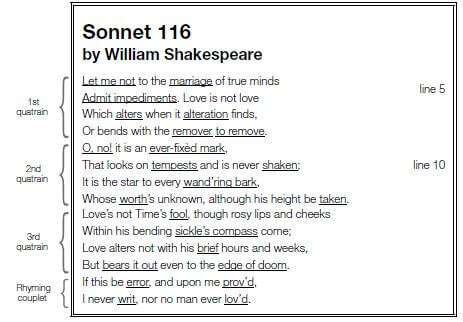
| Definitions of words from the poem: |
| Line 1: | let me not | don’t allow me to |
| marriage | union, unity, bond |
| Line 2: | admit impediments | allow obstacles, flaws or anything else to get in the way |
| Line 3: | alters | changes |
| alteration | a change |
| Line 4: | remover | person taking (love) away; |
| to remove | to take away |
| Line 5: | ever-fixèd mark | permanent, unchanging marker |
| Line 6: | tempests | storms, challenges |
| shaken | moved |
| Line 7: | wand’ring bark | ship lost at sea |
| Line 8: | worth | value |
| taken | measured |
| Line 9: | fool | servant |
| Line 10: | sickle | a tool used to cut grass; |
| compass | range; direction |
| Line 11: | brief | short |
| Line 12: | bears it out | makes it last |
| edge of doom | end of the world; end of time; death |
| Line 13: | error | mistake |
| Line 14: | writ | wrote |
2. Type and form
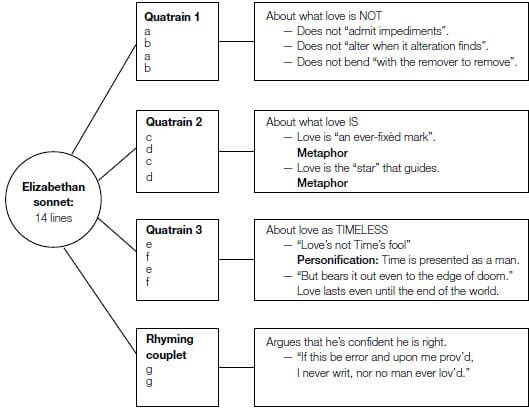
Sonnet 116 is an Elizabethan sonnet. It has 14 lines in one verse that is made up of:
- Three quatrains of four lines each; and
- A rhyming couplet of two lines at the end of the poem.
The rhyming scheme for Sonnet 116 is abab cdcd efef gg
Rhyme: Words at the end of the lines which have the same sound such as “minds” and “finds”.
3. Analysis
| First quatrain (lines 1 – 4) Let me not to the marriage of true minds
Admit impediments. Love is not love
Which alters when it alteration finds,
Or bends with the remover to remove. |
In the first quatrain, the poet suggests what love is not. Nothing should get in the way (“impediments”) of people who are united (perhaps by love or marriage) and have the same values (“true minds”). People who have true minds share the same beliefs, values and ideas. They may be close friends or family members, not only lovers or people who are married in an official way.
Note: Marriage can also mean a closeness or union between two people who love each other.
He celebrates this kind of love and explains that true love does not change (“alters”) when circumstances change (“it alteration finds”). True love stays constant (steady or even) and stable and it does not weaken (“bend”) when there are difficult times, or the loved one does not seem to love any more.
The poet emphasises that love which changes or weakens is not true love by repeating “alter” and “alteration”; and “remover” and “remove” – these words suggest things that take love away or change love.
Note: Notice how “work” amd “bark” rhyme as do “shaken” and “taken”.
| Second quatrain (lines 5 – 8) O, no! it is an ever-fixèd mark
That looks on tempests and is never shaken;
It is the star to every wand’ring bark,
Whose worth’s unknown, although his height be taken. |
In this quatrain, the poet suggest what love is. The poet explains that he thinks the love of true minds is stable and permanent. His exclamation, “O, no!” indicates how strongly the poet rejects the idea that anything can change true love. The poet then uses metaphors based on ships and sailing to tell us what love really is.
In the first metaphor the poet says that true love is an “ever-fixèd mark”, perhaps like a lighthouse. It stays shining and constant as a guide even during the worst storms (“tempests”). This metaphor tells us that true love is faithful and steady and will help you to manage even the worst of life’s problems.
In the second metaphor, Shakespeare says that true love is the “star” that guides a ship that has gone off course or got lost (“wand’ring bark”). This star refers to the North Star, which was used by a ship’s captain to steer a ship in the right direction as it is a constant star, always in the same place in the sky. He is saying that true love is constant and never changes its nature. It can be trusted to guide you through life, like the North Star guides a “wand’ring bark” or a ship lost at sea.
Shakespeare also says that, although the position of a star can be measured, we cannot know the worth or value of the star. In the same way, the value of true love is something which cannot be measured, so its worth is “unknown” (line 8), although it can give us direction and meaning in life.
Did you know: In Shakespear’s day, sailing ships were made of wood. The captain steered the ship by measuring the position of the stars to guide the ship across the sea.
| Third quatrain (lines 9 – 12) Love’s not Time’s fool, though rosy lips and cheeks
Within his bending sickle’s compass come:
Love alters not with his brief hours and weeks,
But bears it out even to the edge of doom. |
In the third quatrain, the poet tells us that such love is timeless – it cannot be measured and lasts to the end of the world.
The passing of time has no effect on true love. The use of a capital letter in “Time” tells us that this is personification, that Time is a person. Shakespeare is writing about time as if it is a man, so he writes “his” not “its”.
However, the speaker in the poem says that love is not the “fool” of Time. He says that love is not a servant that has to obey Time’s rules and so, although Time destroys youth and beauty (cuts down “rosy lips and cheeks” with his “sickle”), love does not change. The poet says that love will last forever, even until the end of the world (“the edge of doom”).
Did you know: Father Time is also called the Grim Reaper or Death. He carries a sickle to harvest people, as a farm worker cuts grass with a sickle. He destroys our youth and beauty so that we get old and wrinkled.
| Rhyming couplet (lines 13 – 14) If this be error and upon me prov’d,
I never writ, nor no man ever lov’d. |
After telling us that love does not change (first quatrain), that love gives us guidance (second quatrain) and finally that love never ends (third quatrain), the poet ends the poem with a little joke. He says that if anyone can prove that his views of love are wrong then it would mean that he didn’t write anything and that no one has ever loved anyone.
This is a clever argument to end the poem with because we all know that Shakespeare has written – we are studying one of his poems right now – and of course people have loved before, and so what he says about love must be correct.
4. Tone and mood
The tone of the poem is generally confident. Shakespeare believes so strongly in love that he does not say love is “like” anything (a simile). Instead, he uses metaphors to say that love IS that thing: love IS a “star” and love IS an “ever-fixèd mark”.
In the third quatrain, Shakespeare’s tone is scornful of Time’s “brief hours and weeks” because true love is not affected by time. Time passes and we grow old and die but love does not die.
The tone of the rhyming couplet is persuasive. The poet or speaker wants to persuade the reader to agree with his views about true love.
The mood of a poem is how it makes the reader feel. How does this poem make you feel? For example, happy, sad, angry, or indifferent?
Note: Scournful is an expression of digust towards someone or something that is seen as unworthy.
Also have you noticed that there are no similies in this poem, only metaphors?
Summary
Sonnet 116 : Let me not to the marriage of true minds by William Shakespeare
- Theme
- Love is constant and everlasting.
- Type and form
- Tone and mood
- Tone: Confident, scornful, persuasive
- Mood: How does this poem make you feel? Happy, sad, angry or indifferent? Always give reasons for your answer.
Activity 1
Refer to the poem on page 2 and answer the questions below.
- Complete the following sentence by using the words provided in the list below.
| Petrarchan; sestet; Elizabethan; Couplet; quatrains; octave |
This is a typical (1.1) … sonnet because of the three (1.2) … and the (1.3) … that rhymes. (3)
- Quote a word in the first line which has connotations of love and unity. (1)
- Refer to the following words in line 1 (“… the marriage of true minds”).
To what do these words refer? (2) - Refer to lines 2-4 (“Love is not love … remover to remove”).
Using your own words, explain the meaning of these lines. (2) - Choose the correct answer to complete the following In line 5, the words “O, no …” show that the speaker is …
- uncertain.
- arrogant.
- doubtful.
- convinced. (1)
- Refer to line 7 (“It is the star to every wand’ring bark”).
Give the literal meaning of the underlined words. (1) - Is the following statement TRUE or FALSE? Quote THREE consecutive words to support your answer.
It is impossible to measure the value of love. (2) - Refer to the following words in line 9 (“Love’s not Time’s fool”). Identify the figure of speech used (1)
- Refer to lines 13 and 14 (“If this be … man ever loved”).
How does the poet use the last two lines to make his argument on true love convincing? (2) - Do you agree with the speaker’s view of love? Explain your (2) [17]
Note:
- Connotations – words with meanings linked to a key word. For example, the connotations of “morning” are fresh,new,early.
- Consecutive words – words that directly follow after one another.
Answers to Activity 1- Elizabethan ✓/ quatrains ✓/ couplet ✓ (3)
- “marriage” ✓ (1)
- The union/ joining together ✓ of like-minded people/ people who think the same way/people who have the same values. ✓ (2)
- True love does not change/ is constant ✓ when circumstances change/ when difficulties arise/ when the people change ✓ (2)
- D / convinced ✓ (1)
- A ship that is lost/moving aimlessly or with no direction ✓ (1)
- True. ✓ “whose worth’s unknown” ✓ (2)
- Personification [or apostrophe] ✓ (1)
- If what he says about love is not true, then it is also true that he did not write this poem. However, you are reading what he has written. Therefore, he did write this poem and therefore what he says about love is true. ✓✓ (2)
- Yes, I agree with the poet that love can last forever. People who really love each other can overcome any problems. ✓✓
OR
No, I disagree/ do not agree with the poet because these days love is superficial and often marriages do not last. ✓✓ (2) [17]
|
Hint ; In question 7, one mark will be given if the first part of the answer (true) is correct. To get 2 marks, give the correct answer and quote the correct three words.
Note: When a question asks for your own view or opinion, you must say if you agree or not and then give a reason for your viewpoint to get 2 marks.
DEATH BE NOT PROUD BY JOHN DONNE
- Themes
- Type and form
- Analysis
- Tone and mood
- Activity 2
This poem was written by John Donne (1572-1631) who lived at the same time as Shakespeare. Donne had an adventurous early life. He travelled by sailing ship on two expeditions to the New World (the United States). He also ran away with his employer’s 16-year-old niece, Anne, whom he married, and so he was fired from his job. Donne was a Christian and became an Anglican priest and later the Dean of St Paul’s Cathedral in London.
1. Themes
The theme of this poem is death. The poet speaks directly to Death, in person, and tells Death not to think that he is important and powerful because Death is really just a kind of sleep – and rest and sleep are pleasant. We all wake from sleep: even people who die will wake from death – in heaven! The poet points out that actually death brings us benefits and that it has no power. There is therefore no reason for people to be afraid of death.
This poem is based on the Christian paradox that in order to live forever you have to die. In the Christian belief, physical death is the gateway to eternal or everlasting life in heaven.
The poet makes a clever argument in this poem. His idea is set out like this:
- When we die, it looks as if we are asleep.
- When we sleep, we will eventually wake up.
- If death looks like sleep, then we will also wake up from death.
- If we wake up from death, we cannot be dead.
- Death is destroyed by eternal life.
Vocab: A paradox is a statement made of two opposite ideas that seems to make no sense but may be true.
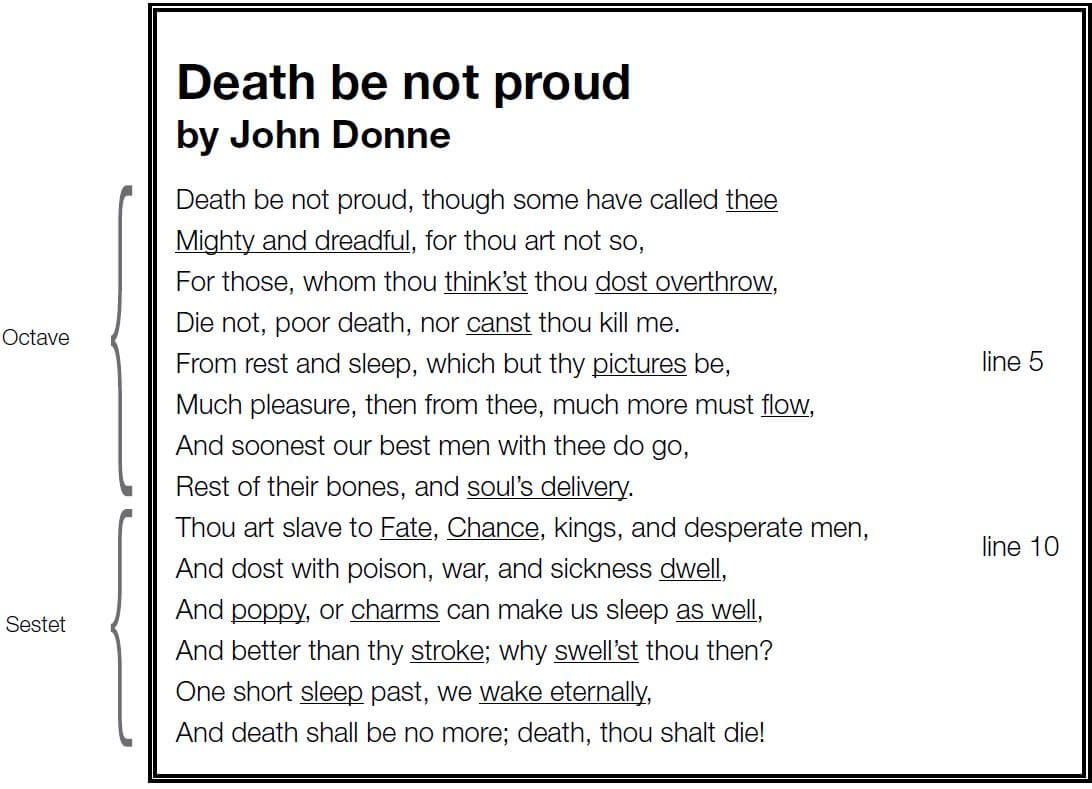
| Definitions of words from the poem: |
| Line 1: | thee | you |
| Line 2: | mighty | powerful, strong |
| dreadful | terrifying, tragic |
| art | are |
| Line 3: | thinks’t | think |
| dost | does |
| overthrow | destroy |
| Line 4: | canst | can |
| Line 5: | pictures | copies, images, representations, likenesses |
| Line 6: | flow | come |
| Line 8: | souls’ delivery | souls going to heaven, to God |
| Line 9: | Fate | luck |
| chance | accidents |
| Line 10: | dwell | live |
| Line 11: | poppy | drug |
| charms | magic spells |
| as well | just as well |
| Line 12: | stroke | attack |
| swell’st | swell, grow big |
| Line 13: | sleep | death |
| wake eternally | live forever |
2. Type and form
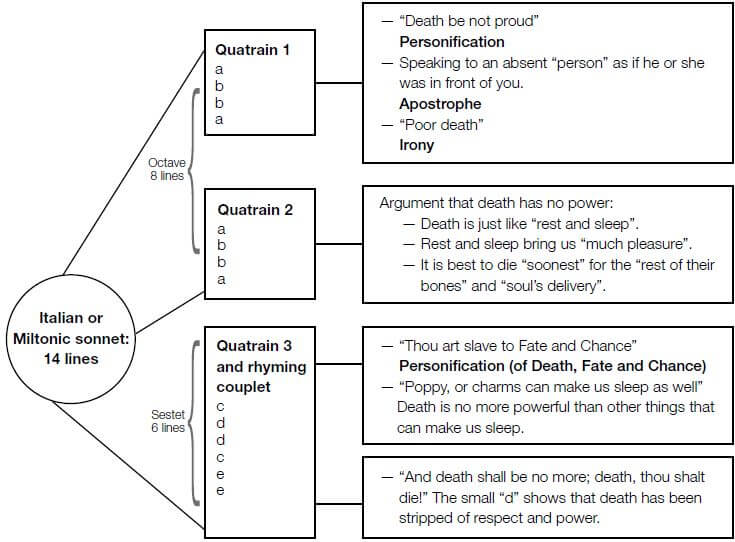
The poem is an Italian or Miltonic sonnet. This is because its 14 lines are made up of:
- An octave of eight lines made up of two quatrains; and
- A sestet of six The sestet is made up of one quatrain and arhyming couplet at the end of the poem.
The rhyming scheme in this sonnet is abba abba cddc ee.
Hint: “Octo” (in octave) means eight “ses” means six, so a sestet has six lines
3. Analysis
| First quatrain of the octave (lines 1 – 4) Death be not proud, though some have called thee
Mighty and dreadful, for thou art not so,
For those, whom thou think’st thou dost overthrow,
Die not, poor death, nor yet canst thou kill me. |
The speaker talks to Death as if Death was a person. This is a figure of speech called personification. By personifying Death, and giving it a human quality – pride – the poet makes death less scary. Death then only has the same power as people like you and me.
The speaker is using another figure of speech here called apostrophe – no, not the punctuation mark! Apostrophe is when you speak directly to an absent person or thing as if he or she was standing in front of you.
The poet orders Death not to be “proud” (arrogant) because people do not really get defeated (“overthrown”) by Death. In fact, Death cannot kill anyone – not even the speaker. The poet explains in the rest of the poem why Death cannot really “kill” anyone.
The poet, however, says that only “some” people consider death “mighty and dreadful” (line 2). In line 3, he goes on to tell Death that people it thinks it has destroyed do not die, and Death cannot kill him, the poet. He mocks Death by pretending to be feel sorry for Death, calling it “poor death”.
The poet is using the word “poor” in an ironical way here, as he does not really pity death.
Vocab: Poor can mean financially poor; or someone undeserving pity. In this poem, the word “poor” is used scornfully. The poet does not really pity death.
Also: Note how the rhyme scheme here is abba. ” Be” rhymes with “delivery” and “flow” with “go”.
| Second quatrain of the octave (lines 5 – 8) From rest and sleep, which but thy pictures be,
Much pleasure, then from thee much more must flow,
And soonest our best men with thee do go,
Rest of their bones, and souls’ delivery. |
People who die look like they are resting and sleeping – both rest and sleep are enjoyable (they give us “much pleasure”). Death is just a copy of these pleasant experiences.
The poet continues to mock Death by saying that if sleep is great and death is like a big sleep – then what an even greater pleasure death must be. Even more, the quicker people die, the better for them (“soonest our best men with thee do go” in line 7)!
The poet gives his evidence for this in lines 7 and 8, where he says the “best men”, those with true faith, welcome death because it rests their bodies (“bones”) and delivers their souls to God.
| Third quatrain (sestet and rhyming couplet, lines 9 – 14 Thou art slave to Fate, Chance, kings, and desperate men, 10
And dost with poison, war, and sickness dwell.
And poppy or charms can make us sleep as well,
And better than thy stroke; why swell’st thou then?
One short sleep past, we wake eternally,
And death shall be no more; death, thou shalt die! |
Note: The rhyme in the sestet is cddc ee
The speaker continues to criticise Death. He says that Death does not have the power to kill people on his own. Death is a servant (a “slave”) to many horrible “masters” such as destiny (“Fate”) and accidents (“Chance”), which may kill us. Death also works for “desperate men” – this would be men who may rob and murder. Death also has to live (“dwell”) with very nasty companions that will do the actual killing: “poison, war, and sickness” (line 10).
Hint: Connotation of a word are extra meanings or the associations with that word. By using the word “Slave”, the poet is saying that Death is not free and has no control over his life.
The poet personifies Death as a slave who has no freedom to act on his own. He is used by other forces which cause death. The poet uses capital letters (F and C) for Fate and Chance as if they are important people; and Death is their slave.
In line 12, the poet reminds Death that even simple sleeping drugs (opium, made from the “poppy”) and charms (“magic”) can make us “sleep” better than Death can (“…better than thy stroke”). The poet asks: if these things do the same work as Death, why is Death is so full of self-importance, “why swell’st thou then?” There is an expression “swell with pride” that describes the feeling of being filled with pride, which gives us an image of a proud, arrogant person pushing his chest out to look big and important! The poet suggests that Death has nothing to be proud of.
| Rhyming couplet (lines 13 – 14) One short sleep past, we wake eternally,
And death shall be no more; death, thou shalt die! |
The last two lines of the poem are a rhyming couplet. Although the words “eternally” and “die” do not seem to rhyme – they would have rhymed in the English accent of that time.
Notice that now the speaker uses a small “d” for death in the last line of the poem (line 14). Death is not important anymore and does not get the capital “D” of a proper noun.
4. Tone and mood
The poet’s tone in the poem is scornful and mocking in the way that he gives orders to Death, which is often considered a terrifying mystery. The tone is also critical of death.
In the end, the speaker uses a triumphant tone because he has won a victory over Death, as Death is conquered and destroyed by eternal life.
The mood of a poem is how it makes the reader feel. How does this poem make you feel? For example, happy, sad, angry, or indifferent.
Summary
Death be not proud by John Donne
- Theme
Death is not a terrifying mystery, but a force without real power. - Type and form
- Tone and mood
- Tone: Scornful, mocking, triumphant
- Mood: How does this poem make you feel? Happy, sad, angry or indifferent? Always give reasons for your answer.
Activity 2
Refer to the poem on page 10 and answer the questions below.
- Refer to the following words in line 1 (“Death be not proud”):
Identify the figure of speech used (1) - Explain why the poet has used this figure of (2)
Hint: to explain this figure of speech, think of how and why the poet talks to Death as a person. - Which three words from the list below could be used to describe Death? (3)
| arrogant; clever; proud; friendly; over-confident; loving |
- Is the following statement TRUE or FALSE?
Everyone fears Death.
Quote ONE word from the poem to support your answer. (2)
note: Write down either true or false and then your one word answer. Remember that this is a quote so make sure you spell the word exactly as it is in the poem. - Complete the following sentences by using the words provided in the list Write down only the words next to the question number.
| entertainment; temporary; relaxation; end; look; final |
The poet says that “rest and sleep” are “pictures” of Death, meaning they only (5.1) … like death. However, people rest and sleep for (5.2) … (2)
- Using your own words, write down THREE causes of death statedin the poem. (3)
- Refer to the following words in line 12 (“why swell’st thou then?”) Explain the meaning of these words as they are used in the (1)
- Refer to lines 10-14. Name two things which have the sameeffect as Death. (2)
- Write down the correct tone word in brackets for each of the lines below:
- “Death be not proud for, thou art not so” (lines 1- 2) (triumphant/critical/ mocking)
- “Thou art slave to Fate, Chance, kings, and desperate men” (line 9) (triumphant/critical/mocking)
- “And poppy, or charms can make us sleep as well, And better than thy stroke” (lines 11-12)
(triumphant / critical / mocking) - Death, thou shalt die.” (line 14) (triumphant/critical/mocking) (4)
- In the last two lines (13–14) the speaker’s tone is …
- triumphant and victorious
- submissive and angry.
- sad and disappointed.
- thoughtful and fearful. (1)
- Discuss the message the poem has for its (2) [23]
To get 2 marks, you must give 2 points.
Answers to Activity 2
- Personification OR apostrophe ✓ (1)
- Personification: The poet gives Death human qualities in order to mock/poke fun at/ridicule/laugh at Death/ to show that Death is like an ordinary human/mortal/ not powerful ✓✓
OR
Apostrophe: He addresses Death as if Death is present/ in front of him. ✓✓ (2) - arrogant ✓/proud ✓/over-confident ✓ (3)
- False. “some” ✓✓ (2)
- 5.1 look ✓ (1)
5.2 relaxation ✓ (1) - You are destined to die in a certain way (Fate). ✓
- You can die in an accident (Chance). ✓
- Your death can be ordered by kings/powerful people. ✓
- You can die in a war. ✓
- You can be murdered. ✓
- You can kill yourself/ suicide. ✓
- You can die by taking poison. ✓
- You can die from illness/disease. ✓ (3)
- The poet is questioning/asking why Death is filled with pride/proud/OR why Death is arrogant/pompous/haughty/ swollen with pride. ✓ (1)
- “poppy” ✓ and “charms” ✓ (2)
- critical ✓
- critical ✓
- mocking ✓
- triumphant ✓ (4)
- A / triumphant and victorious ✓ (1)
- You should not be afraid to die. ✓
- Death has no power. ✓
- Death is temporary/does not last forever. ✓
- There is life after death. ✓ (2) [23]
NOTE:
- In question 4, a mark is awarded only if both parts of the answer are correct: False and “some”.
- Any three of the answers in question 6 are acceptable
- Any 2 of the answers n question11 are acceptable
AN ELEMENTARY SCHOOL CLASSROOM IN A SLUM BY STEPHEN SPENDER
- Themes
- Type and form
- Analysis
- Tone and mood
- Activity 3
This poem was written by Stephen Spender (1909-1995). He was a modern English poet and writer.
Much of his writing is about human rights and social justice. He was politically left-wing and was a member of the Communist Party in Britain in the 1930s. He was actively involved in the anti-Nazi and anti-Fascist politics of that time.
Later in life he edited literary magazines and taught at many institutions. He became Professor of English at University College in London in the 1970s.
1. Themes
The two main themes are a protest against social inequality and againstpoor quality education.
The poet describes some children in a classroom in a very poor area. Most of them look unhealthy and unhappy. The pictures on the walls of the gloomy classroom show an interesting world outside the slum, but the children are trapped in a world of poverty and may never experience a better life unless something is done to change their future.
The poet calls upon the people responsible for education to free these children from their poverty and give them the opportunity to live a better life.
VOCAB: In the title of the poem, an ‘elementary school’ is a primary school (grade 1-7). A ‘slum’ is a very poor area of a city or town with few facilities or services.
An elementary school classroom in a slum by Stephen Spender
| Stanza1 | Far far from gusty waves, these children’s faces.
Like rootless weeds, the hair torn around their pallor.
The tall girl with her weighed-down head. The paper-
seeming boy, with rat’s eyes. The stunted, unlucky heir
Of twisted bones, reciting a father’s gnarled disease,
His lesson from his desk. At back of the dim class
One unnoted, sweet and young. His eyes live in a dream
Of squirrel’s game, in the tree room, other than this. | 1
5
|
|
| Stanza 2 | On sour cream walls, donations. Shakespeare’s head,
Cloudless at dawn, civilised dome riding all cities.
Belled, flowery, Tyrolese valley. Open-handed map
Awarding the world its world. And yet, for these
Children, these windows, not this world, are world,
Where all their future’s painted with a fog,
A narrow street sealed in with a lead sky,
Far far from rivers, capes, and stars of words. | 10 15 |
| |
| Stanza 3 | Surely, Shakespeare is wicked, the map a bad example
With ships and sun and love tempting them to steal –
For lives that slyly turn in their cramped holes
From fog to endless night? On their slag heap, these children
Wear skins peeped through by bones and spectacles of steel
With mended glass, like bottle bits on stones.
All of their time and space are foggy slum.
So blot their maps with slums as big as doom. | 20 |
| |
| Stanza 4 | Unless, governor, teacher, inspector, visitor,
This map becomes their window and these windows
That shut upon their lives like catacombs,
Break O break open, till they break the town
And show the children to green fields and make their world
Run azure on gold sands, and let their tongues
Run naked into books, the white and green leaves open
History theirs whose language is the sun. | 25 30 |
| |
Words to know:
| Definitions of words from the poem: |
| Stanza 1 |
| Line 1: | gusty | windy |
| Line 2: | weeds | unwanted plants |
| pallor | pale, unhealthy skin colour |
| Line 4: | stunted | undeveloped |
| heir | receiver |
| Line 5: | reciting | repeating |
| gnarled | twisted, crooked |
| Line 6: | dim | almost dark, badly lit |
| Line 7: | unnoted | unnoticed |
| Line 8: | squirrel | small, tree-climbing animal |
| Stanza 2 |
| Line 9: | donations | gifts (usually for charity) |
| Line 10: | dawn | sunrise |
| dome | curved shape; Shakespeare’s head |
| Line 11: | Tyrolese | Austrian tyrol (mountains) |
| open-handed | generous |
| Line 12: | awarding | giving |
| Line 14: | sealed | closed up |
| lead | dull, grey |
| Line 15: | capes | land going out into the sea |
| Stanza 3 |
| Line 19: | slyly | secretly, sneakily |
| cramped | small, crowded |
| Line 20: | fog | thick mist |
| slag heap | coal mine dump |
| Line 21: | peeped | looked shyly |
| Line 22: | blot | mark |
| doom | bad future |
| Stanza 4 |
| Line 25: | governor, inspector | people in charge of running schools |
| Line 27: | catacombs | underground burial chambers for the dead |
| Line 30: | azure | bright blue |
| Line 31: | white leaves | books |
| green leaves | nature |
2. Type and form
This poem is divided into four stanzas of eight lines each. It is written in an informal style with no words that rhyme at the ends of the lines, which is typical of modern poetry.
This is known as free verse.
3. Analysis
| Stanza 1 (lines 1 – 8) Far far from gusty waves, these children’s faces.
Like rootless weeds, the hair torn around their pallor.
The tall girl with her weighed-down head.The paper-
seeming boy, with rat’s eyes.The stunted, unlucky heir
Of twisted bones, reciting a father’s gnarled disease,
His lesson from his desk. At back of the dim class
One unnoted, sweet and young. His eyes live in a dream
Of squirrel’s game, in the tree room, other than this. |
Note: Rhyming lines of poetry end in words that sound the same.
In stanza 1, the poet describes some of the children in the classroom. The opening lines of the poem are not complete sentences and have an unusual word order:
Far far from gusty waves these children’s faces
Like rootless weeds, the hair torn round their pallor. (lines 1 and 2)
In ordinary English, the first two lines would be written: “These children’s faces are far, far from gusty waves and they look like rootless weeds. ” By changing the word order, the poet repeats “Far far” to start the poem. This emphasises the poet’s frustration about how far the children’s environment is from what it should be. His tone is angry. The words “gusty waves” (line 1) suggest wind and sea – a healthy, fresh and beautiful place, unlike the gloomy slum they are living in.
In a simile, the poet compares the children to “rootless weeds” (line 2). Weeds are small, unwanted plants. The word “rootless” gives us an even more powerful image of how weak the children are: plants cannot grow without roots to take in water and nutrients, and without roots, they do not even seem to belong in one place in the ground. The simile “like rootless weeds” suggests these children are thin, weak and underfed, but also that they do not have a place in the world. The children’s “pallor” (line 2) makes them look pale and sickly, while the metaphor “torn hair” (line 2) suggests that their hair is messy and they are not well cared for.
The poet goes on to describe some of the children in the class. One girl is tall for her class, but instead of standing tall and proud, she hangs her head (“weighed-down head” in line 3). This suggests she is thin and her head feels too heavy for her body, or that she feels depressed and is not concentrating on the lesson. A boy is “paper-seeming” (line 3 and 4). This metaphor suggests that he is as pale and thin as a piece of white paper. The poet uses hyperbole here to emphasise how thin the boy is.
The metaphor “rat’s eyes” (line 4) paints a picture of little eyes moving quickly around, like a rat’s – perhaps always looking for danger or a way to survive. Some rats have red eyes, so perhaps the boy has an eye disease, or has been crying. The image of this boy is of a thin, pale, frightened, unhealthy child.
A third boy suffers from a disease he has inherited from his father that has left him undeveloped (“stunted”) with “twisted bones” (line 5). To “recite” is to repeat something and learn it off by heart. The poet uses irony by saying the boy “recites” his “disease”, instead of his schoolwork. The poet could be suggesting that the child will repeat the disease by passing it on to his own children one day. The emphasis is on the repetition of disease and ill health.
We are also given the impression that the children are taught to learn things off by heart, without really understanding what they are learning about.
In the final three lines of this stanza, the poet introduces a contrast. The last child mentioned, sitting at the back of the dull, poorly-lit room, is different from the others and looks younger than they do. “Sweet and young” (line 7) suggests he is innocent and has not yet been as badly affected by slum life as the other children and still has dreams of something better. Instead of listening to the lesson, he is dreaming of playing in a different place, somewhere outside in nature (“tree room”). A squirrel is a little animal with bright eyes and a bushy tail that runs freely up and down trees. The child perhaps imagines playing as freely as a squirrel in a beautiful place.
Note:
- A simile is a direct comparison between two things using ‘like’ or ‘as’
- Hyperbole: An overstatement used for emphasis. Here, the boy is not really as thin as a piece of paper.
- A metaphor is a way of comparing two things without using the words ‘like’ or ‘as’.
| Stanza 2 (lines 9 – 15) On sour cream walls, donations. Shakespeare’s head,
Cloudless at dawn, civilised dome riding all cities.
Belled, flowery, Tyrolese valley. Open-handed map
Awarding the world its world. And yet, for these
Children, these windows, not this world, are world,
Where all their future’s painted with a fog,
A narrow street sealed in with a lead sky,
Far far from rivers, capes, and stars of words. |
In the second stanza, the poet describes the classroom. The colour of the classroom walls is “sour cream” (line 9). The connotations of this are of cream that has gone bad, which suggests the walls are dull and not very clean.
The walls are decorated with what the poet calls “donations” (line 9) – which are gifts to the school, but these gifts may not improve the children’s lives. Ironically, these gifts suggest a world that the children may never be able to experience because of their poverty. The speaker uses a bitter tone when he tells us that these children have a life which is a contrast to these pictures. Their world is dirty, polluted, grey and without much freedom.
Note:
- Imagine some connotations of ‘sour cream’. They may include ‘rotten’, ‘horrible tatse’ or ‘ old’.
- Irony: A statement with an underlying meaning different from its surface meaning.
Look at what is on the walls and note the irony of these “donations”:
- A picture of Shakespeare: he represents the world of culture, of theatres and plays that, ironically, the children may never see. The phrase “cloudless at dawn” (line 10) suggests a new day, a new life, and contrasts with the grey skies of the slum outside the classroom “Civilised dome” (line 10) may refer to Shakespeare’s bald head in the shape of a dome. It could also refer to buildings with domes in cities that suggest other cultures and faraway places.
- A poster of the Tyrol: The Tyrolean mountains in Austria have beautiful valleys that are green and filled with wild flowers in summer. Cows graze and wear bells around their Many tourists travel there on holiday, but these children may never get a chance to do that.
- A map of the world: This seems “open-handed” (generous), as if it offers the children the whole, exciting world with its wonderful opportunities, but most of them may never leave the slum in which they live.
The poet’s tone is sad when he says, “these windows, not this world, are world” (line 13). “These windows” refer to the classroom windows that look out on the slum. They do not look out on “this world”, which is the wonderful world shown in the pictures and the map. Instead, the windows “are [their] world”; in other words, the children’s world is the slum that they see through the windows.
The speaker goes on to describe the slum outside the classroom and what it means for the lives of the children. The “narrow” street suggests that the area is built up and crowded. It is “sealed” (line 15) or closed in by the grey, cloudy, heavy (“lead”) sky. The words “lead”, which is a heavy grey metal, and “sealed” make it seem almost as if the children are trapped in a lead coffin. The alliteration of the “s” sound that links the words “street/sealed/ sky” adds to the trapped, closed-in feeling.
As he did at the start of the poem, the poet uses the repetition, “Far far …” (line 16) to emphasise how the children are cut off from nature and the beautiful world beyond the slum. The metaphor “stars of words” (line 16) is interesting. The stars are beautiful and represent dreams, great ambitions and things that are bright and fine. “Stars of words”, therefore, make us think not only of a beautiful night sky, but also of the wonderful ways words can be used: words express wisdom and knowledge, they can inspire us, they can empower us. But perhaps these children have no experience of words used in this way.
Notice that in this stanza, the word “world” is repeated four times, each time with a slightly different meaning or connotation.
| Stanza 3 (lines 17 – 24) Surely, Shakespeare is wicked, the map a bad example
With ships and sun and love tempting them to steal –
For lives that slyly turn in their cramped holes
From fog to endless night? On their slag heap, these children
Wear skins peeped through by bones and spectacles of steel
With mended glass, like bottle bits on stones.
All of their time and space are foggy slum.
So blot their maps with slums as big as doom. |
In this stanza, the poet uses an indignant tone. His anger about injustice increases when he thinks about the children’s future.
“Wicked” (line 17) seems a very strange word to use to describe a great and inspiring writer like Shakespeare, and how, we may wonder, can a map be “a bad example” (line 17) ? We are answered in the next line. Great art and literature, maps of the world, together with a life of travel and adventure (ships) in warm, sunny places belong to a life these children may never have – unless they turn to crime to escape from their poverty. The poet’s diction (his choice of words, such as “wicked/bad”) and the strong rhythm of these lines show how strongly he feels. The poet’s unhappiness is shown again in the next two lines when he describes what the future holds for these children. Their homes are “cramped holes” (line 19) and their lives are dull (“fog”) and without a bright future (“endless night”).
Lines 20 to 24 paint a tragic picture of the children’s future. If you have ever seen a place where coal is mined, you will have seen the slag heaps which are huge dumps of black waste from the coal mines. The children in the poem do not literally live on a slag heap (although their slum may be close to one) but this strong metaphor tells us that their lives are not pleasant, and are without joy or hope.
The poet uses personification in “wear skins peeped through by bones” (line 20) to emphasise how thin the children are. Their bones are “peeping” or looking through their skin. This is also an example of hyperbole as the bones would not actually be sticking out through the skin. The children who wear the broken glasses cannot even see properly – “With mended glass, like bottle bits on stones” (line 21). This simile may refer to the children’s future as well as their physical condition. Is the future they see ahead of them as broken as their glasses? They have nothing good to look forward to as “All their time and space are foggy slum” (line 23).
The last line of stanza 3 shows how angry the poet feels about the future to which these children are condemned. He speaks in a direct, angry andaccusing tone to us and all those people in authority. He says that we may as well condemn the children to endless unhappiness and paint the “map” of their future with a picture of a huge slum, “as big as doom” (line 24).
You met the word “doom” in the Shakespeare sonnet, when it meant 0the end of time/the world, the Day of Judgement. Here “doom” has the connotation of being condemned to suffering and death from which there is no escape. Notice the rhythm of this line, with five short, strong, heavy words following one another, almost like beats of a drum – “So blot their maps with slums as big as doom”.
Note:
- Read this line out loud and hear how it expresses the poet’s anger. ‘ So blot their maps with slums as big as doom’.
| Stanza 4 (lines 25 – 32) Unless, governor, teacher, inspector, visitor,
This map becomes their window and these windows
That shut upon their lives like catacombs,
Break O break open, till they break the town
And show the children to green fields and make their world
Run azure on gold sands, and let their tongues
Run naked into books, the white and green leaves open
History theirs whose language is the sun. |
In the last stanza, the poet introduces hope to a hopeless situation. He calls on those in authority to change these children’s lives and give them a better future. He calls on the school governor (many South African schools have governing bodies), teachers, school inspectors and visitors to take action. To express his excited tone about what he wants to happen, the poet has written this stanza as one long sentence that builds to a climax. However, to make it easier to discuss, it will be divided into two.
Unless, governor, teacher, inspector, visitor, 25
This map becomes their window and these windows
That shut upon their lives like catacombs,
Break O break open, till they break the town
Note: The poet does not mean the authorities must literally break the windows. He means they must Uguratively help to open up the children’s minds and lives.
The first word, “Unless” (line 25), offers the authorities an alternative to “blot[ting] their maps with slums as big as doom”. Instead, the “map” on the classroom wall should no longer be a “temptation” to steal, but become an offer of real opportunities for the children. It should be a “window” (line 26) to all the world has to offer. The authorities must, figuratively, break open the windows for the children and offer them a different future.
At present they are imprisoned as if they were in a grave (“catacomb”). The poet emphasises the need to free the children from this future by his urgent tone. He repeats “break o break” (line 28) and the excited exclamation “o”; he wants the children to be able to escape their dull and lifeless future and even the town itself.
And show the children to green fields and make their world
Run azure on gold sands, and let their tongues 30
Run naked into books, the white and green leaves open
History theirs whose language is the sun.
In the last four lines, the poet’s tone is a passionate plea for the authorities to give the children a different life and a better environment. He wants them to enjoy the green countryside and nature, to play freely and explore the sea and the beach (“run azure on gold sands”) – in other words, they need to experience an unlimited world. He wants them to discover the joy of reading books, which are a source of knowledge, delight and wisdom. He uses the metaphor “their tongues run naked” (line 30 and 31), which suggests drinking up the contents of books the way we drink water if we are thirsty.
The poet wants them to show the same enthusiasm for books and knowledge that are relevant and make sense to them. Here the poet makes it clear that it is only through a good education and a better environment that the children will have the opportunities that at present they do not have. He wants them to have access to “white” leaves (a leaf also means a page, so white leaves are the pages of books) and “green leaves” (nature, the wider world) so that they will have a different future.
The poem reaches its climax in the last line with a powerful metaphor: the new “history” of their lives should be written in the “language of the sun” (line 32). The sun is the source of life, warmth, brightness, energy. These are the qualities that should be part of these children’s lives.
Contrasts
Notice all the colours used in the final stanza: azure (bright blue), gold, white, green, and the colour suggested by the sun. Consider how these contrast with the colours suggested by the images used earlier in the poem: “pallor”, “sour cream”, “fog”, “lead”, “holes”, “endless night”, “slag heap”, “catacombs”.
How does this contrasting group of images show two different kinds of life? The earlier colours are dull and gloomy, lifeless, even deathly, like the lives of the children in the slum; the later ones are bright and beautiful, the way their lives ought to be – a movement from darkness into light. |
4. Tone and mood
In stanza 1, the tone is angry and frustrated because of the hardship the children face.
In stanza 2, the speaker uses a bitter and sad tone when he contrasts the pictures on the classroom wall with the hard realities the children face.
In stanza 3, the tone is indignant and accusing about the injustice the children face in the future.
In stanza 4, the tone is excited and urgent about the need to improve the children’s situation. The final tone is a passionate plea to do so.
The mood of a poem is how it makes the reader feel. How does this poem make you feel? For example, happy, sad, angry, or indifferent.
Summary
An elementary school classroom in a slum by Stephen Spender
1. Theme
A prootest against social inequality and against poor quality education
2. Type and form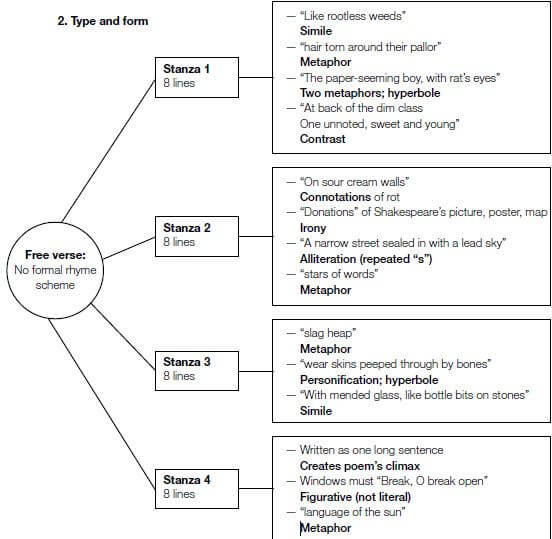
3. Tone and mood
Tone: Moves from angry, frustrated, bitter, sad, indignant and accusing; to excited, urgent and passionate.
Mood: How does this poem make you feel? Happy, sad, angry or indifferent? Always give reasons for your answer.
Activity 3
Refer to the poem on page 19 and answer the questions below.
- Complete the following sentences by using the words provided in the list Write down only the words next to the question number (1 – 3).
| good; primary; children; resources; high; poor |
The setting (background) of the poem is a (1) … school in a (2) … area. There are very few (3) … in the classroom. (3)
- Using your own words, describe the children in the classroom
State THREE points. (3)
NOTE: in this question use your own words. Do not quote directly from the poem. For 3 marks, give 3 points. - Refer to lines 6-8.
In your OWN words, say how this child is different from the rest of the children in his class. (1) - Refer to stanza
How does the speaker feel about the “donations”? Give a reason for your answer. (2)
Note: When you are asked to give a reason, the reason must be based on the poem. - Refer to line 15 (“A narrow street sealed in with a lead sky”).
5.1 Identify the figure of speech used (1)
5.2 Explain why the poet has used this figure of (2) - Refer to stanza
Is the following statement TRUE or FALSE? Quote TWO consecutive words to support your answer.
The children’s homes are large and comfortable. (2) - Choose the correct answer to complete the following sentence: In stanza 4, the speaker’s tone shows that he is …
- commenting critically.
- pleading passionately.
- complaining bitterly.
- demanding forcefully. (1)
- Refer to stanza
Name ONE experience the speaker wishes the children to have. (1) - In your view, how does the speaker (poet) feel about the children? Using your OWN words, give TWO reasons for your (3) [19]
Note: When asked for your view, the answer requires your emotional response and understanding of the poem. For 3 marks, make 1 point about the speaker,s feeling (1 mark) and then give 2 reasons (2 marks).
Answers to Activity 3- 1 = primary ✓; 2 = poor ✓; 3 = resources ✓ (3)
- They are malnourished/ underfed/ very ✓
- They are pale. Their hair is untidy. ✓
- Some children are handicapped/ did not grow properly/ are too small for their age. ✓
- Some have darting, suspicious, hungry eyes. ✓ The girl’s head seems too big for her body. ✓
- The boy has red eyes. ✓
- Some have diseases/ inherited diseases. ✓
- They have broken glasses. ✓ (3)
Any of the above 3 answers are acceptable.
- He is a dreamer. ✓/ He has an active ✓/ He is unassuming. ✓/ He is almost invisible. ✓/ He looks younger/ more innocent. ✓/ He is not affected by his circumstances as muchas others. ✓ (1)
- He is against the donations because they show a world that the children have no experience of. ✓/The donations may tempt the children to steal/ their circumstances will not allow them to experience what the donations offer. ✓ (2)
- 5.1 Metaphor ✓ (1)
5.2 He compares their circumstances to a lead sky/ a narrow ✓✓
OR
The poet suggests that the children are trapped/ caught/ cannot escape and that they are heavily burdened/ very poor/ live in bad circumstances. ✓✓ (2) - “cramped holes” ✓✓ (2)
- pleading passionately ✓ (1)
- He wishes them to get out of the ✓
OR
He wishes them to experience nature/a beach/green fields. ✓
OR
He wishes them to read/experience literature/be exposed to books/good education. ✓ (1) - He feels sorry for ✓
AND
He describes the conditions in which they live/ their appearance vividly./ He objects to the so-called donations./ He is concerned that they might resort to stealing./ He appeals to the authorities to make a difference/ to intervene/ to help/ to save the children. ✓
OR
He is unsympathetic/ he does not care. ✓
AND
He is merely making a social point/criticising a bad education system./ His description of the children is cold and detached/ unemotional./ This is just a typical protest poem.✓ (3) [19
|
AUTO WRECK BY KARL SHAPIRO
- Themes
- Type and form
- Analysis
- Tone and mood
- Activity 4
Auto wreck was written by Karl Shapiro (1913-2000). He was an American poet who began writing poetry when he was fighting in the Second World War (1939 – 1945). He sent his poems back to America, where his fiancée had them published. He wrote Auto wreck in 1941, during the war.
He is famous for writing poetry about ordinary things such as flies, cars, supermarkets and this car crash. Shapiro was awarded the Pulitzer Prize for Poetry in 1945 and was the American Poet Laureate in 1946 and 1947.
Note
- An ‘auto-wreck’ is how Americans refer to a acar-crash.
1. Themes
The main theme of the poem is death, and the uncertainty of life.
The poem shows how uncertain and insecure life can be. None of us knows when and how we will die. The people in the cars were probably not thinking at all about life and death when suddenly the crash happened. In a moment, their lives have been changed by horrible injuries, or have been taken away altogether. The poet has no reasonable explanation for this.
Auto wreck by Karl Shapiro
| Stanza 1 | Its quick soft silver bell beating, beating,
And down the dark one ruby flare
Pulsing out red light like an artery,
The ambulance at top speed floating down
Past beacons and illuminated clocks
Wings in a heavy curve, dips down,
And brakes speed, entering the crowd. | 5 |
| |
| Stanza 2 | The doors leap open, emptying light;
Stretchers are laid out, the mangled lifted
And stowed into the little hospital.
Then the bell, breaking the hush, tolls once,
And the ambulance with its terrible cargo
Rocking, slightly rocking, moves away,
As the doors, an afterthought, are closed. | 10 |
| |
| Stanza 3 | We are deranged, walking among the cops
Who sweep glass and are large and composed.
One is still making notes under the light.
One with a bucket douches ponds of blood
Into the street and gutter.
One hangs lanterns on the wrecks that cling,
Empty husks of locusts, to iron poles. | 15 20 |
| |
| Stanza 4 | Our throats were tight as tourniquets,
Our feet were bound with splints, but now,
Like convalescents intimate and gauche,
We speak through sickly smiles and warn
With the stubborn saw of common sense,
The grim joke and the banal resolution.
The traffic moves around with care,
But we remain, touching a wound
That opens to our richest horror. | 25 |
| 30 |
| Stanza 5 | Already old, the question Who shall die?
Becomes unspoken Who is innocent?
For death in war is done by hands;
Suicide has cause and stillbirth, logic;
And cancer, simple as a flower, blooms,
But this invites the occult mind,
Cancels our physics with a sneer,
And spatters all we knew of denouement
Across the expedient and wicked stones. | 35 |
| |
Words to know:
| Definitions of words from the poem: |
| Stanza 1 (lines 1 – 14) |
| Line 2: | ruby | red |
| flare | bright light warning of danger |
| Line 3: | pulsing | throbbing |
| artery | main blood vessel |
| Line 5: | beacons | lighted signs or traffic lights |
| illuminated | lit up |
| Line 9: | stretchers | beds for carrying the injured |
| mangled | badly injured |
| Line 10: | stowed | packed away |
| little hospital | ambulance |
| Line 11: | hush | quiet |
| tolls | sound a bell makes |
| Line 12: | cargo | load of victims of the crash |
| Line 14: | afterthought | something remembered later |
| Stanza 2 (lines 15 – 21) |
| Line 15: | deranged | very upset, confused, disturbed |
| Line 16: | composed | calm |
| Line 18: | douches | washes away |
| ponds | large pools |
| Line 20: | wrecks | crashed cars |
| cling | stick to |
| Line 21: | husks | outside covering |
| locusts | large insects like grasshoppers |
| Stanza 3 (lines 22 – 30) |
| Line 22: | tourniquets | bandages wrapped very tightly to cut off blood supply and so stop bleeding |
| Line 23: | splints | something stiff that is tied against a broken bone to stop it moving |
| Line 24: | convalescents | people recovering from illness |
| intimate | close |
| gauche | awkward |
| Line 25: | sickly | weak |
| Line 26: | stubborn | determined |
| saw | wise saying |
| Line 27: | grim | gloomy |
| banal | ordinary, of little importance, stereotyped |
| resolution | conclusion, decision |
| Stanza 4 (lines 31 – 39) |
| Line 32: | innocent | not guilty |
| Line 34: | suicide | killing oneself |
| stillbirth | baby born dead |
| logic | reason |
| Line 36: | occult | magic, the supernatural |
| Line 37: | cancels | stops |
| physics | science |
| sneer | mocking look |
| Line 38: | spatters | splashes |
| denouement | ending of a story that explains everything |
| Line 39: | expedient | useful |
| stones | the road |
2. Type and form
This is a descriptive poem that deals with thoughts and feelings, so it could be classed as a lyric poem.
The poem is written in free verse, a form of poetry that has no set rhyming pattern. The structure is informal: lines and stanzas may be of different lengths and usually there is no regular use of rhyme, or even no rhyme at all.
3. Analysis
| Stanza 1 (lines 1 – 7) Its quick soft silver bell beating, beating,
And down the dark one ruby flare
Pulsing out red light like an artery,
The ambulance at top speed floating down
Past beacons and illuminated clocks
Wings in a heavy curve, dips down,
And brakes speed, entering the crowd. |
These lines describe the arrival of the ambulance at the scene of the car crash (auto wreck). In the 1940s, when this poem was written, ambulances had loud bells, not sirens as they have today. The first few words create a pleasant feeling with the description of the ambulance siren as a “soft silver bell”. Notice how the alliteration of the ‘s’ gives a gentle sound. The repetition of “beating, beating” to describe the strokes of the bell is a harsh contrast.
Then the poet refers to the “dark” of the night and the red “flare” (line 1) as the red light on top of the ambulance approaches. The use of the word “dark” instead of “night” helps to make the scene feel more grim and full of danger.
Note: flare- a light that a ship sends out, like a firework, to show that it is in danger and needs help
The poet then shocks us out of any comfortable feelings we have by using the simile “Pulsing out red light like an artery” in line 3 to describe the light. The flashing light is compared to blood shooting out (“pulsing”) from a blood vessel. This comparison makes us feel that the accident may involve serious injuries, even death. The ambulance speeds along, passing the lights of the signs and clocks on buildings in an ordinary street. The poet compares the ambulance that races to the accident to a large bird coming down to land in the metaphor “Wings… dips down” (line 6). The vehicle brakes and slows to a stop among the crowd of bystanders who always gather at the scene of an accident.
| Stanza 2 (lines 8 – 14) The doors leap open, emptying light;
Stretchers are laid out, the mangled lifted
And stowed into the little hospital.
Then the bell, breaking the hush, tolls once,
And the ambulance with its terrible cargo
Rocking, slightly rocking, moves away,
As the doors, an afterthought, are closed. |
These lines describe how the accident victims are loaded into the ambulance and driven away. The poet shows the speed and urgency of the paramedics with the personification of the doors that “leap” or jump open, the way, probably, that the paramedics jump quickly out of the ambulance.
Many words the poet uses in stanza 1 – “quick”, “top speed”, “brakes speed”, “leap” – help to give a sense of emergency and haste to the scene. The scene is lit up by the light from inside the ambulance and we see that the victims are extremely badly injured as they are described as being “mangled” (line 9). The word “stowed” (line 10) means “packed away” and could suggest that these people are hurriedly packed into the ambulance as if they are just things or bodies, not living people.
Note: Mangled – twisted and broken
The metaphor “little hospital” (line 10) tells us that the ambulance is equipped to care for the injured. The poet now uses the word “tolls” (line 11) to describe the ambulance bell. This reminds us of a funeral, when the church bell is “tolled” and we suspect that some of the victims may be dying or even dead. This idea is supported when the poet refers to the victims, describes the injured people in the ambulance as “terrible cargo” (line 12).
The ambulance drives off before the doors are closed. This also gives a sense of urgency to the scene as it needs to hurry to save lives. The extended tolling bells also remind us of a funeral; and the “closing” doors suggest that lives may be also be lost (“closed” in line 14). The ambulance now almost becomes a hearse, a vehicle that transports the dead.
Note: The poet vividly describes the movement of the ambulance by using verbs such as ‘floating’, ‘dips’ and ‘rocking’.
| Stanza 3 (lines 15 – 21) We are deranged, walking among the cops
Who sweep glass and are large and composed.
One is still making notes under the light.
One with a bucket douches ponds of blood
Into the street and gutter.
One hangs lanterns on the wrecks that cling,
Empty husks of locusts, to iron poles. |
The crowd is still wandering around at the scene. “Deranged” literally means ‘mentally disturbed’, which shows how much the accident has upset the onlookers. Note that the poet uses the informal word “cops” instead of ‘police’. In contrast to the onlookers, who are very upset, the policemen are calm as they carry out their duties. Could this be because the police are trained to be calm in an emergency and are used to accident scenes? One policeman washes the blood away with water (“douches”), another makes notes and a third one hangs warning lights (“lanterns”) on the remains of the crashed cars.
The hyperbole, “ponds of blood” (line 18), indicates that much blood has been spilled and tells us how badly the victims have been hurt – but notice how easily the signs of pain and suffering are removed with buckets of water. The broken wrecks of the cars are wrapped around the street poles.
The metaphor comparing the wrecked cars to “empty husks of locusts” (line 21) shows how badly the cars are damaged. The images of the husk and locust suggest the torn and broken metal of the cars. Locusts are also very destructive insects. They can eat and destroy crops very quickly; in the same way that an accident can happen quickly and cars can become wrecks.
Note: Husk – The dried-out covering of a plant like a mealie
| Stanza 4 (lines 22 – 30) Our throats were tight as tourniquets,
Our feet were bound with splints, but now,
Like convalescents intimate and gauche,
We speak through sickly smiles and warn
With the stubborn saw of common sense,
The grim joke and the banal resolution.
The traffic moves around with care,
But we remain, touching a wound
That opens to our richest horror. |
Note: The stanza shows how shocked the onlookers are.
This stanza focuses on the feelings and reactions of the onlookers. The poet uses medical metaphors to describe the way they feel. Their throats feel as if they are tightly tied up by tourniquets. The shock and horror of the accident makes them unable to move freely, as if their bones have been broken and tied to splints to keep them from moving. These medical metaphors suggest that the onlookers, too, have been hurt (but in their minds, not their bodies). The metaphor “convalescents” (line 24) shows them slowly beginning to recover from the shock, but their smiles are “sickly” and false as they try to hide their horror. They try to make contact (“be intimate”) with one another in an awkward (“gauche”) way.
Some “warn/ With the stubborn saw of common sense” (line 26) – perhaps they are talking about how one should drive more carefully; others make “grim jokes” (line 27). Still others make a “banal resolution”, saying stereotypical things and perhaps using clichés such as, ‘You never know when your turn [to die] is coming’, or decide that they themselves will drive more carefully in future.
There are a number of oxymorons in stanza 3. The onlookers make “grim jokes” (line 27) and they cannot stop thinking about and looking at the accident. It fills their minds with “richest horror” (line 30). We can understand how the accident fills them with horror: the victims could have been themselves or their loved ones, and the accident fills them with the fear of death or dreadful injury.
Note: Oxymoron – Deliberately puts 2 words with opposite meaning together. ‘Grim’ means horrible or frightening, which is not something we associate with jokes. ‘Jokes’ have the connotation of laughter and fun.
| Stanza 5 (lines 31 – 39) Already old, the question Who shall die?
Becomes unspoken Who is innocent?
For death in war is done by hands;
Suicide has cause and stillbirth, logic;
And cancer, simple as a flower, blooms,
But this invites the occult mind,
Cancels our physics with a sneer,
And spatters all we knew of denouement
Across the expedient and wicked stones. |
In the last stanza, the poet thinks about the mystery of death and its causes. None of us knows how or when we will die, or who will die next: this is the “old … question” that is in the minds of the onlookers. But this reminds them of another silent question: “Who is innocent?” (line 32). This rhetorical question asks who is responsible for the accident and why those particular people should have been the victims. The poet – and the onlookers – cannot answer the question. Death in an accident like this one does not seem to have a reasonable explanation and is confusing to ordinary people.
Note: Rhetorical question – a question that doesn’t really need an answer.
The poet thinks there are reasons for other forms of death that we can understand: people kill one another in war; they kill themselves because of depression or despair; babies are born dead for medical reasons. Diseases like cancer are shown by the simile comparing the way cancer grows inside you to the way a flower blooms (line 35).
The poet feels the only explanation is an “occult” one: only fate – or perhaps God – can explain death in an accident like this. We like to think we can explain everything through science and reason (“physics”), but such accidents make our science useless and mock it (“cancels our physics with a sneer” in line 37). We like to think that life should be like a story in which everything is explained at the end (the “denouement”), but an accident like this is different, and has no easy explanation.
In the final metaphor the poet shows us that the idea of a “denouement” is destroyed, “spattered” like the blood of the victims all over the road. The description of the road (“stones”) is, as we all know, useful (“expedient”), but, being the scene of the accident, it is also personified as “wicked” (line 39) perhaps because without roads and cars there would be no car accidents.
4. Tone and mood
In stanzas 1, the tone is urgent and matter-of-fact as the cleaning up of the accident is described.
In stanza 2, 3 and 4, the tone is confused and horrified as the spectators realise how terrible the accident was.
In stanza 5, the tone is confused and uncertain at the uncertainties of life and death.
The mood of a poem is how it makes the reader feel. How does this poem make you feel? For example, happy, sad, angry, or indifferent.
Summary
Auto wreck by Karl Shapiro
- Theme
Death and the uncertainty of life. - Type and form
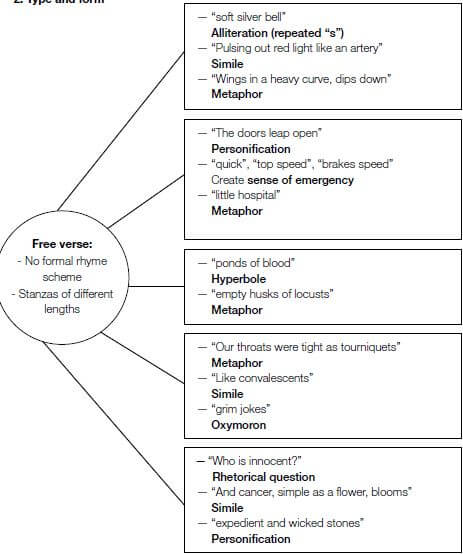
- Tone and mood
Tone: Urgent, matter-of-fact, confused, horrified, fearful, uncertain
Mood: How does this poem make you feel? Happy, sad, angry or indifferent? Always give reasons for your answer.
Activity 4
Refer to the poem on page 31 and answer the questions below.
- Complete the following sentences by using the words provided in the list Write only the words next to the question number (1.1–1.3)
| police van; accident; dead; ambulance; break-down; injured |
This poem describes how the (1.1) … rushes to the scene of the (1.2) … The (1.3) … are picked up and taken to hospital. (3)
- Refer to stanza
2.1 At what time of the day does this incident happen? (1)
2.2 In lines 4-6 (“The ambulance at … and illuminated clocks”) the ambulance is compared to a bird. Quote TWO separate words that support this (1) (2) - Choose the correct answer to complete the following Write only the answer (A-D).
The word “mangled” in line 9 tells us that …- The vehicles are badly damaged.
- Some of the bystanders are very upset.
- The policemen are emotionless.
- The accident victims are seriously injured. (1)
- Refer to lines 15 and 16 (“We are deranged … and composed”).
Quote TWO separate words that show the difference in the reactions of the speaker and the policemen. (2) - Refer to line 25 (“We speak through sickly smiles …”).
Explain why the onlookers have “sickly smiles”. (2) - Refer to stanza
Using your own words, name TWO things that the onlookers are concerned about. (2) - Complete the following sentences by using the words provided in the list below.
| solution; confuses; reason; unnatural; clarifies; logical |
In the last stanza, the speaker argues that there is always a (7.1) … for Suicide, while stillbirth is (7.2) … However, a car crash (7.3)… the minds of ordinary people. (3)
- Explain why the poet mentions war, suicide, stillbirth and cancer in a poem about a road (2)
- The poem was first published in Do you think it is still relevant today?
Discuss your view. (2) - Has this poem changed your understanding of the causes of road deaths? Discuss your (2) [22]
Answers to activity 4- 1.1 Ambulance ✓
1.2 Accident ✓
1.3 Injured ✓ (3) - 2.1 At night / in the evening. ✓ (1)
2.2 “floating”; “wings”; “dips” ✓✓ (2) - D/the accident victims are seriously injured. ✓ (1)
- “deranged” ✓ and “composed” ✓ (2)
- It is a pretence/ a coping mechanism/ false appearance. ✓
To hide their true feelings/ horror ✓ (2) - Who has died/ who will die (next)/ who is responsible for this/ other accidents. ✓✓ (2)
- 7.1 Reason ✓
7.2 Logical ✓
7.3 Confuses ✓ (3) - All these are logical reasons for death. ✓
He is able to understand the cause of death for each of these, but not for road accidents./ No logical reasons are given for road accidents. ✓ (2) - Yes. Road accidents are still very common/many lives are still lost because of road accidents. ✓✓
OR
No. There are many measures in place to reduce accidents. It is easy to establish the cause of accidents nowadays. ✓✓ (2) - Yes, road deaths have definite causes, e.g. carelessness of drivers and pedestrians. ✓✓
OR
No, sometimes road deaths cannot be explained because they are often beyond human control. ✓✓ (2) [22]
|
ON HIS BLINDNESS BY JOHN MILTON
- Themes
- Type and form
- Analysis
- Tone and mood
- Activity 5
On his blindness was written by John Milton (1608-1674). He was a deeply religious English poet. He studied at Cambridge University. As a young man he travelled around Europe and learnt many European languages.
In his later life, there was a civil war in England between King Charles I and Oliver Cromwell and his supporters, who wanted England to become a republic. Milton supported Cromwell and became very politically active. He had to go into hiding when the new king, King Charles II, came into power.
At the age of 44, Milton went blind. Most of his best-known poems were written after this. He composed poems in his head and recited them to his daughters so they could write them down.
Fun fact:
- This poem is based on the parable of the talents in the Bible – Matthew 25, verses 14-30
1. Themes
The main themes in this poem are serving God, blindness (disability) and using one’s talents.
The poet struggles with the fact that he is no longer able to see. He is depressed that he may not be able to serve God by using his talent as a writer. The answer comes to him that God has many followers to do his work and that accepting his blindness and being patient (“stand and wait”) is also serving God
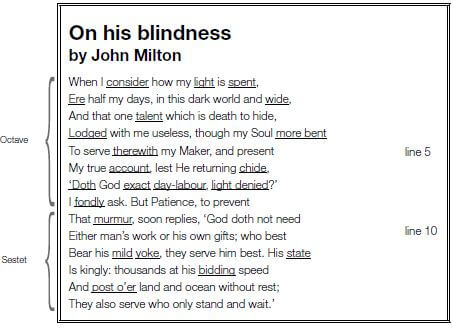
Words to know:
| Definitions of words from the poem: |
| Line 1: | consider | think about |
| light | ability to see |
| spent | finished/used up |
| Line 2: | ere | before (old English) |
| wide | wild (old English) |
| Line 3: | talent | ability / skill |
| Line 4: | lodged | kept in a safe place/ placed |
| more bent | more determined; wanting more to do something |
| Line 5: | therewith | with that |
| Line 6: | account | report/ record/ explanation |
| chide | scold/ show anger/ blame |
| Line 7: | doth | does |
| exact | expect/ demand |
| day-labour | work |
| light denied | sight taken away |
| Line 8: | fondly | foolishly |
| Line 9: | murmur | quiet complaint |
| Line 11: | mild | gentle |
| yoke | the rope and wood collar which goes around the neck of an ox to pull a cart |
| state | position/ situation |
| Line 12: | bidding | request/ command |
| Line 13: | post o’er | travel over (old English) |
Fun fact:
- The title of this poem was not written by Milton. It was given to the poem much later by Bishop Newton, who was referring to Milton’s blindness. That is why it is called, “On his blindness”, rather than ” On my blindness.”
2. Type and form
The poem is an Italian or Miltonic sonnet. This is because its 14 lines are made up of:
- An octave of eight lines made up of two This is where the problem is presented; and
- A sestet of six This is where the problem is resolved. The rhyming scheme in this sonnet is abba abba cdecde.
3.Analysis
| The octave (lines 1 – 8) When I consider how my light is spent,
Ere half my days, in this dark world and wide,
And that one talent which is death to hide,
Lodged with me useless, though my Soul more bent
To serve therewith my Maker, and present
My true account, lest He returning chide,
‘Doth God exact day-labour, light denied?’
I fondly ask. |
In the octave, the problem is presented. The speaker feels depressed when he thinks (“consider” in line 1) about his problem – the problem is that he is going blind “ere half my days” – before he is even half way through his life. He has one great gift from God, a “talent”, which has been “lodged” (given to him) to use but it is “useless” (line 4) because he cannot see to write any more.
Fun fact:
- A ‘talent’ was a coin in the time of the Bible. Jesus used the idea of a ‘talent’ as something valuable, a skill given by God. To use one’s talent or skill was a way of serving God. Hiding one’s ‘talent’ would be an insult to God.
The poet uses a metaphor to refer to his eyesight. He calls it his “light” (line 7). This is an effective comparison because our eyes are important. They are one of the ways we get to understand our world. Light is important
– light allows us to see clearly. Light also represents God and the sun and has connotations of brightness and happiness. This contrasts with the life without light – the “dark world” in line 2.
The poet (or speaker) describes his problem in the octave in one long sentence that ends in the middle of line 8. In this sentence, he lists all the things he is worried about and what may happen as a result of his blindness. He is frustrated because the talent God has given him (“lodged with me”) is “useless” (line 4). He is also frustrated because his soul is absolutely “bent” (determined) on serving his “Maker” (God) (lines 4-5) and he cannot do this if he cannot see.
He is fearful and worried because he knows that God has given him this talent so it would be “death to hide” it (line 3). Milton wants to serve his Maker and use his writing talent so that at the end of his life he can present a good “account” (record of his work) “lest” (in case) God would “chide” (become cross with) him for not using the talent to serve Him (line 6).
The poet is also confused. He says that if God did become angry with him he would ask God how God could demand “day-labour” (work) but at the same time make him blind (“light denied”) and therefore unable to work. Although the poet is frustrated, fearful and a little angry, it is important to note that he remains humble when he speaks to God: he calls God his “Maker”, he is “bent” (wanting / determined) on serving God and he realises that he asks the question foolishly (“fondly” in line 8) because God has a plan we may not know.
Note:
- the poet contrasts light and dark in the poem.
| The sestet (lines 9 – 15) But Patience, to prevent
That murmur, soon replies, ‘God doth not need
Either man’s work or his own gifts; who best
Bear his mild yoke, they serve him best. His state
Is kingly: thousands at his bidding speed
And post o’er land and ocean without rest;
They also serve who only stand and wait.’ |
The sestet is where the problem set out in the octave is resolved. The speaker begins to answer the question in line 8 starting with the word “But”:
But Patience, to prevent
That murmur, soon replies… (lines 8 and 9)
“Patience” (which is a good human quality of being able to wait) seems to appear to him personified almost like an angel from God (in a human form). Notice how Patience is named with a capital ‘P’ – like a proper noun. When Patience appears to him, it is as if the poet’s own mind speaks to him and reassures him.
Patience speaks to stop the poet’s “murmur” (complaints) and explains that God does not need man’s work: people serve God best when they “bear his mild yoke” (obey his gentle commands/ carry a small burden). Patience goes on to explain to the poet that God is so powerful (“His state is kingly” – lines 11 and 12) and that there are “thousands” of others who can serve him in many other places and in many different ways.
The poet finally understands that he does not have to write and perform to serve God if he is not able to do so, because people also serve God just by accepting what happens – “who only stand and wait” (line 14). He realises there are other ways to serve God.
4. Tone and mood
In the octave of this sonnet, the speaker goes through many feelings and the tone reflects each of them: frustrated, fearful, worried and confused. In the sestet, the tone changes. It becomes more accepting and gentle.
The mood of a poem is how it makes the reader feel. How does this poem make you feel? For example, happy, sad, angry, or indifferent.
Summary
On his blindness by John Milton
- Theme
The main themes are serving God, blindness (disability) and using one’s talents. - Type and form
- Tone and moodTone: In the octave it is frustrated, fearful, worried and confused. In the sestet, it is accepting and gentle.
Mood: How does this poem make you feel? Happy, sad, angry or indifferent? Always give reasons for your answer.
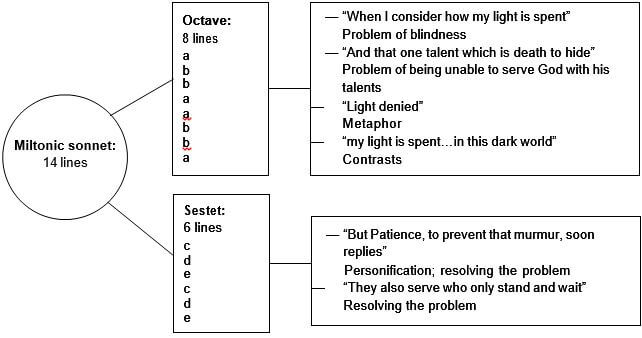
Activity 5
Refer to the poem on page 42 and answer the questions below.
- Complete the following sentences by using the words provided in the list Write only the words next to the question number (1.1–1.3)
| ballad; sonnet; problem; solution; cause; result |
This poem is a Miltonic (1.1) … The octave gives the reader the (1.2) … and the sestet gives the reader the (1.3) … (3)
- Refer to lines 1 and 2 (“When I consider … world and wide”)
Quote TWO contrasting words that best describe the poet’s concern. (2) - Refer to line
3.1 Quote a word from the first line which Milton uses in place of “eyesight”. (1)
3.2 Why do you think he uses this word? (2) - Refer to lines 3 and 4 (“And that one … Soul more bent”).
Why does the poet consider his talent to be useless? (2) - Refer to lines 6 and 7 (“My true account … labour, light denied?”).
5.1 What is the poet’s fear in these lines? (1)
5.2 Why does he have this fear? (1) - Refer to line 8 (“I fondly But Patience, to prevent”).
6.1 Identify the figure of speech used (1)
6.2 Explain why the poet uses this figure of (2) - How does the poet’s mood, or how do his feelings change in the course of the poem?
Choose two words from the box below to complete this sentence:| joy; acceptance; frustration; blind |
At the start of the poem the poet feels 7.1… but at the end of the poem the poet experiences 7.2… (2)
- Refer to lines 10 and 11 “Who best/Bear his mild yoke, they serve him best”.
Choose the correct word in brackets:
8.1 “his/him” are pronouns referring to (God/ the poet). (1)
8.2 “they” is a pronoun referring to (blind people/ all people). (1)
8.3.1 What figure of speech has been used in these lines?- Simile
- Metaphor
- Personification. (1)
8.3.2 Explain the figure of speech by choosing the correct answer to complete the sentence below.
The speaker is comparing the “mild yoke” that God puts on us to:- A donkey pulling a cart
- A small burden or job
- A kind joke (1)
- Choose the correct answer to complete the following Write only the answer (A–D).
The word which best describes the poet’s feeling in lines 9-14 (“That murmur, soon … stand and wait”) is:- acceptance.
- anger.
- depression.
- joy. (1)
- Refer to the last 4 lines of the
Is the following statement TRUE or FALSE? Write “true” or “false” and quote TWO consecutive words to support your answer. (2)
The poet feels that our burdens are not heavy. - Consider the poem as a
11.1 Do you feel sorry for the poet? Discuss your (2)
11.2 Do you think a disabled person should be expected to perform at the same level as an able person? Discuss your (2) [28]
Answers to Activity 5
- 1.1 Sonnet ✓
1.2 Problem ✓
1.3 Solution ✓ (3) - “Light” ✓ and “dark” ✓ (2)
- 3.1 “Light” ✓ (1)
3.2 Joy/ hope/ clarity/ visibility/ warms/ shining/ inspiration ✓✓ (2) - The poet’s talent is that he can write and he will not be able to use this talent if he is blind. ✓✓
OR
He is unable to see. Therefore, he cannot write poetry/ use his gift. ✓✓ (2) - 5.1 He is afraid that God will punish him/ not be satisfied with what he has done. ✓ (1)
5.2 He has not used the talent that God gave him./ He did not use his talent well./ He did not do a full day’s work. ✓ (1) - 6.1 Personification ✓ (1)
6.2 Personification: It becomes the voice of reason/ his conscience. ✓✓
OR
Patience becomes a person who is answering his question. ✓✓
OR
He personifies his thoughts in order to accept his burden. ✓✓ (2) - 7.1 Frustration ✓ (2)
7.2 Acceptance ✓ (1) - 8.1 “His”/ “him” are pronouns referring to God. ✓ (1)
8.2 “They” is a pronoun referring to all people. ✓ (1)
8.3.1 Metaphor ✓ (1)
8.3.2 The speaker is comparing the “mild yoke” to a small burden or job. ✓ (1) - A/acceptance ✓ (1)
- True. “Mild yoke”. ✓✓ (2)
- 11.1 Yes. He has a talent and he cannot use it. ✓✓
OR
No. I admire him for accepting his blindness. ✓✓ (2)
11.2 Yes. Disabled people often perform better than those without disabilities and tend to feel insulted if you make allowances for them. ✓✓
OR
No. You have to make concessions to accommodate disabled people as they have barriers to overcome. ✓✓ (2) [28]
A PRAYER FOR ALL MY COUNTRYMEN BY GUY BUTLER
- Themes
- Type and form
- Analysis
- Tone and mood
- Activity 6
This poem was written by Guy Butler (1918-2001). He was born and grew up in the Karoo. Butler was a professor of English at Rhodes University from 1952 to 1987.
He helped South African English literature achieve recognition and argued for integrating European and African elements in writing. When he wrote poetry in English he gave his writing an African feel.
Much of his poetry reflects his concerns about the problems and difficulties of life in South Africa during the time of apartheid. This poem was written in 1987 during the darkest days of apartheid and meditates on racial conflict. It is a prayer for unity.
1. Themes
As the title suggests, the theme is that South Africans need God’s help to escape the tragedy of apartheid.
The poet says most people cannot see an end or solution to South Africa’s problems (under apartheid) or imagine life after apartheid has ended. He asks God to make sure that once the horrors of apartheid have ended, people will behave and speak in such a way that they will keep (and live up to) their faith in Him.
The poet then says that, in spite of all their suffering, some people have been able to remain kind and good, to smile bravely through their troubles and to think clearly. This gives him hope that there will be a better future.
| A prayer for all my countrymen by Guy Butler |
| Stanza 1 | Though now few eyes | |
| can see beyond |
| this tragic time’s |
| complexities, |
| dear God, ordain | line 5 |
| such deed be done, | |
| such words be said, | |
| that men will praise | |
| Your image yet | |
| when all these terrors and hates are dead: | line 10 |
| Stanza 2 | Through rotting days, | |
| beaten, broken, | |
| some stayed pure; | |
| others learnt how, to grin and endure; | line 15 |
| and here and there | |
| a heart stayed warm, | |
| a head grew clear. | |
Words to know:
| Definitions of words from the poem: |
| Line 1: | now | referring to apartheid times |
| Line 2: | beyond | further than |
| Line 3: | tragic | extremely sad |
| Line 4: | complexities | difficulties, problems, conflicts |
| Line 5: | ordain | order, make something happen/also religious term meaning holy order |
| Line 6: | deed | action |
| Line 9: | Your | referring to God |
| Line 12: | rotting | bad/corrupt |
| Line 14: | pure | good/innocent |
| Line 16: | grin | smile |
| endure | cope with, accept, put up with |
| Line 19: | clear | open, thinking clearly |
2. Type and form
There are two stanzas in this poem:
- The first stanza has 11 lines and in it the poet asks for God’s
- The second stanza is shorter (8 lines) and tells us that some people have stayed good in spite of injustice and
The lines in the poem are short. Most have 4 syllables, although one has 3 and another has 5 syllables. The short lines add to the effect of a prayer and also simplify and make each phrase stand out, since the poet believes that God knows his thoughts and that there is no need to explain them.
In the first stanza, there is one full rhyme (“said”/”dead”), but many half rhymes. Half rhymes are words that almost rhyme but do not quite rhyme, which often give a poem a rather sad feeling as they are less musical. (Look at “ordain” / “done” or “yet’ / “dead”.)
In the second stanza there is one full rhyme: “pure” / “endure” which is more pleasant to listen to and links the more positive ideas contained in these words.
Note
- Syllable – The sound of a vowel (a, e, i, o, u) when pronouncing a word.
3. Analysis
| Stanza 1 (lines 1 – 11) Though now few eyes
can see beyond
this tragic time’s
complexities,
dear God, ordain
such deed be done,
such words be said,
that men will praise
Your image yet
when all these terrors
and hates are dead: |
This stanza contains the poet’s prayer to God to save the people of our country. It is written as one long sentence.
In the four opening lines, the first half of the sentence tells us of the situation about which the poet is writing. The problems (“complexities” in line 4) of South Africa are so great that only a few of the people who suffer can imagine a time when apartheid will be over. Notice that the word “complexities” is in a line of its own (line 4), emphasising the size of the problems facing the country. Using what you have learnt about apartheid, you can decide why the poet calls it a “tragic time” (line 3).
Notice how the alliteration of the “t” sound in “tragic time’s” emphasises the sadness. The image here is depressing, but look at the first word of the poem. It begins with the word “Though” (line 1), meaning that even though few people can see past the time of apartheid a time will come when it ends. This suggests that, even with all the suffering, hope is possible.
In the remaining seven lines of stanza 1, the poet tells us what he is praying for. He addresses God in a prayerful and loving tone, even desperately, when he says “dear God”. The word “ordain” (line 5) is interesting here – the poet asks God to command or order what needs to happen, but “ordain” also has a religious meaning. (A priest is “ordained” when he is allowed to work as a priest.) This suggests that that what God “ordains”, or makes happen, is good and holy. It also conveys a sense of future promise.
The use of repetition in “such deeds / such words” (lines 6 and 7) shows us how important the things are that the poet prays for. He prays that men will retain enough kindness to remain capable of speaking and acting with humanity (ubuntu), and not in ways that would cause them to lose all faith in God.
Once the struggle to end apartheid is over, he hopes that people will have retained enough human kindness and faith in God (“praise Your image yet” in lines 8 and 9) to enable them to make a better society possible for all. The use of the word “yet” (line 9) refers again to his hope that people will, in the future, go back to following in God’s image. Perhaps he is suggesting that human beings are not capable of understanding God, so they create an image of Him for themselves. He might also be referring to the verse in Genesis which says that people are created in the image of God.
The “hates” and “terrors” (lines 10 and 11) refer to the negative effects of the evil system of apartheid. The last line of this stanza (line 11) contains the poem’s only use of personification. The words “are dead” suggest that the poet does believe that apartheid will end, that he has hope.
The poet uses very few punctuation marks, so the lines flow in a simple way, suggesting that the words arise spontaneously in the poet’s consciousness or mind. The colon (:) at the end of the first stanza makes us pause; we expect the second stanza to complete his thoughts.
The poem is very simply written, with very few figures of speech such as similes or metaphors. The simple diction (choice of words) makes it suitable for a prayer and emphasises the poet’s sincerity – the prayer comes from his heart.
Note:
- ‘Tragic time’ makes us think of the suffering most SouthyAfricans had to go through during the apartheid.
| Stanza 2 (lines 12 – 19) Through rotting days,
beaten, broken,
some stayed pure;
others learnt how
to grin and endure;
and here and there
a heart stayed warm,
a head grew clear. |
In this stanza, also written as one long sentence, the poet says that in spite of the harsh, cruel times, some people have still stayed good, brave and kind.
Note that for the first time in the poem there are pauses, indicated by the punctuation (the use of commas and semi-colons at the end of the lines). The poet lists examples of what people have experienced.
The first line in stanza 2 contains the poem’s only metaphor. Apartheid is compared to something that is rotten; it is a morally corrupt and evil system. “Rotting” (line 12) also has connotations of being forced to live in a poor, miserable area with no resources or services, and even of the decaying bodies of the people killed because of apartheid. It also suggests that the apartheid system is no longer fresh, but is old and rotting and it is time to throw it away.
The people were “beaten, broken” (line 13) as a result of the physical violence done to them. But people were also “beaten, broken” in spirit as a result of the injustice and cruelty of apartheid. Notice the use of the sound device in line 13 – the alliteration of “b” in “beaten, broken”, a harsh sound that echoes the heavy sound of blows falling on a body.
But in spite of their suffering, some people “stayed pure” (line 14): they remained good and were not made angry or bitter by the system. “Pure” also has a religious connotation, suggesting that these people were innocent of any corruption and trusted in God.
Other people learnt to bear their suffering bravely and with a smile (“grin and endure” in line 16) and did not feel sorry for themselves. Some remained kind and warm-hearted, while still others learnt to think about the situation clearly and wisely: their heads “grew clear” (line 19). People with clear minds, the ability to think clearly and rationally, were necessary if a solution to the problems was to be found and a better future built.
As some people have been able to rise above their problems and suffering, the poet feels hopeful that a better future will be possible.
Note:
- Connotations of a word are the meanings that that word suggests. ‘Pure’ has connotations of (or suggests) goodness, innocence and honesty.
4. Tone and mood
The general tone of the poem is reverent, sincere and hopeful, as it is a prayer.
The mood of a poem is how it makes the reader feel. How does this poem make you feel? For example, happy, sad, angry, or indifferent.
Summary
A prayer for all my countrymen by Guy Butler
- Theme
South Africans need God’s help to escape the tragedy of apartheid. - Type and form
- Tone and moodTone: Reverent, sincere and hopeful.
Mood: How does this poem make you feel? Happy, sad, angry or indifferent? Always give reasons for your answer.
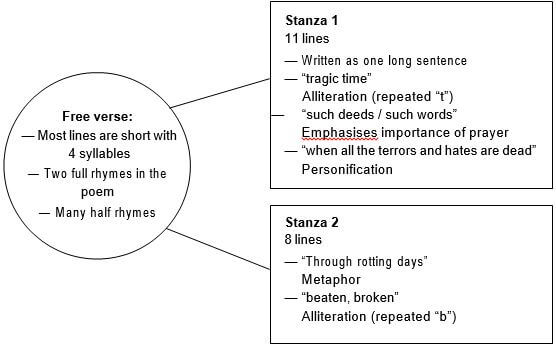
Activity 6
Refer to the poem on page 51 and answer the questions below.
- What is the “tragic time” referred to in line 3? (1)
- Complete the following sentences by using the words provided in the list below. Write down only the words next to the question number (2.1-2.3).
| America; people; South Africa; pardon; prayer; men |
This poem is written as a (2.1) … for all the (2.2) … of (2.3) … (3)
- Refer to line 1 (“Though now few eyes”).
To whom do the “few eyes” belong? (1) - Choose the correct answer to complete the following sentence: In line 4, the word “complexities” means …
- hardships and shortages.
- hardships and answers.
- answers and solutions.
- problems and difficulties. (1)
- Refer to lines 5-9 (“dear God ordain, … Your image yet”).
Explain why the poet wants his countrymen to behave as described in these lines. (2) - Refer to lines 10 and 11 (“when all these terrors/and hates are dead”).
Use ONE word to describe how the speaker feels about the future. (1) - Refer to the poem as a whole and give TWO examples of alliteration used. (2)
- Refer to the second
Using your own words, describe THREE different ways in which people reacted at that time. (3) - Refer to the second
Is the following statement TRUE or FALSE?
Quote a line to support your answer.
The speaker was one of the few people who enjoyed the period of time described in this poem. (2) - At the present time in our history do you think the poet’s prayer has been answered? Discuss your view. (2) [18]
Answers to Activity 6
- Apartheid ✓ (1)
- 2.1 Prayer ✓
2.2 People ✓
2.3 South Africa ✓ (3) - The people or comrades who can see beyond the suffering. ✓ (1)
- D / problems and difficulties ✓ (1)
- He wants them to act and speak responsibly in a way that will be acceptable to God and will set an example to others. ✓✓ (2)
- Hopeful/ positive/ optimistic ✓ (1)
- “tragic time’s” ✓
“deed be done” ✓
“beaten, broken” ✓
“some stayed pure” ✓ (2) - Some did not change/ some remained loyal. ✓
Some pretended to cope/ be happy/ grinned and endured. ✓
Some were balanced in their outlook/ remained hopeful/clear- headed and warm-hearted. ✓
Some became clear-headed/ rational. ✓ (3) - False. “Through rotting days” ✓✓
- Yes, some people have remained warm-hearted and clear- headed according to stanza two. These people help people in need. ✓✓
OR
No, reconciliation and forgiveness are not truly evident even after 1994. There is still a lot of racial prejudice. ✓✓ (2) [18]
THE BIRTH OF SHAKA BY OSWALD MBUYISENI MTSHALI
- Themes
- Type and form
- Analysis
- Tone and mood
- Activity 7
The birth of Shaka was written by Oswald Mbuyiseni Mtshali. Mtshali was born in KwaZulu-Natal in 1940. He travelled to Johannesburg as a young man of 18 and many of his poems are based on life in Soweto. He has won many awards for his poetry and was one of the first black poets to be published in both Zulu and English.
Some of his poetry criticises the way black people were forced to live during apartheid, but other poems, such as The birth of Shaka, are intended to remind black people of their proud culture and history.
Fun fact:
- The Zulu king Shaka was born in 1787 and was assasinated by his half-brothers, Dingane and Mhlangana, in 1828. He was the son of a chief and his mother was called Namdi. His parents were not married. As a boy, he was often mocked because he had no father. Shaka was a great warrior. He developed the Zulu tribe into a mighty nation. During his reign some of the first white settlers arrived from England and landed in what is now KwaZulu-Natal. His half-brother Dingane became king after murdering Shaka, but he reigned fro only 10 years until he was defeated by white Afrikaners at the Battle of Blood River in 1838.
1. Themes
The theme is the power of African culture. It is something Africans must feel proud of. The poet praises Shaka’s power and strength as well as his wisdom. The poet’s intention was to remind the Zulu people of their proud heritage at a time when they were being oppressed and made to feel worthless during apartheid.
| The birth of Shaka by Oswald Mbuyiseni Mtshali |
| Stanza 1 | His baby cry | |
| was of a cub |
| tearing the neck |
| of the lioness |
| because he was fatherless. | line 5 |
| Stanza 2 | The gods | |
| boiled his blood | |
| in a clay pot of passion | |
| to course in his veins. | |
| Stanza 3 | His heart was shaped into an ox shield | line 10 |
| to foil every foe. | |
| Stanza 4 | Ancestors forged | |
| his muscles into | |
| thongs as tough | |
| as wattle bark | line 15 |
| and nerves | |
| as sharp as | |
| syringa thorns. | |
| Stanza 5 | His eyes were lanterns | |
| that shone from the dark valleys of Zululand to see white swallows | line 20 |
| coming across the sea. | |
| His cry to two assassin brothers: | |
| Stanza 6 | ‘Lo! you can kill me | line 25 |
| but you’ll never rule this land!’ | |
Words to know:
| Definitions of words from the poem: |
| Line 2: | cub | baby lion |
| Line 3: | tearing | biting, wounding |
| Line 4: | lioness | female lion, Shaka’s mother Nandi |
| Line 5: | fatherless | he did not live with his father |
| Line 8: | passion | very strong feeling |
| Line 9: | course in his veins | run or flow in his veins |
| Line 11: | foil | stop |
| foe | enemy |
| Line 12: forged | made |
| Line 14: thongs | leather strips |
| Line 15: wattle bark | outside covering of a wattle tree |
| Line 18: syringa | tree with big, sharp thorns |
| Line 19: lanterns | lamps you can carry |
| Line 21: swallows | birds that fly to Europe every year |
| Line 23: assassin | person who kills to take over political power |
| Line 24: lo! | look!, see! |
2. Type and form
This poem is a modern praise poem or izibongo.
It has six stanzas. They all have different line lengths and have no rhyming words.
3. Analysis
| Stanza 1 (lines 1 – 5) His baby cry
was of a cub
tearing the neck
of the lioness
because he was fatherless. |
The lion is known as the “King of the Beasts” because of its strength, fierceness and power. It is also a dangerous animal.
The metaphor comparing the cry of baby Shaka to that of a baby lion tells us that he was born to be a powerful, fierce and dangerous leader. The metaphor also tells us that his cry was so fierce that it tore the neck of its mother, the lioness (line 3).
This fierceness is a contrast to how a baby would normally behave towards its mother and may foreshadow how fierce Shaka would become later. It may suggest that Shaka was aggressive towards his mother, Nandi, because his parents were not married and he grew up without a father. For example, Shaka’s behaviour as a baby gives us a clue to how he will behave when he is a grown man.
| Stanza 2 (lines 6 – 9) The gods
boiled his blood
in a clay pot of passion
to course in his veins. |
Note:
- The expression ‘my blood boils’ means to be very angry
This metaphor tells us that Shaka was not just an ordinary person but someone special, whose nature was made by the gods, which means they gave him some supernatural powers, beyond ordinary human life. In the metaphor, Shaka’s blood is being compared to something specially cooked by the gods.
“Passion” (line 8) refers to very strong feelings such as love or hatred. If you are passionate about something you are very enthusiastic about it and put great energy into it. This metaphor tells us of Shaka’s energy, enthusiasm and devotion to his work as a warrior (great soldier) and leader, as well as his anger. The poet tells us a “clay pot” (line 8) was used when making Shaka’s “blood boil”, to emphasise his African cultural roots.
| Stanza 3 (lines 10 – 11) His heart was shaped into an ox shield
to foil every foe. |
A shield is used to protect yourself from injury, which tells us that in war Shaka would not be hurt but, in fact, would defeat his enemies. This metaphor also tells us he was protective of his people and was strong- hearted, meaning he was brave and determined.
We are reminded of how Shaka represents Zulu culture, as Zulu shields were made from the skin of an ox. Notice the alliteration of “foil … foe” (line 11) which emphasises that he defeated his enemies.
| Stanza 4 (lines 12 – 18) Ancestors forged
his muscles into
thongs as tough
as wattle bark
and nerves
as sharp as
syringa thorns. |
Shaka’s strength did not come only from the gods but also from the ancestors. This is another reminder of African culture, in which the ancestors are believed to guide and help their descendants (family members who come after them). In this metaphor we are told the ancestors “forged” (line 13) Shaka’s muscles. Metals such as iron and steel are shaped by being “forged” – heated until they are very hot and can be beaten or forced into different shapes. This suggests that Shaka was extremely strong, both physically and mentally.
The simile “thongs as tough/ as wattle bark” (lines 14 and 15) also shows how tough and strong Shaka was, as his muscles were like leather and mentally he was strong and determined. The poet then uses another simile, comparing his nerves to the sharp thorns of a syringa tree. In English, if you say someone is “sharp” you mean they are clever and do not miss anything. In addition, sharp thorns can hurt you, so as well as being clever, Shaka was also cruel.
Note:
- There are many images related to African culture in the poem – the clay pot, the ox shield and the ancestors
Stanza 5 (lines 19 – 23)His eyes were lanterns
that shone from the dark valleys of Zululand
to see white swallows
coming across the sea.
His cry to two assassin brothers: |
This is a very interesting stanza that shows Shaka’s wisdom, understanding and ability to see into the future.
Shaka’s eyes are compared to “lanterns” (line 19) that light up the darkness. Here darkness suggests that the Zulu people did not know what their future would be. But Shaka was able to see what the arrival of the “white swallows” (line 21) would mean for his people. Swallows are birds that migrate, moving from Europe to Africa to escape the cold winters.
In this metaphor, the “white swallows” refer to the white settlers (both the British and, originally, the Afrikaners), who came from Europe and who sailed by ship to Africa; they would settle and take over what was then called Natal. As well as referring to the settlers, “white swallows” could also remind us of the white sails of a sailing ship, in which the settlers travelled in those days.
Note that up to this point the tone of the poem has been one of admiration and praise. Now the tone is more quiet and prophetic, as if Shaka can see far into the future.
Note:
- Prophetic – having knowledge of the future
| Stanza 6 (lines 25 – 26) ‘Lo! you can kill me
but you’ll never rule this land!’ |
This stanza is Shaka’s “cry” to the two half-brothers who murdered him.
These lines are also Shaka prophesying what will happen to his country in the future. The land will be taken over by the white settlers and the Zulu people will be ruled by them. These lines are the climax of the poem.
The diction (poet’s choice of word) is unusual here when Shaka exclaims, “Lo!” This is an old-fashioned word meaning “Look! See!”. It is used in the old English translation of the Bible, which makes Shaka sound like a prophet.
The tone changes again now. He speaks to his brothers in a tone of strong defiance as he warns them that they will not achieve much by killing him as the land will be taken over by the settlers.
4. Tone and mood
The poem begins with a tone of admiration and praise. In stanza 5, it changes to become more quiet and prophetic. In the final stanza, the tone becomes defiant.
The mood of a poem is how it makes the reader feel. How does this poem make you feel? For example, happy, sad, angry, or indifferent.
Summary
The birth of Shaka by Mbuyiseni Oswald Mtshali
- Theme
The theme is the power and pride of African culture. - Type and form
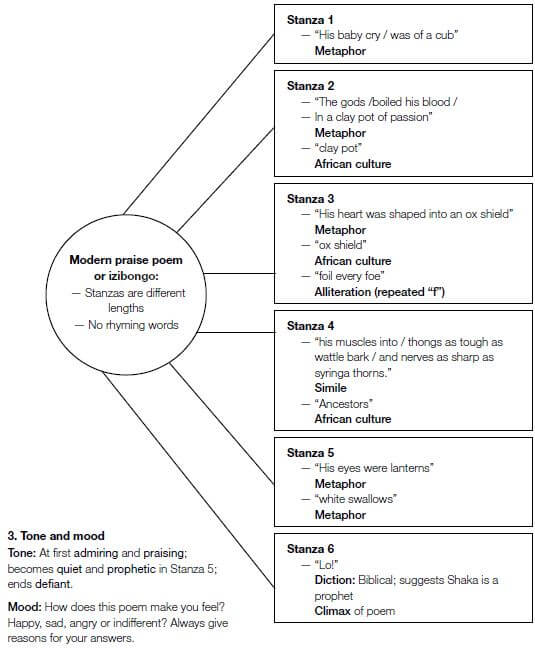
Activity 7
Refer to the poem on page 60 and answer the questions below.
- Complete the following sentences by using the words provided in the list Write down only the words next to the question number (1.1 – 1.3).
| mourned; cruel; warrior; praised; father; loving |
In this poem Shaka, the Zulu king, is (1.1) … . He was a (1.2) … man, but a brave (1.3) … (3)
- Refer to lines 1 and 2 (“His baby cry/was of a cub …”).
2.1 Identify the figure of speech used (1)
2.2 Explain why the poet has used this figure of (2) - Refer to lines 3 and 4 (“tearing the neck/of the lioness”).
To whom does the word “lioness” refer? (1) - Refer to stanza
4.1 In your own words, explain how the gods created (1)
4.2 State ONE of Shaka’s characteristics suggested by the use of the words “clay pot”. (1) - Choose the correct answer to complete the following sentence: In line 11, the words “to foil every foe” mean to …
- free every prisoner.
- betray every enemy.
- stop every enemy.
- kill every prisoner. (1)
- Refer to lines 12 and 13 (“Ancestors forged his muscles …”).
What does the use of the word “forged” in these lines tell the reader about Shaka’s physical abilities? (2) - Refer to stanza
Quote TWO separate words to prove that Shaka was both physically and mentally strong. (2) - Refer to stanza
Is the following statement TRUE or FALSE? Quote a line to support your answer.
Shaka could see what was going to happen in the future. (2) - In the first five stanzas the tone of the speaker shows admiration. Describe the tone in the last stanza (lines 24–25) (1)
- What, in your view, are the qualities of a good leader? (2) [19]
| Answers to Activity 7 |
| 1. 1.1. | Praised ✓ | |
| 1.2. | Cruel ✓ |
| 1.3. | Warrior ✓ | (3) |
| 2.1. | Metaphor ✓ | (1) |
| 2.2. | It compares baby Shaka to a lion cub. ✓✓
OR
To show that although Shaka was still a (newborn) baby, but he was already displaying a fierce/ vicious nature. ✓✓ | (2) |
| 3. | Shaka’s mother OR Nandi ✓ | (1) |
| 4.1 | They gave him an emotional/ passionate nature.
OR
They used a clay pot to boil his blood. ✓ | (1) |
| 4.2. | He was only human/ fragile/ not perfect. ✓
OR
Like a clay pot, he represented/ contained traditional values.
OR
A clay pot represents strength and could mean that the ancestors/gods made him strong. ✓ | ✓ (1) |
| 5. | C / stop every enemy ✓ | (1) |
| 6. | Steel/ metal is normally forged by heating and then shaping it. ✓✓
OR
This tells the reader that Shaka is very strong and has exceptional strength. ✓✓ | (2) |
| 7. | “Tough” ✓, “sharp” ✓ | (2) |
| 8. | True. “His eyes were lanterns” ✓✓ | (2) |
| 9. | It becomes one of sadness. ✓/ It becomes a warning/ threatening/ prophetic/ defiant. ✓ | (1) |
| 10. | A good leader must have vision/ foresight/ must have a good reputation. ✓✓
OR
A good leader must not be concerned about popularity/ must not be afraid of being firm. ✓✓ | (2) |
| | [19] |
THE SERF BY ROY CAMPBELL
- Themes
- Type and form
- Analysis
- Tone and mood
- Activity 8
The serf was written by Roy Campbell (1901-1957). Campbell was born in Durban and moved to Europe in his later life. He was a fluent Zulu speaker. Campbell was critical of the white colonial rulers of South Africa because he felt that they were arrogant and would not accept any ideas except their own.
1. Themes
The theme of the poem is power and oppression.
The poet watches a poor farm worker (a serf) ploughing a field. This ploughman is doing harsh work under difficult conditions. He has no power to change his life or job and works patiently and slowly. This man was once the proud warrior of a great tribe that lived on this land. Now he works on land belonging to a rich farmer.
The poet suggests that this worker’s close relationship to the land and his slow patience will mean that one day the land will belong to him again and he will defeat the powerful people who have taken his land.
Fun Fact:
- Serf is the lowest farm worker in medieval Europe (5th- 15th century). Serfs were treated like slaves.
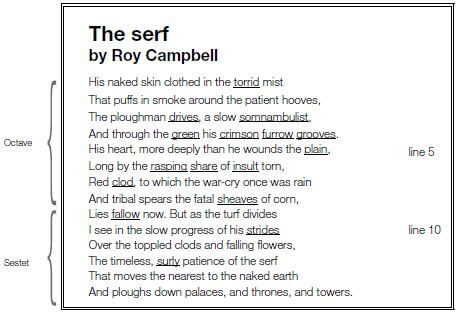
Words to know
| Definitions of words from the poem: |
| Line 1: | torrid | very hot, scorching heat |
| Line 3: | drives | pushes forward like a machine |
| somnambulist | a person who walks while asleep |
| Line 4: | green | refers to the grass |
| crimson | deep purplish red |
| furrow | a line cut in the soil |
| grooves | a long narrow cut into the soil |
| Line 5: | plain | a field |
| Line 6: | rasping | scraping, scratching |
| share (also called a ploughshare) | a tool for making furrows or grooves in the soil so that seeds can be planted |
| insult | abuse, humiliation |
| Line 7: | clod | a lump of soil, clay or mud |
| Line 8: | sheaves | stems of maize or corn |
| Line 9: | fallow | empty, no crops planted |
| Line 10: | strides | long steps or paces |
| Line 12: | surly | bad-tempered, rude |
2. Type and form
The form of this poem is a Miltonic sonnet (also known as a Petrarchan or Italian sonnet). It has 14 lines made up of:
- An octave of eight lines (which describes the problem).
- A sestet (six lines at the end of the poem which give the solution).
The rhyme scheme is abab abab ccdeed.
Note:
- In exam questions form is sometimes called the style or type of poem. All three terms describe the layout of the poem on the page.
3. Analysis
| Octave (lines 1 – 4) His naked skin clothed in the torrid mist
That puffs in smoke around the patient hooves,
The ploughman drives, a slow somnambulist,
And through the green his crimson furrow grooves. |
The octave introduces the problem of the poem as he describes the hard life of the serf. The poet uses a metaphor to describe the ploughman. In line 1, the ploughman is “clothed” in a “torrid mist”. There is so much dust coming from the feet of the animal pulling the plough that it is compared to a “mist” (a cloud) which makes it hard to see the ploughman. The dust is also compared to clothes as it falls onto his skin (line 3).
The poet says that the ploughman is a “slow somnambulist” (line 3). He compares the way the ploughman walks to the way people walk when they are asleep – slowly, as if they are in a dream. This is emphasised by the use of alliteration – the repeated “s” sounds in the words. The “s” sound also appears for emphasis in line 10, “the slow progress of his strides”.
The green grass of the field turns “crimson” (red) as the ploughshare cuts a line, “grooves”, into the earth and turns the red soil to the top of the “furrow” (line 4). The poet’s use of “green” in line 4 is an example of metonomy.
Note:
- Metonomy – A figure of speech in which a thing or a concept is not called by its own name, but by the name of something associated with it in meaning. Here, the poet uses the word green to refer to the grass
| Octave (lines 5 – 8) His heart, more deeply than he wounds the plain,
Long by the rasping share of insult torn,
Red clod, to which the war-cry once was rain
And tribal spears the fatal sheaves of corn,
Lies fallow now. |
The problem presented in the first 4 lines of the octave continues as the poet explains that, not only is the ploughman poor and doing hard labour, he is also broken-hearted and sad. “His heart” is hurt (“torn”) “Long by the rasping share of insult” (lines 5-6). These insults would have been all the horrible things done to the ploughman and his people – losing his land, being forced to work like a slave, losing his pride.
In two metaphors (lines 5-6), “His heart, more deeply than he wounds the plain/Long by the rasping share of insult torn”, the action of ploughing through the soil is compared to wounding. It cuts the ground and the red soil which is brought up by the plough is the colour of blood. The ploughman’s heart is compared to the ground that he ploughs – his heart has been hurt and wounded by “insult” (line 6). This metaphor compares the ploughman’s heart to the red soil.
Now that his heart is sad, it is empty, without feeling. In line 9 (the first line of the sestet), his heart is compared to a field which “lies fallow now” (line 9) with no crops planted. The poet also uses a metaphor to explain how the ploughman was once a great warrior – the cries of war that were good for his heart are compared to rain, which is good for the “clod” (soil), in which seeds will be planted, and once, instead of “sheaves” of corn (line 8), this man had spears.
The poet uses an oxymoron, “fatal sheaves” in line 8. The word “sheaves” has connotations of growth and health; while the word “fatal” means resulting in death. This may mean that the planting of crops caused the end of a way of life for the warriors who used to hunt for their food.
Note:
- Poets use alliteration for two reasons
- To emphasise certain words
- To create the actual sound that the thing they are writing about makes
- Oxymoron – combines 2 words that seem to contradict or oppose each other.
| Sestet (lines 9 – 14) But as the turf divides
I see in the slow progress of his strides
Over the toppled clods and falling flowers,
The timeless, surly patience of the serf
That moves the nearest to the naked earth
And ploughs down palaces, and thrones, and towers. |
In the octave, the poet has told us the problem: the ploughman is tired, oppressed, working on land he does not own, and no longer a mighty warrior.
In the sestet, he now gives us the solution to this problem. As he watches the grass (“turf”) cut through by the blade of the ploughshare, the poet has a vision of the future. He believes that the slow, steady, patient “strides” (line 10) of the ploughman, who belongs to the land and to nature (the “naked earth”), will defeat his oppressors and break down their symbols of wealth and power: “palaces, and thrones, and towers” (line 14). The serf will one day be free again and own the land he works on.
The poet uses another oxymoron in line 10 – “surly patience”. Surly means bad-tempered or rude; and seems to be the opposite of “patience”, which means to quietly wait and endure what you are experiencing.
Note the alliteration used in line 11: “falling flowers”. The “f” sound emphasises how steadily and certainly the serf walks forward — towards making history turn to favour his people again.
4. Tone and mood
In the octave, the tone is despairing and depressing as it describes the hard labour and losses of the serf. The tone changes to become more urgent and hopeful in the sestet.
The mood of a poem is how it makes the reader feel. How does this poem make you feel? For example, happy, sad, angry, or indifferent.
Summary
The serf by Roy Campbell
- Theme
Power and oppression. - Type and form
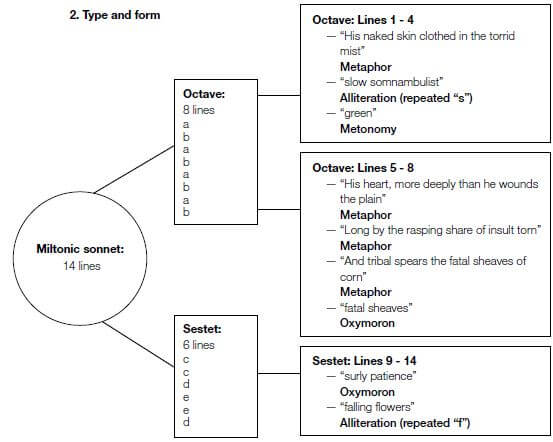
- Tone and moodTone: In the octave: despairing and depressing; in the sestet: urgent and hopeful.
Mood: How does this poem make you feel? Happy, sad, angry or indifferent? Always give reasons for your answer.
Activity 8
Refer to the poem on page 69 and answer the questions below.
- Refer to lines 1-4 (“His naked skin … crimson furrow grooves”).
Is the following statement TRUE or FALSE? Write “true” or “false” and quote a SINGLE word to support your answer.
The serf is forced to work in very hot conditions. (2) - In your own words, explain the meaning of line (2)
- Refer to lines 5-6 (“His heart, more … of insult torn”).
3.1 Identify the figure of speech used (1)
3.2 Explain why the poet uses this figure of (2) - Choose the correct answer to complete the following In line 6 the words “rasping share of insult” refer to the …
- Ploughshare breaking the earth.
- Serf wounding the earth.
- Inhuman treatment of the serf.
- Serf insulting his master. (1)
- Refer to the last six lines of the poem (“Lies fallow now … thrones, and towers”).
Discuss the speaker’s warning in these lines. State TWO points. (2) - Complete the following sentences by using the words provided in the list Write only the words next to the question number (6.1–6.3)
| owner; labourer; ploughs; oppression; harvest; freedom |
This poem is about a farm (6.1) … who (6.2) … the earth. The serf represents patient revolutionaries whose sacrifice is responsible for human (6.3) … (3)
- Consider the poem as a whole. Do you feel sorry for the serf? Discuss your (2)
- Give TWO reasons why the title “The serf” is a suitable one for this poem. (2)
- Is this poem a South African poem? Quote two consecutive words from the poem to support your (2)
- The word “naked” is used twice in the Complete the sentence below quoting phrases from the poem.
The word naked has been used negatively to show that the serf is poor because he has only his “naked…(10.1) “ and it has been used positively to show that he belongs to the land and to nature the “naked…(10.2)” (2) [21]
Answers to Activity 8
- True, “torrid”. ✓✓ (2)
- The “green” grass is turned over as the ploughshare is pushed through it and the red colour of the soil is turned to the top. ✓✓ (2)
- 3.21Metaphor ✓ (1)
3.2 His heart is being compared to a red clod/ ✓✓
OR
The poet shows that both his heart and the earth are damaged/ broken. ✓✓
OR
The poet shows that the field is being damaged and his heart is broken/he has been hurt. ✓✓ (2) - C / inhuman treatment of the ✓ (1)
- The speaker is warning the oppressors, the rich people in power at the time, that their wealth and power will be broken down and the serf will slowly defeat the oppressors and be ✓✓
OR
A revolution is coming because the labourers will revolt. ✓✓
OR
Danger is coming because the labourers will revolt. ✓✓ (2) - 6.1 labourer ✓
6.2 ploughs ✓
6.3 freedom ✓ (3) - YES, because he is tired (“somnambulist”) and it is hot (“torrid”)/ he is poor (“naked”) and his heart is dry and sad (like a field without ‘rain’). ✓✓
OR
NO, he is patient (“surly patience”) and freedom will come to him one day and he will overthrow the oppressors (“break down palaces”) and have his land again. ✓✓
OR
NO, many people earn a living in a hard way. He should be grateful he has a job. ✓✓ (2) - Serfs were poor and this worker has only a “naked skin”/ They were farm workers and he “ploughs” the field. ✓✓
OR
It is appropriate because “serf” means that you are owned by your master and subjected to hard labour, just as the serf in the poem is subjected to hard labour. ✓✓
OR
He is not allowed to leave/ seen as a possession/ not paid for his hard work. ✓✓ (2) - “tribal spears” ✓✓ (2)
- The word “naked” has been used negatively to show that the serf is poor because he has only his “naked skin” ✓ and it has been used positively to show that he belongs to the land and to nature, the “naked earth” ✓. (2) [21]
MEMENTOS, 1 BY WD SNODGRASS
- Themes
- Type and form
- Analysis
- Tone and mood
- Activity 9
This poem was written by W.D. Snodgrass (1926-2009). He was an American poet who won a number of prizes for his work. He also wrote essays and was an academic who taught at several US universities, finally retiring in 1994.
He is best known for writing very personal poems about his own life and loves. His poems are often about the pain of life that we do not show to one another when we meet in our busy lives: the pain of love lost, divorce, death, unsatisfying jobs and dreams which are not achieved.
Snodgrass wrote another poem, called Mementos, 2, which is why this poem is called Mementos, 1.
1. Themes
The theme of this poem is memory, and the power that mementos (such as photographs) have to bring back feelings and memories from the past.
The poet is looking through a collection of old papers when he comes across a photograph of his ex-wife. After his first shock, he feels glad for a moment. It was taken at their first dance and she looked young and very pretty. He remembers how that picture had helped him cope with his fear during the war, but then he feels bitter as he remembers how their marriage failed and ended in divorce.
However, he puts the photograph back to look at it again one day, which may mean that he still has some feelings for his wife. In this poem, he addresses his words to “you” — referring to the person in the photograph.
Fun fact:
- Mementos are small objects that we keep to remember our friends and special times in our lives. Examples are photographs or letters.
| Mementos, 1 by W.D. Snodgrass |
| Stanza 1 | Sorting out letters and piles of my old
Canceled checks, old clippings, and yellow note cards
That meant something once, I happened to find
Your picture. That picture. I stopped there cold,
Like a man raking piles of dead leaves in his yard
Who has turned up a severed hand. |
| Stanza 2 | Still, that first second, I was glad: you stand
Just as you stood – shy, delicate, slender,
In that long gown of green lace netting and daisies
That you wore to our first dance.
The sight of you stunned
Us all. Well, our needs were different, then,
And our ideals came easy. |
| Stanza 3 | Then through the war and those two long years
Overseas, the Japanese dead in their shacks
Among dishes, dolls, and lost shoes; I carried
This glimpse of you, there, to choke down my fear,
Prove it had been, that it might come back.
That was before we got married. |
| Stanza 4 | Before we drained out one another’s force
With lies, self-denial, unspoken regret
And the sick eyes that blame; before the divorce
And the treachery. Say it: before we met. Still,
I put back your picture. Someday, in due course,
I will find that it’s still there. |
Words to know
| Definitions of words from the poem: |
| Line 2: | canceled checks | old cheques that have been paid up, no longer of value |
| clippings | cuttings from newspapers and magazines |
| Line 4: | cold | frozen, still |
| Line 5: | raking | using a rake to collect leaves |
| Line 6: | severed | cut off from the body |
| Line 8: | delicate | small |
| slender | slim, thin |
| Line 9: | gown | dress |
| lace netting | delicate fabric |
| daisies | small flowers |
| Line 10: stunned | amazed |
| Line 12: ideals | ideas of perfection / can also mean beliefs, goals |
| Line 13: the war | reference to World War 2 |
| Line 16: glimpse | sight (the photo) |
| choke | hold back |
| Line 19: drained | emptied |
| force | energy, life |
| Line 20: self-denial | give up something, deny yourself something you want |
| regret | feel sorry |
| Line 22: treachery | disloyalty, unfaithfulness |
| Line 23: in due course | later on |
2. Type and form
This poem is of the type known as confessional poetry, in which the poet confesses or shares very personal and private thoughts and feelings. In this case, he shares his memories of and feelings about his first marriage.
One of the formal elements in the poem’s structure is that there are four stanzas of six lines each and the lines are similar in length.
The poet uses some rhyme, but in no set pattern. For example, look at “old” and “cold” in stanza 1, or “force, divorce and course” in the last stanza.
He also uses half-rhymes, which are words that almost rhyme, but not quite. For example, look at “years / fear” in stanza 3.
3. Analysis
| Stanza 1 (lines 1 – 6) Sorting out letters and piles of my old
Canceled checks, old clippings, and yellow note cards
That meant something once, I happened to find
Your picture. That picture. I stopped there cold,
Like a man raking piles of dead leaves in his yard
Who has turned up a severed hand. |
This stanza describes the poet’s reaction to finding an old photograph of his ex-wife. He is sorting out old papers, probably to throw away what he no longer needs. There are “Canceled checks” which are old cheques that have been paid and returned by the bank.
There are also pieces cut out from old newspapers or magazines that had interested him at the time, and old note cards which have turned yellow with age. Note how the words “canceled / old/ yellowed” (line 2) tell us that these papers have been there for a very long time; they had been important to him (“meant something”) long ago.
Suddenly he finds a photograph of his ex-wife; perhaps he had forgotten about it, for he is shocked. Notice the short, sharp punctuation in line 4, with two full stops in four words: “Your picture. That picture. I stopped there cold”. The short phrases and full stops make us stop short so that we experience the shock that the poet feels when he sees the picture. The italics used in “That picture” are for emphasis. We realise that he knows this photograph and it is a special picture of someone who was once very important to him.
The poet’s use of the word “cold” in line 4 helps to describe his shock at seeing the picture. He then explains how he feels with a horrifying simile: he feels like someone innocently tidying up his garden when he finds, among the dead leaves, a “severed hand” (lines 4 and 5).
Note:
- Cancelled checks is American spelling. We use cancelled cheques.
- Font means the type of print or writing used. There are three main fnt types;
- Standard
- Bold – is used for emphasis
- Italics – also used for emphasis and for words which come from another language
Stanza 2 (lines 7 – 12)Still, that first second, I was glad: you stand
Just as you stood – shy, delicate, slender,
In that long gown of green lace netting and daisies
That you wore to our first dance. The sight of you stunned
Us all. Well, our needs were different, then,
And our ideals came easy. |
This stanza describes the poet’s memories of the time when the photograph was taken. In spite of the shock, the poet feels glad for a moment as it brings back a happy memory. The photograph was taken of his ex-wife at the first dance they had gone to together and she looked very beautiful in a lovely green lace dress with little daisies on it. Everyone there admired her (“stunned/ Us all.” – line 10 and 11). In the 1940s people often went to dances, so their first dance suggests they had not been going out together for very long. At that time she was shy, small and slim, perhaps a little uncertain of herself.
The poet must also have been very young, about 18 years old. He reflects that when they were young, they had simpler needs and less complicated expectations of each other, and of life itself, perhaps. Their “ideals came easy” (line 12): young people are usually more idealistic and hopeful about what they believe and about their goals in life.
Note:
- In the second World War the Americans fought against the Japanese in the Pacific, and the poet joined the American navy in 1944, when he was about 18
| Stanza 3 (lines 13 – 18) Then through the war and those two long years
Overseas, the Japanese dead in their shacks
Among dishes, dolls, and lost shoes; I carried
This glimpse of you, there, to choke down my fear,
Prove it had been, that it might come back.
That was before we got married. |
Now the poet remembers how this photograph had helped him cope with his fear during the two years he had spent at war.
By describing the two years as “long” (line 13), the poet tells us that this was a difficult and unhappy time. He saw the horrors of war in which not only soldiers but also Japanese civilians (ordinary people) suffered. He refers to Japanese people lying dead in their “shacks” amid the ordinary belongings of their everyday lives: “dishes, dolls and lost shoes” (line 15). In writing of this, the poet shows little emotion, unlike the feelings he expresses when he describes finding the photograph or the failure of his marriage.
He carried the photograph with him in the war as the “glimpse” (line 16) of her gave him comfort. A “glimpse” is a quick look at something. This does not mean that he took only quick looks at the picture. Rather, the picture itself is just a “quick look” at the real person.
The photograph helped him to push back (“choke back”) his fear and reminded him of a happy time in his life; it gave him hope that that he might find that happiness again. Notice the metaphor “choke” (line 16). When you choke, something is stopping your breathing, and so “choking” something down suggests that this is not an easy or comfortable thing to do. The poet ends this stanza by saying with a bitter tone that the photograph comforted “ … before we got married” (line 18).
| Stanza 4 (lines 19 – 24) Before we drained out one another’s force
With lies, self-denial, unspoken regret
And the sick eyes that blame; before the divorce
And the treachery. Say it: before we met. Still,
I put back your picture. Someday, in due course,
I will find that it’s still there. |
In this stanza, the poet recalls the breakdown of the marriage and the unhappiness this brought.
The first line continues the thought of the last line of stanza 3. Once they were married they “drained out one another’s force” (line 19). In this metaphor the poet compares the way they took away each other’s enthusiasm for life (“force”) to the way water drains out of a pipe. When a pipe, or bath, is drained, it is left empty, and they were emptied of happiness. Notice that the poet says we – they were both to blame for their unhappiness.
The poet says the causes of this were the lies they told each other, and their self-denial (line 20). “Self-denial” suggests sacrifice. Perhaps they both felt they had given up dreams or things they wanted to do for the other person’s sake and then resented it and felt bitter about it. Both felt “regret” (line 20) – felt sorry – but did not say so; their feelings remained “unspoken” (line 20). The poet does not say what they regretted.
They blamed each other for their unhappiness with “sick eyes” (line 21). Their eyes were not literally “sick”; this is a metaphor suggesting that their feelings were reflected in their eyes – they felt anger and dislike and their eyes showed how each blamed and accused the other, neither taking responsibility for what they were doing to their marriage. Eventually they got divorced. The poet refers to their ‘”treachery” (line 22); perhaps this was their betrayal of the ideals they used to have, or perhaps they were unfaithful or deliberately hurt each other in other ways.
He addresses his ex-wife directly when he writes: “Say it: before we met” (line 22). This line may have many meanings. The poet may mean that they were happy before they met. It could also mean that each had not known what sort of person the other would turn out to be.
However, he does not throw the picture away, but puts it back to look at again some other time. There are a number of possible reasons why he keeps the photograph:
- At a later date he may feel differently about these
- He still cannot cope with the hurt, but may be able to deal with it better in the
- In spite of painful memories of marriage, the photograph still reminds him of a time when he and his ex-wife were happy and in
- He has not come to terms with the divorce
- He still has feelings for his ex-wife.
The poet’s bitterness and pain are expressed in the first four lines, but the last two lines of the poem have a more gentle tone as he decides to keep the picture.
4. Tone and mood
Overall, the poem has a conversational tone, as though the poet were talking directly to his ex-wife.
However, the tone changes through the poem. The tone is one of horror when he first discovers his ex-wife’s picture, and changes to a happy tone as he remembers good times with her. The tone becomes bitter and sad as he remembers the war and the breakdown of their marriage. The final lines, though, have a hopeful tone.
The mood of a poem is how it makes the reader feel. How does this poem make you feel? For example, happy, sad, angry, or indifferent.
Summary
Mementos, 1 by W.D. Snodgrass
- Theme
The theme is memory, and the power of mementos to bring back past feelings and memories. - Type and form
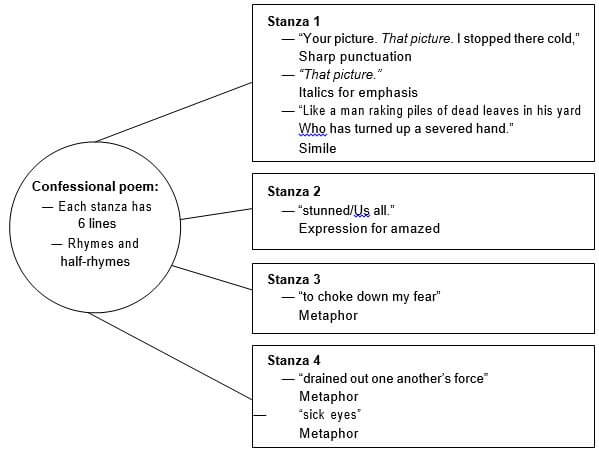
- Tone and moodTone: Overall, it has a conversational tone. It shifts through the poem from one of horror; to a happy tone; to a bitter and sad tone; and ends on a more gentle and hopeful tone.
Mood: How does this poem make you feel? Happy, sad, angry or indifferent? Always give reasons for your answer.
Activity 9
Refer to the poem on page 77 and answer the questions below.
- Complete the following sentences by using the words provided in the list below.
| stunned; mother; shocked; disappointed; ex-wife; glad |
The speaker is sorting out old papers when he finds a photograph of his (1.1) … Initially, he is (1.2) … but then he is (1.3) … to find it as it brings back old memories. (3)
- Refer to line 4 (“Your That picture. I stopped there cold,”).
Explain why the words “That picture” are written in a different font (letter type).(1) - Refer to lines 4-6 (“I stopped there … a severed ”).
3.1 Identify the figure of speech used here
3.2 Explain why the poet has used this figure of speech (2) - Choose the correct answer to complete the following In line 10, the word “stunned” suggests that the girl was …
- gorgeous.
- scary.
- motionless.
- happy. (1)
- Refer to lines 11-12 (“Well, our needs … ideals came ”).
Using your own words, say what the speaker and his wife’s lives were like when they were young. (1) - Refer to stanza (3)
6.1 Quote THREE separate words to show that not only soldiers were affected by the war.
6.2 Explain what the photograph meant to the speaker during the war (1) - Refer to the last
7.1 Is the following statement TRUE or FALSE? Give a reason for your answer.
The speaker’s wife was responsible for the breakdown of their marriage. (2)
7.2 What does the speaker’s decision to keep the photograph reveal about him? (1) - In the first stanza, the tone of the speaker is one of shock
What is the tone in the last stanza? (1) - After reading this poem, do you think it is a good idea to use old photographs as a way of remembering the past?
Discuss your view. (2) [18]
Answers to Activity 9
- 1.1 Ex-wife ✓
1.2 Shocked ✓
1.3 Glad ✓ (3) - It emphasises/shows the importance of the photo/It shocks him./It refers to a particular picture of relevance/ significance. ✓ (1)
- 3.1 Simile ✓ (1)
3.2 Finding this photograph is as shocking/unexpected as finding a severed hand in your garden. ✓ (1) - A /gorgeous ✓ (1)
- Simple/carefree/uncomplicated ✓ (1)
- 6.1 “shacks” ✓
“dishes” ✓
“dolls” ✓ (3)
6.2 It helped him cope with his fears/it helped him to choke down his fears. ✓ (1) - 7.1 False.
Both of them were responsible. ✓✓
OR
They drained one another’s force. ✓✓ (2)
7.2 He is not ready to let go./The photograph still has meaning for him./He has not come to terms with the divorce yet./He still has feelings for his ex-wife. ✓ (1) - The tone becomes gentler/accepting/agreeable/forgiving. ✓ (1)
- Yes, people need real objects like photographs to remember the ✓✓
OR
No, memories should not depend on objects such as photographs. ✓✓ (2) [18]
CHEETAH BY CHARLES EGLINGTON
- Themes
- Type and form
- Analysis
- Tone and mood
- Activity 10
This poem was written by Charles Eglington (1918-1971). Eglington was born in Johannesburg and graduated from Wits University. He spent his life working in the media as a newspaper journalist, a translator and also in radio. Many of his poems are about animals.
Fun fact
- Did you know the cheetah is the world’s fastest animal – it can reach speeds of up to 96 kilometres per hour!
1. Themes
The main themes in this poem are that appearances can be misleading; and that in nature only the strongest survive.
The poet tells the story of an ordinary event among wild animals in nature – a hunter catching its prey. In the first part of the poem, the poet describes a young cheetah lying relaxed in the long grass of the bushveld, while a herd of buck grazes nearby. The buck do not know that the cheetah is close by.
The big cat is waiting for darkness before hunger makes it go out and hunt. Then the cheetah races forward towards the herd, which smells it and begins to run in panic. The chase is like a lottery, as the buck do not know which one of them will be caught. The cheetah leaps on one unlucky buck and kills it. (Cheetahs knock their prey down, jump on it and then bite its neck to kill it.)
| Cheetah by Charles Eglington |
| Stanza 1 | Indolent and kitten-eyed, | |
| This is the bushveld’s innocent |
| The stealthy leopard parodied |
| With grinning, gangling pup-content. |
| Stanza 2 | Slouching through the tawny grass | 5 |
| Or loose-limbed lolling in the shade, | |
| Purring for the sun to pass | |
| And build a twilight barricade. | |
| Stanza 3 | Around the vast arena where, | |
| In scattered herds, his grazing prey | 10 |
| Do not suspect in what wild fear | |
| They’ll join with him in fatal play; | |
| Stanza 4 | Till hunger draws slack sinews tight | |
| As vibrant as a hunter’s bow; | |
| Then, like a fleck of mottled light, | 15 |
| He slides across the still plateau. | |
| Stanza 5 | A tremor rakes the herds: they scent | |
| The pungent breeze of his advance; | |
| Heads rear and jerk in vigilant | |
| Compliance with the game of chance. | 20 |
| Stanza 6 | In which, of thousands, only one | |
| Is centred in the cheetah’s eye; | |
| They wheel and then stampede, for none | |
| Knows which it is that has to die. | |
| Stanza 7 | His stealth and swiftness fling a noose | 25 |
| And as his loping strides begin | |
| To blur with speed, he ropes the loose | |
| Buck on the red horizon in. | |
Words to know
| Definitions of words from the poem: |
| Line 1: | indolent | lazy |
| Line 2: | innocent | harmless |
| Line 3: | stealthy | quiet, sneaky, secret, dangerous |
| parodied | copy in a funny way |
| Line 4: | grinning | smiling |
| gangling | long-legged, awkward, clumsy |
| pup-content | happy |
| Line 5: | Slouching | moving casually, relaxed |
| tawny | yellowish-brown |
| Line 6: | loose-limbed | with relaxed legs |
| lolling | lying back, relaxing |
| Line 7: | purring | sound made by a happy cat |
| Line 8: | twilight | early evening |
| barricade | barrier, wall |
| Line 9: | vast | very big |
| arena | stadium, sports field |
| Line 10: | scattered | spread out |
| grazing | eating grass |
| prey | something or somebody who is being hunted |
| Line 11: | do not suspect | have no thoughts, do not expect |
| Line 12: | fatal | ending in death |
| Line 13: | slack | loose |
| sinews | tough fibres that tie muscles to bone |
| Line 14: | vibrant | full of life, energy |
| bow | weapon used to shoot arrows |
| Line 15: | fleck | tiny spot |
| mottled | patches of light and dark, full of shadows |
| Line 16: | slides | moves smoothly, swiftly, quietly |
| plateau | flat raised ground |
| Line 17: | tremor | shaking, shiver |
| rakes | moves through |
| scent | smell |
| Line 18: | pungent | strong smell |
| advance | moving towards them |
| Line 19: | rear | lift quickly |
| jerk | pull up quickly |
| vigilant | watchful, senses danger |
| Line 20: | compliance | giving in to, obeying the rules |
| Line 22: centred | in the middle of, focused, given attention |
| Line 23: wheel | turn |
| stampede | run away in terror and panic |
| Line 25: swiftness | quickness |
| fling | throw |
| noose | circle of rope |
| Line 26: loping | running |
| strides | big steps |
| Line 27: blur | look unclear and fuzzy |
| Line 28: horizon | far distance |
2. Type and form
This is a narrative poem that tells the story of how the cheetah hunts its prey.
The poem has a formal structure (the way it is set out) with seven stanzas of four lines each (quatrains) that have a regular pattern of rhyme (abab).
Each of the seven stanzas tells a different part of the story. Some stanzas focus on the cheetah, others on the buck. In the last stanza, the two come together when the cheetah catches a buck. The poem’s structure (the form) and the hunt described in the poem (the content) are closely linked in an effective way.
3. Analysis
| Stanza 1 (lines 1 – 4) Indolent and kitten-eyed,
This is the bushveld’s innocent
The stealthy leopard parodied
With grinning, gangling pup-content. |
In stanza one, the poet describes the cheetah as seeming to be harmless. The poet uses imagery as if he is describing a harmless young animal – the cheetah looks “innocent”. The metaphor “kitten-eyed” (line 1), compares the cheetah’s big eyes to those of a sweet kitten. The poet feels the leopard is a more impressive-looking animal and that the cheetah is a “parody” (or funny copy) of a leopard.
Both the leopard and the cheetah are big cats that have spots, but where the leopard is described as “stealthy” (line 2), which suggests it is secret and dangerous, the cheetah seems to smile in a rather silly way. The metaphor “pup-content” (line 4) compares it to a happy (and harmless) puppy.
The word “gangling” means it has long, loose legs that make it seem rather awkward and clumsy. The words for baby animals like “kitten” and “pup” suggest it is young, as does “gangling”, as teenage animals (including people) often seem to have long, thin bodies before they grow older, stronger and more muscular.
| Stanza 2 (lines 5 – 8) Slouching through the tawny grass
Or loose-limbed lolling in the shade,
Purring for the sun to pass
And build a twilight barricade. |
The cheetah moves lazily and casually (“slouching” in line 5) through the grass or lies back, (“lolling” in line 6) in the shade during the day. Notice how the alliteration links the words “Loose-limbed lolling” in line 5, emphasising how relaxed the animal is.
The big cat purrs like a happy house cat as it waits patiently for the sun to set. Again, this makes the cheetah seem harmless, as cats purr when they are relaxed and content. At twilight it is growing dark and the metaphor “barricade” (line 8) compares the darkness to a wall or barrier that will hide the cheetah when it hunts. Barricades are often built across streets during wars or riots, so the poet’s diction (choice of words) creates a more uneasy tone with the use of “barricade”.
Up to now, the herd of buck and the cheetah seem relaxed. By including the word “barricade”, the poet introduces tension at the end of the stanza. The barricade interrupts the relaxed tone.
| Stanza 3 (lines 9 – 12) Around the vast arena where,
In scattered herds, his grazing prey
Do not suspect in what wild fear
They’ll join with him in fatal play; |
The tension in the poem grows. The poet sets the scene for the hunt. The huge grasslands (“vast arena” line 9), the herds of buck that are spread about (“scattered”) as they graze and have no idea that there is a cheetah nearby waiting to kill one of them, its “prey” (line 10). In this stanza, the poet uses an extended metaphor which is carried on in the first and last lines of the stanza. The hunt is compared to a game that is played to the death in an “arena”. This game or “fatal play” (line 12) is an oxymoron, because “play” suggests a game, but “fatal” means deadly, so this game will end in a death.
This creates a visual image (a picture we can see in our minds) of the games in the Coliseum, the great sports stadium of ancient Rome, when spectators enjoyed watching men fight with swords and the loser was often killed. As we read, we feel fearful for the unsuspicious buck that do not know of the danger that is coming. We begin to sympathise with the “wild fear” (line 9) they will feel when the cheetah begins its chase. Notice how vividly and strikingly the poet’s diction in “wild fear” conveys the panic the buck are going to feel. The uneasy tone becomes stronger now.
| Stanza 4 (lines 13 – 16) Till hunger draws slack sinews tight
As vibrant as a hunter’s bow;
Then, like a fleck of mottled light,
He slides across the still plateau. |
This stanza describes the cheetah as it attacks. The animal now changes from a harmless-seeming young animal into a dangerous predator (hunter) as it begins its chase. Unlike the ancient Romans, for whom killing was a sport, the cheetah hunts only to eat and survive.
When it starts to think about hunting its body changes from relaxed to tense. The poet uses a simile that compares it to a bow. When an archer (who shoots with bow and arrow) gets ready to shoot the arrow, he pulls back the string of the bow very tightly so that the arrow will shoot forward with great speed and power. In the same way, when the cheetah is hungry and ready to hunt, it tenses all the muscles in its body (“slack sinews tight” in line 13). As it jumps forward, the cheetah’s body bends in a curve like a bow and it is no longer “slack” (relaxed) but “vibrant” – filled with energy and life.
The poet uses a simile “like a mottled fleck of light” (line 15) to describe the cheetah’s speed, as its spotted body moves as fast as a flashing spot of light. It moves so smoothly and quickly that it seems to “slide” across the flat ground (line16). Notice how the alliteration of the hissing “s” sound in “slide/still” emphasises its speed. The cheetah’s movement is purposeful, controlled and confident.
| Stanza 5 (lines 17 – 20) A tremor rakes the herds: they scent
The pungent breeze of his advance;
Heads rear and jerk in vigilant
Compliance with the game of chance. |
The poet now describes the reaction of the herd. The buck catch the strong (“pungent”) smell of the cheetah, perhaps carried to them on the wind. They all shiver (“tremor”) with fear (line 17). The metaphor “rakes” describes the way the shiver of fear (“tremor”) runs through the herd the way a rake (a garden instrument like a very big fork) can sweep along the ground.
All moving together at the same time, the buck at once raise their heads and become tense and watchful. In a metaphor the poet compares the buck to people taking part in a “game of chance” (line 20). They have no choice but “compliance” – they have to fit in with the rules of the “game” in which they know that any one of them might be attacked and killed by the cheetah. Unfortunately for the buck, the rules of nature are that some animals have to die so that others can survive.
| Stanza 6 (lines 21 – 24) In which, of thousands, only one
Is centred in the cheetah’s eye;
They wheel and then stampede, for none
Knows which it is that has to die. |
Of all the thousands of buck, the cheetah sets his eyes on only one. All his attention is on one buck. The buck all turn round quickly, they “wheel” and “stampede” (line 23) to get away. When herd animals (such as cows, horses or buck) are afraid, they stampede – the whole herd runs away in a mass panic. Their movement is uncontrolled. They know one of them will die, but do not know which of them the cheetah has chosen to kill.
The rhyming of “eye” (line 22) and “die” (line 24) links these two words to emphasise that the buck has no chance of escape. The buck is in the cheetah’s sight.
| Stanza 7 (lines 25 – 28) His stealth and swiftness fling a noose
And as his loping strides begin
To blur with speed, he ropes the loose
Buck on the red horizon in. |
In this last stanza, the poet returns to describing the cheetah. He again uses an extended metaphor, this time of a cowboy using a lasso.
The silent speed (“stealth and swiftness” in line 25) with which the cheetah runs towards the buck is compared to the rope and noose flying through the air. The cheetah’s long steps (“loping strides” in line 26) begin to go so fast that you cannot see the animal clearly; you see only a blur. The cowboy metaphor is continued when the cheetah leaps on the buck’s back to knock it to the ground, as this is compared to the rope pulling the animal in. The horizon is described as “red” (line 28). This could refer to the red of the setting sun but it also suggests that the land itself is stained with the blood of the dead buck.
Note that stanzas 6 and 7 are part of a continuous run-on line – this helps to suggest that the cheetah is gaining speed and its movements are not interrupted as it chases its prey.
There is a contrast between the description of the harmless looking cheetah in the first two stanzas and the dangerous hunter in the later stanzas.
Note:
- Lasso – a long rope with a loop at the end called a noose. To catch a cow, the cowboy throws the rope so that the loop falls around the animal’s neck so that he can pull it in.
- Run-in-line: the meaning runs on from one line to the next, without being broken by punctuation.
4. Tone and mood
The tone of the poem is relaxed, like the cheetah, at the start. It becomes more urgent and tense as the poem progresses, starting with the uneasy tone at the end of stanza 3. The tone of danger increases later in the poem as the poet describes the hunt.
The mood of a poem is how it makes the reader feel. How does this poem make you feel? For example, happy, sad, angry, or indifferent.
Summary
Cheetah by Charles Eglington
- Theme
The main themes are that appearances can be misleading; and that in nature, only the strongest survive. - Type and form
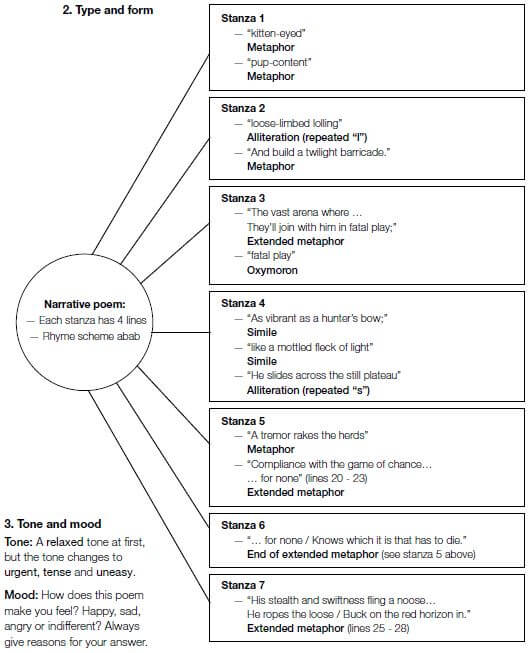
Activity 10
Refer to the poem on page 87 and answer the questions below.
- Complete the following sentences by using the words provided in the list below.
| young; snarling; awkward; old; smiling; graceful |
The poet says that the cheetah is (1.1) … but it has (1.2) … movements and it appears to be (1.3) … (3)
- What does the word “indolent” in line 1 tell you about the cheetah? State TWO (2)
- Choose the correct answer to complete the following In line 3 the speaker’s tone shows that he feels …
- the cheetah is better than the leopard.
- the leopard is better than the cheetah.
- the cheetah and the leopard are the same.
- the cheetah is quieter than the leopard. (1)
- Refer to the words “twilight barricade” in line
4.1 Identify the figure of speech used (1)
4.2 Explain why the poet uses this figure of (2) - Which ONE WORD in stanza three shows that purpose of the hunt is to find food? (1)
- Quote two consecutive words in this stanza that contradict each other (oxymoron), and suggest that the hunt is not really a game? (2)
- Refer to line 14 (“And vibrant as a hunter’s bow”).
7.1 Identify the figure of speech used (1)
7.2 Explain why the poet has used this figure of (2) - Refer to line 20 (“Compliance with the game of chance”).
Do you think the use of the word “compliance” is suitable? Discuss your view. (2) - What message does this poem have for you? (1) [18]
| Answers to Activity 10 |
| 1.1 | Smiling/young/graceful/awkward ✓ | |
| 1.2. | Awkward/graceful ✓ | |
| 1.3. | Young/smiling ✓ | (3) |
| 2. | The cheetah is lazy/inactive/idle ✓✓ | (2) |
| 3. | B / the leopard is better than the cheetah. ✓ | (1) |
| 4.1. | Metaphor ✓ | (1) |
| 4.2. | Night/darkness will become his shield from his prey ✓✓
OR
Night/darkness will conceal/hide him from his prey ✓✓
OR
Night /darkness will contain his prey ✓✓ | (2) |
| 5. | “prey” ✓ | (1) |
| 6. | “fatal play” ✓✓ | (2) |
| 7.1. | Simile ✓ | (1) |
| 7.2. | The poet compares the cheetah to a hunter’s bow. When it is hunting, the cheetah has the speed and force of a hunter’s bow and arrow. ✓✓
OR
To show that the cheetah is as fast/quick as a hunter’s bow (arrow) ✓✓ | (2) |
| 8. | Yes, when one sees no way out of a fatal situation, one gives in and accepts one’s fate. ✓✓
OR
No, although the herd knows that one of them is to be killed, they still try and escape. ✓✓
OR
No, one does not simply accept one’s fate when facing danger/ death/ There’s always a chance of survival if one tries to escape. ✓✓ | (2) |
| 9 | - Cruelty of nature ✓
- Survival of the fittest ✓
- Appearances can be misleading ✓
- The cycle of life/predators only kill for food ✓
- In every situation in nature there is a killer and a victim. ✓
| (1) |
| | [18] |