Home Blog Page 172

Nothing but the Truth questions and answers

Nothing but the Truth questions and answers “Nothing but the Truth” questions are those that demand honest, unvarnished responses. They bypass social niceties and delve deep into the core of a matter, encouraging transparency and vulnerability. These questions eschew superficiality in favor of genuine connection and understanding.


On this page you will find, Nothing but the Truth novel study tips, with comprehension and contextual questions and answers.

[Thando and Sipho talk before they leave for the airport with Mr Khahla.]

nothing but the truth extract

List of Questions

  1. State the relationship between the two speakers in this extract. (1)
  2. Refer to line 1 (“Have you tried to find her?”). About whom are Thando and Sipho speaking? (1)
  3. Refer to line 2 (“She left me … to be found.”). If you were the stage director of this play, what would you:
    a) Tell Sipho to do while saying these words? (1) b) Want his face to express? (1)
  4. What do Thando’s words in lines 1 to 11 tell us about her
    feelings? State TWO points.
  1. Refer to lines 16 and 17 (“Are we going … in the hearse?”).
    Why do Thando and Sipho arrange for a hearse to go to the
    airport? (1)
  2. Complete the following sentence by filling in the missing word.
    Write down only the question number and the word.
    Sipho never talks about … because he is afraid of losing
    Thando to him. (1)

7. Is the following statement TRUE or FALSE? Write ‘true’ or ‘false’ and give a reason for your answer.
Mandisa’s father was killed by the police.

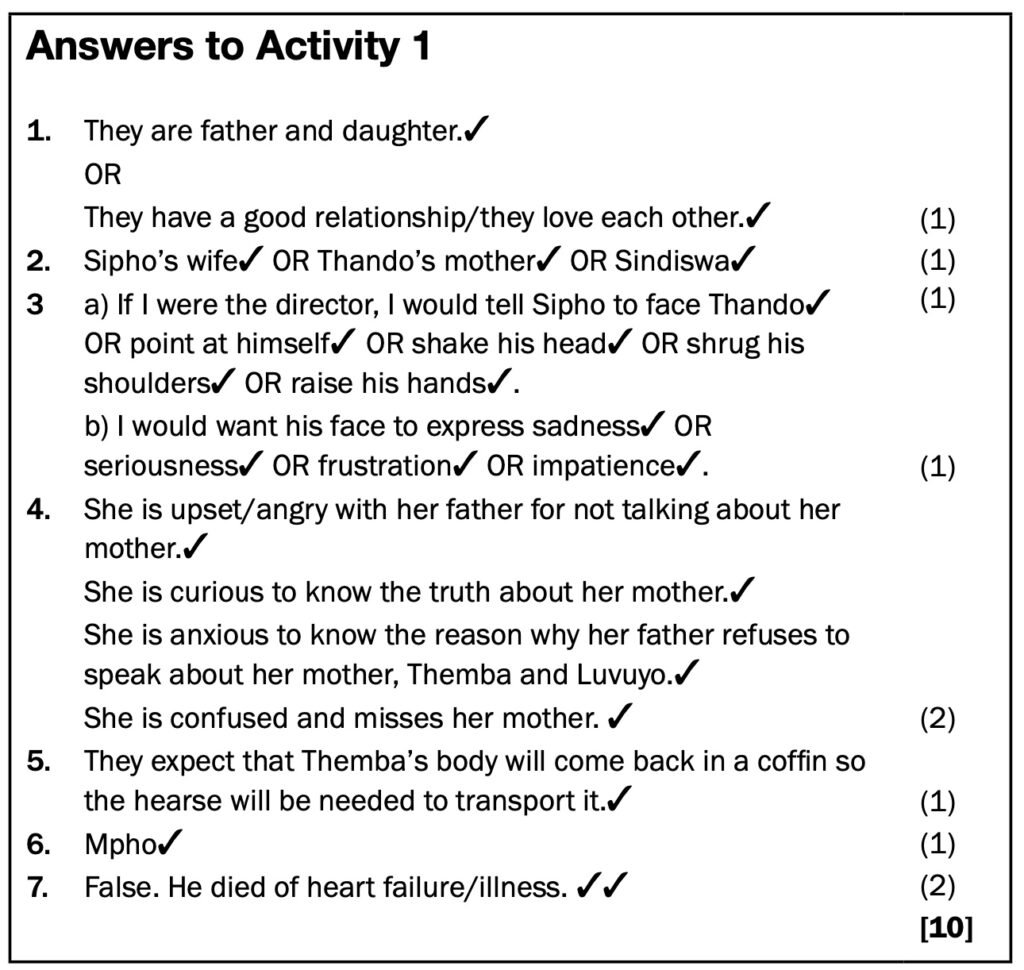
Answers

nothing but the truth answers

Download Nothing but the truth Study Guide here

Life of Pi Summary and Analysis: Grade 12

Life of Pi Summary and Analysis: Grade 12 The protagonist is Piscine Molitor “Pi” Patel, an Indian boy from Pondicherry, India, who explores issues of spirituality and metaphysics from an early age.

Life of Pi Novel Summary

“Life of Pi” is a novel by Yann Martel, which tells the story of a young Indian boy named Pi Patel, who survives a shipwreck and is stranded on a lifeboat in the middle of the Pacific Ocean with a Bengal tiger named Richard Parker.

The novel is divided into three parts. In the first part, we learn about Pi’s childhood in Pondicherry, India, where his family owns a zoo. Pi is a curious and spiritual young boy, who explores his faith by practicing Hinduism, Christianity, and Islam simultaneously. When Pi’s family decides to move to Canada, they set sail on a Japanese cargo ship, along with many of their animals. However, the ship encounters a severe storm and sinks, leaving Pi stranded on a lifeboat with Richard Parker and other animals.

In the second part of the novel, Pi and Richard Parker are stranded on the lifeboat in the middle of the Pacific Ocean. They struggle to survive, facing challenges such as extreme weather, hunger, and dehydration. Despite his fear of the tiger, Pi manages to train Richard Parker and create a temporary peace between them.

Video: Life of Pi (Book) – Thug Notes Summary & Analysis

In the third and final part of the novel, Pi and Richard Parker wash up on the shore of a small island. The island provides them with food and water, but they soon realize that it is carnivorous and must leave. Pi and Richard Parker continue their journey across the ocean, eventually arriving in Mexico. Richard Parker immediately disappears into the jungle, and Pi is rescued and taken to a hospital.

The novel’s themes include faith, survival, and the power of storytelling. Through Pi’s journey, Martel explores the complexity and beauty of the human spirit, and how it can be tested and triumph over adversity.

In the end, the novel leaves the reader with a sense of wonder and possibility, as Pi’s extraordinary journey challenges our understanding of what is possible and what it means to be human.

Setting, Context and Timeline

The setting and context of Yann Martel’s “Life of Pi” are integral to the plot and themes of the novel. Part 1 of the novel is set in Pondicherry, which was a French colony in India and is now known as Puducherry. The city’s beautiful Franco-Tamil architecture is still visible today. The Botanical Gardens in Pondicherry once housed a zoo, and the director of the film adaptation used the gardens to film the zoo scenes in the movie. However, the zoo in the novel is largely fictitious, as the Pondicherry Zoo did not have the diverse range of species described by Pi.

The political climate of India during the time period in which the novel is set is also important. In 1975, Prime Minister Indira Gandhi was found guilty of charges related to her election campaign and declared a “state of emergency” that lasted 18 months. This period was marked by controversy, as Gandhi suspended civil liberties and jailed her opponents. Pi’s father becomes nervous about the possibility of Gandhi taking over his business and decides to move his family from India to Canada.

The setting and context of the novel play a key role in the plot development. Pi’s family’s ownership of a zoo allows for the situation in which Pi and the tiger are stranded at sea together to be believable, rather than contrived. Part 2 of the novel focuses on Pi’s journey at sea with the tiger, as they face extreme challenges and struggle to survive.

Part 3 of the novel is set in Benito Juarez Infirmary in Tomatlán, Mexico, where the first two parts of the novel come together to clarify the events in the story. The setting of the infirmary allows for the resolution of the plot and the exploration of the novel’s themes, including faith, survival, and the power of storytelling. Overall, the setting and context of “Life of Pi” contribute to the novel’s depth and richness, and play an important role in the story’s development.

Characters

  1. Pi (Piscine Molitor Patel): Pi is the protagonist of the novel and the main character. He is a young Indian boy who is stranded on a lifeboat in the Pacific Ocean with a Bengal tiger named Richard Parker. Pi is a complex character who is deeply spiritual and curious about the world around him.
  2. Richard Parker, the tiger: Richard Parker is a Bengal tiger who is stranded on the lifeboat with Pi. At first, he poses a threat to Pi’s survival, but the two eventually develop a symbiotic relationship as they learn to coexist on the lifeboat.
  3. The Author: The Author is never named and remains largely a mystery throughout the novel. He serves as the narrator and is responsible for telling Pi’s story to the reader.
  4. Santosh Patel, Pi’s father: Santosh Patel is Pi’s father and the owner of the Pondicherry Zoo. He is a strict but loving father who teaches Pi important lessons about survival and self-reliance.
  5. Gita Patel, Pi’s mother: Gita Patel is Pi’s mother and a kind and nurturing figure in his life. She is deeply religious and teaches Pi about the importance of faith and devotion.
  6. Ravi Patel, Pi’s brother: Ravi Patel is Pi’s older brother and a source of rivalry and conflict in his life.
  7. Francis Adirubasamy, known as Mamaji: Mamaji is Pi’s mentor and provides him with guidance on his spiritual journey. He is also responsible for telling the story of Pi’s survival to the author.
  8. Satish Kumar, the biology teacher: Satish Kumar is Pi’s biology teacher and a source of inspiration and knowledge for Pi. He encourages Pi’s curiosity and love of learning.
  9. Satish Kumar, the Muslim mystic: Satish Kumar is a Muslim mystic who teaches Pi about the importance of seeing God in everything.
  10. Father Martin, the Catholic priest: Father Martin is a Catholic priest who teaches Pi about the tenets of Christianity and helps him explore his own spirituality.
  11. The Hindu Priest / Pandit: The Hindu Priest or Pandit helps Pi learn about Hinduism and the importance of devotion and ritual.
  12. The blind Frenchman, another castaway: The blind Frenchman is another castaway who encounters Pi on his journey. He is a source of conflict and danger for Pi.
  13. The ship’s cook, a cruel man: The ship’s cook is a cruel man who poses a threat to Pi’s survival.
  14. Meena Patel, Pi’s wife: Meena Patel is Pi’s wife, whom he marries later in the novel.
  15. Nikhil Patel, Pi’s son: Nikhil Patel is Pi’s son, whom he has with Meena.
  16. Mr Tomohiro Okamoto, Japanese official: Mr Tomohiro Okamoto is a Japanese official who interviews Pi after he is rescued from the lifeboat.
  17. Mr Atsuro Chiba, Japanese official: Mr Atsuro Chiba is another Japanese official who interviews Pi after he is rescued from the lifeboat.

Downloadable Guide

Argumentative essay topics for High School, College, and University Students

Argumentative essay topics for High School, College, and University Students Argumentative essays are a staple in academic writing, requiring students to articulate their viewpoints on contentious issues and support them with evidence and reasoning. However, choosing the right topic can make or break the essay-writing experience. To alleviate the stress of topic selection, here’s a curated list of argumentative essay topics suitable for students at different educational levels: high school, college, and university.

What is an argumentative essay?

The argumentative essay is a very specific kind of writing in which a learner selects a topic (often a controversial topic), researches it extensively, and then uses the evidence gathered in their research process to establish their position on the topic in an essay designed to persuade others.

5 Common Characteristics of an argumentative essay

The following five features make up the structure of an argumentative essay:

  1. Introduction and thesis
  2. Opposing and qualifying ideas
  3. Strong evidence in support of claim
  4. Style and tone of language
  5. A compelling conclusion

34 Argumentative essay Topics for College and Grade 12 Class 12 Students

  1. Does your vote count?
  2. Does diversity in media matter?
  3. Does the wage gap really exist?
  4. What should be done about gun control in the countries (choose a specific country)?
  5. Does the average citizen need to have the right to own a gun?
  6. Should marijuana be legalized?
  7. Should religion have a place in government?
  8. Should students be allowed to choose their own classes (as they do in college) from a younger age?
  9. Is net neutrality important?
  10. Is single-sex education beneficial or harmful to students?
  11. What should young people be given more credit for?
  12. Is the widespread increased use of technology good for young children—or does it harm their development?
  13. How is the President doing at his job?
  14. What is the greatest threat to our environment?
  15. Should we be investing in space exploration?
  16. Is the development of technology that automates jobs previously held by real people good or bad for our society?
  17. Is celebrity culture harmful or harmless? Why?
  18. What types of restrictions should there be on abortions?
  19. How involved should South Africa get in conflicts in other African countries?
  20. Should employers be required to pay a living wage?
  21. What is the line between cultural appropriation and cultural appreciation?
  22. Do corporations have social responsibilities to their customers?
  23. Should there be restrictions or laws on what types of bathrooms trans people can use?
  24. What types of academic requirements should student athletes have to meet in order to maintain their eligibility to compete?
  25. The Electoral College—effective or outdated?
  26. Which branch of government is the most important?
  27. Is homeschooling good for students?
  28. Should hate speech be protected under free speech?
  29. Should an employer be able to fire someone if the employer has a problem with the employee’s race, gender, religion, sexual orientation, identity, etc.?
  30. Are GMO foods good or bad for our country?
  31. What levels of education do people really need in order to be qualified to enter the workforce?
  32. Do our schools today adequately prepare students for the real world?
  33. What is the best way for the average person to make a difference?
  34. Should people who make more money pay taxes on a higher percentage of their income?

Advanced Argumentative essay topics for University and College Students

Technology Argumentative essay topics

  1. Should social media platforms be banned from collecting their users’ data?
  2. Should companies have to hire human workers overusing autonomous machines?
  3. Should cell phones be banned from vehicles?
  4. 13 Reasons why Cell Phones should not be allowed in school
  5. Has the internet made society better?
  6. Should parents limit screen time for kids?
  7. Should everyone get the internet for free?
  8. Is technology too isolating?
  9. Should cyber-bullying carry legal consequences?

Health Argumentative essay topics

  1. Are GMOs good for us or bad for us?
  2. Should schools require vaccinations for students?
  3. Would universal healthcare improve healthcare access?
  4. Should medical professionals be allowed to market pharmaceuticals to their patients?
  5. Should parents limit the number of activities their kids participate in?
  6. Are kids more depressed than they used to be?
  7. Is there too much focus on diets in society?
  8. Is fasting healthy?
  9. Does our society undervalue sleep?
  10. Are car seats effective at keeping children safe in car crashes?
  11. Is physical health more important than mental health?
  12. Should vaccinations be compulsory for all South African citizens?

Government-related Argumentative essay topics

  1. Should climate change be a governmental issue?
  2. Would America function better without the electoral college?
  3. Should America automate voter registration?
  4. Should all states provide automatic mail-in ballots for elections?
  5. Should people serving prison sentences be allowed to vote?
  6. Should Americans vote on and elect Supreme Court justices?
  7. Should unpaid internships be illegal?
  8. Should the government increase the federal minimum wage?
  9. Should the government provide everyone with a universal basic income?
  10. Should corporations pay more taxes?
  11. Should the government regulate what we eat?
  12. Should the government impose term limits on Congresspeople?
  13. Should South Africa have an official language?
  14. Should the drinking age in South Africa be lowered to 18?
  15. Should personal ownership of guns be illegal?
  16. Should the government be blamed for the current national obesity rate?
  17. Should military service be compulsory in South Africa?
  18. Should smoking in public be illegal?
  19. Should alcohol sales be illegal between midnight and noon?
  20. Should the voting age in South Africa be raised to 21?
  21. Should the government be able to censor people on the internet?
  22. Are the current political fundraising rules effective?
  23. Is South African immigration policy effective?
  24. Is the South African Constitution outdated?

Education Argumentative essay topics

  1. Should colleges and universities have to pay their student athletes?
  2. Should public schools allow student-led religious clubs and organizations?
  3. Should schools require students to say the Pledge of Allegiance?
  4. Should schools require their students to wear school uniforms?
  5. Should physical education classes be graded?
  6. Should college and university be free like elementary, middle and high school?
  7. Should college students be prohibited from participating in Greek life?
  8. Should art classes be compulsory in school?
  9. Should music and other types of art be free online?
  10. Should students who cheat on tests be punished?
  11. Should schools limit the use of computers and other technology for students?
  12. Is single-sex education better than co-education?
  13. Should schools run year round?
  14. Should schools abolish homework?
  15. Should all students receive free breakfast and lunch at school?
  16. Is private education too competitive?
  17. Should teachers be held accountable for poor test scores?
  18. Should high school students get to choose which classes they take?
  19. Should students be required to learn a foreign language?
  20. Should teachers assign grades to students?
  21. Are standardized tests effective?
  22. Do sports hurt academic performance in teenagers?
  23. Should students be allowed to use computers for research when taking tests?
  24. Should high school graduates take a gap year before beginning their careers or going to college?
  25. Should the school day start after 9 am?
  26. Is online learning effective?
  27. Should middle and high school students be required to work part-time?
  28. Should teachers earn more money?
  29. Should parents be punished if their kids skip school?
  30. Should college be compulsory for all kids?
  31. Should students have the option of grading their teachers?
  32. Should schools allow corporal punishment?
  33. Are schools safer with armed guards?
  34. Should school libraries ban certain books from students?

Environmental Argumentative essay topics

  1. Do electric vehicles decrease overall emissions?
  2. Is the seemingly increased frequency of natural disasters a result of climate change?

Economic Argumentative essay topics

  1. Should companies have to provide paid parental leave?
  2. Should all companies offer paternity leave?
  3. Is the current American tax system fair?
  4. Should there be a salary cap for celebrities like athletes and actors?
  5. Do CEOs make too much money?
  6. Should most companies move to a four-day workweek?
  7. Is there an income inequality problem in South Africa?
  8. Are workers more productive at home?

Sports Argumentative essay topics

  1. Should women be allowed to play professional sports on men’s teams?
  2. Are designated hitters good or bad for the sport of baseball?
  3. Should dance be an Olympic sport?
  4. Should steroid users be banned from their sport forever?
  5. Should tackle football be illegal for kids under 18 years old?
  6. Does the use of helmets in sports like football and hockey make playing more dangerous?
  7. Should professional athletes and professional coaches make the same amount of money?

Ethics-related Argumentative essay topics

  1. Should social media sites regulate and censor user posts?
  2. Are humans and our actions responsible for climate change?
  3. Should the death penalty be illegal?
  4. Should torture ever be allowed?
  5. Should influencers be allowed to market products?
  6. Are curfews for teenagers effective?
  7. Is animal testing moral?
  8. Should smoking cigarettes be illegal?
  9. Should public video surveillance be illegal?
  10. Should people be fined for not recycling?
  11. Are children too coddled?
  12. Should marketing designed for kids be illegal?
  13. Should society hold celebrities to a high moral standard?
  14. Should violent video games be illegal?
  15. Do violent video games cause people to act more violently?
  16. Are beauty pageants dangerous for the participants?
  17. Should drugs be legal?
  18. Is affirmative action effective
  19. Is cloning unethical?
  20. Are social protests effective?
  21. Should there be a limit to the number of children a person can have?
  22. Should fur coats be illegal?
  23. Should drunk drivers have their driver’s licenses permanently revoked?
  24. Is graffiti an act of vandalism or the creation of art?

Religion Argumentative essay topics

  1. Should religious groups and organizations have to pay taxes like businesses do?
  2. Should religion be a required course in school?
  3. Should all clergy people be allowed to marry and have children?

Poetry: Voice of the Land English Grade 12: Mind the Gap Guide pdf download

Poetry: Voice of the Land English Grade 12: Mind the Gap Guide pdf download Poetry, as presented in the Grade 12 English “Mind the Gap” Guide, serves as a conduit through which students traverse landscapes of language, encountering diverse perspectives and experiences. Each poem becomes a microcosm of thought, woven with imagery, symbolism, and rhythm, inviting readers to immerse themselves in its depths.

On this page, you will find Poetry: Voice of the Land English Grade 12: Mind the Gap Guide, which includes downloadable pdf, poems and a Study guide. This is a Grade 12 English Home Language poetry study guide

Download the Poetry: Voice of the Land English Grade 12: Mind the Gap Guide

What are Adjectives give 10 examples

What are Adjectives give 10 examples

What are Adjectives

In English language, an adjective is a word that modifies a noun or noun phrase or describes its referent. Its semantic role is to change information given by the noun.

10 Examples of Adjectives

If they ask you in the exam to give 10 examples of adjectives in a setence, you should mention the following:

  1. They live in a beautiful home.
  2. Refilwe is wearing a sleeveless shirt today.
  3. She wore beautiful shoes.
  4. He writes meaningless letters.
  5. This car is much nicer.
  6. She wore a beautiful dress.
  7. Ofunwa is an adorable boy.
  8. Mpho’s hair is gorgeous.
  9. This bottle is breakable.
  10. I met a homeless person in Cape Town.
Adjectives Example (Watch)

Adjectives to describe Taste

BitterLemon-flavoredSpicy
BlandMintySweet
DeliciousPickledTangy
FruitySaltyTasty
GingerySourYummy

Adjectives to describe Touch

BoilingFluffySharp
BreezyFreezingSilky
BumpyFuzzySlick
ChillyGreasySlimy
ColdHardSlippery
CoolHotSmooth
CuddlyIcySoft
DampLooseSolid
DirtyMeltedSticky
DryPainfulTender
DustyPricklyTight
EncrustedRoughUneven
FilthyShaggyWarm
FlakyShakyWet

Adjectives to describe Sound

BlaringMelodicScreeching
DeafeningMoaningShrill
FaintMuffledSilent
HoarseMuteSoft
High-pitchedNoisySquealing
HissingPurringSqueaking
HushedQuietThundering
HuskyRaspyVoiceless
LoudResonantWhispering

Adjectives to describe Color

Actually, any colour can be used as an adjective:

AzureGrayPinkish
BlackGreenPurple
BlueIndigoRed
BrightLavenderRosy
BrownLightScarlet
CrimsonMagentaSilver
DarkMulticoloredTurquoise
DrabMustardViolet
DullOrangeWhite
GoldPinkYellow

Adjectives to describe Size

AbundantJumboPuny
Big-bonedLargeScrawny
ChubbyLittleShort
FatLongSmall
GiantMajesticTall
GiganticMammothTeeny
GreatMassiveThin
HugeMiniatureTiny
ImmensePetiteVast

Adjectives to describe Shape

BlobbyDistortedRotund
BroadFlatRound
ChubbyFluffySkinny
CircularGlobularSquare
CrookedHollowSteep
CurvedLowStraight
CylindricalNarrowTriangular
DeepOvalWide

Adjectives to describe Time

AnnualFuturisticRapid
BriefHistoricalRegular
DailyIrregularShort
EarlyLateSlow
EternalLongSpeed
FastModernSpeedy
FirstOldSwift
FleetOld-fashionedWaiting
FutureQuickYoung

Adjectives to describe an Amount

AllHeavyOne
AmpleHundredsPaltry
AstronomicalLargePlentiful
BountifulLightProfuse
ConsiderableLimitedSeveral
CopiousLittleSizable
CountlessManySome
EachMeaslySparse
EnoughMereSubstantial
EveryMultipleTeeming
FewMyriadTen
FullNumerousVery

Adjectives to describe an Emotion

AbrasiveEmbarrassedGrumpy
AbruptEnergeticKind
AfraidEnragedLazy
AgreeableEnthusiasticLively
AggressiveEnviousLonely
AmiableEvilLucky
AmusedExcitedMad
AngryExhaustedManic
AnnoyedExuberantMysterious
AshamedFairNervous
BadFaithfulObedient
BitterFantasticObnoxious
BewilderedFierceOutrageous
BoringFinePanicky
BraveFoolishPerfect
CallousFranticPersuasive
CalmFriendlyPleasant
CalmingFrightenedProud
CharmingFunnyQuirky
CheerfulFuriousRelieved
CombativeGentleRepulsive
ComfortableGlibRundown
DefeatedGloriousSad
ConfusedGoodScary
CooperativeGratefulSelfish
CourageousGrievingSilly
CowardlyGustySplendid
CrabbyGutlessSuccessful
CreepyHappyTedious
CrossHealthyTense
CruelHeinousTerrible
DangerousHelplessThankful
DefeatedHilariousThoughtful
DefiantHungryThoughtless
DelightfulHurtTired
DepressedHystericalTroubled
DeterminedImmoralUpset
DisgustedImpassionedWeak
DisturbedIndignantWeary
EagerIrateWicked
ElatedItchyWorried
EmbarrassedJealousZany
EnchantingJollyZealous

Adjectives to describe a Person or Personality

AggressiveFamousRestless
AgoraphobicFearlessRich
AmbidextrousFertileRighteous
AmbitiousFragileRitzy
AmoralFrankRomantic
AngelicFunctionalRustic
BrainyGabbyRuthless
BreathlessGenerousSassy
BusyGiftedSecretive
CalmHelpfulSedate
CapableHesitantShy
CarelessInnocentSleepy
CautiousInquisitiveSomber
CheerfulInsaneStingy
CleverJauntyStupid
CommonJuicySuper
CompleteMachoSwanky
ConcernedManlyTame
CrazyModernTawdry
CuriousMushyTerrific
DeadNaughtyTesty
DeepOddUninterested
DelightfulOldVague
DeterminedOpenVerdant
DifferentOutstandingVivacious
DiligentPerkyWacky
EnergeticPoorWandering
ErraticPowerfulWild
EvilPuzzledWomanly
ExuberantRealWrong

Adjectives to describe Appearance

AblazeDistinctQuirky
AdorableDrabRuddy
AlluringDullShiny
AttractiveElegantSkinny
AverageEmbarrassedSloppy
AwkwardFancySmiling
BalancedFatSparkling
BeautifulFilthySpotless
BlondeGlamorousStrange
BloodyGleamingTacky
BlushingGlossyTall
BrightGracefulThin
CleanGrotesqueUgly
ClearHandsomeUnattractive
CloudyHomelyUnbecoming
ClumsyInteriorUncovered
ColorfulLovelyUnsightly
ConfidentMagnificentUnusual
CrackedMurkyWatery
CrookedOld-fashionedWeird
CrushedPlainWild
CurlyPoisedWiry
CutePrettyWooden
DebonairPuffyWorried
DirtyQuaintZaftig

Adjectives to describe Situations

AccidentalDoubtfulMain
AchievableElementaryMinor
AdvantageousFinger-printedNasty
AlcoholicGroundlessNutritious
AnimatedHardObsolete
AquaticHarmfulOptimal
AromaticHighOrganic
AspiringHonestPremium
BadHorribleQuizzical
BawdyIllegalRainy
BiographicalIllegibleRedundant
BizarreImperfectRemarkable
BrokenImpossibleSimple
CarefulInternalTangible
CredibleInventiveTricky
CreepyJazzyWholesale
CumbersomeJuvenileWorse
DisastrousLegalWry
DismissiveLogicalX-rated


My Child My Africa Questions and Answers pdf Guide

My Child My Africa Questions and Answers pdf Guide The title encapsulates the deep-seated paternalistic attitude prevalent during apartheid, where the white minority often viewed themselves as benevolent guardians of the black majority. It also reflects the paternalistic relationship between Mr. M and his students, particularly his star pupil, Thami.

My Child My Africa Book Summary

My Children! My Africa! was first performed on 27 June 1989, just before the end of apartheid. The play explores the rising tensions between Black people and the apartheid government, and more generally between Blacks and Whites near the end of apartheid.

There are three main characters in the play and all of them are thoughtful, clever and admirable, and each wins our love and our loyalty.

The play is set a year before the State of Emergency which took place from 1984 to 1989 in South Africa, (refer to p8 of My Children! My Africa!). 1984 -1990 was a period when freedom fighters such as Nelson Mandela and other leaders were still in prison. However, there were ongoing negotiations to end apartheid. The intensity of the struggle for freedom was at its height, the resistance to apartheid was starting to become violent.

Township schools were at the forefront of violent resistance to apartheid and Zolile High School was amongst those schools. Apartheid was about to end in South Africa and Fugard attacks the ANC’s decision to boycott schools and as a result initiate damage that would negatively affect generations of Africans. The play shows the suffering that Black South Africans went through during the apartheid era. It does this by telling the story of the friendship of two people – Isabel Dyson, a girl of 18 years from a White school (Camdeboo Girls High) and Thami Mbikwana, a 19 year old Black boy from a Black school (Zolile High).The third main character is Mr M, is a teacher from Zolile High school.

The meeting between Isabel and Thami occurs when Mr M organises an inter-school debate between Camdeboo and Zolile high schools. It is through Thami and Isabel’s relation that we come to understand the cruelty of apartheid and the violence of the struggle against Apartheid.

The play is also about Mr M’s ideology that education cannot be sacrificed for political gains. He is a proponent of education as the most powerful tool in the struggle for freedom and equality. ‘Thami feels constrained by the education system under apartheid, causing him to clash with his teacher Mr. M who has more traditional views about life in South Africa.’ (Cohen 24 March 2017).

By the end of the play, Mr M is killed, Thami goes into exile and Isabel makes a promise to the spirit of Mr. M that she will make her life useful.

“My Children! My Africa! was greatly influenced by Fugard’s own experience as a white person in South Africa during apartheid. Like Isabel, the white character in the play, Fugard grew up with black South Africans working for his family, and was affected by the way others saw his relationship specifically to a worker named Sam with whom he was close. As an adult, Fugard worked with a group of amateur black actors in a ghetto outside Johannesburg, which got him interested in doing activist theater specifically critiquing segregation.” Cohen, Madeline. “My
Children! My Africa! Study Guide”. GradeSaver, 24 March 2017 Web. 3 February 2020 The play was written at the time apartheid was ending. While Fugard disapproved of the injustices of the South African government, he was against the disruption of the education of the Black child.

Watch My Children! My Africa! by Athol Fugard (Act One of Two)

My Children! My Africa! by Athol Fugard (Act One of Two)

Popular Exam Questions and Answers

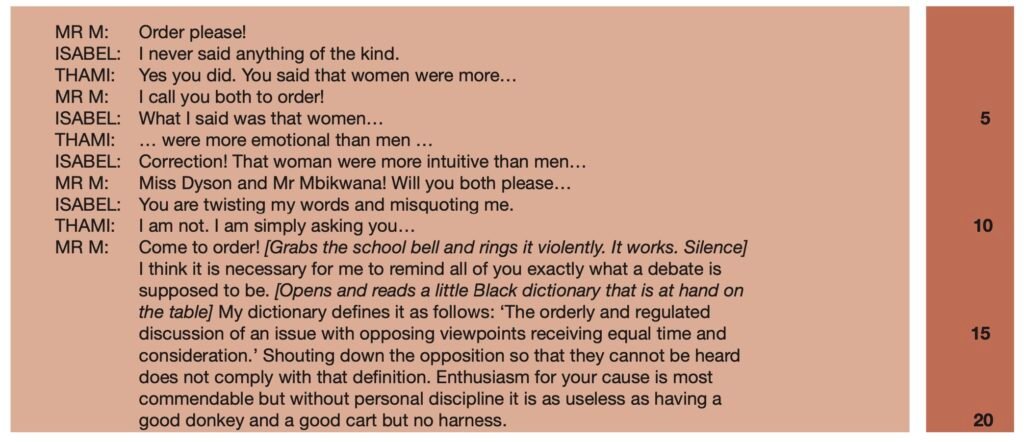
Read the following extract and answer the questions.

  1. Provide the setting of this extract.
  2. Mr M repeats his call of order three times.
  3. Why do you think it is necessary for Mr M to call order so many times?
  4. The play begins with a debate. Briefly explain how this came about.
  5. According to the stage direction, the bell is rung violently and then there is dead silence. Do you think this is dramatically effective? Give a reason for your answer.

Read the Act 1 Scene 2 and answer the following questions.

  1. Who is Miss Brockway?
  2. Explain why one must drive slowly on Brakwater roads.
  3. In Scene 2, the town of Camdeboo is contrasted with the Brakwater location. Use the table to compare the descriptions of Camdeboo and Brakwater in this Scene. Write at least two characteristics of each place.
  4. Number One Classroom made a special impression on Isabel.’ Was this impression positive or negative or both? Explain your answer.
  5. In your own words, explain what Isabel means when she says: it’s what I was made to believe was out there for me…..the ideas, the chances, the people…..specially the people!….all of that is only a fraction of what it could

View Answers on the Downloadable Guide

Contents of the Guide

  1. What happens and who is involved?
  2. Themes
  3. Style
  4. Diction and figurative language
  5. Tone and mood
  6. Question and Answers ( activities from 1 – 10)

More Questions and Answers

  1. What inspired the author to write the book “My Child, My Africa”? Answer: The author was inspired by his experiences growing up in apartheid South Africa and the powerful connection he felt to his African heritage and culture. He wanted to capture and share this connection with others, especially with future generations.
  2. What is the central theme of the book? Answer: The central theme of the book is the importance of understanding and embracing one’s African heritage and culture in the face of racial oppression and inequality.
  3. What role does the protagonist play in the story? Answer: The protagonist of the story is a young South African man who is struggling to reconcile his African heritage with the realities of apartheid South Africa. He is a symbol of the struggle of all Africans to assert their identity and cultural heritage in the face of oppression and racism.
  4. How does the protagonist’s relationship with his father change throughout the story? Answer: The protagonist’s relationship with his father changes dramatically throughout the story. At first, the protagonist is distant from his father, who is a stern and authoritarian figure. However, as the protagonist begins to embrace his African heritage and understand his father’s struggles, their relationship deepens and becomes more meaningful.
  5. What does the protagonist learn about himself and his heritage through the course of the story? Answer: Through the course of the story, the protagonist learns to embrace his African heritage and understand its importance to his identity and sense of self. He learns that his heritage is a source of strength and pride, despite the challenges and difficulties he faces as a result of apartheid.
  6. What role does music play in the story? Answer: Music is a central theme in the story, serving as a powerful symbol of the protagonist’s connection to his African heritage and culture. It is a source of comfort and inspiration for him, even in the darkest moments of apartheid.
  7. How does the protagonist’s relationship with his mother change throughout the story? Answer: The protagonist’s relationship with his mother changes dramatically throughout the story. At first, he is distant from her and feels that she does not understand his struggles. However, as he begins to embrace his African heritage and understand her struggles, their relationship deepens and becomes more meaningful.
  8. What role does the struggle against apartheid play in the story? Answer: The struggle against apartheid is a central theme in the story, serving as a backdrop to the protagonist’s personal journey of self-discovery and growth. The struggle against apartheid represents the larger struggle of all Africans to assert their identity and cultural heritage in the face of oppression and racism.
  9. How does the protagonist’s relationship with his friends change throughout the story? Answer: The protagonist’s relationship with his friends changes dramatically throughout the story. At first, he is distant from his friends and feels that they do not understand his struggles. However, as he begins to embrace his African heritage and understand their struggles, their relationship deepens and becomes more meaningful.
  10. What role does education play in the story? Answer: Education is a central theme in the story, representing the protagonist’s desire to understand and embrace his African heritage and culture. Through education, he learns about his heritage, its history, and its importance to his identity and sense of self.
  11. How does the protagonist’s relationship with his community change throughout the story? Answer: The protagonist’s relationship with his community changes dramatically throughout the story. At first, he is distant from his community and feels that they do not understand his struggles. However, as he begins to embrace his African heritage and understand the struggles of his community, his relationship with them deepens and becomes more meaningful.

Downloadable Pdf Guide (with Questions and Answers)

English HL Grade 12 P1 P2 P3 Trials Exams: Controlled Test September 2021 Term 3 Past Papers and Memos PDF Download

English HL Grade 12 P1 P2 P3 Trials Exams: Controlled Test September 2021 Term 3 Past Papers and Memos PDF Download The Trials Exams in English HL typically consist of three papers: Paper 1, Paper 2, and Paper 3. Each paper evaluates different aspects of students’ language proficiency and literary analysis.

List of English HL Grade 12 Trials Exams: September 2021 Past Papers and Memos

Paper 1


Paper 2

Drama: Macbeth English Grade 12: Mind the Gap Guide pdf download

Drama: Macbeth English Grade 12: Mind the Gap Guide pdf download “Macbeth” unfolds against the backdrop of medieval Scotland, where the eponymous protagonist, a valiant warrior, encounters three mysterious witches who prophesy his rise to power. Fueled by ambition and manipulated by his wife, Lady Macbeth, he commits regicide to claim the throne, setting off a chain of events that lead to his downfall. The play is a gripping exploration of the corrupting influence of unchecked ambition, the nature of fate, and the consequences of immoral actions.

On this page, you will find Drama: Macbeth English Grade 12: Mind the Gap Guide, which includes downloadable pdf, Book Summary, Characters, Plot, Themes, Study Guide

Download the Drama: Macbeth English Grade 12: Mind the Gap Guide

Short Stories: Changes English Grade 12 Study Guide and Notes pdf download

Short Stories: Changes English Grade 12 Study Guide and Notes pdf download Short stories hold a unique place in literature, offering condensed narratives that pack a punch. For students delving into English literature at the Grade 12 level, exploring short stories is not just an academic exercise but a journey into the complexities of human experience, societal norms, and literary craftsmanship.On this page you will find all resources needed for Changes – An Anthology of Short Stories Grade 12 book, such as: Stories Summaries, Questions and Answers, Notes, and exam structure. This content is for English FAL Paper 2 .

Short Stories: Changes English Grade 12 Study Guide and Notes pdf download

Changes – An Anthology of Short Stories Grade 12 book Download

Changes – An Anthology of Short Stories Grade 12 book can be downloaded on this link.

Download the Short Stories: Changes English Grade 12: Mind the Gap Guide

Short Stories: Changes English Grade 12 Notes

Story 1: Transforming Moments

Transforming means change from one state to another. The story is about the narrator who changes from someone who has a low self-esteem to a confident female praise poet within a short space of time. This transformation is due to her encounter with a praise poet (Imbongi).

Transforming Moments Story Summary

The narrator is a seventeen-year-old girl who has very little self-confidence. She has low self-esteem because she believes she is ugly. She is a brilliant learner who reads a lot and produces excellent results. Some girls only befriend her because she does not mind helping them with their schoolwork.

The other girls tease her because no boys are interested in her. However, a handsome rugby player who comes from Port Elizabeth (Sizwe) asks the narrator to be his girlfriend. The narrator is not interested in him because she wants to concentrate on her studies. As they get to know each other, they become good friends. The narrator continues to concentrate on her schoolwork and does very well. This pleases her sister who pays for her education. The narrator also helps in the church and the minister, Father Fikeni insists that she joins the church choir. Her involvement makes her become Father Fikeni’s favourite.

Father Fikeni and his wife take her to visit his family in Tsolo for a weekend. The narrator describes the minister’s wife as someone who does not talk much. The narrator wishes she could be as beautiful as the minister’s wife (since she considers herself ugly). The minister takes the narrator to a meeting at the chief’s place. She observes the praise poet (Imbongi), named Cira and is impressed by his skill and language use. Cira has such an effect on the narrator such that she decides to also become a praise poet.

After writing her first poem, she reads it aloud and realises that she has a beautiful voice for reading poetry. She begins to love herself for the first time and her confidence grows. She thinks she may be the first female praise poet and she knows Father Fikeni will be happy for her. Her trip turns out to be a turning point of her life.

Character Analysis

The Narrator:

  • She is a round character, she experiences both inner conflict and outer conflict.
  • She is emotionally weak at the beginning.
  • She lacks confidence and has a low self-esteem.
  • She is intelligent as she gets high marks at school.
  • After the encounter with the praise poet she transforms, loves herself and becomes confident.
  • She is determined to pursue her talent as a woman praise poet.

Read the following extract and answer questions which follow:

My essays were the epitome of good work and they would be read to the whole class. I was probably proud of myself, even though I didn’t really give it any serious thought. Somehow, my academic success did not do much for my confidence or give me any self-love. I thought I was very ugly and the fact that my hair was so hard to manage did not make things easier. I used to describe it as dry grass in winter. After a while, I even stopped combing it. I’d wash it and dry it, get dressed in my black skirt and white shirt, which were not as nice as those of the other girls, and off I’d go to school. To top it all, I had knockknees and big feet! I was just so ugly and awkward – I hated myself. And, my God – I sat in the front desk! Miss-ugly-top-of-the-class.

Our school was one of the biggest high schools in the Eastern Cape and we had a great school choir that simply collected trophies. I remember Bulelwa’s voice every time I think of our choir. I used to close my eyes and enjoy listening to her sing. I don’t know how many times I wished I had a tape recorder so that I could tape her voice and have the pleasure of listening to her for the rest of my life. I must say, I felt great on those rare afternoons when Bulelwa would come and study with me under the black wattle tree near the teachers’ cottages. I loved that spot. And I also remember that Bulelwa would stand by me when some of the girls in dormitory teased me about boys.

  1. What is the setting of the story? (1)
  2. In which area of her schoolwork does the narrator show a particular talent? (1)
  3. Explain why the following statement is FALSE: The narrator’s academic success results in a fulfilling life for her. (2)
  4. Refer to line 6 (describe it as…stopped combing it.)
    • (a) Identify a figure of speech in this line. (1)
    • (b) Explain the comparison in this figure of speech. (2)
  5. What do the words, ‘that simply collected trophies’ imply about the school choir? (2)
  6. Discuss the narrator’s opinion about Bulelwa. (1)
  7. Refer to the story as a whole: Do you think the narrator admires the ‘boy from Port Elizabeth’? Discuss your view. (2


More Questions with answers:

  1. What is the central theme of the story “Transforming Moment”? Answer: The central theme of the story is the transformative power of love and empathy.
  2. Who is the protagonist in “Transforming Moment”? Answer: The protagonist is a young girl who experiences a transformative moment.
  3. What event leads to the protagonist’s transformation in the story? Answer: The protagonist’s transformation is triggered by an encounter with an old woman who shows her kindness and love.
  4. How does the protagonist feel before and after the transformative moment in the story? Answer: Before the transformative moment, the protagonist feels hopeless and alone. After the transformative moment, she feels hopeful, loved and empowered.
  5. Why does the protagonist choose to help the old woman in the story? Answer: The protagonist chooses to help the old woman because she is inspired by the old woman’s kindness and love, and she wants to repay that kindness by showing her own.
  6. How does the protagonist’s transformation impact her future? Answer: The protagonist’s transformation leads her to lead a more meaningful and fulfilling life, as she begins to show compassion and kindness to others.
  7. What is the message that Gcina Mhlophe wants to convey through the story “Transforming Moment”? Answer: The message that Gcina Mhlophe wants to convey is that a single act of kindness and love can have a profound impact on someone’s life and lead to personal transformation.

Grade 12 English FAL Paper 2 Literature exam Structure

In the Paper 2 Literature exam, you need to answer questions from two sections. Choose the two sections that you know best:

  • Section A: Novel
  • Section B: Drama
  • Section C: Short stories
  • Section D: Poetry

A total of 70 marks is allocated for Paper 2, which means 35 marks for each section you choose. You will have two hours for this exam.

Grade 12 Poetry Questions and Answers Guide

Grade 12 Poetry Questions and Answers Guide Poetry has a unique power to captivate hearts and minds, to evoke emotions, and to provoke thought. For students navigating the world of literature, Grade 12 poetry can be both exhilarating and daunting. With its rich symbolism, complex themes, and diverse poetic devices, analyzing poetry requires a keen eye and a deep understanding.

Grade 12 Prescribed Poems for English

  1. Remember by Christina Rossetti
  2. First Day after the War by Mazisi Kunene
  3. The Zulu Girl by Roy Campbell
  4. Motho Ke Motho Ka Batho by Babang Jeremy Cronin
  5. Funeral Blues by W. H. Auden
  6. A Hard Frost by C. Day Lewis
  7. An African Thunderstorm by David Rubadiri
  8. An African Elegy by Ben Okri
  9. somewhere i have never traveled by E. E. Cummings
  10. The Garden of Love by William Blake
  11. Felix Randal byGerard Manley Hopkins
  12. Vultures by Chinua Achebe

How to approach and answer poetry questions as a Grade 12 Learner?

  • Look at the title of the poem – the meaning in relation to the poem as a whole.
  • Look at the poet’s name – who is the poet, when did he/she live, what famous themes does that poet usually write about?
  • Read through the poem and try to figure out what the general idea or theme is.
    • Themes are things that the poet feels strongly about, and may be influenced by his/her personal beliefs and experiences. It is often introduced in the opening sequence of the work and is known as the exposition.
    • Common themes: Love, hatred, friendship, betrayal, loss, heroism, jealousy, racism, sexism, materialism, religion, crime, war
  • Begin to look at the details of the poem, trying to see how the poet brings his theme to life
  • Look at another section of the poem, trying to see how the poem is progressing
  • Look at how the poem concludes
  • Sum up your sense of the poem as a whole, and your sense of the writer
  • Look at the structure of the poem – how is it arranged into lines, stanzas and rhyme scheme?
  • Look at diction (choice of words). Try to understand the meaning of difficult words by looking at the context in which they are used.
  • Positioning of words and word order – sometimes unusual word order is used to emphasise an idea or theme.
  • Look at figures of speech and sound devices.
  • What is the mood of the poem? Ask yourself what feeling/emotion does the poet/speaker express in the poem or what atmosphere is created.
  • Read questions carefully and look at the mark allocation.

Download a full guide

Grade 12 Poetry Questions and Answers downloadable in pdf