Home Blog Page 2

Second Additional Languages Grade 12 exam guidelines – 2024 Scope Scope pdf download

Second Additional Languages Grade 12 exam guidelines – 2024 Scope Scope pdf download The Curriculum and Assessment Policy Statement (CAPS) for Official Languages: Second Additional Language outlines the nature and purpose of the subject Official Languages:Second Additional Language. This guides the philosophy underlying the teaching and assessment of the subject in Grade 12.

The purpose of Second Additional Languages Grade 12 Examination Guidelines

The purpose of Second Additional Languages Grade 12 Examination Guidelines:

  • Provide clarity on the depth and scope of the content to be assessed in the Grade 12 National Senior Certificate Examination in Second Additional Languages Grade 12.
  • Assist teachers to adequately preparing learners for the examinations.

Second Additional Languages Grade 12 exam guidelines 2024 Scope pdf download

Second Additional Languages Grade 12 Examination Guidelines for Mid-Year and Final Exams (English and Afrikaans). This document deals with the final Grade 12 external examinations. It does not deal in any depth with the school-based assessment (SBA), practical assessment tasks (PATs) or final external practical examinations, as these are clarified in a separate PAT document which is updated annually.

Download the exam guidelines below:

Note: The exam guide below was created in 2021, however, it is still be applicable for upcoming 2024 exams, untill the DBE provides an updated exam guideline document. 

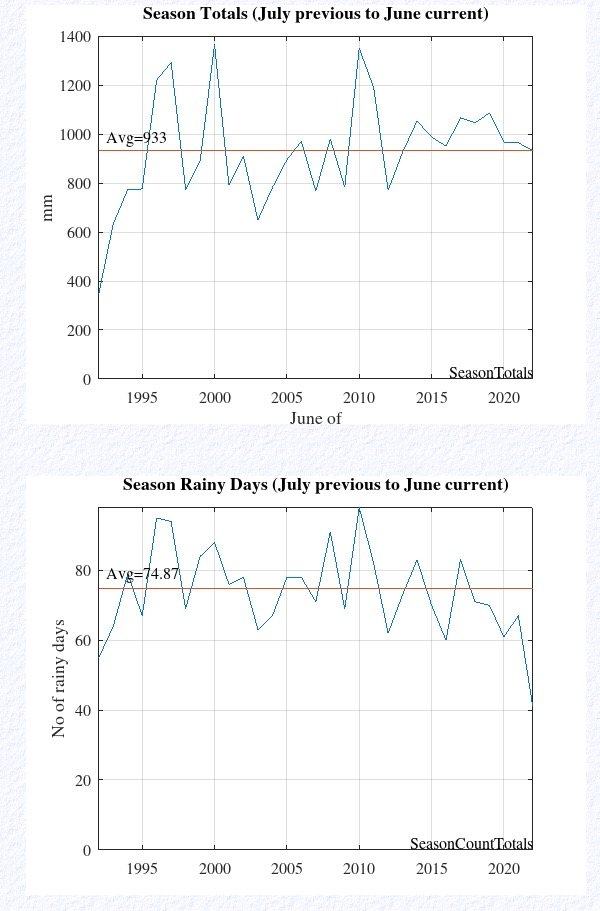
Annual Rainfall Graph of The Past 5 Years in South Africa 2018 to 2022

Annual Rainfall Graph of The Past 5 Years in South Africa 2018 to 2022 The southwest monsoon, which is also called the ‘long rains’, lasts from June to September and brings about 75% of India’s annual rainfall. The remaining 25% is brought by the northeast monsoon, which is also called the ‘short rains’ and lasts from October to December.

The first graphs show the annual rainfall in millimeters from 1995 to 2020. The second map depicts the number of rainy days in each year between 1995 and 2020.

Annual rainfall graphs 1995 -2020: South Africa

Annual rainfall graphs of the past five years in South Africa


Credit

https://ajiraforum.com/south-africa/annual-rainfall-graphs-of-the-past-five-years-in-south-africa/

ECONOMIC GEOGRAPHY OF SOUTH AFRICA GRADE 12 NOTES – GEOGRAPHY STUDY GUIDES

On this page you will find ECONOMIC GEOGRAPHY OF SOUTH AFRICA GRADE 12 NOTES – GEOGRAPHY STUDY GUIDES This chapter covers South Africa’s economic activities,This chapter covers South Africa’s economic activities,as well as food security.
1Key concepts

ConceptDefinition
Balance of paymentA country’s financial statement showing its transactions with the rest of the world
Balance of tradeThe value of exports minus the value of imports
Bridge industriesIndustries that are located between the source of raw materials and the customer, e.g. oil refineries
CentralisationMovement of industries into core areas
DecentralisationMovement of activities away from over-centralised areas
Economic activitiesActivities that people practise to meet their needs or earn a living
ExportsGoods and services that are sold to foreign countries
Favourable trade balanceOccurs when the value of exports is greater than the value of imports
Food insecurityWhen not all the people have enough food to meet their needs for a healthy and productive life
Food securityWhen all the people have enough food to meet their needs for a healthy and productive life
Footloose industriesIndustries that can be located in any place without being affected by factors such as resources or transport, e.g. diamond processing and computer chip manufacturing
Foreign exchangeThe money paid to South Africa by other countries, e.g. dollars and pounds, in exchange for goods and services
Formal sectorRegistered businesses that are licensed to sell goods or provide services
GlobalisationThe way in which the economic, social, political and cultural activities of countries across the world are interconnected (working together)
Gross Domestic Product (GDP)The total value of goods and services produced within the borders of the country in a year
Gross National Product (GNP)The total value of goods and services produced by the permanent citizens of a country in one year (note that permanent citizens may work out of the country)
HawkerAn informal street trader
ImportsGoods and services that are bought from foreign countries
Industrial Development Zone(IDZ)Industrial estates or areas aimed at economic growth and new investment; used by developing countries to attract investment, create jobs and boost exports
Informal sectorActivities by small, unregistered businesses that sell goods or provide services without being licensed, e.g. petty trade, casual employment, spaza shops and street hawkers or traders
InfrastructureTransport network (roads, railways) and services (electricity, telecommunication, water and sewerage) that are in place
Primary activitiesActivities that involve taking natural resources from the earth, e.g. farming (livestock, crops), forestry, mining, fishing
Quaternary activitiesActivities that deal with information and research
Secondary activitiesActivities that involve the processing of raw materials and manufacturing of goods, e.g. factories and industries
Semi-skilled workerA worker who does routine tasks (simple tasks that are done on a regular basis); someone who is not skilled or trained to do specialised work (difficult tasks that need special training)
Skilled workerA worker who has a specific set of skills or specialised knowledge that has usually been obtained through some kind of formal training
Spatial Development Initiatives (SDI)Programme aimed at improving infrastructure and attracting business investments in rural areas that were neglected and underdeveloped
Tertiary activitiesActivities that deal with the supply of services, e.g. banking, trade and transport
TradeThe flow of goods and services from producers to consumers across the world
Trading blocA group of countries that have common markets or trade agreements
Unskilled workerA worker who performs simple duties that do not require any specific skills, training or previous experience; usually involves hard physical labour

If you know and understand all the definitions of economic geography, you will be able to answer most of the questions in the economic geography section of the final exam. Use mobile notes to help you memorise these key concepts. Instructions for making them are on page x in this guide.
In an exam you may be asked to test your understanding of terms by matching the key concept with the definitions provided. An example of this kind of question is provided in activity 4.1 on page 80. Practise this by completing the activity.

Take care not to confuse the terms gross domestic product (GDP) and gross national product (GNP) with one another. GDP refers to the total value of goods and services produced in one year within the borders of South Africa.
2
GNP refers to the total value of goods and services produced in one year by the permanent citizens of a country (even if they live and work in another country).

Activity 4.1
Choose a term from Column B that matches a statement in Column A. Write only the letter (A to F) next to the question number (1 to 5), for example 6 – G.

Column A  Column B 
  1. Obtaining raw materials from the earth
  2. Total value of goods and services produced by the permanent citizens of a country in one year
  3. Provision of services
  4. Processing of raw materials
  5. Value of all goods and services produced in a country in one year
  1. Gross domestic product
  2. Tertiary activity
  3. Gross national product
  4. Primary activities
  5. Economic activities
  6. Secondary activities
    [10]


Answers to activity 4.1

  1. D (Primary activities) (2)
  2. C (Gross National Product) (2)
  3. B (Tertiary activities) (2)
  4. F (Secondary activities) (2)
  5. A (Gross Domestic Product) (2)
    [10]

In the next section we focus on primary, secondary and tertiary economic activities. These economic activities are important to the economy and the country’s development, and are interdependent. Primary activities stimulate secondary activities which, in turn, stimulate job creation in the tertiary sector.

4.1 Primary economic activities

Primary activities involve extracting (removing) raw materials from the earth, for example farming, fishing, forestry and mining. We focus on farming and mining as they are the two primary activities that contribute the most to South Africa’s economy.
4.1.1 Farming in South Africa
In this section we focus on factors that favour and hinder farming. There are different types of farming: crop farming, stock farming and mixed farming (both crop and stock). The word ‘agriculture’ is used to refer to all types of farming. Firstly, pay attention to Table 4.1, where the differences between a large scale farmer and small scale farmer are explained.
Table 4.1 The differences between a large scale farmer and a small scale farmer

Small scale farmer  Large scale farmer 
  • Farmers with limited resources
  • Hobby farmers, retirement farmers, lifestyle farmers
  • Those who sell directly to consumers — through farmers markets, CSAs and other marketing channels which are not part of the traditional, wholesale distribution chain
  • Those who grow vegetables or fruits while also raising livestock
The modern trend to enlarge farms to reach optimal size as a business enterprise rather than as a unit size suited to single family management.

Factors favouring (promoting) farming
These factors make farming more productive and profitable:

  • There is a high demand (market) for farming products so farmers sell their crops more easily. Farmers’ profits rise when they can sell for a higher price to overseas markets with a demand for their crops or stock.
  • The fertile floodplains of rivers allow farmers to produce more crops or grazing land (pastures) in these areas. This supports farming and increases profits.
  • The eastern half of the country gets more than 500 mm of rain a year. This makes it possible to produce more crops and ensures greener pastures for stock farming, therefore increasing profits.
  • The relatively high summer temperatures help crops to grow and increase crop production. It also ensures greener pastures for stock farming.
  • Availability of labour (workers)

Use the following word mnemonic to help you remember the factors that favour farming in South Africa:
F = Fertility → Farmer
D = Demand → Daniel
R = Rain → Reaps
T = Temperatures → Tomatoes

Factors hindering (restrict/limit) farming
These factors make farming difficult and therefore less productive and less profitable:

  • Rainfall is low and unreliable on the plateau, which limits crop production and decreases available pastures for stock farming.
  • Soil erosion due to incorrect farming methods increases farming costs and decreases profits.
  • Natural hazards such as droughts, floods and hail storms damage crops and stock and decrease production and profits.
  • HIV and AIDS have a negative impact on the health and productivity of farm workers.
  • Price fluctuations (when prices go up and down) make it difficult for farmers to stay in business and make a profit.
  • Pests which affect crops and stock are costly to control and cause a decrease in production and profits.

Use the following word mnemonic to help you remember the factors that hinder farming in South Africa:
H = Hazards → Hungry
P = Price → People
S = Soil →Seek
H = Health → Healthy
R = Rainfall v Round
P = Pests v Potatoes

Importance of farming in South Africa (role of farming in SA)
Farming benefits the economy and people in these ways:

Farming provides jobs to people and so decreases unemployment.

  • Farming provides food to the country so less food needs to be imported. Food that is supplied locally is less expensive than imported food.
  • Farming equipment is expensive because much of it is imported, but South Africa has reduced these costs by manufacturing some equipment locally, for example irrigation systems.
  • Farming involves moving crops to the markets, which in turn leads to improving the country’s infrastructure (roads, railways and communication systems).
  • South African farming products are exported to other countries earning us foreign exchange. This improves the country’s economy.

In an exam you may be asked to state the factors that favour or hinder farming. You may also be asked to explain the importance of farming to South Africa.

Food security and insecurity
Food security is when all the people have enough food to meet their needs for a healthy and productive life. Some of the factors (reasons) why people have enough food (food security) are:

  • Commercial farms are able to produce enough food due to favourable climatic factors.
  • People can afford to buy the food. In other words, farmers have a market.
  • The need to import food from other countries at high costs is reduced because food is grown locally.
  • Genetically modified crops are more resistant to diseases, pests and viruses so more crops can be produced.

Food insecurity is when not all the people have enough food to meet their needs for a healthy and productive life. Food insecurity affects poor people, many of whom live in rural areas. These people try to survive by growing their own food. This is called subsistence farming. This type of farming provides only enough food for the farmer’s own family.
Some of the factors (reasons) why people do not have enough food (food insecurity) are:

  • There is a lack of fertile (arable) land on which to grow food.
  • Climate change increases natural disasters (droughts and floods) that damage crops.
  • When you are poor it is more difficult to buy the things you need to farm, such as enough land, equipment, seeds and irrigation systems.
  • Subsistence farmers are often uneducated about ways to improve crop production so land is often overused for crops or overgrazed by cattle.

Some of the measures (ways) to prevent food insecurity are:

  • Prevent soil erosion by practising better farming methods, for example crop rotation or rotational grazing (putting cattle in different fields or camps).
  • Use efficient ways of storing food, especially when more crops are produced in high-rainfall seasons.
  • Improve ways of storing and using water supplies to reduce water wastage.

In an exam you may be asked to define the terms food security and food insecurity and state the factors that lead to food security and food insecurity. Learn this information to answer this question.
Apply what you have learnt about food security by completing activity 4.2 on page 83.

Activity 4.2
The cartoon in Figure 4.1.1 below shows how environmental problems can affect food security.
3

  1. How has the use of fossil fuels and fertilisers caused climate change? (3 × 2 = 6)
  2. How does climate change link to rising sea levels? (2 × 2 = 4)
  3. How would rising sea levels affect food security? (1 × 2 = 2)
  4. Explain your answer in question 3. (1 × 2 = 2)
  5. Name another factor in the cartoon that would affect food security. (1 × 2 = 2)
    [16]
Answers to activity 4.2

  1. Fossil fuels and fertilisers release greenhouse gases like carbon dioxide and methane into the air.These gases trap heat in the atmosphere.This increases the Earth’s temperature, which leads to changes in Earth’s climate and weather. (6)
  2. The increase in the Earth’s temperature causes the polar icecaps to melt.This leads to increasing sea levels. (4)
  3. It would decrease food security/cause food insecurity. (2)
  4. Land would be flooded, so there is less land to use for agriculture or food production. (2)
  5. Overfishing (2)
    [16] 

4.1.2 Mining in South Africa
In this section we focus on factors favouring and hindering mining. There are different types of mining: open cast and shaft mining.
Factors favouring (promoting) mining
These factors make mining more productive and profitable:

  • South Africa has many different minerals which can be mined and used in factories or exported so the country earns foreign exchange.
  • South African mines benefit from having lots of local unskilled labour. This results in lower labour costs and therefore higher profits.
  • Foreign skilled miners come to work in South African mines and the mines benefit from their knowledge and skills.
  • Many countries invested money in our mines, which assisted with further development of the mines and a lowering of costs.
  • A well-developed infrastructure (roads and railway lines, water and electricity) assists mines to do business.

Use the following word mnemonic to help you remember the factors that favour mining in South Africa:
M = Minerals →Miners
L = Labour → Love
F = Foreign → Finding
I = Investment → Important
I = Infrastructure → Irons

Factors hindering (restrict/limit) mining
These factors make mining less productive and less profitable:

  • The high temperatures in some underground mines create difficult working conditions and this decreases productivity.
  • Large distances between the mines and the harbours or towns increase the cost of transporting the minerals to the markets.
  • There are high costs involved in training and housing mine workers.
  • Mine worker strikes decrease productivity and profits.
  • Water shortages and underground flooding of mines are a serious problem. It is expensive to fix the problem and this decreases profits.
  • Ensuring safety on the mines is costly, especially when tunnel roofs collapse.

Use the following word mnemonic to help you remember the factors that hinder mining in South Africa:
S = Safety → Sometimes
W = Water → Workers
C = Costs → Can
D = Distances → Dig
T = Temperatures → Too
S = Strikes → Slowly

The importance of mining to the South African economy (role of mining in SA)
Mining benefits the economy and people in these ways:

  • The mining sector provides many jobs, which decreases unemployment.
  • Mines supply raw materials to secondary activities such as factories and industries. This in turn stimulates industrial development.
  • When mines start up, new towns and transport networks develop around the mines.
  • Mining stimulates other sectors of the economy, such as farming, building and trade, to meet the needs of the growing number of people who live and work in mining towns.
  • Harbours, like those at Saldanha Bay (Western Cape) and Richards Bay (KwaZulu-Natal), expand (grow bigger) to cope with increased mineral exports to other countries. This creates more jobs and also helps other sectors of the economy to grow.
  • The export of mining products increases the profits of the mines because they earn foreign exchange.

Impact of mining on the environment
The processes involved in removing minerals from the earth create waste products and have a negative effect on the environment. Some of the negative effects of mining are:

  • The natural vegetation is removed to clear the ground for mining activities. This leads to an increase in soil erosion in these areas.
  • When vegetation is removed it destroys natural habitats and damages ecosystems, which can lead to the extinction of plants and animals in the area.
  • The land is destroyed when mine dumps and slimes dams are built to store waste.
  • Chemicals that leach (wash off) from the mine dumps when it rains cause water and land pollution.
  • Sinkholes are a danger in areas where mining takes place.
  • Coal is a major mining product in South Africa. Power stations burn coal to make electricity. The carbon dioxide that is released during this process contributes to global warming and climate change.

In an exam you may be asked to state the factors that favour or hinder mining. You may also be asked to explain the importance of mining to South Africa and the impact of mining on the environment.

4.2 Secondary economic activities

Secondary activities involve the processing of raw materials and manufacturing of goods. We use the word ‘industries’ for secondary activities. For example, sugar cane is turned into sugar at an industry called a sugar refinery; trees are turned into wood shavings and then paper at an industry called a sawmill; cowhides are turned into leather to make handbags and shoes at an industry called a tannery.
Secondary activities can be divided into heavy and light industries. Learn the information in Table 4.2 below to understand the differences between these two types of industries.

In an exam you may be asked to identify a heavy or light industry from a picture or on a topographic map. You may also be asked to state the characteristics of heavy or light industries. Learn the information in Table 4.2 to help you answer these questions.

Light industry Heavy industry
ExampleJewellery making, clothes factory, computer manufacturer, food and beveragesPower stations, iron and steel factory, motor vehicle factory, paper mill
LocationIn a city in the CBD; in the zone of decay; in an industrial estateOn the outskirts of a city; in rural areas near the raw material source
Raw materialSmall, may be partially processedLarge, bulk, not processed
Land requirementsNo specific needs, may be in a multistorey buildingNeeds a large area of flat land, singlestorey buildings
InfrastructureUses existing road network and local power supplyNeeds access to major roads or railways, water supply and power supply
Environmental impactHas little to no impact on the surrounding areaUtilises a large amount of water and causes air and noise pollution

Table 4.2: The differences between heavy and light industries

In the next sections we focus on factors that affect the location of industries and the factors that favour or hinder the development of secondary economic activity. We look at the development of the four main industrial regions in South Africa:

  • Pretoria–Witwatersrand–Vereeniging complex (PWV) (Gauteng)
  • Durban–Pinetown (Ethekwini)
  • Port Elizabeth–Uitenhage (Nelson Mandela Bay)
  • Southwestern Cape

4.2.1 Industrial development in South Africa
The availability of raw materials in South Africa has led to the development of large industries (factories) that process the raw materials or use semifinished products to manufacture final products.

Factors affecting the location of an industry
When deciding where to site an industry, the following two factors are the most important:

  • Raw materials: How close are the natural resources or raw materials the industry needs to make its product?
  • Markets: How close is the industry to the market where it sells its product? In other words, how close are the consumers (the people that buy the product)?

An industry will locate itself close to either the raw materials or the market. If the raw material is large and difficult to transport, the industry will locate close to the raw material. This industry would be called raw-material orientated.
If the raw material is smaller and easier to transport, the industry will locate close to the market. The industry would be called market orientated.
The following factors can also affect the location of an industry:

  • Transport: Access to major transport routes between the industry, the raw material source and the market.
  • Energy: A reliable supply of electricity is needed to be able to process raw materials or manufacture goods.
  • Labour: A skilled and unskilled work force must live in the area where the industry is located.
  • Link industries: These are industries that you sell your product to. How close the industry is to its link industries will affect its transport costs.
  • Government policies: Government may offer subsidies or tax incentives to industries that locate in certain areas, which may help to decrease costs.

Factors favouring (promoting) industrial development in South Africa
These factors make industries more productive and more profitable:

  • South Africa has a wide range of industries because there is a wide range of raw materials to support production.
  • A well-developed infrastructure (roads and railway lines, water and electricity) assists industries to do business.
  • The availability of cheap, level (flat) land makes it cheaper to develop industries in South Africa.
  • The availability of a large skilled and unskilled labour force in the areas where industries are located decreases the costs of training and worker accommodation and transport.

Factors hindering (restricting/limiting) industrial development in South Africa
These factors make industries less productive and less profitable:

  • The large distances between South Africa and its foreign markets increase transport costs and make it more difficult to compete with industries in those countries.
  • There is a shortage of skilled labour in South Africa. This increases labour costs because industries have to attract foreign skilled labour and pay high salaries to retain skilled workers.
  • Labour strikes decrease the productivity of industries in South Africa and this increases costs and limits further industrial development.
  • Water and electricity shortages and price increases limit further industrial development.

Importance of industrial development in South Africa

  • When we export processed goods we earn more foreign exchange than if we exported the raw material.
  • Industries provide more and higher paid employment to the population, this in turn leads to an increase in the standard of living of the population. This increases their buying power which further stimulates industrial development. It also increases the money made from rates and taxes, so the government has more money to spend on improving infrastructure and other facilities.
  • The employment of people in industries leads to the development of more skills and experience; this in turn leads to the development of new technology.
  • Industrial growth stimulates the development of all other services and facilities.

Main industrial regions in South Africa
Figure 4.2.1A on page 88 shows the four main industrial regions in SouthFigure 4.2.1A on page 88 shows the four main industrial regions in SouthAfrica.
4Activity 4.3
Choose a term from the box that matches the descriptions that follow. heavy industries; footloose industries; market-orientated industries; centralisation; decentralisation; Durban–Pinetown; Gauteng/Pretoria–Witwatersrand–Vereeniging

  1. Over-concentration of industries in a few core areas
  2. The largest industrial core area in South Africa
  3. Industries that can locate anywhere due to improved technology
  4. Industries that must be close to the consumers
  5. These industries are associated with high noise and air pollution
    (5 × 2 = 10)
Answers to activity 4.3

  1. Centralisation (2)
  2. Gauteng/Pretoria–Witwatersrand–Vereeniging (2)
  3. Footloose industries (2)
  4. Market-orientated industries (2)
  5.  Heavy industries (2)
    [10] 

Strategies for industrial development
As part of the development plan for underdeveloped regions, the South African Government (Department of Trade and industry in partnership with the Department of Transport) introduced TWO development plans:

  • Spatial Development Initiative (SDI)
  • Industrial Development Zones (IDZ)
Spatial Development Initiative Industrial Development Zones 
  • Is a development corridor, that is, development along a major transport route, for example, a major highway.
  • Connects major industrial or mining areas.
  • Government improves infrastructure all along the development corridor to stimulate development and access to areas along the route.
  • Small towns and activities such as farming and tourism are developed along the route.
  • Usually close to harbours or airports
  • Include already existing factories in a town
  • Government plans upgrade of infrastructure and services to attract further development
  • IDZs are linked to each other or other major cities by SDIs

5


4.3 Tertiary economic activities

Tertiary economic activities involve the selling of goods and provision of services. For example, the selling of goods would include any supermarket, car dealer or clothes shop. Examples of services are hairdressers, doctors, internet cafes, and repair and maintenance companies.
Tertiary economic activities are divided into the formal sector and informal sector. In this section we will focus on the informal sector in South Africa, its characteristics and the reasons for its development. We will also look at the challenges facing this sector and how the informal sector can be improved.
4.3.1 The informal sector in South Africa
Examples of people who work in the informal sector are hawkers, parking guards and casual labourers (painters, tilers, gardeners, cleaning staff).

  • If not registered, then they don’t pay income tax.

Characteristics are the things that members of a group have in common.

Characteristics of the informal sector
The informal sector has the following characteristics:

  • Workers are self-employed.
  • Women and children are mainly involved in this sector.
  • It is associated with casual labour.
  • It employs unskilled or semi-skilled workers.

Importance of the informal sector
The informal sector benefits the economy and people in the following ways:

  • It provides an income to many people and decreases unemployment.
  • Informal traders are more accessible to working class consumers.
  • Consumers can buy goods in smaller quantities and at a lower price.
  • It provides opportunities for people to grow and apply their entrepreneurial skills.

Reasons for the development of the informal sector

  • Large scale job losses in the formal sector increase the number of people who make work for themselves in the informal sector.
  • Greater mechanisation (use of machinery) on farms and in industry results in more workers being unemployed and needing to make work for themselves in the informal sector.
  • People who lack formal qualifications are less likely to be employed in the formal sector, causing them to make work for themselves in the informal sector.
  • Immigrants who are not able to find legal employment in the formal sector turn to the informal sector to make an income.

Do not confuse the terms informal sector and informal settlement with one another:

  • Informal sector is the economic term for people not employed in the formal sector.
  • Informal settlement refers to ‘squatter’ areas, where people live.

Problems or challenges facing the informal sector
These factors make informal trading less productive and less profitable:

  • Traders are frequently harassed by local authorities.
  • Traders do not have access to proper trading facilities.
  • Traders and their goods are exposed to the weather.
  • Banks do not like to give loans to informal traders.
  • The sector is unpredictable and the income unreliable.

Measures to improve the informal sector
These are some of the things that can be done to help informal traders:

  • Local authorities can provide specific areas for informal trading.
  • Local authorities can provide infrastructure, such as hawker stalls.
  • Banks can make access to bank loans easier.
  • Local authorities can provide training to teach people the necessary skills to develop their businesses.

4.4 Quaternary economic activities

Quaternary economic activities deal with communication, technology and research. Examples of quaternary activities are new product development, medical research, customer surveys and market research, call centres, facebook, Google and other information age businesses.

Activity 4.4
Choose a description from Column B that matches a term in Column A.
Write only the letter (A-L) next to the question number (1-10), e.g. 11.L

Column A Column B 
  1. Trade
  2. Import
  3. Decentralisation
  4. Trading blocs
  5. Industrial Development Zones
  6. Informal sector
  7. MEDCs
  8. Multinational corporation
  9. LEDCs
  10. Globalisation
  1. Groups of countries that have common markets or trade agreements
  2. Industrial estates aimed at economic growth and new investment
  3. Buying and selling of goods and services
  4. Movement of activities away from over- centralised areas
  5. Commodity brought into a country
  6. Movement of industries into core areas
  7. The way in which activities of countries across the world are interconnected
  8. Countries that are less developed in the world
  9. The trade involving businesses not registered with the government and occupying premises illegally
  10. Company that has factories, offices or shops in different countries
  11. Countries that are more developed than others
  12. Value added to raw materials
    (10 × 2 = 20)


Answers to activity 4.4

  1. C
  2. E
  3. D
  4. A
  5. B
  6. I
  7. K
  8. J
  9. H
  10. G(10 × 2 = 20)
    [20] 

The economic geography section will appear in Section B of the theory paper in Questions 3 and 4. Note that you will be asked to answer questions based on information contained in texts, graphs and tables. The answers can be found in the information given, so read the information carefully to find the answer.

The next section will help you to understand graphs and tables in economic geography. Learn this information to prepare for this section of the exam.

4.5 Understanding graphs and tables

In the exam, economic concepts are often tested using tables or graphs. It is important that you understand how to get information from a graph or table to answer such questions.
When a question in the exam refers to a table or graph, it is important that you study the table or graph before you read the questions. This is similar to reading a comprehension text before answering the questions. You will need to UNDERSTAND the table or graph in order to answer the questions.
4.5.1 Understanding graphs
In this section we look at two types of graphs: bar graphs and pie charts.
Follow these steps when you read a graph:

Steps to reading a bar graph

Step 1: The heading of a graph will tell you what the graph shows and what is being compared. It will tell you how the two or more factors shown on the graph are connected. In other words, it will tell you what the relationship is between the factors shown.
Step 2: Look at the labels on the different axes to see what factors are being compared on the graph. These should be the same factors mentioned in the heading.
Step 3: Look at the units of measurement on the different axes, for example percentage and time, or amount of money compared across economic sectors.
Step 4: Look at what is being compared and how the factors affect one another. In other words, try and understand the relationship between the different factors. For example, as the one factor increases so the other factor may decrease, or as one factor increases so the other factor may stay the same.
Step 5: Look for anything that is unusual on the graph. See if there is anything that does not fit the relationship between the factors. In other words, if the relationship shown is that one factor increases and all the other factors except for one factor decrease, we will have something to say about the exception. For example, on a graph it could be shown that the contribution of primary economic activities increased production over time, except for mining whose production decreased.
Step 6: Now read the questions set. Circle the question word to understand what is asked. Set about answering the questions. You will find the answers by reading the information in the graph.

Let us apply these steps by looking at specific examples in Figure 4.5.1A (right) and 4.5.1.B on page 95.
Here are some helpful guidelines that show you to how to read and understand graphs.

Example of a bar graph
Carefully study the bar graph in Figure 4.5.1A below which shows the contribution of different economic sectors to South Africa’s GDP (Gross Domestic Product).
6

Follow these steps to read the graph

  1. The heading – the graph shows GDP (factor 1) in relation to different industries (factor 2), and time (factor 3).
  2. The axes – the vertical axis shows factor 1 (the GDP). The horizontal axis shows factor 2 (different industries) and factor 3 (time).
  3. Units of measurement – on the vertical axis factor 1 (GDP) is shown as a percentage of total GDP. The horizontal axis lists factor 2 (industries) by name and factor 3 (time) in years.
  4. Look at whether the GDP trend goes up or down from 1995 to 2002 in each industry. For example, manufacturing goes down from 1995 to 2002. The amount it decreases is calculated by subtracting the lower amount from the higher amount: 21,2% – 20,2% = 1%.
  5. Look at what is unusual – the contribution of finance and transport is much higher in 2002.
  6. Now read the questions in activity 4.5 on page 95.

Activity 4.5
The following questions refer to the graph in Figure 4.5.1A on page 94.

  1. What do the letters GDP stand for? (1 × 2 = 2)
  2. Which industry contributes the most to the GDP? (1 × 2 = 2)
  3. To what economic activity does mining and agriculture belong to? (1 × 2 = 2)
  4. Mining and agriculture contribute less to the GDP than manufacturing, which is a secondary activity. Explain the reason for this observation. (2 × 2 = 4)
  5. The contribution of transport to the GDP increased from 1995 to 2002. Give a possible reason for this. (1 × 2 = 2)
    [12]
Answers to activity 4.5

  1. Gross domestic product. (2)
  2. Manufacturing (2)
  3. Primary(2)
  4. Mining and agriculture produce raw materials which are sold for less money than processed goods sold by manufacturing industries. (2)
  5. Increased government spending on infrastructure
    development / Increased use of public transport generating more revenue for the state. More purchases and use of private vehicles. (2)
    [12]

Example of a pie chart
Carefully study the pie chart or pie graph below (Figure 4.5.1B) illustratingCarefully study the pie chart or pie graph below (Figure 4.5.1B) illustratingthe contribution of different provinces to the national GDP.
7

Follow the steps to read the graph

  1. The heading – the graph shows GDP (factor 1) in relation to different provinces (factor 2).
  2. The sectors (pieces or slices) of the pie graph show factor 1 – the contribution of each province to the GDP.
  3. Units of measurement – the sectors of the pie graph show factor 1 (GDP) in percentage.
  4. The relationship between the different factors – because a pie chart compares parts of a whole, you need to note the different sizes of the sectors. This tells you how much each province contributes to the total GDP.
  5. Look for anything that is unusual – for example, which is the largest piece of the pie (Gauteng) and which is the smallest piece of the pie (Northern Cape).
  6. Now read the questions in activity 4.6.

Activity 4.6
The following questions refer to Figure 4.5.1B on page 95.

  1. Rank the top three provinces in terms of their contribution to the GDP from largest to smallest contribution. (1 × 2 = 2)
  2. Give two reasons why the province ranked first in your answer in question 1 holds that position. (2 × 2 = 4)
  3. The following questions refer to the province which contributes the least to the national GDP.
    1. Name the province which contributes the least to the national GDP. (1 × 2 = 2)
    2. Name the ocean current that flows alongside this province. (1 × 2 = 2)
    3. What impact does this ocean current have on the rainfall in this province? (1 × 2 = 2)
    4. Explain how your answer in question c) affects the province’s contribution to the GDP. (2 × 2 = 4)
      [16]
Answers to activity 4.6

  1. Gauteng, KwaZulu-Natal, Western Cape (2)
  2. Gauteng has the most industries/many tertiary activities/ a large population which creates large market/many companies have main branches or headquarters there. (any 2) (4)
    1. Northern Cape (2)
    2. Benguela (2)
    3. Decreases rainfal (2)
    4. Less rainfall lowers productivity on farms so less produce to sell 33/Less rainfall causes poor water supply which limits industrial development.(4)
      [16] 

4.5.2 Understanding tables
In this section we look at how to read and understand the information in a table. Follow these steps when you read a table:

Steps to read a table
Step 1: Look at the heading for the table to see what is shown
Step 2: Look at the labels in the different columns
Step 3: Look at the relationship between what is compared
Step 4: Now read the questions

Carefully study Table 4.4 below and then follow the steps to read the table.

South Africa’s mineral production and relative ranking in the world   
Mineral SA’s percentage of world production World position 
Asbestos 6 4
Chromium 76 1
Coal 11 4
Diamonds 24 2
Iron 7 5
Manganese 78 1
Platinum group791

Table 4.4

Steps

  1. The heading – the table shows which minerals (factor 1) South Africa produces, how much we produce (factor 2), and where we are ranked in the world of production (factor 3).
  2. The first column lists factor 1 (minerals), the second column shows factor 2 (percentage of world production), and the third column shows factor 3 (the country’s ranking in world production).
  3. What mineral do we produce most of (Platinum) and where are we ranked in the world for manganese (first)? For how many minerals do we rank in first or second place? (three – chromium, manganese and platinum group)
  4.  Now read the questions in activity 4.7.


Activity 4.7
The following questions refer to Table 4.4 on page 97.

  1. What economic activity does the extraction of minerals fall into? (1 × 2 = 2)
  2. South Africa is a major mineral producer in the world. State three factors that favour mining in South Africa. (3 × 2 = 6)
  3. State the two reasons why mining is important to South Africa. (2 × 2 = 4)
  4. What major mineral mined in South Africa is not listed in table 4.4? (1 × 2 = 2)
  5. The price for platinum increased dramatically, but has now decreased again. What problem does this price fluctuation cause for the platinum mines? (2 × 2 = 4)
    [18] 


Answers to activity 4.7

  1. Primary(2)
    1. The country has many different minerals /It has lots of
      local unskilled labour /It has access to many foreign
      skilled miners/Many countries invested money in our
      mines /The country has a well-developed infrastructure
      (roads and railway lines, water and electricity). (any 3) (6)
    2. Mines provide employment to many South Africans /
      Mines supply raw materials to factories /When mines
      start up, new towns and transport networks develop /
      Other economic activities, such as farming and trade,
      increase to meet the needs of the new mining towns /
      Harbours grow bigger /Export of mining products
      increases the profits of the mines. (any 2) (4)
  2. Gold(2)
  3. It will cause productivity to increase and decrease.
    As productivity decreases, costs increase and profits fall.
    It will cause the mine’s profits to increase and decrease.
    As profits decrease, mine workers may lose their jobs.
    (any 2 facts; or any other logical answer) (4)
    [18] 

MAPWORK GRADE 12 NOTES – GEOGRAPHY STUDY GUIDES

On this Page you will find MAPWORK GRADE 12 NOTES – GEOGRAPHY STUDY GUIDES

5.1 Introduction

Mapwork is a practical section of Geography where you are required to apply all the different skills, techniques and the theory that you have learnt. It consists of the following sections:

  • Mapwork calculations
  • Reading, interpretation and analysis of theory
  • Geographical Information Systems (GIS)

Maps tell you a story about a place. Look at all the information given on the map to interpret it:

  • What is the name on the top of the map?
  • Look at the latitude and longitude. Get an idea where the map is. For example, 20°S would indicate it is in Limpopo.
  • Look at all the information provided (magnetic declination information, scale of the map, contour interval, map projection used) in the ‘margins’ of the map.
  • Look at the bottom of the map, for the diagram showing the map sheet reference. It may show additional information such as oceans or borders.
  • Notice where roads or railways go off the map. The town they lead to may give you clues.
  • Make use of the key/reference list to identify features. Remember, the first word in the reference list refers to the first picture and not both pictures.

Look for the following aspects on the map:

  • Is this a high or low rainfall area? Is the rainfall seasonal?
  • What kinds of rivers are visible and how many are there?
  • Identify the urban and rural areas.
  • Identify the different land uses in the mapped area, for example, agricultural/industrial/built-up areas.
  • What factors may have affected the location of various land uses?
    For example, industry alongside a perennial river.
  • Identify the type of farming – is it commercial or subsistence?
  • Look at the relief – is it flat or hilly, are the slopes steep or gentle?
  • Look at the contour lines to determine this.

Look at the information given in the orthophoto:

  • Is the orthophoto labelled? If not, check the numbers or letters in the question, for example: ‘Identify land use labelled G on orthophoto’ – G will only be on one of the photos.
  • Is a rectangle drawn around the area covered by the orthophoto? If not, orientate the photo to the map.
  • Read the instructions carefully as you may need to use both the map and the photograph to answer a question.
  • Make use of all the information on the orthophoto, for example, road names, heights, etc.

Remember your calculator, protractor, 30 cm ruler and a pencil.

A topographic map is a way to show mountains, valleys and aspects of a landscape by means of contour lines and intervals.
An orthophoto map is a corrected aerial photograph. Human-made and other features that are not clear are labelled on the orthophoto.

5.2 Some basic mapwork concepts

  1. Direction is expressed using the points on a compass – North, South, East and West, and the points between them. These are known as the 16 cardinal points.
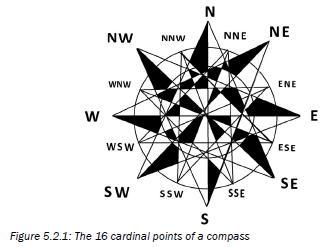
    1
  2. The three main lines of latitude that run across the surface of the Earth are the equator, the Tropic of Cancer and the Tropic of Capricorn. The equator is the longest line of latitude (where the Earth is widest in an East–West direction). It is located at 0 degrees latitude. The equator divides the planet into the northern and southern hemispheres. The Tropic of Cancer is located at 231/3° north of the equator. The Tropic of Capricorn lies at 231/3°  south of the equator. The Tropic of Capricorn runs through northern South Africa.
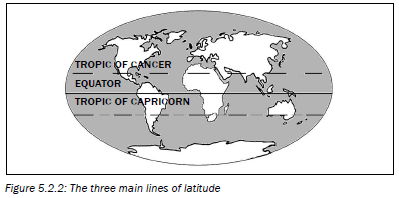
    2
  3. Reading a map is as easy as reading a book but, instead of using the alphabet, you have to know the conventional signs used in maps. These help you to see the landscape (relief, drainage, vegetation and huhuman-made features). Conventional signs are used to show particular features. They may be letters of the alphabet or symbols. Many symbols look like the features they represent.

Use the following mnemonic to remember the order of the compass points:
N – Never North
E – Eat East
S – Silk South
W – Worms West

The following table lists some of the symbols you may find on a map:

Symbol What it looks like 
WeirRepresented as a black line across a river, like a dam wall. It is a barrier or mini dam wall which slows down the flow of water.
Furrow and canalRepresented as a solid blue line and labelled as furrow or canal. It is used to transport water from source (dam/river) to where it is needed.
AerodromeA small airport
Slimes damRepresented as a solid black line forming a geometric shape, often rectangular. It stores liquid waste from the mining process.
Mine dumpRepresented as solid lines radiating out from a central point. It is a small mountain-like feature, often yellowish in colour. It consists of solid waste from the mining process.
Rifle range/ shooting rangeThese are enclosed by a solid black line. This is a place where people practise shooting.

Table 5.1: Symbols found on maps

Colours are often used to make symbols clearer. There are six colour groups:

Colour What it is used for 
BrownLand or earth features: Contours, eroded areas, prominent rocky outcrops, sandy areas and dunes, secondary roads
BlueWater features: Aqueducts, canals, furrows, coastlines, dams, lakes, marshes, swamps and vleis, pans, rivers, water-towers. National freeways are also shown in dark blue
GreenVegetation features: Cultivated fields, golf courses, nature and game reserve boundaries, state forest boundaries, orchards and vineyards, recreation grounds, woodland/plantations
BlackConstruction features: Roads, tracks, railways, buildings, bridges, cemeteries, communication towers, dam walls, excavations and mine dumps, telephone lines, power lines, wind pumps, wrecks, ruins, trigonometrical station, boundaries
GreyConstruction features: Built-up areas
RedConstruction features: National, arterial and main roads, lighthouses and marine lights. Pink also shows international boundaries

Table 5.2: Colours used on maps
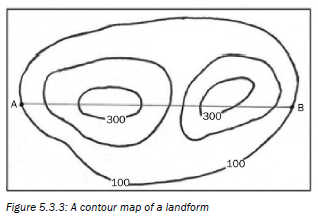
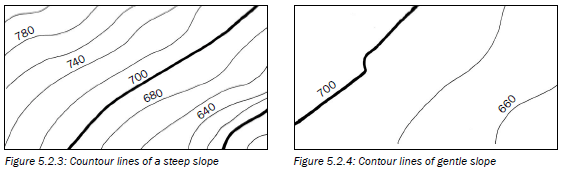
4. Contour lines on a map show the area’s relief (the difference in elevation) or altitude (height in metres of the land above sea level).
The closer together the contour lines are, the steeper the slope is.

The lines are labelled so that you read up the slope.
3

5.3 Mapwork calculations

5.3.1 Introduction to mapwork calculations
In this section you will learn how to do various mapwork calculations on a topographic map and an orthophoto. These calculations will be explained by means of examples.
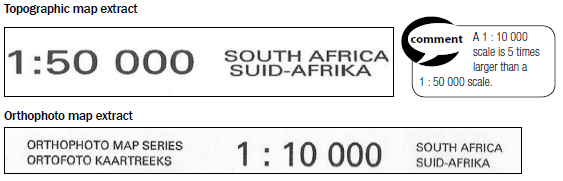
When doing calculations, you will be required to give an answer in kilometres or metres. Always take note of whether the calculation is to be done from a topographic map or an orthophoto, as this will change your scale. The orthophoto scale is larger and provides more detail. Use the conversion table below (Table 5.3).

TOPOGRAPHIC MAP
1 cm : 50 000 cm
1 cm = 500 m
1 cm = 0,5 km
ORTHOPHOTO MAP
1 cm: 10 000 cm
1 cm: 100 m
1 cm: 0,1 km
Scale If the answer must be in kilometres (km) If the answer must be in metres (m) 
Topographic map
1:50 000 →
Multiply by 0,5 on a topographic mapMultiply by 500 on a topographic map
Orthophoto map
1:10 000  →
Multiply by 0,1 on an orthophotoMultiply by 100 on an orthophoto

Table 5.3: Converting a given scale to kilometres or metres
4Calculations in mapwork need a good understanding of difference in height and straight line distance to calculate distance, gradient and area.
Look at the example and revise these calculations.
Learn the conversions given in Table 5.3 below.

Example
On a 1:50 000 map
5
Difference in height (vertical)
Simply subtract the smaller height from the greater height.
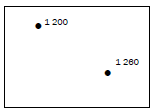
For example, to calculate the difference in height between spot height
1 260 and spot height 1 200:
1 260 − 1 200 = 60 m

Straight line distance (horizontal)
Measure the distance on the map in centimetres and multiply by the scale.
For example, to calculate the distance between spot height 1 200 and spot height 1 260 in kilometres:
Map distance = 2,4 cm
Scale: 1 cm represents 0,5 km
2,4 × 0,5 = 1,2 km

5.3.2 Mapwork calculations: distance, area and gradient
In the exam you may be asked to do distance, area and gradient calculations on a topographic map or an orthophoto. The following are examples of these calculations for both topographic maps and orthophotos. The method and formulae are the same for both kinds of maps, but remember to use the correct conversion calculation on page 103.

Distance
This is the straight line distance from one point to another or the actual distance, e.g distance along a road, railway, hiking trail, etc.
We calculate distance to find out how far one place is from another.

Formula
Actual distance = map distance × scale
AD = MD × S

Method for calculating distance
Follow these steps:
Step 1: Measure the map distance in centimetres.
Step 2: To convert to kilometres, multiply the map distance by 0,5 if on a topographic map, or by 0,1 if on an orthophoto to get km. To convert to metres, multiply the map distance by 500 if on a topographic map or by 100 if on an orthophoto.

Always take note of the unit in which the answer must be given, for example km or m.
If the exam question asks for “the distance along a road” then you would measure the line as if you were walking on it.

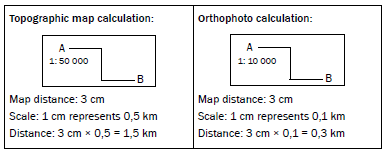
Worked example 1 – straight line distance
Calculate the distance from point A to point B.

Topographic map calculation:
A————————–B
1: 50 000

Map distance: 4,6 cm
Scale: 1 cm represents 0,5 km
Distance: 4,6 cm × 0,5 = 2,3 km

Orthophoto calculation:
A—————————-B
1: 10 000

Map distance: 4,6 cm
Scale: 1 cm represents 0,1 km
Distance: 4,6 cm × 0,1 = 0,46 km

Worked example 2 – actual distance
Calculate the distance along the road from point A to point B.
6
Activity 5.1
Calculate the following distances which are shown on a topographic map.
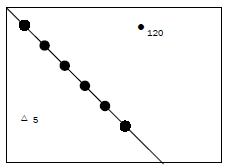
7

  1. Calculate the distance from trig. station 5 to spot height 120 in metres. (3)
  2. Calculate the distance along the powerline in kilometres. (3)
    [6]
Answers to activity 5.1
1. Distance = 4,4 cm3 × 5003 = 2 200 m3 (3)
2. Distance = 6,8 cm 3× 0,53 = 3,4 km3 (3)
[6] 

Activity 5.2
Calculate the following distances which are shown on an orthophoto.
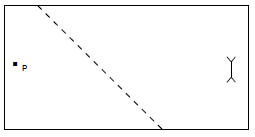
8

  1. Calculate the distance from the post office to the dipping tank in metres. (3)
  2. Calculate the distance along the track in kilometres. (3)
    [6]
Answers to activity 5.2

  1. Distance = 6,6 cm3× 1003 = 660 m3 (3)
  2. Distance = 5,4 cm3 × 0,13 =0,54 km3 (3)
    [6] 

Area
Area is the amount of surface a two-dimensional shape covers. (A twodimensional shape has length and breadth.)
We calculate area to find out how much land is covered (e.g. by a maize field) or how much space we have to build on.

Formula for area
Area = Length × Breadth
A = L × B

Method for calculating area
Follow these steps:
Step 1: Measure the length in cm and convert to km or m.
Step 2: Measure the breadth in cm and convert to km or m.
Step 3: Apply the formula A = L × B.
Step 4: Write the answer in kilometres squared (km²) or metres squared (m²).

Worked example

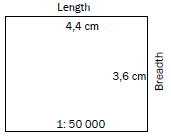
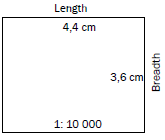
Topographic map calculation: Orthophoto calculation: 
9
Answer in km²
A = L × B
L: 4,4 cm × 0,5 = 2,2 km
B: 3,6 cm × 0,5 = 1,8 km
A: 2,2 × 1,8 = 3,96 km²

Answer in m²
A = L × B
L: 4,4 cm × 500 = 2 200 m
B: 3,6 cm × 500 = 1 800 m
A: 2 200 × 1 800 = 39 600 m²

10
Answer in km2
A = L × B
L: 4,4 cm × 0,1 = 0,44 km
B: 3,6 cm × 0,1 = 0,36 km
A: 0,44 × 0,36 = 0,1584 km²

Answer in m2
A = L × B
L: 4,4 cm × 100 = 440 m
B: 3,6 cm × 100 = 360 m
A: 440 × 360 = 158 400 m²

Activity 5.3

  1. The block below is shown on a topographic map. Calculate the area of the block in metres squared.
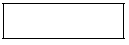
    11(5)
  2. The block below is shown on a topographic map. Calculate the area of the block in kilometres squared.

    12(5)
    [10]

Always write the formula A = L × B. It’s an easy mark.

Answers to activity 5.3

  1. A = L × B
    L: 3,7 cm × 500 = 1 850 m
    B: 1,1 cm × 500 = 550 m
    A: 1 850 × 550 = 1 017 500 m² (5)
  2. A = L × B
    L: 4,4 cm × 0,5 = 2,2 km
    B: 2,3 cm × 0,5 = 1,15 km
    A: 2,2 × 1,15 = 2,53 km² (5)
    [10] 

Activity 5.4

  1. The block below is shown on an orthophoto. Calculate the area of the block in metres squared.
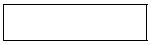
    13(5)
  2. The block below is shown on an orthophoto. Calculate the area of the block in kilometres squared.
    14(5)
    [10]
Answers to activity 5.4

  1. A = L × B
    L: 4,4 cm × 100 = 440 m
    B: 1,1 cm × 100 = 110 m
    A: 440 × 110 = 48 400 m² (5)
  2. A = L × B3
    L: 1,1 cm × 0,1 = 0,11 km
    B: 1,1 cm × 0,1 = 0,11 km
    A: 0,11 × 0,11 = 0,0121 km² (5)
    [10] 

Gradient
Gradient is the relationship between height and distance. The gradient tells us how steep a straight line is.
We calculate gradient to find out how steep or gentle a slope is.
Formula for gradient

Gradient =     Height (vertical)
Distance (horizontal)
OR
G = H
D


Method for calculating gradient
Follow these steps:
Step 1: Calculate the difference in height by subtracting the lowest height from the highest height. The answer must be in metres.
Step 2: Measure the distance in cm.
Step 3: Convert to metres by multiplying by 500 (if you are working with a topographic map) or by 100 (if you are working with an orthophoto).
Step 4: Write the two answers as a ratio.
Step 5: Divide both sides of the ratio by the height. This is so we can get a ratio of 1 to a relative number, in other words, distance.
Step 6: Your answer is the gradient written as a ratio.

Worked example

Topographic map calculation: Orthophoto calculation: 
Calculate the gradient between 5400 and ·5000
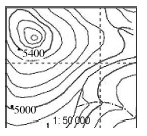
15
G = H
D
H: 5 400 – 5000 = 400 m
D: 2,2 cm × 500 = 1 100 m
G: 400:1 100
400:400
= 1:2,75
Calculate the gradient between ·5400 and ·5000
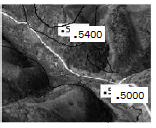
16
G = H
D
5 400 – 5 000 =  400
11 cm × 100     1 100
400: 1 100
400
= 1:2,75

Always write the formula G = H  in your answer. This will give you a mark.
D
Activity 5.5
Calculate the gradient from trig. station 8 to spot height 1120, which are shown on a topographic map.
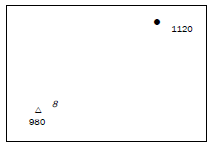
17
Note that 8 is the number of the trig. station. The height is written below the triangle, i.e. it is 980.

Answer to activity 5.5
G = H
D
H: 1 120 − 980 = 140 m
D: 4,4 cm × 500 = 2 200 m
G: 140 : 2 200
140     140
= 1:15,71
[5] 

Activity 5.6
Calculate the gradient from trig. station 8 to spot height 213, which are shown on an orthophoto. [5]
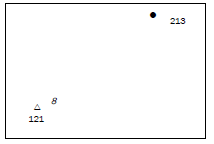
18

Answer to activity 5.6
G = H
D
H: 213 − 121 = 92 m
D: 4,4 cm × 100 = 440 m
G: 92  : 440
92     92
= 1:4,78
[5] 

5.3.3 Mapwork calculations: True bearing, magnetic declination, magnetic bearing, position, map sheet reference, vertical exaggeration
Note that true bearing, magnetic declination, magnetic bearing and position, and map sheet reference calculations can only be done on a topographic map. Vertical exaggeration calculations can be done on both a topographic map and an orthophoto.

True bearing
True bearing is the angle measured clockwise from true north (0°).
We calculate true bearing, magnetic declination and magnetic bearing to help us determine in which direction we are going or to help us find our way.

Method for measuring the true bearing from A to B
Follow these steps:
Step 1: Draw a straight line joining A and B.
Step 2: Draw a north line through A (the point of measurement).
Step 3: Place the 0 of your protractor at the top of the north line.
Step 4: Moving in a clockwise direction from 0, read off where the line joining A and B touches the protractor.

The true bearing from A to B is 138°. (In the exam, a degree either way will be accepted, i.e. the answer can be 137° to 139°.)
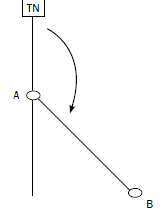
19
Always remember to move to the right (clockwise).

Activity 5.7
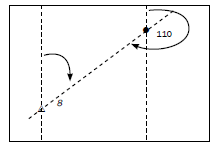
20

  1. Calculate the true bearing from trig. station 8 to spot height 110. (2)
  2. Calculate the true bearing of trig. station 8 from spot height 110. (2)
    [4]
  • MAPWORK GRADE 12 NOTES – GEOGRAPHY STUDY GUIDES
Answers to activity 5.7

  1. 58° (57°– 59°) (2)
  2. 238° (237°– 239°) (2)
    [4] 

Magnetic declination
Magnetic declination is the angle between true north and magnetic north. This angle is calculated when the map is drawn, but the position of magnetic north changes, so the angle between true north and magnetic north (the magnetic declination) will also change. You will need to calculate what the magnetic declination is for the current year.
You will find the magnetic declination for the year the map was drawn on the map. This information appears on a map on the left-hand side or at the bottom of the map. You need this information to do the magnetic declination calculation. Look at the following example:

Example
Mean magnetic declination (MD) 20º 10’ west of true north (1990.01)
Mean annual change (AC) 2’ westwards (1985–1995)
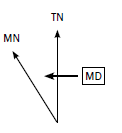
21
Note the following:

TN is true north. This is found at the North Pole.

  • MN is magnetic north. This is the direction in which a compass would point.
  • MD is the magnetic declination. It is the angle you are calculating.
  • 1990.01 refers to the year and the month that the declination was recorded.
  • 1985–1995 refers to the years the mapmaker used to get the mean (average) magnetic declination. You will not need these years.
  • Mean annual change refers to how much the magnetic declination changes by each year. The change is in minutes (this is shown by the symbol ‘).
  • The declination can change in a westerly (angle increases) or easterly (angle decreases) direction.
Method for calculating magnetic declination
Follow these steps:
Step 1: Work out the difference in years between the current year and year given on the map. Your answer must be in years. (Use the year that is printed straight after the words ‘true north’. You can ignore the month that is shown.)
Step 2: Multiply the number of years with the mean annual change (this is given on the map) to get the change since the declination was recorded.
Step 3: If the mean annual change is eastwards, then you have to subtract the change from the magnetic declination given. If the mean annual change is westwards, then you must add it to the given magnetic declination.
Step 4: Your answer is the magnetic declination for the current year. Magnetic declination is always west of true north.

Worked example 1: If the annual change is westwards
Mean magnetic declination (MD) 20º 10’ west of true north (1990.01)
Mean annual change (AC) 2’ westwards (1985–1995)
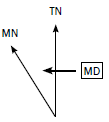
22
Calculating magnetic declination for 2012
MD = 20° 10’ W of TN
AC = 2’ W
2012 – 1990 = 22 years
22 × 2’ W = 44’ W
MD = 20° 10’ W + 44’ W = 20° 54’ W of TN

Worked example 1: If the annual change is eastwards
Mean magnetic declination (MD) 18º 50’ west of true north (1985.01)
Mean annual change (AC) 1’ eastwards (1980–1990)
22
Calculating magnetic declination for 2012
MD = 18° 50’ W of TN
AC = 1’ E
2012 − 1985 = 27 years
27 × 1’ E = 27’ E
MD = 18° 50’ W – 27’ E = 18° 23’ W of TN

Worked example 3: If the magnetic declination is given with a decimal place instead of minutes
If the MD given on the map is recorded as a decimal, for example 23°,5 W, you must multiply the number after the comma by 6 to convert it to minutes. For example:
5 × 6 = 30’. So, the MD is now 23°30’ W. The decimal comma has been removed and you have a MD in degrees and minutes.
Now look at the following worked example:
Mean magnetic declination (MD) 18º,3 west of true north (1985.01)
Mean annual change (AC) 1’ westwards (1980–1990)
22
Calculating magnetic declination for 2012
MD = 18°,3 W of TN = 18° 18’ W of TN
AC = 1’ W
2012 – 1985 = 27 years
27 × 1’ W = 27’ W

Worked example 4: If the magnetic declination answer has the minutes greater than 59’
Once you have done your calculation, if the magnetic declination for the current year has minutes greater than 59’ you need to convert the minutes to degrees.
For example: MD = 23° 76’
76’ – 60’ leaves 16’. The 60 minutes you subtracted equal 1 degree, which you add to the 23° to get 24° 16’.
Now look at the following worked example:
Mean magnetic declination (MD) 31º 33’ west of true north (1990.08)
Mean annual change (AC) 2’ westwards (1987–1993)
22
Calculating magnetic declination for the current year
MD = 31° 33’ W of TN
AC = 2’ W
2012 – 1990 = 22 years
22 × 2’ W = 44’ W
MD = 31° 33’ W + 44’ W
= 31° 77’ W of TN
= 32° 17’ W of TN

Worked example 5: When the change is eastwards and the change is greater than the minutes in the MD
If the mean annual change has minutes greater than the minutes in the magnetic declination, you need to borrow a degree in the magnetic declination and convert it into minutes. Look at the following example:
MD = 20° 10’ W – 44’ E
Before you can subtract the mean annual change of 44’ E from the given magnetic declination, you need to borrow 1° from 20° and convert it to minutes. This leaves you with 19°. Now take the 1° and convert it to 60’ (remember that 1° = 60’). Now add the 60’ to the 10’. This gives you 70’. Now you can continue with the calculation:
19° 70’ – 44’ E = 19° 26’ W
Now look at the following worked example:
Mean magnetic declination (MD) 25º 32’ west of true north (1986.04)
Mean annual change (AC) 2’ eastwards (1983–1992)
22
Calculating magnetic declination for 2012
MD = 25° 32’ W of TN
AC = 2’ E
2012 – 1986 = 26 years
26 × 2’ E = 52’ E
MD = 25° 32’ W – 52’ E
= 24° 92’ – 52’
= 24° 40’ W of TN

Remember that 1° = 60’ (1 degree = 60 minutes)

  • Always add degrees to degrees and minutes to minutes. Never add degrees to minutes.
  • Always subtract degrees from degrees and minutes from minutes. Never subtract minutes from degrees!

Magnetic bearing
Magnetic bearing is the angle measured clockwise from magnetic north.
Here the magnetic north line is taken as 0º whereas in true bearing, true north is taken as 0°.
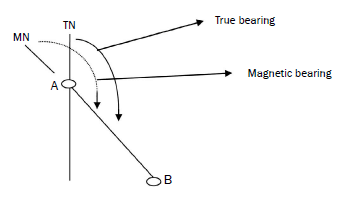
23

Formula for magnetic bearing
Magnetic bearing = true bearing + magnetic declination
MB = TB + MD

Method for calculating magnetic bearing
To get the true bearing and the magnetic declination we use the same methods applied in 5.3.3A (on page 111) and 5.3.3B (on page 112).
These methods are provided again below. Follow these steps:
Step 1: Measure the true bearing from A to B (as described in 5.1.3A)
Step 1a: Draw a straight line joining A and B.
Step 1b: Draw a north line through A (the point of measurement).
Step 1c: Place the 0 of your protractor at the top of the north line.
Step 1d: Moving in a clockwise direction from 0, read off where the line joining A and B touches the protractor.
Step 2: Calculate the magnetic declination (as described in 5.1.3B)
Step 2a: Work out the difference in years between the current year and year given on the map. Your answer must be in years. (Use the year that is printed straight after the words ‘true north’. You can ignore the month that is shown.)
Step 2b: Multiply the number of years with the mean annual change (this is given on the map) to get the change since the declination was recorded.
Step 2c: If the mean annual change is eastwards, then you have to subtract the change from the magnetic declination given. If the mean annual change is westwards, then you must add it to the given magnetic declination.
Step 2d: Your answer is the magnetic declination for the current year.
Magnetic declination is always west of true north.
Step 3: Now add the true bearing to the magnetic declination. Your answer must not have a direction (north, south, east or west) because it is an angle measured only in degrees and minutes.

Example
MD = 18°,8 W = 17° 48’ W
Change in years = 2012 – 1988 = 24 years
Change since 1989 = 24 × 4’ = 96’ W = 1° 36’ W
MD = 17° 48’ + 1° 36’
= 18° 84’ W = 19° 24’ W
TB = between 299° and 303°
MB = TB + MD
= 301° + 19° 24’
MB = 320° 24’

Always write the formula MB = TB + MD in your calculations as this will earn you a mark.

Worked example 1
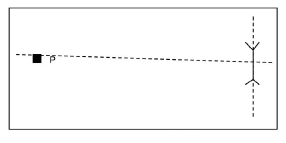
24
Mean magnetic declination (MD) 20º, 2’ west of true north (2001.09)
Mean annual change (AC) 1’ westwards (1998–2004)
22
Calculate the magnetic bearing of the post office from the dipping tank for 2012.
MB = TB + MD
TB = 272° (271°– 273°)
MD = 20°, 2 W of TN = 20°12’ W of TN
AC = 1’ W
2012 – 2001 = 11 years
11 × 1’ W = 11’ W
MD = 20° 12’ W + 11’ W = 20° 23’ W of TN
MB = 20° 23’ + 272°
= 291° 23’– 293° 23’

Worked example 2
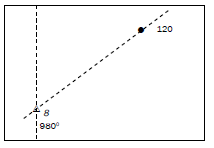
25
Mean magnetic declination (MD) 20º 31’ west of true north (1998.10)
Mean annual change (AC) 4’ westwards (1995–2001)
22
Calculate the magnetic bearing from trig. beacon 8 to spot height 120 for 2012.
MB = TB + MD
TB = 57° (56°– 58°)
MD = 20°31’ W of TN
AC = 4’ W
2012 – 1998 = 14 years
14 × 4’ W = 56’ W
MD = 20° 31’ W + 56’ W
= 20° 87’ W of TN
= 21° 27’ W of TN
MB = 21° 27’ + 57°
= 77° 27’ – 79° 27’

Position/co-ordinates
Co-ordinates are a set of two numbers that indicate the exact position of any point on Earth. Latitude is the co-ordinate that specifies the north– south position of a point on the Earth’s surface. Longitude is the coordinate that specifies the east–west position of a point on the Earth’s surface.
Co-ordinates are useful as they tell us exactly where a place or landform is.

Example of position/co-ordinates
If you wanted to locate a house and only had the co-ordinates 35°S 29°E, you would have to search an area of 6 084 km2. You would need to be more specific when giving the location of a place.
Note the following about position/co-ordinates:

  • On a 1:50 000 map the numbers in the top left corner indicate latitude and longitude. Latitude and longitude are measured in degrees and minutes.
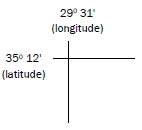
    26
  • Each line drawn on a map is 1’ of latitude or longitude (‘ is the sign for a minute).
  • Each fifth minute on a map is labelled. This helps you to count accurately.
  • Latitude minutes increase as you move south (down the map). Longitude minutes increase as you move east (to your right along
  • the map).
  • The correct format for writing position is as follows:
    _____° ____,___’ S
    _____° ____,___’ E
Think of latitude and longitude in the following way:
L A T I T U D E
O
N
G
I
T
U
D

Method for finding the position of an object
You can calculate the position of spot height 501 using the diagram in Figure 5.3.1.
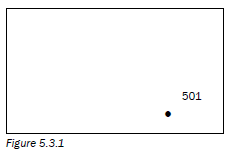
27
Learn the format for writing position. Note that you always write latitude N or S first.

Use the following steps
Step 1: Write the format for position like this (leaving the blanks for you to fill your answer in later).
_____° ____,___’ S
_____° ____,___’ E
Step 2: Work out the degrees for latitude and longitude for the map.
They are written in the top left-hand corner of the map. Write the degrees down on your format.
24° ____,___’ S
31° ____,___’ E
Step 3: Work out the minutes for latitude and longitude. The spot height is in the 10′ block for latitude (not the 11′ block for latitude) and the 28′ block for longitude (not the 29′ block for longitude). Write the minutes down in the blank spaces of your position format.
24° 10′,___’ S
31° 28′,___’ E
Step 4: Measure the distance between 10′ and 11′ and divide it by 2. Then make a mark on the line between 10′ and 11′ where 3 cm is.
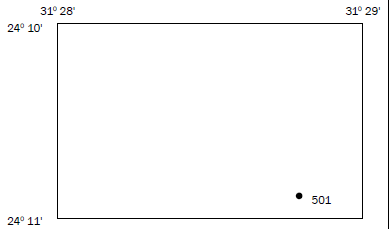
28
Step 5: Measure the distance between 28′ and 29′ and divide it by 2.
Make a mark on the line between 28′ and 29′ where 4,7 cm is. Step 6: The space between 10′ and 11′ is divided into 10 decimal places, in other words, 10,1′; 10,2′; 10,3′; 10,4′; 10,5′; 10,6′; 10,7′; 10,8′ and 10,9′.

As the spot height is in the bottom half of the block, we are only concerned with the 10,5’ to 10,9’ part of the block.
Once you have divided the block in half, divide the half you are interested in equally with 4 lines. This can be done freehand (without a ruler), but judge carefully so that the spaces are equal.
Step 7: The space between 28′ and 29′ is divided into 10 decimal places, in other words, 28,1′; 28,2′; 28,3′; 28,4′; 28,5′; 28,6′; 28,7′; 28,8′ and 28,9′.
As the spot height is in the right-hand half of the block, we are only concerned with the 28,5′ to 28,9′ part of the block.
Once you have divided the block in half, divide the half you are interested in equally with 4 lines. This can be done freehand (without a ruler), but judge carefully so that the spaces are equal.
Steps 6 and 7 are shown below:
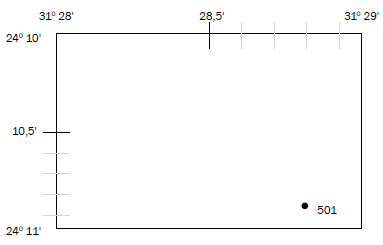
29
Step 8: Line up your ruler with the spot height and the line for latitude (on the left of the map). Make a mark. Read off the decimal place for latitude and write it down on your position format. 24° 10,8′ S or 24° 10,9′ S (both answers are acceptable)
Step 9: Line up your ruler with the spot height and the line for longitude (at the top of the map). Make a mark. Read off the decimal place for longitude and write it down on your format.
Your answer is now complete:
24° 10,8′ S or 24° 10,9′ S (both answers would be accepted)
31° 28,8′ E
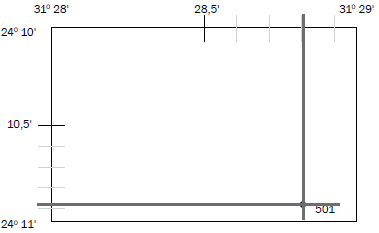
30
-After 10,9’ it becomes 11’, so you can never have 10,10’.
After 28,9’ it becomes 29’, so you can never have 28,10’
-Make sure your ruler is straight by lining up the markings on the ruler with any of the lines on the map.
Example
The position of spot height
501 in Figure 5.1 is…
A. 31° 28,8’ S; 24°10,8’ E
B. 31° 28,8’ E; 24° 10,8’ S
C. 24° 10,8’ S; 31° 28,8’ E
D. 24°11,8’ S ; 31° 29,8’ E
(The correct answer is C.)
-In the exam, position is often asked in the multiple-choice section of the paper. Be careful, as an answer may look correct – but longitude is written first! You should know this is wrong because latitude is always written first!

Map sheet references/map code
The map sheet reference is the title of the map and refers to the area that the map covers. The sheet reference links one South African map to all the maps of South Africa.
An example of a map sheet reference is 3318CD. The digits (numbers) and letters have specific meaning:
The numbers in the map sheet reference refer to the intersection of the lines of latitude and longitude (3318CD). The first two numbers refer to latitude (33) and the last two numbers refer to longitude (18). The letters CD refer to the blocks.
The area within these lines of latitude and longitude is divided into four squares, labelled A, B, C and D (big blocks).
Each of the big blocks is then subdivided into four smaller squares, also labelled A, B, C and D (small blocks).

Remember, latitude (N or S) is always written first.
In the exam, you may be asked two types of questions based on the map sheet reference:

  • Typical question 1: What is the map sheet reference of the map? (You will find the answer at the top of the map in front of the name of the place shown on the map.)
  • Typical question 2: Name the map sheet reference in any direction from the given map sheet reference. (This is explained in Examples 1 and 2 below.)

Example 1
For the map title 3318CD Cape Town:
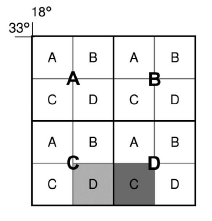
31
Give the map sheet reference to the east of 3318CD.

  • The block to the east of 3318CD (light shading) is block C (darker shading).
  • This block is still within the 33° latitude and 18° longitude area, so the numbers (3318) stay the same.
  • But it is now in big block D, so the letters change to DC.
  • The map sheet to the east of 3318CD is 3318DC.
Practise this type of question by trying the following:

  1. Give the map sheet reference for the map to the north of 3318CD.
  2. Give the map sheet reference for the map to the north-east of 3318CD.
  3. Give the map sheet reference for the map to the north-west of 3318CD.

Answers:

  1. 3318CB
  2. 3318DA
  3. 3318CA

Example 2
For the map title 3318CD Cape Town.
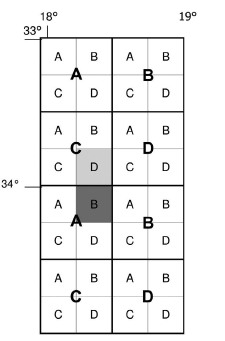
32
Give the map sheet reference to the south of 3318CD.

  • The block to the south of 3318CD (light shading) is the block B (darker shading).
  • This block is out of the 33° latitude area and in the 34° latitude area. However, the block is still within the 18° longitude area. The latitude changes but the longitude stays the same (3418).
  • It is now in big block A, so the letters change to AB.
  • The map sheet to the south of 3318CD is 3418AB.

Always look for a grid showing the map sheet reference at the bottom of a map sheet. It may also provide you with information to help you answer other questions.

Practise this type of question by trying the following:

  1. Give the map sheet reference for the map to the south-east of 3318CD.
  2. Give the map sheet reference for the map to the south-west of 3318CD.

Answers:

  1. 3418BA
  2. 3418AA

When answering this type of question, take note of the following:

  • If you are asked for the grid reference north and you go north (up) out of the big block, the latitude must decrease by 1°.
  • If you are asked for the grid reference south and you go south (down) out of the big block, the latitude must increase by 1°.
  • If you are asked for the grid reference east and you go east (right) out of the big block, the longitude must increase by 1°.
  • If you are asked for the grid reference west and you go west (left) out of the big block, the longitude must decrease by 1°.

Vertical exaggeration
In mapwork, we draw a cross section (view from the side) of an area or landform to better understand what the area or landform looks like.
A cross section is when we ‘cut’ through a landform, to see what it looks like from the side. Figure 5.3.2 below shows a cross section through a tap.
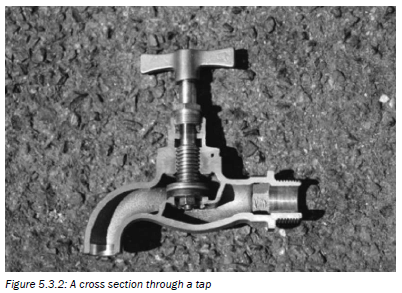
33
To draw a cross section of a landform, we need to look at the contour lines.
These are the brown lines we see all over a topographic map. Contour lines show the height of the area. Along one contour line, the height is the same.
Study Figure 5.3.2 to understand what is meant by the term cross section.

Figure 5.3.3 below is a contour map of a landform. If we had to draw a cross section from A to B on Figure 5.3.3 we would first imagine we were walking from A to B:

  • Looking at the heights on the contours we see we are walking uphill;
  • Then we go downhill a little bit;
  • Then uphill again; and
  • Then downhill to B.

34

A cross section is drawn on a graph. We use the vertical axis to show the height and horizontal axis to show the distance.
If the vertical and horizontal scales are the same, it is not easy to see the differences in slope.
Figure 5.3.4 below shows the cross section from A to B (in Figure 5.3.3).
Because the vertical and horizontal scales are the same (1:10 000), we do not really get a good idea of the differences in slope.
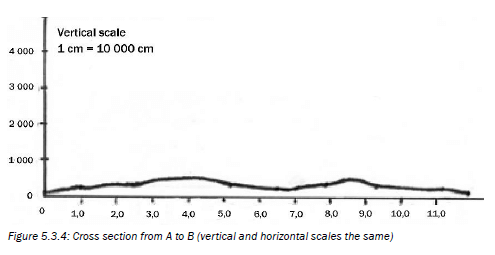
3536

To overcome this problem, we exaggerate (make it more obvious or clear) the profile vertically by using a different vertical scale from the horizontal scale. This is shown in Figure 5.3.5.
Figure 5.3.5 uses a vertical scale where 1 cm represents 20 m for the same map. It is much easier to see the changes in slope along the profile.
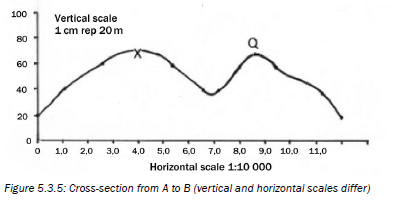
37
We therefore say the cross-section has been exaggerated, and we need to calculate how many times it has been made steeper or exaggerated. This is called the vertical exaggeration.

Formula to calculate vertical exaggeration
Vertical exaggeration = Vertical scale divided by Horizontal scale
VE = VS ÷ HS
or
VE = VS
HS

Remember the horizontal scale lies the same way as the horizon.

Method for calculating vertical exaggeration
Follow these steps:
Step 1: Change the vertical scale from a word scale to a number scale. The vertical scale will be given to you in the question, e.g. 1 cm = 40 m.
You must have the same units on both sides of the vertical scale in order to write it as a number scale. We need to convert 40 m into cm. To do this you multiply the 40 m by 100 (1 m = 100 cm).
Our scale becomes 1 cm = 4 000 cm or   1
4 000
Step 2: The horizontal scale is already written as a number scale. On a topographic map the scale is 1:50 000 and on an orthophoto the scale is 1:10 000.
Step 3: Write both scales as fractions and divide the vertical scale by the horizontal scale:
VE =    1     ÷     1
4000     50 000
Step 4: Now ‘tip and times’ the two fractions. You do this by swopping the top and bottom numbers of the horizontal scale fraction and then multiplying the top of each fraction together and the bottom of each fraction together.
VE =    1      × 50 000
4000           1
Step 5: You are now left with one fraction. Divide the top by the bottom.
(Use your calculator to divide 50 000 by 4 000.)
VE = 50 000
4 000
An easy way to remember that the horizontal scale goes on top is that ‘H’ comes before ‘V’ in the alphabet.
Step 6: Write the answer as follows: VE = 12,5 times
This means the cross section has been exaggerated 12,5 times in order to see the changes in the landscape more easily.

Example of a topographic map calculation:
Calculate the vertical exaggeration for a cross section drawn on a topographical map with a vertical scale of 1 cm = 20 m.
VE = VS ÷ HS
Step 1:
VS: 1 cm = 20 m
1 cm = 20 × 100 cm = 2000 cm
VS 1:2000
VS   1
2 000
Step 2:
HS 1:50 000
HS    1
50 000
Step 3:
VE =    1     ÷    1
2 000    50 000
Step 4:
VE =    1      × 50 000
2 000         1
Step 5:
VE = 50 000
2 000
Step 6:
Answer:
VE = 25 times
Example of an orthophoto calculation:
Calculate the vertical exaggeration for a cross section drawn on an orthophoto with a vertical scale of 1 cm = 20 m.
VE = VS ÷ HS
Step 1 :
VS: 1 cm = 20 m
1 cm = 20 × 100 cm = 2000 cm
VS 1:2000
VS   1
2 000
Step 2:
HS 1:10 000
HS 1
10 000
Step 3:
VE =    1     ÷    1
2 000    10 000
Step 4:
VE =    1      × 10 000
2 000         1
Step 5:
VE = 10 000
2 000
Step 6:
Answer:
VE = 5 times

Worked example 1
Calculate the vertical exaggeration for a cross section drawn on a topographical map with a vertical scale of 1 cm = 50 m.
Answer
VE = VS ÷ HS
VS: 1 cm = 50 m
1 cm = 50 × 100 cm = 5000 cm
VS 1:5 000
VS   1
5 000
HS 1:50 000
HS     1
50 000
VE =   1      ÷    1
5 000   50 000
VE =    1      × 50 000
5 000         1
VE = 50 000
5 000
VE = 10 times

Always write the formula VE = VS ÷ HS as this will earn you a mark.

Worked example 2
Calculate the vertical exaggeration for a cross section drawn on an orthophoto map with a vertical scale of 1 cm = 25 m.
Answer
VE = VS ÷ HS
VS: 1 cm = 25 m
1 cm = 25 × 100 cm = 2 500 cm
VS 1:2 500
VS    1
2 500
HS 1:10 000
HS     1
10 000
VE =   1     ÷    1
2 500    10 000
VE =    1      × 10 000
2 500          1
VE = 10 000
2 500
VE = 4 times

Intervisibility
Intervisibility is used to determine whether one place is visible from another place, in other words, whether you can see one place from another place.
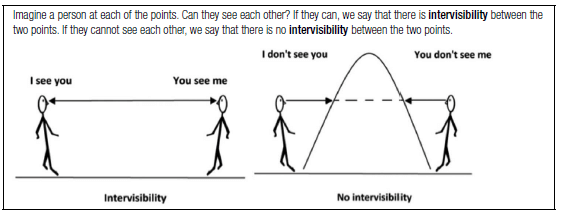
38Method to determine intervisibility
To work out whether two places are intervisible, follow these steps:
Step 1: Draw a line joining the points between the two places.
Step 2: Look to see if the line you have drawn cuts through any part of the cross section. If it does cut through, then there is no intervisibility between the two points. If it does not cut through, then there is intervisibility between the two points.

In the exam, you may be given a cross section and asked to determine if two places are intervisible.

Example 1
In Figure 5.3.6 below, is point Q intervisible from point P?
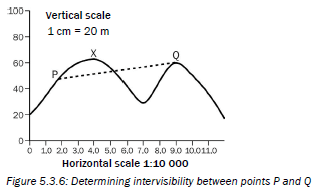
39
The answer is that there is no intervisibility between P and Q, as the line cuts through the cross-section (goes through the mountain). This means you cannot see point Q from point P, and you cannot see point P from point Q.

Example 2
In Figure 5.3.7 below, is point X intervisible from point Q?
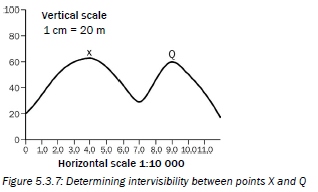
40
The answer is there is intervisibility between X and Q, as the line does not cut through the cross-section. This means you can see point X from point Q, and you can see point Q from point X.

Activity 5.8
Refer to the topographical map and orthophoto of Nelspruit at the back of this study guide to answer the following questions:

  1. Calculate the area covered by block B3 on the Nelspruit topographical map in kilometres squared. (5)
  2. Calculate the magnetic bearing for 2012 from trig. beacon 101 (C3) to spot height 676 (C4) on the topographical map. Show all steps followed (calculations). Marks will be allocated for calculations. (10)
  3. Calculate the gradient between trig. beacon 101 in block C3 and spot height 676 in block C4. (5)
    [20]

Check how well you can do mapwork calculations by completingactivity 5.8.

Answers to activity 5.8

  1. Area = length × breadth
    = (3,7 cm × 0,5) km × (3,3 cm × 0,5) km
    = 1,85 km × 1,65 km
    = 3,05 km2(5)
  2. Magnetic declination: 15°02′ west of true north
    Annual change: 03′ E
    Number of years: 2012 – 1986 = 26 years
    26 × 3′ = 78′ E = 1° 18′ E
    Magnetic declination: =15°02′ W – 1°18′ E
    = 14° 62′ W – 1° 18′ E
    = 13°44′ W
    Magnetic bearing = True bearing + Magnetic declination
    = 102° + 13° 44′ W
    = 115° 44′ (10)
  3. Gradient =   Height   = H
    Distance    D
    H = 754,4 – 676 = 78,4 m
    D = 5,6 cm × 500 = 2 800 m
    G = 78,4 : 2 800
    78,4 78,4
    G = 1:35,73 (5)
    [20]

5.4 Application of theory to a topographic map and an orthophoto

In this section we look at how the theory that you have learnt in previous chapters can be applied to a topographic map or an orthophoto.
5.4.1 Climatology
In the exam, you may be asked questions such as:

  1. Which slopes are the warmest?
    Determine which slope faces north. North-facing slopes are the warmest.
  2. Which slopes are the coldest?
    Determine which slope faces south. South-facing slopes are the coldest.
  3. Why are there more houses and plantations on a slope in a valley?
    Determine which slope faces north. North-facing slopes are the warmest and people choose to live there. Plants also grow better there.
  4. Where will the thermal belt occur?
    Determine where the valley is and where halfway up the valley would be.
    This is where you will find the thermal belt (temperature inversion).
  5. Where will frost occur?
    Determine where the bottom of the valley is. Frost pockets occur at the bottom of a valley.
  6. Does the area experience high rainfall?
    Determine the amount of cultivated land, the number of perennial rivers (flow all year round) and the total number of rivers in an area (drainage density). High-rainfall areas have lots of cultivated land, many perennial rivers indicate high drainage density.
  7. Does the area experience low rainfall?
    Determine the amount of cultivated land, the number of perennial rivers (flow all year round) and non-perennial rivers (only flow in the rainy season), and the total number of rivers in an area (drainage density). Low-rainfall areas have very little cultivated land; few, if any, perennial rivers and many nonperennial rivers; and few rivers, indicating low drainage density.
  8. Does the area experience seasonal rainfall?
    Determine the number of non-perennial streams, dams, furrows and whether the cultivated land is next to a river. Seasonal rainfall areas have mostly non-perennial rivers, many dams, furrows and the cultivated land is next to the perennial rivers.

Questions 6, 7 and 8 also test some geomorphology knowledge.
5.4.2 Geomorphology
In the exam, you may be asked questions such as:

  1. In which direction does the river flow?
    Determine the height of the river at each point where it starts and ends on the map. A river flows downhill, so it flows from the highest point to the lowest point.
    Look at the tributaries that join the main river. The direction in which tributaries join the main river follows the same direction in which the river is flowing.
  2. Identify the drainage pattern of the river.
    Determine the pattern of the river system. Is it a dendritic, radial or trellis pattern? Refer to Figure 2.2.3 C to E on page 31 showing drainage patterns in Chapter 2: Geomorphology.
  3. Determine the underlying rock structure of an area.
    Determine the drainage pattern in the area. The causes of a drainage pattern tell you the kind of rock in the area. For example, if there is a dendritic drainage then the underlying rocks are either horizontal sedimentary rock, igneous or metamorphic rock. Refer to Figure 2.2.3 C to E showing drainage patterns in Chapter 2: Geomorphology.
  4. In which stage (course) is the river?
    Determine the steepness of the sides of the valley and the steepness of the river course. A very steep valley is V-shaped and has a steep gradient.
    This is where the upper course of a river is found. In contrast, if you find a wide floodplain (flat area alongside a river), meanders, marshes or vleis, and oxbow lakes, this is where the lower course of a river is found.

5.5 Geographical information systems – GIS

GIS is an organised collection of computers, computer programmes, geographic data and people. This definition gives you the components that make up GIS: People who know how to use computers (hardware) and programmes (software) to provide information (from geographic data) are able to solve a problem or answer a specific question.

Key concepts

Concept  Definition 
Components of GISHardware (computers), software (computer programmes), data (information), people, procedures (how to solve a problem or answer a question), network (where to get the information from).
Spatial dataSpatial data refers to the position of an object, in other words, its co-ordinates.
For example, the spatial data for a tree could be: 29°30,3′ S; 19°10,8′ E
Attribute dataAttribute data is information that describes or gives the characteristics of an object.
For example, the attribute data for a tree could be: It is an acacia tree, which is 5 m tall.
Vector dataSpatial data stored in the form of co-ordinates, shown as point, line or polygon features.
a) Point featuresPoint features on a map include spot height, buildings and trig stations.
a
b) Line featuresLine features on a map include rivers, roads and walls.
b
c) Polygon featuresPolygon features on a map include cultivated land, built-up areas and dams.
c

In a mapwork exam, you may be asked to identify a point, line or polygon feature on a map. Look at the conventional signs shown in the block (referred to in the question).

  • Point features are indicated by a circle (e.g. spot height), triangle (e.g. trig. station), square (e.g. building, post office), rectangle (e.g. factory) or a single object (wind pump, dipping tank).
  • Line features are indicated by a straight line (e.g. farm boundary, wall) or a curved line (e.g. rivers, roads and railways).
  • A polygon feature is any sign that takes up more space than a single feature, for example, a dam, cultivated land, built-up area or golf course.

If you know and understand this definition of geographic information systems (GIS), then you will be able to answer the relevant questions in the mapwork section of the final exam. Use mobile notes to help you learn these key concepts.

BufferingTo demarcate (mark off) an area around an object. The marked-off area is the buffer zone.
Buffer zones often protect people from living in a dangerous area.
For example, along a river people should live above the 50-year flood line. The 50-year flood line is the height below which the river floods. The area below the 50-year flood line is the buffer zone for this area. If you live in the buffer zone your home is likely to be affected when the river floods. If you take notice of the buffer zone and live above the 50-year flood line, your home is likely to be safe when the river floods.
Figure 5.5.1 below shows how point, line and polygon features have buffer zones placed around them.
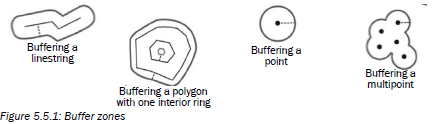
41
Raster dataSpatial data stored in the form of pixels. Pixels are similar to the blocks found on a topographic map (e.g. block A3). The size of the pixel (block) will determine in how much detail an area will be shown. Smaller pixels show more detail. Larger pixels show less detail.
Remote sensingTaking a picture of something from far away, for example from a satellite.
Spatial resolutionHow clear and easy the detail is to see.
Data or thematic layeringWhen different kinds of information are placed one on top of the other to see the overall picture.
For example, on the Nelspruit map, the layers of data needed to draw block D1 are:

  • Vegetation
  • Contour lines
  • Roads
  • Power lines
  • Built-up areas
  • Water

42

Data sharingData sharing is the practice of making data used for scholarly research available to other investigators.
Data standardisationIt is the process of achieving agreement on common data definitions, representation and structures to which all data layers must conform.
Data securityThis means protecting a database from destructive forces and the unwanted actions of unauthorised users. This may be done by encryption, firewall or password.
Data queryingThis is a process used to retrieve or get data from the data base.
Statistical analysisThe collection of methods used to process large amounts of data and report overall trends.

Activity 5.9
Refer to the topographic map 2530BD Nelspruit and the orthophoto map extract at the back of this study guide to answer the following questions.

  1. Underline the correct term that matches the description below:
    1. Data that refers to the actual position of an object is vector/raster data. (1 × 2 = 2)
    2. Data that is stored in pixels is vector/raster data. (1 × 2 = 2)
  2. Refer to block B1 on the 2530BD Nelspruit topographic map. Give an example from this block of the following:
    1. Point feature (1 × 2 = 2)
    2. Line feature (1 × 2 = 2)
    3. Polygon feature (1 × 2 = 2)
  3. List any four layers that were used to draw this topographic map. (4 × 2 = 8)
    [18]
Answers to activity 5.9

    1. Data that refers to the actual position of an object is vector/ raster data. (2)
    2. Data that is stored in pixels is vector/raster data. (2)
    1. Point feature: spot height/farmstead/tree (any 1) (2)
    2. Line feature: contour/power line3/track or hiking trail/ road/dam wall/river (perennial or non- perennial)/ furrow (any 1) (2)
    3. Polygon feature: woodland/cultivated land/orchards/ excavations (any 1) (2)
  1. The following layers were used to draw the topographic map:
    • Woodland – all the farming land and woodland areas
    • Height – the brown contour lines
    • Water – all the rivers and the perennial water and furrows
    • Transport – roads and track/hiking trail (8)
      [18]

GEOMORPHOLOGY GRADE 12 NOTES – GEOGRAPHY STUDY GUIDES

On this page you will find GEOMORPHOLOGY GRADE 12 NOTES – GEOGRAPHY STUDY GUIDES, Geomorphology is the study of the landforms found on the Earth’s surface and the processes that create them. In this chapter, fluvial geomorphology is covered.
The following table of key concepts covers fluvial geomorphology.
If you know and understand these definitions of fluvial geomorphology, then you will be able to answer most of the questions in the Geomorphology section of the final exam.
Use mobile notes to learn these key concepts. They are easy marks!

Key concepts

Concept Definition 
Base flowThe flow of groundwater in the same direction as the river.
Base levelThe lowest level to which a river can erode.
CondensationWhen water vapour reaches dew point temperature and changes into water droplets.
DepositionWhen a river deposits (lays down) the sediment it is carrying on the river bed.
Drainage basinAn area drained by a river system.
ErosionThe removal of soil and wearing away of rocks by wind, water or ice.
EvaporationWhen water in the liquid form is converted (changed) into water vapour (gas).
Fluvial hydrographsShow runoff of a river at particular time at a point on a river.
GroundwaterWater stored below the ground in soil and rock.
Headward erosionWhen a river cuts back towards its source.
Infiltration/percolationA process whereby water seeps into the soil or rock.
Interceptionhe process by which raindrops are prevented from falling to the ground by plant leaves, stems and branches.
Perennial river/permanent riverRiver that flows throughout the year.
PrecipitationAny form of water falling from the sky (e.g. rain, hail, snow).
RejuvenationThe renewal of erosion activity in a river.
River/channel flowWater that flows within a river channel.
River dischargeThe volume of water that flows past a point in a river in a given time.
River meanderA series of bends in a river as it moves along the floodplain.
River sourceThis is where a river starts; normally high up in mountainous areas.
River mouthThis is where a river ends; normally when it reaches the sea or ocean.
Runoff/overland flowRainwater which runs overland towards a river, lake or the sea.
Seasonal/periodic/non-perennial riverRiver that only flows during the rainfall season.
Stream capture/piracyWhen one river ‘robs’ another of its water.
Stream channelWhere the water flows in a river (river bed).
ThroughflowThe movement of groundwater through the soil due to gravity.
TranspirationWater vapour is released from leaves in trees and plants.
TributaryA smaller river which flows into (joins) a larger river.
Watershed/Drainage divideHigh-lying land separating drainage basins.
Water tableThe level below which the ground is saturated (it can hold no more water).

If you know and understand these definitions of fluvial geomorphology, then you will be able to answer most of the questions in the Geomorphology section of the final exam. Use mobile notes to learn these key concepts. They are easy marks!

Fluvial geomorphology
This chapter deals with the action of water on the Earth’s surface. TheThis chapter deals with the action of water on the Earth’s surface. Theword fluvial refers to the action of running water.
1

2.1 Groundwater

Groundwater is water stored beneath the Earth’s surface. When precipitation (rain) falls to the surface of the Earth, it either flows over the surface (runoff) or it is absorbed (infiltrates) into the groundwater supply. This section studies how the infiltration, runoff and groundwater systems work and lead to the formation of rivers. Refer to Figure 2.1A below of the water cycle (this was studied in Grade 10).
2Groundwater supplies are replenished (filled up) when water infiltrates into the ground. For water to infiltrate into the soil, three important aspects should be present:

  1. Enough porous soil or rock to allow the water to infiltrate through it.
  2. Time for the surface water to be absorbed into the ground. This is affected by the steepness of the slope and the nature of the rain.
  3. Vegetation (plants) to slow down the speed of runoff, making it easier for infiltration to happen.

To see how these three aspects affect runoff and infiltration study Table 2.1 below.

Factor  Impact on groundwater 
Porous rockMore infiltration, less runoff and more groundwater
Rock is not porousLess infiltration, more runoff and less groundwater
More time (gentle slope)More infiltration, less runoff and more groundwater
Less time (steep slope)Less infiltration, more runoff and less groundwater
More vegetationMore infiltration, less runoff and more groundwater
Less vegetationLess infiltration, more runoff and less groundwater

Run-off and infiltration factors are the same as drainage density factors.
Table 2.1: Factors affecting runoff and infiltration

Figure 2.1B below shows the impact of rock type, time and vegetation on groundwater. From the diagram we can see how the amount of groundwater affects the height of the water table. This is the level below which the ground is saturated (when it can hold no more water).
3

Activity 2.1

  1. List three important things that should be present for water to infiltrate into the soil. (3 × 2 = 6)
  2. Describe how groundwater supplies are replenished (filled up). (1 × 2 = 2)
  3. Why is it important to manage (look after) groundwater? (1 × 2 = 2)
    [10]

In the exam, you may be given a diagram and asked to identify which aspect or factor has affected the runoff or infiltration.

Answers to activity 2.1

  1. Porous rock, time for water to infiltrate (steepness of the slope), more vegetation (6)
  2. Groundwater supplies are replenished by precipitation. (2)
  3. South Africa has a shortage of water.
    To ensure we have a sustainable supply of water. (2)
    [10] 

2.2 Rivers

When there is less infiltration, more runoff takes place. This starts as sheet flow but very soon the water flows in a path called channel flow.
When we study rivers we look at them in different ways:

  • Types of rivers
  • River discharge
  • Drainage basins
  • Stages and profiles of rivers

2.2.1 Types of rivers
The water table refers to the surface of the water-saturated part of the ground. The height of the water table changes each season. This gives rise to different types of rivers. Rivers are classified depending on when (or if) the river valley cuts into the water table.
There are three types of rivers:

  • Permanent rivers flow all year round and are always in contact with the water table.
  • Periodic rivers only flow during the rainy season. They are in contact with the water table only in the rainy season.
  • Episodic rivers only flow after heavy rainfall when runoff flows into the river. They do not come into contact with the water table.

4

In the exam, you may be given a diagram of a cross section of a river and asked to identify the type of river. Learn to identify the different river types by redrawing and labelling Figure 2.2.1A.

River discharge
The amount of water flowing out of a river shows many aspects of a river. One way to study this discharge or runoff is by looking at a flow hydrograph.
When runoff enters a river, the amount of water flowing in the river increases. A hydrograph records how quickly the water level increases (time) and how high the water level reaches (peak flow discharge).
A flow hydrograph combines two graphs:

  • A bar graph showing the amount of precipitation
  • A line graph showing how the water level increases and decreases over time

Figure 2.2.1B below shows an example of a flow hydrograph. Study the graph and then read the explanation alongside.
5 1

Explanation of the elements in Figure 2.2.2B(left):

  1. The line graph shows the volume of the river over time. The horizontal axis shows time in hours and the vertical axis shows runoff in cubic metres per second (m3/sec).
  2. The rising segment shows the rate at which the water in the river is increasing. It is steep if infiltration is rapid. It is gentle if infiltration is slow as water takes longer to reach the river.
    • Urban areas have a rapid rising segment as the water reaches the river quickly.
    • Naturally vegetated areas allow for infiltration and the rising segment is less steep.
  3. The falling segment shows the rate at which the water in the river is decreasing. It may be less steep than the rising segment.
    • In urban areas the segment falls rapidly as less water has been added as base flow due to lower infiltration.
    • Natural areas show a slower decrease due to added base flow from infiltrated water.
  4. The bar graph shows the amount of rainfall (precipitation) that occurs in the drainage basin over time. This is shown on the vertical axis in millimetres (mm).
  5. Time lag (also called lag time) is the time that it takes from the heaviest rainfall to the fullest amount of water in the river (peak flow). It is calculated by establishing the time difference between the heaviest rainfall and the peak flow of the river.
  6. Base flow is the groundwater contribution to the discharge of a river.
  7. The highest point on the line graph is the peak flow discharge. This is when the river reaches its highest volume.

The flow hydrograph in Figure 2.2.1B can be interpreted as follows:
The slope of the line graph indicates the increase in the river’s volume (discharge). If the slope of the line graph is steep, there is more runoff than infiltration. If the slope is gentle, there is more infiltration than runoff. The graph in Figure 2.2.1B has a steep slope, so there is more runoff than infiltration.
The highest point on the line graph is the peak flow discharge. This is when the river reaches its highest volume. The difference in time between when it rains and when the peak flow discharge occurs is called the time lag. The time lag is affected by the amount of runoff and infiltration that occurs. More runoff causes a shorter time lag and more infiltration causes a longer time lag.
The following factors influence the time lag:

  • Amount of vegetation (increased vegetation reduces runoff and causes a longer time lag)
  • Steepness of slope (a steeper slope increases runoff and causes a shorter time lag)
  • Amount of rainfall (lots of rainfall increases runoff and causes a shorter time lag)
  • Nature of rainfall (heavy rainfall increases runoff and causes a shorter time lag)

Figure 2.2.1C below shows the difference in the time lag between a natural catchment and an urbanised catchment.
6
We can interpret the flow hydrograph in Figure 2.2.1C as follows:

  • The line graph for the urbanised catchment area is much steeper than the line graph for the natural catchment as there is more runoff and less infiltration in the urbanised catchment.
  • This is because the urbanised catchment has less vegetation which results in more runoff.
Natural catchment (more vegetation) Urbanised catchment (less vegetation) 
More infiltrationLess infiltration
Less runoffMore runoff
Longer time lagShorter time lag
Lower peak dischargeHigher peak discharge

Table 2.2: The difference between natural catchment and urbanised catchment
The amount of runoff on the surface leads to the development of rivers, which together form a river system within a drainage basin.
In the exam, you may be asked to determine the impact on time lag if an area that has a lot of vegetation (natural catchment) becomes urbanised (is covered by a city).
Study Table 2.2
(right) and make sure you know the difference between a natural catchment and an urbanised catchment so that you can interpret flow hydrographs in the exam. Remember, the catchment area refers to the area from which rainfall flows into a river, lake or reservoir.

Flow characteristics
The nature of the landscape over which the rivers flow will determine how the water moves in the river systems. Figure 2.2.1D (right) shows the two types of flow, namely laminar and turbulent flow.
A smooth channel causes a laminar flow of water and is more efficient. Less of the available energy is used to overcome friction (found on the lower course of a river).
A rough channel causes a turbulent flow of water. An uneven rocky bed causes an uneven flow of water. This increases the surface area for friction. This type of flow is very inefficient (found on the upper course of a river).
2.2
2.2.2 Drainage basins
A drainage basin is an area drained by a river system. You need to know the different parts of a drainage basin to understand the other aspects of rivers, such as a river’s source, river mouth, watershed and tributaries. Figure 2.2.2A (right) shows the different parts of a drainage basin.
A river does not flow by itself but is part of a river system (a main river and all its tributaries).
We will now look at two aspects of river systems: drainage density and drainage patterns.
7

Drainage density
Drainage density describes how many streams there are in a drainage basin. Drainage density is affected by the same factors that affect runoff and infiltration:

  • More infiltration will cause fewer rivers to occur, causing a low drainage density.
  • More runoff will cause more rivers to occur, causing a high drainage density.

Figure 2.2.2B (i) (right) shows a low drainage density and Figure 2.2.2B (ii) (right) shows a high drainage density.
Interpretation of Figure 2.2.2B (i):
Drainage basin (i) has fewer tributaries so it has a low drainage density.
Some reasons for low drainage density are:

  • Soft rainfall causing more infiltration
  • Gentle slopes causing more infiltration
  • Lots of vegetation causing more infiltration
  • Very little rain so the ground can still hold more water causing more infiltration

You may be asked in an exam to give reasons for an area having a high or low drainage density.

Interpretation of Figure 2.2.2B (ii):
Drainage basin (ii) has more tributaries so it has a high drainage density.
Some reasons for high drainage density are:

  • Heavy rainfall causing more runoff
  • Steep slopes causing more runoff
  • Very little vegetation causing more runoff
  • Lots of rain so the ground cannot hold any more water causing more runoff
  • Very little rain so the ground can still hold more water causing moreVery little rain so the ground can still hold more water causing more infiltration

2.2b

Activity 2.2
Refer to drainage basins A and B in Figure 2.2.2C and the flow hydrograph showing line graphs D and E after a period of rainfall, to answer the following questions.
8

  1. The rivers in drainage basin A flow all year round. What type of river would this be classified as? (1 × 2 = 2)
  2. Graph D in the flow hydrograph shows the runoff of drainage basin A after a period of rain.
    1. Define the term ‘lag time’. (1 × 2 = 2)
    2. How would the lag time change if massive deforestation were to occur in drainage basin A where D was recorded? (1 × 2 = 2)
    3. Justify your answer in question b). (2 × 2 = 4)
    4. Name another factor which could occur and have the same impact on the lag time as mentioned in question b). (1 × 2 = 2)
    1. State the drainage density of drainage basin B. (1 × 2 = 2)
    2. Describe THREE possible causes for the drainage density found in drainage basin B. (3 × 2 = 6)
      [20]
Answers to activity 2.2

  1. Permanent river (2)
    1. The difference in time between when it rains and when the peak flow discharge occurs. (2)
    2. Lag time will be shorter (2)
    3. There is less vegetation, so there is more runoff (4)
    4. Steep slope/Heavy rainfall/Lots of rain (any 1)(2)
    1. High drainage density (2)
    2. Heavy rainfall causing more runoff
      Steep slopes causing more runoff
      Very little vegetation causing more runoff
      Lots of rain so the ground cannot hold any more water causing more runoff (any 3)(6)
      [20] 

Complete activity 2.2 to practise the concepts you have learnt so far in this chapter.

Drainage patterns
In a river system, individual streams flow over the surface in stream channels. These channels will cut into the rock surface where it is easiest to erode the rock. These channels form patterns known as drainage patterns. Figure 2.2.2D, E, F below show three types of drainage patterns.
You may be asked in an exam to identify the drainage pattern, describe the pattern (what it looks like) or explain what caused the pattern to occur. When you are asked to explain the cause of the drainage pattern, you may be required to name the underlying rock structure in the area.
Figures 2.2.2 D, E and F summarise the main things you need to learn about drainage patterns.

9Name: Dendritic
Description: Looks like the branches of a tree with tributaries joining the main river at acute angles
Explanation: Occurs where the underlying rock is of homogenous (equal) resistance, namely either horizontal (flat) sedimentary rock, massive igneous or metamorphic rock
10Name: Trellis
Description: Parallel streams with short tributaries joining at right angles (90°)
Explanation: Occurs where the surface rock is of alternate resistance (strong and weak rock), or where sedimentary rock is folded
11Name: Radial
Description: Streams flow outwards from one raised central point (dome or volcano)
Explanation: Rivers flow downhill and away from the highest central point.

Activity 2.3
Identify and briefly describe the drainage patterns in Figure 2.2.3G below.
(3 × 4 = 12)
[12]
12

Answers to activity 2.3

  1. Dendritic: Looks like the branches of a tree with tributaries joining the main river at acute angles. (4)
  2. Trellis: Parallel streams with short tributaries joining at right angles (90°). (4)
  3. Radial: Streams flow outwards from one raised central point (dome or volcano).  (4)
    [12] 

2.2.3 Stages of a river
As a river flows from the mountains (source) to the sea (mouth), the amount of erosion and deposition changes. This changes what the river looks like from its source to its mouth:

  • In its upper course, a river erodes vertically (downwards) creating steep valleys.
  • In the middle course, lateral erosion and a little bit of deposition occur. The lateral erosion occurs unequally (unevenly) on the sides of the river. This causes the river to start meandering (flowing or bending from side to side).
  • By the time the river reaches its lower course, the eroded material (sediment) carried by the river begins to be deposited onto the floodplains. A floodplain is a wide, flat area alongside a river.
  • Floodplains are formed by the river eroding laterally (sideways). In the lower course the meanders may be cut off when the river flows straight, forming an ox-bow (U-shaped) lake.

Figure 2.2.3A (see page 33) shows the stages of a river in plan view.
Figure 2.2.3B (see page 33) shows the stages of a river in oblique view.
Table 2.3 (see page 33) summarises the features of a river at each stage.
You may be asked in an exam to identify the stage of a river from a plan view, an oblique view or a cross section diagram. You may also be asked to draw a river in a plan view or a cross section diagram of a river at a particular stage. To do this, learn the characteristic features of each stage. This is also useful for identifying the stage of a river on a topographic map.

Upper course Middle course Lower course 
13
Figure 2.2.3A: Plan view of upper course, middle course and lower course
141516
Figure 2.2.3B: Oblique view of upper course, middle course and lower course
Typical features at each stage  
  • Steep, V-shaped valley
  • Narrow channel
  • Waterfalls
  • Gorges (steep, narrow valley)
  • Open, gentle sloping valley with floodplain
  • Wider channel
  • Meanders (slip-off and undercut slopes)
  • Wide, flat floodplain
  • Wide valley
  • Very wide channel
  • Oxbow lakes

Table 2.3: Typical features of a river at each stage
2.2.4 River profiles
When we look at a river from the side (profile view) we can study it from two sides:

  • Longitudinal profile: The profile from the river’s source to its mouth.
  • Cross profile: The profile from one side of the river valley to the other side, through the river channel (depth and width).

Figures 2.2.4A and 2.2.4B (i) to (iii) on the next page show the profiles of a river. These figures are drawn as cross–sectional views. A cross section can be drawn as a longitudinal profile and as a cross profile.
17

Activity 2.4

  1. Draw a longitudinal profile of a river (from source to mouth) and show the upper, middle and lower courses. (1 × 4 = 4)
  2. List two features of the upper course of a river. (2 × 2 = 4)
  3. Describe a river in its lower course. (2 × 2 = 4)
  4. Describe one difference between the river channel in the upper course and the lower course. (2 × 2 = 4)
    [16]
Answers to activity 2.4

  1. 18
  2. Steep V-shaped valley
    Narrow channel
    Interlocking spurs
    Waterfalls
    Gorges  (any 2) (4)
  3. Wide flat floodplain
    Wide valley
    Very wide channel
    Ox-bow lakes  (any 2) (4)
  4. Narrow channel in the upper course
    Wide channel in the lower course  (4)
    [16] 

Figure 2.2.5A: An oblique view of a Figure 2.2.5B: An oblique view of a river valley in the upper course before river valley in the upper course after river rejuvenation has occurred river rejuvenation has occurred
2.2.5 River capture and rejuvenation
The longitudinal profile of a river has a concave shape. Changes can occur to a river’s longitudinal profile because of two processes:

  • Rejuvenation: We will focus on the causes of rejuvenation and the changes to the cross profiles of each stage in a river.
  • River capture: We will focus on the features that occur as a result of river capture.

Rejuvenation
When a river gets more energy it is said to be rejuvenated. It has more energy to erode downwards and laterally (sideways).
The causes of river rejuvenation are:

  • An increase in the volume of the river, giving the river more energy.
  • A drop in sea level due to uplift of land makes the longitudinal profile steeper, giving the river more energy.

Let us now look at the changes in the cross profiles of a river due to rejuvenation:

  • Upper course: The valley becomes steeper and more V-shaped. This is shown in Figure 2.2.5B (below right).
    19

Middle course: Downward erosion results in a second U-shaped valley forming. This results in a valley within a valley. This is shown in Figure 2.2.5C (above).
Lower course: Downward and lateral (sideways) erosion cause a second valley to form. Because floodplains occur in this stage of a river, the valleys have a step-like (terraced) appearance. This is shown in Figure 2.2.5D (above). If meanders occur, they will be eroded downwards (incised) forming steep-sided meanders.
Let us now look at the changes in the longitudinal profile of a river due to rejuvenation:
The concave shape of a longitudinal profile is called a graded profile. When rejuvenation occurs, there is a sudden drop in the profile, causing the profile to no longer be concave. The profile is now an ungraded profile. The sudden drop in the profile is called a knickpoint. Rejuvenation can occur more than once along a river’s profile forming knickpoints along the way. Figure 2.2.5E (left) shows a graded (concave) longitudinal profile of a river before rejuvenation. Figure 2.2.5F (left) shows an ungraded (not concave) longitudinal profile of a river after rejuvenation.
The river wants to regain its concave profile so it will erode the knickpoints, making them less visible over time.
20

River capture
A river is rejuvenated when it gets more energy. A river which has more energy can lead to more erosion, especially headward erosion. Headward erosion is when the source of a river erodes backwards towards the watershed. The headward erosion eventually leads to the river capturing the water of another river. River capture is sometimes called river piracy.
This is because one river ‘robs’ another river of its water.
Headward erosion occurs because a river has more energy. Reasons for the increased energy are:

  • A river flowing over a steeper gradient will flow faster
  • A river with a larger volume will flow faster
  • A river flowing over less resistant rock will flow faster

In Figures 2.2.5G and H (see page 37) you can see how river A erodes back (headward erosion) towards river B. River A ‘captures’ extra water from river B. River A is rejuvenated.
Study Figures 2.2.5I and J (see page 37) of stream capture and note the different features formed as a result of river capture.
Figure 2.2.6E: Graded longitudinal profile of a river before rejuvenation
Figure 2.2.5F: Ungraded longitudinal profile of a river after rejuvenation
A graded profile has no kickpoint, it is a smooth concave slope.
An ungraded profile has one or more kickpoints
You may be asked in an exam to identify if rejuvenation has occurred. Knickpoints occur during rejuvenation. After rejuvenation, knickpoints wear away, making the profile smooth once again (graded).

Once river capture has occurred, various features are visible in the drainage basin.
21
Study Figures 2.2.5 I and J (above) and take note of the different features formed as a result of river capture.

Feature  Explanation 
Captor riverThe energetic stream that cuts back and intercepts (takes) the water of the other river.
Captured riverThe river which has its water intercepted (taken) by the captor river.
Misfit streamThe river that has lost its source water as a result of capture. It is also called the beheaded stream.
Elbow of captureThe point of capture where a change of flow direction occurs.
Wind gapThe area between the elbow of capture and the misfit stream where water stops flowing and dry deposited gravels are exposed.
WaterfallThis may form at the point where the captured river flows into the captor river.

Table 2.4: Features of river capture

Example of a description of river capture
River capture takes place when the energetic stream (captor stream) cuts back and
intercepts (takes) the water from the other river (captured/beheaded river). The captured
river turns into a misfit stream and a wind gap forms (where water stops flowing
altogether). An elbow of capture is formed at the point of capture. Sometimes a waterfall
may be formed at the elbow of capture. The captor stream is rejuvenated.

You may be asked in an exam to identify the features of river capture on a diagram or you may be asked to describe the features in detail. Use mobile notes to help you learn the features of river capture provided in Table 2.4.

Activity 2.5
Figure 2.2.5K (right) shows a plan view of an area before river capture has occurred. Redraw the rivers after river capture has occurred.
On the diagram you have drawn, label the resultant features of river capture.
[6]
22

23
South Africa is not a water rich country.
2.2.6 Catchment area and river management
Importance of managing drainage basins and catchment areas

  • Our river systems are a resource.
  • Like all other natural resources, rivers are shared.
  • Water is essential for our survival and well-being, as well as for social and economic development.
  • Water resources are used for agriculture, industry, domestic use, hydro electric power and recreation.
  • River systems are part of the water cycle.
  • All water bodies are linked.
  • The way we use the land has a dramatic impact on the water cycle.
  • Our river systems are a habitat and function as ecosystems.
  • A river links together many ecosystems in a catchment.

Impact of people on drainage basins and catchment areas

  • Landfills, mining and agriculture pollute groundwater.
  • Industries and sewage works discharge water waste into rivers.
  • Agricultural run-off contains fertilizers and pesticides, which pollute rivers.
  • Domestic use of rivers in informal settlements pollutes and litters rivers.
  • Boreholes reduce the amount of groundwater that feeds rivers.
  • Alien vegetation consumes large quantities of water very quickly in the river zone.
  • Overgrazing and removal of vegetation reduce groundwater and increase run-off.
  • Dams change the flow of a river.
  • Draining of wetlands causes increased flooding.
  • Flood control methods restrict the path of a river.

Activity 2.6
Use the topographical map of Nelspruit 2530BD at the back of this study guide to answer the following questions.

  1. The contour interval of this topographical map is…
    1. 1000 metres
    2. 50 000 metres
    3. 25 metres
    4. 20 metres
  2. The Crocodile River is a/an…
    1. Periodic river
    2. Exotic river
    3. Permanent river
    4. Seasonal river
      (2 × 2 = 4) [4]
Answers to activity 2.6

  1. D
  2. [4]

RURAL SETTLEMENT AND URBAN SETTLEMENT GRADE 12 NOTES – GEOGRAPHY STUDY GUIDES

On this page you will find RURAL SETTLEMENT AND URBAN SETTLEMENT GRADE 12 NOTES – GEOGRAPHY STUDY GUIDES

Settlement geography is the study of where people live and the reasons why they live where they do.
1If you know and understand the key concepts on the next page, you will be able to answer most of the questions in the Settlement section of the final exam. Make mobile notes (instructions are on page x in the introduction) and use them to learn these key concepts.

Key concepts

Concept Definition 
Agenda 21 (local)A plan of action or process to ensure sustainable development by:

  • Including local communities in all decisions made.
  • Using local resources wisely.
  • Including indigenous knowledge.
  • Developing the local community and improving the quality of life of people alongside conservation strategies.
Break-of-bulk town/cityWhere one type of transport is replaced by another type, e.g. a harbour or port.
Central place town/cityProvides urban services to surrounding rural area.
Dispersed pattern/ isolated patternBuildings are arranged far apart from one another.
Dormitory town/cityA settlement which is mostly residential, as people work in a nearby city.
Dry-point settlementA settlement in a wet area which could be flooded and so is situated away from the water source.
FunctionRefers to the activities (primary, secondary or tertiary) that take place in settlements.
Gap town/cityA town or city situated at a point of access over or through a physical barrier, e.g. at a mountain pass.
HierarchyRanking of places from villages to megalopolis OR ranking of functions or orders within an urban centre.
Informal settlementAn informal or unplanned area that is occupied by people who do not have access to formal housing and who erect dwellings on open land, usually on the outskirts of a town. Buildings are made of cardboard, zinc, plastic or wood, or any available materials. It is also sometimes called a squatter camp or shanty town.
Junction town/cityWhere two major transport routes meet. This can be roads or railway lines.
Land use zonesAreas in an urban area that have a specific purpose or function.
Minimum service areaThe minimum area needed to maintain a settlement, service or function.
MultifunctionalThis is classified as urban because it has both secondary and tertiary activities.
Nucleated pattern/ clustered patternBuildings are arranged close to one another.
Pull factors (positive factors)The qualities of an area that make people want to move there.
Push factors (negative factors)Problems experienced in an area that make people move away.
RangeThe maximum distance people are prepared to travel to a settlement or a function.
Rate of urbanisationThe speed at which urbanisation is taking place.
Rural depopulationA decrease in the number of people living in rural areas as the population ages because young people are leaving.
Rural–urban migrationPeople move from the rural areas in search of better opportunities in cities.
SettlementA group of people living on a day-to-day basis in an area that has buildings, communication networks and functions.
Settlement patternThis refers to a settlement being arranged either in a nucleated or dispersed manner.
SiteThe actual piece of land that a settlement is found on.
SituationThe settlement in relation to its surrounding environment.
Specialised town/cityA town or city with one main dominant function.
Sphere of influenceThe maximum area served by a settlement or function.
Threshold populationThe minimum number of people needed to maintain a settlement or function or to keep it profitable.
Trade and transport town/cityTown or city found near to or on transport routes.
Types of towns/citiesThere are three main types of towns/cities:

  • Central place towns/cities.
  • Trade and transport towns/cities.
    • Break-of-bulk towns/cities.
    • Junction towns/cities.
    • Gap towns/cities.
  • Specialised towns/cities.
Types of settlementsThese are classified as either rural or urban according to function.
UnifunctionalThis is classified as rural because it has mainly primary activities.
Urban expansionThe area that an urban area uses (physical area) increases over time, e.g. new buildings and infrastructure.
Urban growthThe number of people living in an urban area increases by natural increase (births minus deaths) as well as rural–urban migration.
Urban profileThe view of an urban area from the side to indicate the different land use zones.
UrbanisationAn ever increasing percentage of the total population living in urban areas.
Village shapesRural villages are classified as linear, round/square or crossroads.
Wet-point settlementA settlement in a dry area situated near to a water source.

3.1 Study of settlements

In this chapter we learn that settlements are classified according to function, or size and complexity.
3.1.1 Function

  • Rural settlements are mainly unifunctional (they have one main function) with only primary economic activities occurring, e.g. farming or forestry.
  • Urban settlements are multifunctional (they have many functions), i.e. they have both secondary activities (factories/manufacturing) and tertiary activities (services).

3.1.2 Size and complexity

  • Settlements are classified from the smallest to the largest.
  • A farmstead, hamlet and village are rural settlements.
  • A town, city, metropolis, conurbation and megalopolis are urban settlements.

Study Figure 3.1.2 below to understand the differences in size and complexity of rural and urban settlements.

Rural Farmstead
A single farm and outbuildings
arrow
Hamlet
A loose grouping of a few farmsteads
arrow
Village
A denser grouping of many farmsteads
Urbanarrow
Town
A densely populated urban area, e.g. Harrismith or Beaufort West
arrow
City
A large town where many people live and work, e.g. East London,
Bloemfontein
arrow
Metropolis
A main city in a region which is surrounded by dependent towns, e.g.
Cape Town, Durban, Port Elizabeth
arrow
Conurbation
A large urban area formed by the growth and coalescence of a number of
cities and towns, e.g. Witwatersrand
arrow
Megalopolis
A gigantic urban complex formed when a number of conurbations join,
e.g. Boston, New York and Washington (Bonywash)

Figure 3.1.2: Size and complexity of settlements
It is important to be able to classify settlements according to their function, size and complexity, and pattern.

Activity 3.1
Complete the table to illustrate your understanding of the classification of settlements as either rural or urban.

RuralUrban
Function (activity)(1 × 2 = 2)(1 × 2 = 2)
Size and complexity
(smallest to largest settlements)
(3)(5)

[12]

Answers to activity 3.1

RuralUrban
Function (activity)Unifunctional
(primary activities) (2)
Multifunctional
(secondary and tertiary activities)(2)
Size and complexity
(smallest to largest settlements)
Farmstead, hamlet and village(3)Town, city, metropolis,conurbation,
megalopolis (5)

[12]

3.2 Rural settlements

Rural settlements are the smallest settlements which are unifunctional.
They are farmsteads, hamlets or villages, where primary activities (farming, fishing, forestry or mining) take place. Figure 3.2.A illustrates a rural settlement.

Land use in rural settlements
The largest land use in South Africa is agriculture. Approximately 12, 1% of the land is used for both commercial and subsistence cultivation of crops.
Although rural communities focus on primary economic activities (farming and forestry), there are a number of different ways in which the land in these settlements can be used.
Subsistence farming involves using the land to grow crops and breed animals that are a source of food for the family living on the farm. The aim is not to sell the goods, but to consume them.
Commercial farming is practised where the land is used to grow crops or breed animals that are then sold as food sources to other markets. The main aim of this rural land use is to generate income for the farmers.
Commercial farming can be either intensive or extensive.
Commercial farming can be divided into:

  • Stock farming: Animals, for example, cows, chicken, sheep, pigs.
  • Crop farming: Cultivation of land, for example, maize, wheat, fruit, vegetables.
  • Mixed farming: A combination of stock and crop farming.

2

You need to know how to identify stock and crop farming on a map.

Rural settlement patterns
A rural settlement pattern refers to whether the farmsteads are grouped together or not. There are two rural settlement patterns:

  • Nucleated pattern: Farmsteads are arranged close to one another. Figure 3.2.B (below left) shows a nucleated pattern. These buildings are rural, so they cannot be classified as being larger than a hamlet or village.
  • Dispersed pattern: Farmsteads are arranged far apart from one another. Figure 3.2.C (below right) shows a dispersed pattern.
    This can only be an isolated farmstead – this is one farm house, stables or sheds or kraals, and surrounding fields.

Try to imagine yourself living in these different settlement patterns to help you remember the advantages and disadvantages.
In an exam you may be asked to identify the pattern of settlement (nucleated or dispersed). Learn Figures 3.2B and 3.2C below to enable you to answer this question.

In the exam, you may be asked what the advantages or disadvantages are of living in a nucleated or dispersed settlement. Study table 3.1 (right) to help you answer this question.
3

Nucleated rural settlement  
AdvantagesDisadvantages
  • More interaction with people
  • Safer as there are more people
  • Can share ideas on how to solve a problem
  • Can share the cost of tools and machinery
  • Not enough privacy
  • There may be arguments as you have to agree on how to solve a problem
  • Have to share the profits
  • Cannot use tools or machinery when you want to
Dispersed rural settlement
AdvantagesDisadvantages
  • More privacy
  • Can make your own decisions
  • All the profit is your own
  • Better use of machinery and tools
  • Not enough interaction with people
  • Not as safe as it is far from other people
  • Have to pay for all costs by yourself
  • Difficult to share ideas when you have a problem

Table 3.1: Advantages and disadvantages of living in a dispersed or nucleated rural settlement
When you learn these advantages and disadvantages remember that:

  • If it is an advantage for nucleated it will be a disadvantage for dispersed.
  • If it is a disadvantage for dispersed it will be an advantage for nucleated.

3.2.1 Reasons for the location of rural settlements
Where a settlement occurs is referred to as its location. We will discuss the location of settlements under the headings site and situation.

  • The site of a rural settlement refers to the exact piece of ground the settlement is found on.
  • The situation of a settlement refers to the settlement in relation to its surrounding environment.

Figure 3.2.1A below illustrates the relationship between the site and the situation of a settlement.
4
Site of a rural settlement
When choosing a site for rural settlements, the following factors are considered:

  • Availability of water
  • Arable (fertile) land
  • Pastoral (grazing) land
  • Building materials
  • Fuel such as wood from a forest

Situation of a settlement
When choosing a situation for rural settlements the following factors are considered:

  • Above the flood line away from a river
  • On the north-facing slope for warmer temperatures
  • In the thermal belt for warmer night time temperatures
  • Next to a road for accessibility

These last two factors are not as relevant today as they were in the past.
In an exam you may be asked to identify factors that affected the choice of the site of a particular settlement in a diagram. In this type of question if a key is given, study it carefully to help you answer the question.

Activity 3.2
Study the two rural settlement diagrams in Figures 3.2.1B and 3.2.1C and complete the table.
5

Figure 3.2.2BFigure 3.2.2C
Function (1 × 2 = 2) (1 × 2 = 2)
Settlement pattern (1 × 2 = 2) (1 × 2 = 2)
Factors affecting the site (1 × 2 = 2) (1 × 2 = 2)
Factors affecting the situation (1 × 2 = 2) (1 × 2 = 2)

[16]

Practise applying what you have learnt about the site and situation of rural settlements by completing Activity 3.2.

Answers to activity 3.2

Figure 3.2.2BFigure 3.2.2C
FunctionRural/unifunctional (2)Rural/unifunctional (2)
Settlement patternNucleated (2)Dispersed/isolated(2)
Factors affecting the siteArable land
Drinking water
(any 1) (2)
Arable land
Drinking water
Grazing land
(any 1) (2)
Factors affecting the situationAway from water
Dry point settlement
(any 1) (2)
Away from water
Dry point settlement
Near a road for transport
(any 1) (2)

[16]
3.2.2 Rural-urban migration
As countries develop and urban areas expand, more and more people move from the rural areas to cities and towns. This movement of people from a rural area to an urban area is called rural-urban migration.
In this section we look at the factors that cause people to leave the rural areas (push factors) and move to the urban areas (pull factors). We will also look at what governments do to keep people in the rural areas.

Push and pull factors causing people to leave the rural areas
Table 3.2 below summarises the factors that make people want to leave the rural areas and move to cities.
Make sure you understand the difference between push and pull factors.

Push factors

Remember, these make you want to leave rural areas.
They push you away.

Pull factors

Remember, these make you want to move to urban areas.
They pull you in.

Natural disasters, such as drought or floods, have a greater impact in rural areas.Natural disasters have a smaller impact; government provides more help to urban areas during droughts and floods.
Lack of facilities in rural areas, e.g. fewer schools, colleges or universities, and fewer hospitals or clinics in rural areasBetter and more access to education and medical facilities in urban areas
Lack of services in rural areas, e.g. water, electricity, transportBetter access to services in urban areas, e.g. water, electricity, transport
Lack of employment in rural areas – few jobs are available and there is little variety in the types of jobs availableMore jobs and more types of jobs available in urban areas
Lack of housing in rural areasMore housing and better housing available in urban areas
Lack of recreational facilities, entertainment and social interaction in rural areasMore recreational facilities, entertainment and social interaction in urban areas
Poverty in rural areas, which limits people’s chances of improving their standard of living.Better standard of living possible in urban areas

Table 3.2: Push and pull factors

Strategies for getting people to stay in rural areas
Rural to urban migration causes many problems in rural and urban areas. Because of this, the government has various solutions or strategies (plans) to keep people in rural areas and to attract people back to rural areas.
Agenda 21 is a broad strategy to develop rural areas. Some of the basic ideas are included in the list below:

  • Before you can implement a solution, it is important to speak to the local people and get their ideas on how to improve the area.
  • Solutions should look to use the skills and talents of the local people.
  • Basic needs (food, shelter, clothing and clean running water) must be satisfied before other development can happen.
  • Improve services (like electricity and roads) and facilities (like hospitals and schools) to encourage people to stay in the area.
  • When providing for these basic needs, such as building roads or clinics, use local labour and train people so they can use their new skill or trade to earn a living in the area.
  • Improve food security by educating farmers in the use of better farming methods, tools and seeds.
  • Attract secondary activities, like factories, to rural areas. Encourage these industries to use local raw materials and skills to ensure rural people are employed.

Rural depopulation does not only affect rural areas but also small towns. Many people are leaving small towns to move to the big cities. Below are some basic ideas to consider when improving small towns:

  • Improve roads to and from the small town.
  • Upgrade facilities in the small town.
  • Town councils must find ways to advertise their town to attract tourists or people to come and live there, for example:
    • Build old age homes and offer services specifically for older people. This would attract older people to retire to the small town.
    • Develop a holiday resort, or attract people for weekend getaways to the small town.
  • 6

3.3 Urban settlements

Urban settlements are towns or cities where secondary and tertiary activities take place. More and more people are living in urban areas so towns are growing larger and more complex all the time. Figure 3.3A below shows an urban settlement.
7
3.3.1 Reasons for the location of urban settlements
Where a settlement is found or occurs is referred to as its location.
Site of an urban settlement
When choosing a site for urban settlements, the following factors are considered:

  • Availability of water: This is no longer as relevant, since water can be piped over long distances.
  • Soil: People prefer to build on soil which allows water to drain through it. It is difficult to build on clay because water collects on top of this type of soil.
  • Rock structure: Sites which are far from sinkholes, fault lines and volcanoes are better to build on.
  • Relief: Sites with gentle gradients are preferred, as building costs
    are cheaper.
  • Transport and trade: Development often occurs at a river crossing.
  • Human factors: Sites with historical, cultural or social value attract people to live in the area.

In an exam you may be asked to identify factors that affected the choice of a particular settlement in a diagram. In this type of question, if a key is given look at it carefully to help you answer the question. Learn the information (left) to help you answer this question.

3.3.2 Types of urban settlements
Urban areas are classified according to their function (the main reason why they are there). There are three main types of urban areas:

  • Central places
  • Trade and transport towns or cities
  • Specialised town or cities

Table 3.3 summarises the three types of urban areas.

1. Central places     
Small towns supplying urban goods and services to surrounding rural areas     
Low order good/service
• Need often (bread, milk, doctor)
• Smaller threshold population
• Several shops/services
High order good/service
• Don’t need or need less often (e.g. TV, health spa)
• Larger threshold population
• Few shops/services
2. Trade/transport towns or cities    
Develop where transport routes meet
Break of bulk
Transport changes, e.g. from sea to land
8
Example: Durban
 Junction
Intersection of two main transport routes
9
Example: De Aar (Touws River)
Gap
Point of access at physical barrier
(e.g. mountain pass)
10
Example: De Doorns (Hex River Pass)
3. Specialised towns or cities
Develop because of one main function in the area
Mining
11
Example: Welkom
Education
12
Example: Grahamstown
Industrial
13
Example: Secunda
Resort
14
Example: Margate
Commuter/dormitory
15
Example: Soweto

Table 3.3: The three types of urban areas

Use the word CRIME to help you remember the different types of specialised towns:
C Commuter
R Resort
I Industrial
M Mining
E Education

Make up your own mnemonics to remember the facts about these three types of urban areas (see page xi in the introduction to learn more about mnemonics).

Central places
Central places are small towns that supply urban services to the surrounding rural area. They have shops that sell basic goods or provide basic services to people who live and work on the farms in the area. Goods or services may be classified as low or high order. Study Table 3.4 below to learn the differences between low and high order goods or services.

 Low order goods/services High order goods/services 
DefinitionA function or good you need or buy oftenA function or good you buy less often or do not need on a regular basis
ExamplesLow order goods: bread, milk, petrol
Low order services: doctors, mechanics
High order goods: television, designer shoes
High order services: specialist doctors, health spas
Threshold populationSmaller number of peopleLarger number of people
Number of these shops or servicesMany – people want to buy low order goods and services on a regular basisFew – people do not need high order goods and services very often

Table 3.4: Low and high order goods or services

  • Threshold population: The number of people a function must serve in order to be profitable, or the number of people needed to support a function or town. Threshold population refers to how many customers a shop or service must have in order to be profitable.
  • Range: The distance a person will travel to obtain a particular good or service. Range refers to how far someone will travel to buy a particular product or access a particular service.
  • Sphere of influence or service area: The area served by a business selling a particular good or service. This is the area where people live who buy goods from a particular shop or use a particular service.

Make sure you know these three definitions which relate to central places. They are easy marks!

Activity 3.3

  1. Expand the blank diagram in Figure 3.3.2A below and use the following terms to add a key to the diagram:
    1. Threshold population (1 × 2 = 2)
    2. Range (1 × 2 = 2)
    3. Sphere of influence (1 × 2 = 2)
      16
  2. Write definitions to show your understanding of the terms in a), b) and c). (3 × 2 = 6)
    [12]

Apply what you have learnt about central places by completing activity 3.3.

Answers to activity 3.3

  1. 17
    1. The minimum number of people needed to maintain a settlement or function (2)
    2. The maximum distance people are prepared to travel to a settlement or a function (2)
    3. The maximum area served by a settlement or function (2)
      [12] 

Trade and transport towns or cities
These are towns or cities which develop at a point where transport routes meet. Easy access to trade and transport in the area is the reason why people settle there.
There are three types of trade and transport cities:

  • Break-of-bulk towns or cities: They develop at a point where the type of transport changes. This is most often at a harbour where the transport changes from sea to land.
  • Junction towns or cities: They develop at an intersection of two major transport routes, for example a railway junction.
  • Gap towns or cities: They develop at a point of access through or over a physical barrier, for example at a mountain pass.

Specialised towns or cities
These are towns or cities which have developed because of one main or dominant function occurring in the area. If the function were to stop then the city would be at risk of becoming a ghost town (a deserted town).
Examples of specialised towns or cities are:

  • Mining towns or cities, e.g. Welkom
  • Education towns or cities, e.g. Grahamstown
  • Industrial towns or cities, e.g. Secunda, Sasolburg
  • Resort towns or cities, e.g. Margate
  • Dormitory or commuter towns or cities, e.g. Soweto

In an exam, you may be asked to identify the type of trade and transport city in a diagram. If a key is given, look at it carefully to help you answer the question. Learn the information above to help you answer this question.
3.3.3 Structure of an urban area
The study of an urban area involves focusing on the following three aspects:

  • Urban profile
  • Urban street patterns
  • Urban land use zones

Urban profile
An urban profile is a view of the urban area from the side, like looking at the side view of a person’s face. We call the side view a profile. A profile is seen in cross section drawings.
18When we study an urban profile we take note of the height, the density of the buildings, and land value.

  • Looking at the city from the centre towards the outskirts
    The height of the buildings decreases the further away you go from the centre of the city. The density (how many buildings there are in an area) also decreases the further you go from the city centre. The reason for the decrease in density and height is because land value decreases as you move away from the centre of the city.
  • Looking at a city from the outskirts towards the centre
    The height of the buildings increases the closer you get to the city centre. The density of the buildings also increases the closer you get to the city centre.
  • Thinking about land value
    Land value in the centre of the city is very high because it is in high demand (lots of people value it and want to live or work there). The land value decreases the further you go from the city centre. The density and height in the centre of the city is highest because of the high land value. People must make maximum use of the land. This is why there are many high-rise buildings in the city centre.
    Due to the high land value in the city centre, certain functions will move to the outskirts of the city, such as factories, businesses and residential (houses). Factories and business are often located in specific areas known as industrial or office parks. Houses are located in residential suburbs.

Figure 3.3.3B below shows the urban profile and how the land value decreases from the central business district (CBD) towards the outskirts of the urban area.
18In an exam you may be asked to describe how the building density or buildings might change as you move away from the CBD. You may also be asked to explain why the height or density of buildings changes. Learn the information above to help you answer this question.

Activity 3.4

  1. On the urban profile shown in Figure 3.3.3B on page 56 draw a line graph to show how land value changes as you move towards the CBD. (1 × 2 = 2)
  2. How does building density change as you move towards the centre of the city? (1 × 2 = 2)
  3. Explain your answer in question 2. (2 × 2 = 4)
  4. Why would an office park move away from the Central Business District? (2 × 2 = 4)
    [12]

Apply your understanding of urban profiles by completing Activity 3.4.

Answers to activity 3.4

  1. 20
  2. The density of the buildings increases.  (2)
  3. The land is very expensive in the CBD so many buildings are built closer together and on smaller pieces of land. (4)
  4. Land value is cheaper /There is less traffic congestion / It is closer to clients /There is less noise /There is more parking(any 2) (4)
    [12] 

Urban street patterns
The structure of an urban area can be studied from above by looking at the patterns formed by the streets of the urban area. The layout or arrangement of the roads is called the street pattern. In this section we focus on four street patterns:

  • Gridiron
  • Radial
  • Planned irregular
  • Unplanned irregular

Study Figures 3.3.3A to D to G (below and on page 58) to understand the four street patterns.

Gridiron street pattern

  • The roads intersect at right angles, forming rectangular blocks.
  • Found in the CBD and older cities

Advantages of the gridiron street pattern

  • Easy to find way around (cannot get lost)
  • Land can be divided up easily
  • Can be converted into one-way streets to ease traffic congestion
  • Shorter distance to travel
  • Little wastage of land

Disadvantages of the gridiron street pattern

  • Traffic congestion as traffic stops at every intersection
  • More accidents because of intersections
  • Monotonous (boring) suburb layout
21

In Paper 1 or Paper 2 you may be asked to identify the street pattern and state the advantages and disadvantages of the street pattern. You may also be asked to give the age of a settlement based on the street pattern in the settlement.

Radial street pattern

  • The roads spread out from a central point, similar to a spider’s web.
  • Found in very old cities like Paris in Europe or Kimberley in South
    Africa. It is also found in more recently planned cities like Sasolburg
    in South Africa.

Advantages of the radial street pattern

  • Easier flow of traffic
  • All roads lead to central point in town, for example a place of
    worship, monument, town square, etc.

Disadvantages of the radial street pattern

  • Traffic jams are common as all roads lead to the centre
  • Traffic is slow as there are no shortcuts
  • Space is wasted
22
Planned irregular street pattern

  • The roads have few intersections and curve a lot.
  • Found in modern cities and newer suburbs

Advantages of the planned irregular street pattern

  • Improves the flow of traffic
  • Roads are quieter because there are fewer intersections and less
    through-traffic
  • Interesting suburb layout because of unexpected turns in the road
  • Accommodates the nature of the topography

Disadvantages of the planned irregular street pattern

  • It is easy to get lost.
  • It is not easy to subdivide or expand.
 23
Unplanned irregular street pattern

  • There is no clear design or plan to these roads.
  • Typical of informal settlements

Advantages of the unplanned street pattern

  • One of a kind (unique) pattern

Disadvantages of the unplanned street pattern

  • Traffic congestion
  • Unplanned/no order
  • Get lost easily
 24

Urban land use zones
The structure of an urban area can be studied by looking at the different land use zones in a city. A land use zone is an area which has features that define its function. For example, a residential area is made up of houses or flats, recreational areas, schools and shops. These features tell us that people live in the area. Another example is an industrial area, which is made up of many large buildings (factories), major transport routes and few open or green areas.
Urban street patterns will be tested in activity 3.5 in the mapwork interpretation of settlement based on the Nelspruit map.

The photographs and some orthophotos in Figures 3.3.3H (i)–(xiv) below show different land use zones and their features. An orthophoto is an aerial photograph that has been geometrically corrected so that the scale is uniform and there is no visual distortion. Remember, aerial means ‘seen from above’.

Description Photograph Orthophoto 
Central Business District (CBD)

  • In the city centre
  • Highest land values
  • Most accessible
  • Highest building density
  • Tallest buildings
25 26
Transition zone

  • Zone of mixed and changing land use, e.g. residential becoming commercial Often a zone of decay
  • Landlords are not maintaining the area or buildings.
  • Working class residents live here, in high-density flats or small houses.
  27
Light industry

  • Often near the CBD or in planned industrial estates (areas where government plans to provide needed power and transport for factories)
  • Found near road transport as raw materials are often transported more easily in this way
  • Little noise and air pollution created by these industries
 28 29
Heavy industry

  • Found on the outskirts of the city where land is cheapest Found near major road and rail networks for transport of raw materials and finished products
  • Often low-income housing is found nearby
  • Heavy air and noise pollution
  • Needs to be on flat land, near a water source
 30
Middle- to high-income residential/upper class residential

  • Found away from the CBD
  • Often has a good view
  • Townhouses and big houses
  • Larger properties as more space is available
  • Good services and facilities, including recreation areas
 31 32
Low-income residential/working class residential

  • Buildings very close together
  • Close to business area
  • Fewer facilities and poor services
  • Small blocks
  • Buildings look the same
 33
Informal settlement

  • Found on the city outskirts
  • No service delivery (no roads, sanitation, water, electricity or schools)
  • High poverty levels
  • High crime rates
  • Houses are built out of plastic, wood, zinc, etc
  • Unhealthy conditions
  • Very dense housing with unplanned street patterns
 34
Green belt/recreation

  • No buildings in this area
  • Used for public gardens, parks and sports fields. Area has many trees and lawns.
  • Helps to clean the air in urban areas
  • Calms traffic and reduces noise levels
 35 36
Rural urban fringe

  • Mixed land use with both urban and rural functions
  • Urban functions like rubbish dumps, airports, cemeteries and golf courses
  • Land use starting to change from rural to urban as city expands
  • Large properties because land here is often cheaper
  • Less developed areas
  • Plots and smallholdings
 37 38

See if you can find examples of these land use zones in the area where you live.

Land use models
Land use models are simplified diagrams which are used to represent  the pattern of land use functions within a city or a town. It should be remembered that these are a simplification of reality and it is unlikely that any model will fit every town or a city well.
The urban models listed below are a few examples of the currently used urban models in the world.
They are:

  • Multiple nuclei model
  • The modern American-Western city model
  • Third world city model
  • South African city model.

As cities developed and changed over time, people designed land use models to represent the patterns of land use at that time. Today most cities fit the multiple nuclei model.
In developing countries cities have a different pattern, with sections that are well developed and defined (for example, areas where the colonial powers lived), and sections that are unplanned and irregular (for example, areas where the indigenous people lived). The irregular sections have grown due to rural-urban migration.
South African cities have a completely different pattern due to apartheid laws like the Group Areas Act. Our cities have a multiple nuclei pattern with some additions – see Figure 3.3.3K.
40

Land use zones and mapwork interpretation
It is important that you understand how to identify land use zones on a topographic map or orthophoto, as this is a frequently asked question in the Mapwork section of the exam (Paper 2).
Central Business District

  • In the centre of the town
  • Has a gridiron pattern
  • Transport routes meet here

Working class residential zone

  • Near CBD or industrial area or sewage disposal works or railway line
  • Very small blocks (grey blocks on a map show built-up areas)

Upper class residential areas

  • On outskirts of town (but not near factories or sewage works)
  • Near to golf courses or the sea
  • Large grey blocks

Heavy industry

  • On outskirts of town
  • Next to main transport routes (highway or railroad)
  • Near a river
  • Indicated by large black blocks on the map

In Paper 1 and Paper 2 you may be asked to identify the land use zones seen in diagrams, cartoons, photographs and on a topographic map or on an orthophoto. You may also be asked to describe the characteristics of the land use zone. Learn the above information to help you answer the question.

Activity 3.5
This activity is a mapwork interpretation of a settlement. Refer to the topographic map 2530BD Nelspruit and the orthophoto map extract at the back of this study guide and answer the following questions.

  1. Nelspruit/Mbombela is the capital of which South African province? (1 × 2 = 2)
    1. What factors influenced the site of Nelspruit/ Mbombela? (4 × 2 = 8)
    2. Discuss the situation of Nelspruit/Mbombela. (3 × 2 = 6)
    1. Identify the settlement pattern in block C2. Give a reason to support your answer. (2 × 2 = 4)
    2. What is the shape of the settlement in block B3? Why do you think it has taken this shape? (2 × 2 = 4)
  2. Classify the type of farming in block C3 as fully as possible, explaining your answer. (3 × 2 = 6)
    1. What is different about the farm Friedenheim in block C5? (1 × 2 = 2)
    2. How could this farm help to prevent rural–urban migration? (1 × 2 = 2)
  3. What type of city would Nelspruit/Mbombela be classified as? Explain your answer. (2 × 2 = 4)
    1. Give the block reference of the land use zone known as the CBD. (1 × 2 = 2)
    2. Draw a simple cross section sketch to illustrate the urban profile of the land use zone in question a). (2 × 2 = 4)
    3. What type of street pattern is found in this zone?
      Give two advantages and two disadvantages for this street pattern. (5 × 2 = 10)
  4. West Acres is an example of an upper income residential area. Give two reasons from the map to support this statement. (2 × 2 = 4)

    Study the orthophoto at the back of the study guide.

  5. What land use is found at A, B, C and D? (4 × 2 = 8)
  6. The residents of West Acres do not like travelling to the centre of Nelspruit/Mbombela to do their shopping as it has become so congested. Where would you suggest that they build a new shopping mall? Explain why you have chosen this site to build on. (3 × 2 = 6)
    [70]
Answers to activity 3.5

  1. Nelspruit/Mbombela is the capital of Mpumalanga province. (2)
    1. Analysis of the site of Nelspruit/Mbombela:
      • Near water from the river
      • Arable land from the river valley
      • Possible building material from the surrounding hills
      • Possible fuel from the vegetation on the slopes (8)
    2. Discussion of the situation of Nelspruit/Mbombela:
      1. Topography: It is on the valley floor so easy to establish/ Gap city between the mountains
      2. Gradient: The city is built on flat land for the large buildings/Residential areas are more on the slopes
      3. River: Buildings on the inner bank away from possible flooding
      4. Transport: On the main road to Mozambique on N4/ Links to the west–east and north–south/Part of Maputo Corridor (any 3 facts) (6)
    1. Block C2 is a nucleated settlement pattern. The buildings are close to one another. (4)
    2. The settlement in block B3 has a linear shape. It lies along
      the road/along a contour so that it is easy to build on the same height above sea level/altitude.33 (4)
  2. The type of farming in block C3 is commercial farming. The farm is large/The farmer lives on his farm and has maximum control/The farm is near to the road for easy transport. (any 3 facts) (6)
    1. The farm Friedenheim in block C5 is an experimental farm. It has a research/education function. (2)
    2. This farm can help to prevent rural–urban migration because: It creates work for the people living in the area and people can migrate back to the area/It supports Agenda 21, enabling people to become more independent or able to make a living. (any 1 fact) (2)
  3. Nelspruit (Mbombela) can be classified as any one of the following:
    Central place – there is a lot of farming in the area so Nelspruit offers urban services to the surrounding rural area, e.g. market for farm produce, schools for rural children to attend.
    Trade and transport city – it is built where two major roads meet
    Gap city – it is built in the valley between mountains. (any 1) (4)
    1. The land use zone known as the CBD is in block E4 on the map (2)
    2. Simple cross section sketch to illustrate the urban profile of this land use zone:
      41
    3. This zone has a gridiron street pattern.
      Advantages (any 2) Disadvantages (any 2) 
      Easy to find your way around (cannot get lost)
      Land can be divided up easily
      Can be converted into oneway streets to ease traffic congestion
      Shorter distance to travel
      Little wastage of land
      Traffic congestion as traffic stops at every intersection
      More accidents because of intersections
      Heavy traffic causes road rage
      More pollution from cars
      Monotonous (boring) town layout
      (10)
  4. West Acres is an example of an upper income residential area. Two reasons are evident on the map to support this statement:
    • Away from the CBD
    • It has large blocks of land between the roads.
    • Street pattern plan is irregular
    • It is on the warmer, north-facing slope so land will be more expensive.
    • Away from pollution and noise (any 2) (4)

      Questions based on the orthophoto:

  5. Land use found at A, B, C and D:
    1. = Transport (railway station)/Industrial
    2. = Commercial/Business – CBD
    3. = Residential
    4. = Recreation/Showground (8)
  6. The best place for a shopping mall for the residents of West Acres would be near E on the orthophoto. The reasons are as follows:
    • The land is not being used for other purposes.
    • It is near a road so people living nearby can get there easily.
    • It is close to the suburb West Acres.
    • The land here is quite flat (as indicated by the contours that are far apart). (any 3 reasons) (6)
      [70] 

Study Tables 3.5 to 3.7 to learn about the causes, effects and solutions to these three urban problems.
3.3.4 Urban settlement problems
As an urban area grows and more people move into the area, certain problems are created and get worse as the city gets bigger. These problems are often worse in the CBD.
In this section we focus on the following three urban problems:

  • Congestion
  • Urban decay
  • Centralisation
Problem: Congestion (too many cars on the roads)   
 Causes  Effect  Solution
  • Too many people using own cars
  • Not enough public transport
  • Old street planning
  • Increased air pollution
  • More accidents
  • More stress and health problems; road rage
  • Improve public transport
  • Have lift schemes
  • Encourage some businesses to move out of the CBD
  • Synchronize traffic lights

Table 3.5: Causes, effects and solutions to the urban problem of congestion

Problem: Urban decay (where parts of the city are not looked after or are over-used)   
 Causes Effect  Solution
  • CBD moving into residential areas
  • Too many people living in the city
  • Unoccupied/empty buildings
  • Slums develop
  • Services and facilities decline
  • Increased pollution
  • Area becomes dirty and neglected (not looked after)
  • Get people in slums to help fix up their area, increase their ownership of buildings
  • Improve and upgrade services and facilities

Table 3.6: Causes, effects and solutions to the urban problem of urban decay

Problem: Centralisation (too many people and activities moving into the city, close to centre)   
Causes Effect Solution 
  • High demand for land in the city
  • Too many people living in the city
  • Increased pollution
  • Increase in health problems
  • Increased destruction of the environment
  • Overuse of resources
  • Production of too much waste
  • Move certain functions out of the city
  • Stricter controls on all types of pollution
  • Develop more green belts

Table 3.7: Causes, effects and solutions to the urban problem of centralisation
In an exam you may be asked to state the causes or effect or solution to an urban problem. You may also be asked to describe the causes or effect or solution to an urban problem in a paragraph.

3.3.5 Economic, social and environmental injustice
In geography you are often asked to describe, explain, or discuss the effect, impact, or injustice of particular phenomena. To do this, we first need to understand the meanings of these words.

  • Injustice: inequity, unfairness, unjustness, wrong, grievance; means an act that inflicts undeserved hurt. Injustice applies to any act that involves unfairness to another or violation of one’s rights
  • Opposite of injustice: equity, fairness, justice.
  • Economic injustice: when different people have different levels of income in a society.
  • Social Injustice: the distribution of advantages and disadvantages within a society.
  • Environmental injustice: the unfair distribution of environmental benefits and burdens. Environmental justice is the fair treatment and meaningful involvement of all people regardless of race, colour, national origin, or income with respect to the development, implementation, and enforcement of environmental laws, regulations, and policies.
  • Impact: the effect or impression of one thing on another.
  • Effect: something brought about by a cause or agent; a result or outcome.

In Geography when a question refers to economic, social and environmental factors, impacts or injustices the term relates to the following:

  • Economic: this term deals with the making of or losing money by business, countries, and individuals. It includes economic activities (primary, secondary, and tertiary activities). It is concerned with the human-made environment; the infrastructure and buildings.
  • Social: this term relates or deals with people, demographic factors (birth rates, death rates, income, literacy levels and employment), and basic needs.
  • Environmental: of, relating to, or associated with the environment.

In a test or exam the question would be as shown below. Possible answers are given.

Discuss the economic, social, and environmental injustices of the following:
Or
Discuss the economic, social, and environmental impacts or effects of the following:

  1. Flooding (Mid-latitude cyclones, tropical cyclones)
  2. Drought (HP cells)
  3. Global warming
  4. Mining
  5. Zone of decay/Overpopulation or overcrowding
  6. Rural depopulation
  7. Globalisation/Increased trade

42

Activity 3.6
Refer to Figure 3.3.5A below, which shows a settlement typical of the South African urban landscape. It shows urban functions or services of a low and a high order.
43

    1. What is a settlement? (1 × 2 = 2)
    2. Is the settlement shown in Figure 3.3.5A a rural or an urban settlement? (1 × 2 = 2)
    3. Give one reason for your answer to question b) above. (1 × 2 = 2)
    1. Distinguish between a low-order function and a highorder function. (2 × 2 = 4)
    2. From Figure 3.3.5A, identify one low-order function and one high-order function. (1 × 2 = 2)
    3. Explain the meaning of the term sphere of influence of a function or service. (1 × 2 = 2)
    4. Will the hospital or the café have a larger sphere of influence? (1 × 2 = 2)
    5. Explain your answer to question d) above. (2 × 2 = 4)
    1. The bakery is an example of a light industry. What is a light industry? (1 × 2 = 2)
    2. Unlike a heavy industry, the bakery can be located close to the hospital. Explain why this bakery does not have to be located outside the city. (2 × 2 = 4)
    3. Why is it important for the bakery to have a central location? (2 × 2 = 4)
    1. With reference to Figure 3.3.5A, explain why many people from the surrounding rural areas are attracted to this settlement. (2 × 2 = 4)
    2. Explain why it is important for the illustrated settlement to slow down the movement of people from rural areas to this settlement. (2 × 2 = 4)
      [38]

Apply your knowledge from the whole settlement section to complete activities 3.6 and 3.7.

Answers to activity 3.6

    1. A settlement is a grouping of people, buildings, communication networks and activities that function as a single, integrated system on a regular, daily basis.(2)
    2. It is an urban settlement. (2)
    3. It is multifunctional/Secondary and tertiary functions are shown.(any 1) (2)
    1. Low-order function: Needed on a daily basis; has a small sphere of influence, small range and small threshold population(2)
      High-order function: Needed less often; has a large sphere of influence, large range and large threshold population.(2)
    2. Low-order: Bakery/Café/Flour mill
      High order: SABC/Hospital/Bank/Chem-Lab Research
      (any 1) (2)
    3. Sphere of influence is the area served by a function or service (2)
    4. Hospital (2)
    5. A hospital has a high-order function and people are prepared to travel great distances to use this service.(2)
      A hospital needs a large threshold population and therefore a large sphere of influence is needed. (2)
    1. A light industry is an industry that uses small quantities of raw materials and causes little pollution. (2)
    2. Reasons why the bakery does not have to be located outside the city:
      • Little air pollution
      • Little noise pollution
      • No bad odours (bad smells)
      • No dangerous activities
      • Only needs a small piece of land (any 2) (4)
    3. Reasons why it is important for the bakery to have a central location:
      • Products are perishable (can go bad)
      • Must be close to the consumers
      • More accessible 3(any 2) (4)
    1. Reasons why people are attracted to the settlement:
      • Variety of services (e.g hospital, bank, transport)
      • Job opportunities in many different economic activities
      • Higher paid jobs in secondary and tertiary sectors
      • Good infrastructure
      • Entertainment(any 2) (4)
    2. Slowing down the rural-urban migration must happen so that it can:
      • Avoid overcrowding
      • Reduce traffic congestion
      • Reduce pressure on resources
      • Reduce the unemployment caused by too many people coming to the city
      • Reduce the problem of lower standards of living
      • Reduce the problem of informal settlements being built
      • Prevent a possible increase in crime
      • Prevent urban decay
      • Prevent the development of social problems (any 2) (4)
        [38] 

Activity 3.7
Refer to Figure 3.7 and read the following extract (Cape Peninsula) before you answer the questions that follow.

The Cape Peninsula stretches from the Cape of Good Hope and Cape Point northwards to Table Mountain and the city of Cape Town. It comprises, for the most part, strikingly beautiful mountains, including the well-known Table Mountain which overlooks the bay and city. Its western and eastern shorelines are graced by attractive residential and resort centres that are a magnet for holiday-makers.
(Adapted from Traveller’s Guide to South Africa)


Question 1
Refer to the wine farms located in the area of Constantia. Wine farm estates are examples of isolated farmsteads.
1.1 Define the term isolated farmstead. (1 × 2 = 2)
1.2 State two economic advantages of this settlement pattern. (2 × 2 = 4)
1.3 Describe two social disadvantages of this settlement pattern. (2 × 2 = 4)
1.4 Wine farms in South Africa form part of all three economic activities: primary, secondary and tertiary activities. Explain this statement in a short a paragraph (no more than 12 lines). (6 × 2 = 12)
[22]

Question 2
Study the city of Cape Town in the centre of Figure 3.7 to answer the following questions.
2.1 Define the term site. (1 × 2 = 2)
2.2 What two factors were responsible for the site chosen for the development of Cape Town? (2 × 2 = 4)
2.3 Why is Cape Town classified as a break-of-bulk point? (1 × 2 = 2)
442.4

  1. What do the letters CBD stand for? (1 × 2 = 2)
  2. Identify the street pattern of the CBD of Cape Town. (1 × 2 = 2)
  3. Provide one advantage and one disadvantage of this street pattern. (2 × 2 = 4)
  4. With reference to Figure 3.7, identify one characteristic of the CBD’s profile. (1 × 2 = 2)
  5. Explain why the CBD has the characteristic you identified in question d). (2 × 2 = 4)

2.5 What evidence is there that the CBD of Cape Town is the most accessible land use zone? (1 × 2 = 2)

[24]

Question 3
Refer to the residential areas of Sea Point and the Malay Quarters.
3.1

  1. Classify the two areas as low- or high-income areas respectively. (2 × 2 = 4)
  2. Explain your classification of Sea Point in question a) by referring to evidence from Figure 3.7. (2 × 2 = 4)

3.2 The open space around the Malay Quarter may attract migrants from the rural areas.

  1. What is likely to develop here as a result of this migration? (1 × 2 = 2)
  2. Explain the occurrence of this development. (2 × 2 = 4)
  3. State two reasons for these migrants leaving the rural areas. (2 × 2 = 4)
  4. What problems are associated with this development? (2 × 2 = 4)
  5. You are part of a task team set up by the government to provide suggestions on how to slow the movement of people from the rural areas, as well as attract people back to small towns. In a short paragraph (no more than 12 lines), discuss some of your suggestions. (6 × 2 = 12)
    [34]

Question 4
4.1 Provide the correct term for the following phrases:

  1. A settlement where only primary activities occur (1 × 2 = 2)
  2. An urban settlement which consists of a main city with surrounding dependent towns (1 × 2 = 2)
  3. The increase in the number of people living in an urban area (1 × 2 = 2)
  4. A resource from the earth which cannot be replenished. (1 × 2 = 2)
  5. The economic sector which involves the accessing and distribution of information. (1 × 2 = 2)

4.2 Match the columns. Simply write the number of the term in Column A next to the letter of the correct phrase from Column B.

Column A Column B 
  1. Junction town
  2. Zone of decay
  3. Centrifugal forces
  4. Intensive farming
  5. Spatial development initiatives
  1. Plans to provide basic needs to all areas
  2. Farmland with a high carrying capacity
  3. Reasons why people leave a CBD or city
  4. Plans to improve the peripheral areas
  5. An old area in the CBD
  6. A town formed where two rivers meet
  7. An area around the CBD with mixed functions
  8. A town formed at a point where two major transport routes meet (5 × 2 = 10)
    [20]


Answers to activity 3.7
Question 1
1.1 An individual farmstead on its own piece of land.  (2)
1.2 All profit is your own /Make own decisions / Make effective use of machinery /Less time wasted travelling to work.(any 2) (4)
1.3 Little social interaction /Less help in times of trouble / No sharing of ideas. (any 2) (4)
1.4 Primary activities refer to the extraction of raw material from the Earth. The growing of grapes is a primary activity.
Secondary activities refer to the manufacturing of raw material into processed goods. Making wine from grapes is a secondary activity.
Tertiary activities refer to the provision of services and selling of goods. Wine farms sell wine/have restaurants and wine tasting which attracts tourists. (12)
[22]

Question 2
2.1 A site is the exact piece of land a settlement is found on. (2)
2.2 Available flat land /Natural harbour providing access to the ocean (4)
2.3 It has a harbour where the mode of transport changes, e.g from land to sea. (2)
2.4

  1. Central Business District(2)
  2. Gridiron street pattern(2)
  3. Advantage: Easy to find your way /Easy to extend / Easy to subdivide(any 1)
    Disadvantage: Causes traffic congestion /Monotonous (boring) layout (any 1) (4)
  4. Tall buildings/Skyscrapers(2)
  5. Land is in demand so price increases /Cheaper to build upwards(any 1) (4)

2.5 All transport routes converge in the CBD. 33 (2)
[24]

Question 3
3.1

  1. Sea Point – high income ; Malay Quarter – low income (4)
  2. Has sea view, which increases land value /On outskirts city; residents can afford transport costs (any 1) (4)

3.2

  1. Informal settlement (squatter settlement) (2)
  2. Migrants are uneducated so they cannot find a job They cannot afford rent or to buy a house3(4)
  3. Family land not big enough to divide among children / Traditional farming methods so low food output / Inadequate services and facilities /Droughts and floods have greater impact /Farm workers evicted / Job losses due to increased mechanisation(any 2) (4)
  4. High degree of unemployment /Social problems, such as violence and crime, more common / Increase in litter and pollution /Waterborne diseases common /Increased spread of diseases (any 2) (4)
  5. Need to speak to community and find out their needs / Find out skills and talents in area /Need to set up industry in area based on local skills or raw materials or products / Improve farming methods of subsistence farmers /Possibly change to commercial cash crops/Small towns advertise attractions in their town/Find ways to attract tourists, for example lodges, casinos, holiday resorts, etc. / Develop or market the town as a commuter or retirement town / Petition government to maintain services and facilities  (any 6 facts; include points for both rural areas and towns) (12)
    [34]

Question 4
4.1

  1. Rural
  2. Metropolis
  3. Urban growth
  4. Natural, non-renewable resource
  5. Quaternary (10)

4.2

  1. – viii)
  2. – vii)
  3. – iii)
  4. – ii)
  5. – iv) (10)

[20]

CLIMATE AND WEATHER QUESTIONS AND ANSWERS GRADE 12

CLIMATE AND WEATHER QUESTIONS AND ANSWERS GRADE 12 While weather refers to short-term changes in the atmosphere, climate refers to atmospheric changes over longer periods of time, usually defined as 30 years or more. This is why it is possible to have an especially cold spell even though, on average, global temperatures are rising.

1. Multiple-choice questions
Example:
Another name for a mid-latitude cyclone is:

  1. Temperate cyclone
  2. Tropical storm
  3. Typhoon
  4. Tropical cyclone
    (Correct answer is underlined)

2. Short answer questions
Example:
List two characteristics of a tropical cyclone.
Answer:

  1. Accompanied by thunderstorms
  2. Eye in the centre
  3. Draw a cross-section from A to B

For example, see Figures 1.2.2A and 1.2.3B.

Activity 1
Study the synoptic weather chart in Figure 1.3.3B below and answer the questions that follow.
21

  1. Name the high pressure cells labelled A and B. (2 × 2 = 4)
  2. Give TWO pieces of evidence from the map that this is a summer map. (2 × 2 = 4)
  3. Identify the low pressure cell labelled E. (1 × 2 = 2)
  4. The letter G indicates a mid-latitude cyclone.
    1. Name the fronts labelled F and H. (2 × 2 = 4)
    2. In which direction does this cyclone generally move? (1 × 2 = 2)
    3. Describe how front F will affect the weather of Cape Town. (3 × 2 = 6)
  5. Refer to the cyclone named Cathy.
    1. What type of cyclone is Cathy? (1 × 2 = 2)
    2. State how many cyclones have occurred for this season, including Cathy. (1 × 2 = 2)
    3. In which direction does this cyclone move? (1 × 2 = 2)
    4. List TWO conditions necessary for this cyclone to form. (2 × 2 = 4)
  6. Refer to the weather station labelled D and describe the weather in terms of: cloud cover, wind speed, wind direction, air temperature, dewpoint temperature. (4 × 2 = 8)
    [40]
Answers to activity 1

    1. South Atlantic high pressure
    2. South Indian high pressure (4)
  1. A tropical cyclone can be seen on the map.
    Mid-latitude cyclones are seen south of South Africa.
    The South Indian and South Atlantic high pressures are south of South Africa.
    A low pressure cell can be seen over the centre of South Africa.
    The date: 30/01/201033 (any 2) (4)
  2. Coastal low pressure (2)
    1. F – Cold front; H – Warm front (4)
    2. In an easterly direction/from west to east (2)
    3. Temperatures will decrease; pressure will increase;
      Cumulonimbus clouds and thunderstorms will occur (6)
    1. Tropical cyclone (2)
    2. Three (2)
    3. Westerly/from east to west (2)
    4. Temperature must be above 27°C; Humidity must be high; There must only be light and variable wind;
      The atmosphere must be unstable; There must be a wide area of low pressure with closed isobars; It must be between 5°S and 25°S (needs Coriolis force);
      Little surface friction (any 2) (4)
  3. Cloud cover: Clear skies; Wind speed: 10 knots;
    Wind direction: SSE; Air temperature: 22°C;
    Dewpoint temperature: 15 °C (8)
    [40] 

Activity 2
Figure 1.4.2B (left) illustrates valley climates. Study the diagram and answer the questions that follow.
25

  1. Name the valley winds depicted in A and B. (2 × 2 = 4)
  2. State ONE advantage of the wind labelled A. (1 × 2 = 2)
  3. Name the layer labelled C. (1 × 2 = 2)
  4. Explain how the wind labelled B influences:
    1. Farming in the valley (2 × 2 = 4)
    2. Industry in the valley (2 × 2 = 4)
      [16]
Answers to activity 2

    1. Anabatic wind/upslope wind
    2. Katabatic wind/downslope wind/gravity wind(4)
  1. It can carry pollution out of the valley. (2)
  2. Inversion layer/thermal belt (2)
    1. Winds bring cold air into the valley.
      These winds cause a frost pocket to form.
      The frost can kill the crops. (4)
    2. Cold conditions make working conditions in the industry difficult.
      Pollution produced by the industry will be trapped in the valley. (4)
      [16]

RURAL SETTLEMENT AND URBAN SETTLEMENT QUESTIONS AND ANSWERS GRADE 12

RURAL SETTLEMENT AND URBAN SETTLEMENT QUESTIONS AND ANSWERS GRADE 12 Urban settlements usually refer to cities, suburbs and towns. Urban areas have more development in terms of access to infrastructure and connectivity like airports, ports, railways, housing, roads etc.While Rural settlements are the situations where people settle on the outskirts of cities and towns. Usually characterized by large landscapes and alleys. The distribution pattern of buildings and houses in a particular geographic region is referred to as a settlement pattern.

Activity 3.1
Complete the table to illustrate your understanding of the classification of settlements as either rural or urban.

RuralUrban
Function (activity)(1 × 2 = 2)(1 × 2 = 2)
Size and complexity
(smallest to largest settlements)
(3)(5)

[12]

Answers to activity 3.1

RuralUrban
Function (activity)Unifunctional
(primary activities) (2)
Multifunctional
(secondary and tertiary activities)(2)
Size and complexity
(smallest to largest settlements)
Farmstead, hamlet and village(3)Town, city, metropolis,conurbation,
megalopolis (5)

[12]

Activity 3.2
Study the two rural settlement diagrams in Figures 3.2.1B and 3.2.1C and complete the table.
5

Figure 3.2.2BFigure 3.2.2C
Function (1 × 2 = 2) (1 × 2 = 2)
Settlement pattern (1 × 2 = 2) (1 × 2 = 2)
Factors affecting the site (1 × 2 = 2) (1 × 2 = 2)
Factors affecting the situation (1 × 2 = 2) (1 × 2 = 2)

[16]

Answers to activity 3.2

Figure 3.2.2BFigure 3.2.2C
FunctionRural/unifunctional (2)Rural/unifunctional (2)
Settlement patternNucleated (2)Dispersed/isolated(2)
Factors affecting the siteArable land
Drinking water
(any 1) (2)
Arable land
Drinking water
Grazing land
(any 1) (2)
Factors affecting the situationAway from water
Dry point settlement
(any 1) (2)
Away from water
Dry point settlement
Near a road for transport
(any 1) (2)

[16]

Activity 3.3

  1. Expand the blank diagram in Figure 3.3.2A below and use the following terms to add a key to the diagram:
    1. Threshold population (1 × 2 = 2)
    2. Range (1 × 2 = 2)
    3. Sphere of influence (1 × 2 = 2)
      16
  2. Write definitions to show your understanding of the terms in a), b) and c). (3 × 2 = 6)
    [12]

Apply what you have learnt about central places by completing activity 3.3.

Answers to activity 3.3

  1. 17
    1. The minimum number of people needed to maintain a settlement or function (2)
    2. The maximum distance people are prepared to travel to a settlement or a function (2)
    3. The maximum area served by a settlement or function (2)
      [12] 

Activity 3.4

  1. On the urban profile shown in Figure 3.3.3B on page 56 draw a line graph to show how land value changes as you move towards the CBD. (1 × 2 = 2)
  2. How does building density change as you move towards the centre of the city? (1 × 2 = 2)
  3. Explain your answer in question 2. (2 × 2 = 4)
  4. Why would an office park move away from the Central Business District? (2 × 2 = 4)
    [12]

Apply your understanding of urban profiles by completing Activity 3.4.

Answers to activity 3.4

  1. 20
  2. The density of the buildings increases.  (2)
  3. The land is very expensive in the CBD so many buildings are built closer together and on smaller pieces of land. (4)
  4. Land value is cheaper /There is less traffic congestion / It is closer to clients /There is less noise /There is more parking(any 2) (4)
    [12] 

Activity 3.5
This activity is a mapwork interpretation of a settlement. Refer to the topographic map 2530BD Nelspruit and the orthophoto map extract at the back of this study guide and answer the following questions.

  1. Nelspruit/Mbombela is the capital of which South African province? (1 × 2 = 2)
    1. What factors influenced the site of Nelspruit/ Mbombela? (4 × 2 = 8)
    2. Discuss the situation of Nelspruit/Mbombela. (3 × 2 = 6)
    1. Identify the settlement pattern in block C2. Give a reason to support your answer. (2 × 2 = 4)
    2. What is the shape of the settlement in block B3? Why do you think it has taken this shape? (2 × 2 = 4)
  2. Classify the type of farming in block C3 as fully as possible, explaining your answer. (3 × 2 = 6)
    1. What is different about the farm Friedenheim in block C5? (1 × 2 = 2)
    2. How could this farm help to prevent rural–urban migration? (1 × 2 = 2)
  3. What type of city would Nelspruit/Mbombela be classified as? Explain your answer. (2 × 2 = 4)
    1. Give the block reference of the land use zone known as the CBD. (1 × 2 = 2)
    2. Draw a simple cross section sketch to illustrate the urban profile of the land use zone in question a). (2 × 2 = 4)
    3. What type of street pattern is found in this zone?
      Give two advantages and two disadvantages for this street pattern. (5 × 2 = 10)
  4. West Acres is an example of an upper income residential area. Give two reasons from the map to support this statement. (2 × 2 = 4)

    Study the orthophoto at the back of the study guide.

  5. What land use is found at A, B, C and D? (4 × 2 = 8)
  6. The residents of West Acres do not like travelling to the centre of Nelspruit/Mbombela to do their shopping as it has become so congested. Where would you suggest that they build a new shopping mall? Explain why you have chosen this site to build on. (3 × 2 = 6)
    [70]

Answers to activity 3.5

  1. Nelspruit/Mbombela is the capital of Mpumalanga province. (2)
    1. Analysis of the site of Nelspruit/Mbombela:
      • Near water from the river
      • Arable land from the river valley
      • Possible building material from the surrounding hills
      • Possible fuel from the vegetation on the slopes (8)
    2. Discussion of the situation of Nelspruit/Mbombela:
      1. Topography: It is on the valley floor so easy to establish/ Gap city between the mountains
      2. Gradient: The city is built on flat land for the large buildings/Residential areas are more on the slopes
      3. River: Buildings on the inner bank away from possible flooding
      4. Transport: On the main road to Mozambique on N4/ Links to the west–east and north–south/Part of Maputo Corridor (any 3 facts) (6)
    1. Block C2 is a nucleated settlement pattern. The buildings are close to one another. (4)
    2. The settlement in block B3 has a linear shape. It lies along
      the road/along a contour so that it is easy to build on the same height above sea level/altitude.33 (4)
  2. The type of farming in block C3 is commercial farming. The farm is large/The farmer lives on his farm and has maximum control/The farm is near to the road for easy transport. (any 3 facts) (6)
    1. The farm Friedenheim in block C5 is an experimental farm. It has a research/education function. (2)
    2. This farm can help to prevent rural–urban migration because: It creates work for the people living in the area and people can migrate back to the area/It supports Agenda 21, enabling people to become more independent or able to make a living. (any 1 fact) (2)
  3. Nelspruit (Mbombela) can be classified as any one of the following:
    Central place – there is a lot of farming in the area so Nelspruit offers urban services to the surrounding rural area, e.g. market for farm produce, schools for rural children to attend.
    Trade and transport city – it is built where two major roads meet
    Gap city – it is built in the valley between mountains. (any 1) (4)
    1. The land use zone known as the CBD is in block E4 on the map (2)
    2. Simple cross section sketch to illustrate the urban profile of this land use zone:
      41
    3. This zone has a gridiron street pattern.
      Advantages (any 2) Disadvantages (any 2) 
      Easy to find your way around (cannot get lost)
      Land can be divided up easily
      Can be converted into oneway streets to ease traffic congestion
      Shorter distance to travel
      Little wastage of land
      Traffic congestion as traffic stops at every intersection
      More accidents because of intersections
      Heavy traffic causes road rage
      More pollution from cars
      Monotonous (boring) town layout
      (10)
  4. West Acres is an example of an upper income residential area. Two reasons are evident on the map to support this statement:
    • Away from the CBD
    • It has large blocks of land between the roads.
    • Street pattern plan is irregular
    • It is on the warmer, north-facing slope so land will be more expensive.
    • Away from pollution and noise (any 2) (4)

      Questions based on the orthophoto:

  5. Land use found at A, B, C and D:
    1. = Transport (railway station)/Industrial
    2. = Commercial/Business – CBD
    3. = Residential
    4. = Recreation/Showground (8)
  6. The best place for a shopping mall for the residents of West Acres would be near E on the orthophoto. The reasons are as follows:
    • The land is not being used for other purposes.
    • It is near a road so people living nearby can get there easily.
    • It is close to the suburb West Acres.
    • The land here is quite flat (as indicated by the contours that are far apart). (any 3 reasons) (6)
      [70] 

Study Tables 3.5 to 3.7 to learn about the causes, effects and solutions to these three urban problems.

Activity 3.6
Refer to Figure 3.3.5A below, which shows a settlement typical of the South African urban landscape. It shows urban functions or services of a low and a high order.
43

    1. What is a settlement? (1 × 2 = 2)
    2. Is the settlement shown in Figure 3.3.5A a rural or an urban settlement? (1 × 2 = 2)
    3. Give one reason for your answer to question b) above. (1 × 2 = 2)
    1. Distinguish between a low-order function and a highorder function. (2 × 2 = 4)
    2. From Figure 3.3.5A, identify one low-order function and one high-order function. (1 × 2 = 2)
    3. Explain the meaning of the term sphere of influence of a function or service. (1 × 2 = 2)
    4. Will the hospital or the café have a larger sphere of influence? (1 × 2 = 2)
    5. Explain your answer to question d) above. (2 × 2 = 4)
    1. The bakery is an example of a light industry. What is a light industry? (1 × 2 = 2)
    2. Unlike a heavy industry, the bakery can be located close to the hospital. Explain why this bakery does not have to be located outside the city. (2 × 2 = 4)
    3. Why is it important for the bakery to have a central location? (2 × 2 = 4)
    1. With reference to Figure 3.3.5A, explain why many people from the surrounding rural areas are attracted to this settlement. (2 × 2 = 4)
    2. Explain why it is important for the illustrated settlement to slow down the movement of people from rural areas to this settlement. (2 × 2 = 4)
      [38]

Apply your knowledge from the whole settlement section to complete activities 3.6 and 3.7.

Answers to activity 3.6

    1. A settlement is a grouping of people, buildings, communication networks and activities that function as a single, integrated system on a regular, daily basis.(2)
    2. It is an urban settlement. (2)
    3. It is multifunctional/Secondary and tertiary functions are shown.(any 1) (2)
    1. Low-order function: Needed on a daily basis; has a small sphere of influence, small range and small threshold population(2)
      High-order function: Needed less often; has a large sphere of influence, large range and large threshold population.(2)
    2. Low-order: Bakery/Café/Flour mill
      High order: SABC/Hospital/Bank/Chem-Lab Research
      (any 1) (2)
    3. Sphere of influence is the area served by a function or service (2)
    4. Hospital (2)
    5. A hospital has a high-order function and people are prepared to travel great distances to use this service.(2)
      A hospital needs a large threshold population and therefore a large sphere of influence is needed. (2)
    1. A light industry is an industry that uses small quantities of raw materials and causes little pollution. (2)
    2. Reasons why the bakery does not have to be located outside the city:
      • Little air pollution
      • Little noise pollution
      • No bad odours (bad smells)
      • No dangerous activities
      • Only needs a small piece of land (any 2) (4)
    3. Reasons why it is important for the bakery to have a central location:
      • Products are perishable (can go bad)
      • Must be close to the consumers
      • More accessible 3(any 2) (4)
    1. Reasons why people are attracted to the settlement:
      • Variety of services (e.g hospital, bank, transport)
      • Job opportunities in many different economic activities
      • Higher paid jobs in secondary and tertiary sectors
      • Good infrastructure
      • Entertainment(any 2) (4)
    2. Slowing down the rural-urban migration must happen so that it can:
      • Avoid overcrowding
      • Reduce traffic congestion
      • Reduce pressure on resources
      • Reduce the unemployment caused by too many people coming to the city
      • Reduce the problem of lower standards of living
      • Reduce the problem of informal settlements being built
      • Prevent a possible increase in crime
      • Prevent urban decay
      • Prevent the development of social problems (any 2) (4)
        [38] 

Activity 3.7
Refer to Figure 3.7 and read the following extract (Cape Peninsula) before you answer the questions that follow.

The Cape Peninsula stretches from the Cape of Good Hope and Cape Point northwards to Table Mountain and the city of Cape Town. It comprises, for the most part, strikingly beautiful mountains, including the well-known Table Mountain which overlooks the bay and city. Its western and eastern shorelines are graced by attractive residential and resort centres that are a magnet for holiday-makers.
(Adapted from Traveller’s Guide to South Africa)


Question 1
Refer to the wine farms located in the area of Constantia. Wine farm estates are examples of isolated farmsteads.
1.1 Define the term isolated farmstead. (1 × 2 = 2)
1.2 State two economic advantages of this settlement pattern. (2 × 2 = 4)
1.3 Describe two social disadvantages of this settlement pattern. (2 × 2 = 4)
1.4 Wine farms in South Africa form part of all three economic activities: primary, secondary and tertiary activities. Explain this statement in a short a paragraph (no more than 12 lines). (6 × 2 = 12)
[22]

Question 2
Study the city of Cape Town in the centre of Figure 3.7 to answer the following questions.
2.1 Define the term site. (1 × 2 = 2)
2.2 What two factors were responsible for the site chosen for the development of Cape Town? (2 × 2 = 4)
2.3 Why is Cape Town classified as a break-of-bulk point? (1 × 2 = 2)
442.4

  1. What do the letters CBD stand for? (1 × 2 = 2)
  2. Identify the street pattern of the CBD of Cape Town. (1 × 2 = 2)
  3. Provide one advantage and one disadvantage of this street pattern. (2 × 2 = 4)
  4. With reference to Figure 3.7, identify one characteristic of the CBD’s profile. (1 × 2 = 2)
  5. Explain why the CBD has the characteristic you identified in question d). (2 × 2 = 4)

2.5 What evidence is there that the CBD of Cape Town is the most accessible land use zone? (1 × 2 = 2)

[24]

Question 3
Refer to the residential areas of Sea Point and the Malay Quarters.
3.1

  1. Classify the two areas as low- or high-income areas respectively. (2 × 2 = 4)
  2. Explain your classification of Sea Point in question a) by referring to evidence from Figure 3.7. (2 × 2 = 4)

3.2 The open space around the Malay Quarter may attract migrants from the rural areas.

  1. What is likely to develop here as a result of this migration? (1 × 2 = 2)
  2. Explain the occurrence of this development. (2 × 2 = 4)
  3. State two reasons for these migrants leaving the rural areas. (2 × 2 = 4)
  4. What problems are associated with this development? (2 × 2 = 4)
  5. You are part of a task team set up by the government to provide suggestions on how to slow the movement of people from the rural areas, as well as attract people back to small towns. In a short paragraph (no more than 12 lines), discuss some of your suggestions. (6 × 2 = 12)
    [34]

Question 4
4.1 Provide the correct term for the following phrases:

  1. A settlement where only primary activities occur (1 × 2 = 2)
  2. An urban settlement which consists of a main city with surrounding dependent towns (1 × 2 = 2)
  3. The increase in the number of people living in an urban area (1 × 2 = 2)
  4. A resource from the earth which cannot be replenished. (1 × 2 = 2)
  5. The economic sector which involves the accessing and distribution of information. (1 × 2 = 2)

4.2 Match the columns. Simply write the number of the term in Column A next to the letter of the correct phrase from Column B.

Column A Column B 
  1. Junction town
  2. Zone of decay
  3. Centrifugal forces
  4. Intensive farming
  5. Spatial development initiatives
  1. Plans to provide basic needs to all areas
  2. Farmland with a high carrying capacity
  3. Reasons why people leave a CBD or city
  4. Plans to improve the peripheral areas
  5. An old area in the CBD
  6. A town formed where two rivers meet
  7. An area around the CBD with mixed functions
  8. A town formed at a point where two major transport routes meet (5 × 2 = 10)
    [20]


Answers to activity 3.7
Question 1
1.1 An individual farmstead on its own piece of land.  (2)
1.2 All profit is your own /Make own decisions / Make effective use of machinery /Less time wasted travelling to work.(any 2) (4)
1.3 Little social interaction /Less help in times of trouble / No sharing of ideas. (any 2) (4)
1.4 Primary activities refer to the extraction of raw material from the Earth. The growing of grapes is a primary activity.
Secondary activities refer to the manufacturing of raw material into processed goods. Making wine from grapes is a secondary activity.
Tertiary activities refer to the provision of services and selling of goods. Wine farms sell wine/have restaurants and wine tasting which attracts tourists. (12)
[22]

Question 2
2.1 A site is the exact piece of land a settlement is found on. (2)
2.2 Available flat land /Natural harbour providing access to the ocean (4)
2.3 It has a harbour where the mode of transport changes, e.g from land to sea. (2)
2.4

  1. Central Business District(2)
  2. Gridiron street pattern(2)
  3. Advantage: Easy to find your way /Easy to extend / Easy to subdivide(any 1)
    Disadvantage: Causes traffic congestion /Monotonous (boring) layout (any 1) (4)
  4. Tall buildings/Skyscrapers(2)
  5. Land is in demand so price increases /Cheaper to build upwards(any 1) (4)

2.5 All transport routes converge in the CBD. 33 (2)
[24]

Question 3
3.1

  1. Sea Point – high income ; Malay Quarter – low income (4)
  2. Has sea view, which increases land value /On outskirts city; residents can afford transport costs (any 1) (4)

3.2

  1. Informal settlement (squatter settlement) (2)
  2. Migrants are uneducated so they cannot find a job They cannot afford rent or to buy a house3(4)
  3. Family land not big enough to divide among children / Traditional farming methods so low food output / Inadequate services and facilities /Droughts and floods have greater impact /Farm workers evicted / Job losses due to increased mechanisation(any 2) (4)
  4. High degree of unemployment /Social problems, such as violence and crime, more common / Increase in litter and pollution /Waterborne diseases common /Increased spread of diseases (any 2) (4)
  5. Need to speak to community and find out their needs / Find out skills and talents in area /Need to set up industry in area based on local skills or raw materials or products / Improve farming methods of subsistence farmers /Possibly change to commercial cash crops/Small towns advertise attractions in their town/Find ways to attract tourists, for example lodges, casinos, holiday resorts, etc. / Develop or market the town as a commuter or retirement town / Petition government to maintain services and facilities  (any 6 facts; include points for both rural areas and towns) (12)
    [34]

Question 4
4.1

  1. Rural
  2. Metropolis
  3. Urban growth
  4. Natural, non-renewable resource
  5. Quaternary (10)

4.2

  1. – viii)
  2. – vii)
  3. – iii)
  4. – ii)
  5. – iv) (10)

[20]

FULL COLOR MAPS GRADE 12 NOTES – GEOGRAPHY STUDY GUIDES

FULL COLOR MAPS GRADE 12 NOTES – GEOGRAPHY STUDY GUIDES A color map is a set of values that are associated with colors. Color maps are used to display a single-band raster consistently with the same colors. Each pixel value is associated with a color, defined as a set of red, green, and blue (RGB) values.

1 1 2 1 3 1 4 1 5 1 6 1


GEOMORPHOLOGY QUESTIONS AND ANSWERS GRADE 12

GEOMORPHOLOGY QUESTIONS AND ANSWERS GRADE 12, Geomorphology is the study of landforms and landform evolution. The topic traditionally has been studied both qualitatively, which is the description of landforms, and quantitatively, which is process-based and describes forces acting on Earth’s surface to produce landforms and landform change.

Activity 2.1

  1. List three important things that should be present for water to infiltrate into the soil. (3 × 2 = 6)
  2. Describe how groundwater supplies are replenished (filled up). (1 × 2 = 2)
  3. Why is it important to manage (look after) groundwater? (1 × 2 = 2)
    [10]

In the exam, you may be given a diagram and asked to identify which aspect or factor has affected the runoff or infiltration.

Answers to activity 2.1

  1. Porous rock, time for water to infiltrate (steepness of the slope), more vegetation (6)
  2. Groundwater supplies are replenished by precipitation. (2)
  3. South Africa has a shortage of water.
    To ensure we have a sustainable supply of water. (2)
    [10] 

Activity 2.2
Refer to drainage basins A and B in Figure 2.2.2C and the flow hydrograph showing line graphs D and E after a period of rainfall, to answer the following questions.
8

  1. The rivers in drainage basin A flow all year round. What type of river would this be classified as? (1 × 2 = 2)
  2. Graph D in the flow hydrograph shows the runoff of drainage basin A after a period of rain.
    1. Define the term ‘lag time’. (1 × 2 = 2)
    2. How would the lag time change if massive deforestation were to occur in drainage basin A where D was recorded? (1 × 2 = 2)
    3. Justify your answer in question b). (2 × 2 = 4)
    4. Name another factor which could occur and have the same impact on the lag time as mentioned in question b). (1 × 2 = 2)
    1. State the drainage density of drainage basin B. (1 × 2 = 2)
    2. Describe THREE possible causes for the drainage density found in drainage basin B. (3 × 2 = 6)
      [20]
Answers to activity 2.2

  1. Permanent river (2)
    1. The difference in time between when it rains and when the peak flow discharge occurs. (2)
    2. Lag time will be shorter (2)
    3. There is less vegetation, so there is more runoff (4)
    4. Steep slope/Heavy rainfall/Lots of rain (any 1)(2)
    1. High drainage density (2)
    2. Heavy rainfall causing more runoff
      Steep slopes causing more runoff
      Very little vegetation causing more runoff
      Lots of rain so the ground cannot hold any more water causing more runoff (any 3)(6)
      [20] 

Complete activity 2.2 to practise the concepts you have learnt so far in this chapter.

Activity 2.3
Identify and briefly describe the drainage patterns in Figure 2.2.3G below.
(3 × 4 = 12)
[12]
12

Answers to activity 2.3

  1. Dendritic: Looks like the branches of a tree with tributaries joining the main river at acute angles. (4)
  2. Trellis: Parallel streams with short tributaries joining at right angles (90°). (4)
  3. Radial: Streams flow outwards from one raised central point (dome or volcano).  (4)
    [12] 

Activity 2.4

  1. Draw a longitudinal profile of a river (from source to mouth) and show the upper, middle and lower courses. (1 × 4 = 4)
  2. List two features of the upper course of a river. (2 × 2 = 4)
  3. Describe a river in its lower course. (2 × 2 = 4)
  4. Describe one difference between the river channel in the upper course and the lower course. (2 × 2 = 4)
    [16]
Answers to activity 2.4

  1. 18
  2. Steep V-shaped valley
    Narrow channel
    Interlocking spurs
    Waterfalls
    Gorges  (any 2) (4)
  3. Wide flat floodplain
    Wide valley
    Very wide channel
    Ox-bow lakes  (any 2) (4)
  4. Narrow channel in the upper course
    Wide channel in the lower course  (4)
    [16] 

Activity 2.5
Figure 2.2.5K (right) shows a plan view of an area before river capture has occurred. Redraw the rivers after river capture has occurred.
On the diagram you have drawn, label the resultant features of river capture.

[6]
22

23
South Africa is not a water rich country.

Activity 2.6
Use the topographical map of Nelspruit 2530BD at the back of this study guide to answer the following questions.

  1. The contour interval of this topographical map is…
    1. 1000 metres
    2. 50 000 metres
    3. 25 metres
    4. 20 metres
  2. The Crocodile River is a/an…
    1. Periodic river
    2. Exotic river
    3. Permanent river
    4. Seasonal river
      (2 × 2 = 4) [4]
Answers to activity 2.6

  1. D
  2. [4]